TU GATO NO MAÚLLA, ¿es normal? 🤐🐱 Gatos callados vs. gatos muy habladores
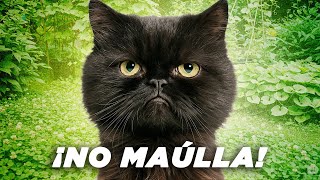
This is a YouTube video titled "TU GATO NO MAÚLLA, ¿es normal? 🤐🐱 Gatos callados vs. gatos muy habladores" created in August 2025. The content features a veterinarian named Carlos explaining why some cats meow more than others, discussing genetic, hormonal, and behavioral factors influencing feline vocalization. The video also includes a conversational segment with another speaker named Jose, adding a casual and humorous tone. The overall context is educational, aimed at cat owners to better understand their pets' communication and behavior.
There are some cats that are super soothing and never stop getting our attention, while there are other cats that never meow. Is that normal? Hi, I'm Carlos and I'm a veterinarian and this is Alcachofo. Welcome to the Happy Pets and Families Channel. Hey, Carlos, why doesn't my cat meow at all? If someone gave me €1 every time I had been asked that question, I would be immensely rich. Right now I would be swimming in €1 coins. However, that hasn't happened. And today I'm going to tell you in this video why there are some cats whose voices are unknown because they barely open their beaks. As often happens with our feline companions. This is a cocktail of genes, hormones, and perhaps a bit of mystery. Before we start, I have to tell you that Happy Pets and Families needs you. So if you like our videos, give us a like share them. And above all, if you want to support us a lot, a lot, give us a super thank you. Okay, let's start with the basics. Why do cats meow? Our feline companions use vocalization or meowing to communicate with us primarily. I've already told you a few times that cats in the wild don't usually use this type of communication with each other. Instead, they use other methods, such as non verbal communication. Well, not meowing, which involves their little ears, facial expressions and body language. Let's go. Of course, this can't be confused with hissing or growling when they're fighting, which can be heard in those cases. Of course, logically, they're defending their territory and are sending a message, in this case an auditory one, to the other cat to say, don't be too smart. Don't come any closer. But anyway, cats have basically developed meowing during close contact with humans, because when they're adults, they use it to get our attention to say, hey, human, I'm here. Or especially, hey, human, feed me. But of course, not all cats do it the same way. You might live with your feline companion and say, well, my cat doesn't meow at me when asking for food. So let's move on to the next question. Why do some cats meow more than others? We have to start by taking into account the feline's own personal or feline history. There are some cats that live in a domestic environment where they are used to always having their needs met, and those cats may meow a little less because they don't need it. So it's more common to see that the most talkative cats are those that have perhaps been rescued from the street, that have experienced a bit more need, that have lived in a community with other cats, and that, therefore, that meowing helps them differentiate themselves and make the human pay a little more attention to them. But anyway, here comes the most interesting part. Yumi Okamoto, a researcher at a Japanese university, has recently discovered that although the meowing pattern depends a lot on the cat's experiences, there is also a part that is very, very closely related to its genesis. The meowing pattern has been linked to a gene called ar, not Ana Rosa Quintana. The presence of this gene in its DNA will depend a lot on how sensitive the cat is to testosterone, which is a sex hormone with male characteristics. As you can see, there are many things involved. Why? Well, because the more this gene is present, the more, the longer that section in the cat's DNA, the less sensitive it is to testosterone. And shorter sections make them more sensitive. And the curious thing is that this influences our feline companion's cat. Like nature, cats that have this shorter part, that is, that are more sensitive to testosterone, meow more. And, for example, if we're talking about a female cat, that she's also usually a little more skittish, a little more aggressive, and cats are a little more fearless. They learn to open doors more quickly. For example, you'll see what meowing has to do with opening doors. Well, look, there you have it. And yet kittens that have that part of their DNA that's longer, that are less sensitive to testosterone, for example, are a little calmer. They're more attached to people, a little less skittish, and they meow less. And what does all this depend on? Well, it's also closely related to human selection itself that has been made of feline breeds generally, since testosterone ends up bringing a series of characteristics that are a little less desirable for coexistence, such as aggression being a little more elusive than the breeds that are more selected. Well, the aim is for cats to be more attached. Therefore, unintentionally, those cats that have that longer gene are being selected because they do not have those characteristics. And therefore, those cats generally meow a little less. They are calmer. Well, of course, when a person is going to buy a cat, because that is what best matches their lifestyle. And these are desirable characteristics for that person. And that is why human selection has influenced the size of that gene. And having said that, as always, the message is to adopt and not buy. Give a shelter kitten a chance, because they all deserve to live in a family. In contrast to this selection, common Cats tend to have this part of their genitals and therefore tend to be more talkative. What happens to the cat, which is a common cat, not at all selected, and is a very talkative cat. It is already selective with its food. As you can see, there is a part that we can influence and a part that we cannot. Its genes are there, but they are not determining, they are not definitive. If your cat is a bit of a chatterbox, a bit of a meower, but begins to see that meowing at you is starting to give him results for all those things he wants, for example, to get more food or to get you to get up at 3 in the morning, which sounds good, right? Logically, he will repeat that behavior because he is seeing that his goals are being met. He says, okay, I'll meow here a little. I'll warm up my human companion's ear, and in the end he'll give me a treat so he doesn't hear me. Now I know how to do it. And in the future he will repeat that same behavior. Here's the last piece that we were missing from the puzzle. You too can be very responsible for your cat's meowing, especially excessively. So for those of you who ask me, hey, is it normal that my cat doesn't run away from me? Well, yes, it is normal that your cat may not express himself in that way, because he already gets everything he needs through other means, he communicates it to you in a different way. For example, my Lou, the cat that lives with my parents, only meows a little bit. And very occasionally, he really wants what you have in your hand so that you can give it to him like his little packet of wet food. But during the rest of the day, you never hear him meow at you. He is a normal cat, so he should have that gene a little shorter and be more talkative. But he has realized that in his day to day life, in his relationship with humans, he doesn't need to meow, and that's why he doesn't use it. So if your cat doesn't meow, you don't have to worry. And if he meows a little more like the kocihofo, well, we already know that the answer lies in his genes. I can't be doing anything wrong, can I? However, if there is a change in the pattern of your cat's meowing, then that is something you should be a little more concerned about. For example, there are some diseases like feline hyperthyroidism that cause cats that didn't meow before to start meowing more than usual. They are also cats that are more active, which is good because they are restless and never stop so suddenly. My kitty, Fluffy, who used to spend all day on the couch, has started to not rest, has lost weight and spends the day meowing. Hey, that is something you should be concerned about. And perhaps you should see your vet More little things. Fluffy, who used to be quiet, now suddenly he spends the day lying in his bed and doesn't tell me anything. He just wants to be there, although I hear him purring. Well, maybe Fluffy is telling you that he is sick. He just doesn't feel like coming to you to make you happy and doesn't want to move much because something hurts or is bothering him. In that case, the purring is not because he is comfortable, but because he wants to calm down. And my little star used to be like an angel, but now she meows like a truck driver. Now her meow is hoarse. When she opens her mouth, she seems to be hoarse, as if she can't make that meow. And logically, it's not that she's abused whiskey and cigars throughout her life, but perhaps something has changed in her body. For example, it's very common in nerve injuries, which is the one that gives, well, all the nervous stimulation to this area, which is called the larynx, or recurrent that when it's injured, when for whatever reason that area becomes inflamed, for example, because she's received a blow or because she's gotten a little wound or whatever, in the end, it ends up affecting the type of meow, it becomes more hoarse. Perhaps that area has also become a little more inflamed. Normally because she's had laryngitis. Like it can also happen to people. Hey, maybe when your cat wakes up from a nap, you've noticed that he meows a little more hoarsely and that the meow doesn't come out of his body, but after about 30 seconds it goes away. Well, he's been breathing through his mouth with his mouth open, and that's why that area is a little dry and he pees a little worse. But hey, if these are very, very specific changes, then in that case you realize that nothing is wrong. And if it persists over time, then a professional should see him. And a special, very special section at this point in the video for those cats that meow and meow and meow and don't stop and don't stop and they're getting on your nerves. Those cats probably don't have a physical health problem, a physical illness, but perhaps they have a behavioral problem because they've realized, as I said before, that the meowing ends up causing them certain things, or that you take care of them, or that you pet them, that you play with them, that you feed them, in short, all those types of things that perhaps the cat is looking for at that moment. In this case, perhaps the problem is a bit more yours because you have to try well find the tools to help your cat with that, uh, that slightly strange relationship that is developing between you. As I have told you many times in the video, and there are people who accuse me that it is useless, that ignoring the cat is useless. What happens is that it is a somewhat tense situation and requires a lot of work and a lot of perseverance on your part. And I am not going to summarize all that right now, but you should know that we have a lot of content on the channel about that specific topic that I have left here below in Linked Videos. And I have also left here below the links to the scientific articles that I have used to make this video. I don't know about you, but I'm very interested in these types of topics which help me explain certain behaviors in our cats. And above all for me, what's most important is how we can apply them. Because often knowing where these behaviors come from also helps us with related things. Wings, for example, to improve their well being. If we take into account that some cats meow more than others, then perhaps we can develop a more verbal, more oral form of communication with that cat. Try to identify what types of meows or how they are meowing to ask us for certain things. And yet other cats that are a little quieter perhaps guide us more towards recognizing their nonverbal language, their body language, to see if something is happening to them and if there is something that requires our attention. But anyway, I hope that in the end this has given you something and that it ends up improving your coexistence with your feline companion at home. And well, now it's your turn. Tell me in the comments what your feline companion is like. Is he talkative? Does he meow a lot? Does he get away from me? Does he get what he wants, even if he doesn't run away? Hey, I'm really interested in that. Leave me a comment and tell me all about it. Also, if you like the video, give us a like, share it with everyone and subscribe to the channel if you haven't already. We also have a secondary channel here on YouTube called Questions and Answers from a Veterinarian. And if you want to support us. A lot, a lot. As you know, a big thank you. Before we go, let's meet Grim and Mittens, who live with their human companion, Perisha Ramirez. These beauties are called Nilo and Kira, and they live with their human companion, Han. Finally we have this very friendly orange kitty. His name is Tommy and he lives with his human companion, Alvaro. Thank you very much for following the Happy Pets and Families channel. And we'll see you in the next video. Look at him there in the sun.
There's a kitty. There's a kitty that you have to work on. Yes, even on Saturdays, my friend. Yes, even on Saturdays we work in this house. Kitten. It's the same for me, huh? I think the same as you. Oh, my kitty. But then I'll take you down because you're too hot. And in the summer neither you nor I want you. So Carlos is wrong? No, no, it's not that simple. Come on, let you explain. No, I wasn't going to let you explain. It really inspired me. Okay, you have to say things, Jose. You have to convey your feelings. Kitten, I love you very much, but you have to tell me too. I love the kitty more. Kitten, in this house, I'm no longer valued. Only you are valued. Because you're a little fluffy and adorable ball Jen, whose name is a. She's not Ana Rosa Quintana. It made me laugh. I don't know why this nonsense, huh? Okay, since it's aggressiveness, that evasiveness is good. And I'll see you in the next video. Oh, yeah.
More from Javier

Cuando nadie reconoce tu dolor por la pérdida de una mascota: así es el duelo desautorizado 💔




¿Tu perro hace suficiente ejercicio? Mantenerlo activo es clave para que viva mejor 🐶💪

GATIFICANDO UNA PARED PARA MI GATO 😻🧗♂️ Ideas para aprovechar el espacio vertical en casas pequeñas



Por qué duele tanto perder a un perro o un gato: el vínculo que explica nuestro duelo 💔🐾

