Veterinario 👨⚕️ desmontando este estudio que dice que LOS GATOS SON PSICÓPATAS 🤯 🙀
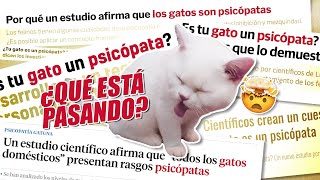
This is a YouTube video titled "Veterinario 👨⚕️ desmontando este estudio que dice que LOS GATOS SON PSICÓPATAS 🤯 🙀" created on January 19, 2022. The content features a veterinarian named Carlos who critically analyzes and debunks a scientific study claiming that cats exhibit psychopathic traits. He explains the study's methodology, its limitations, and why applying human psychological concepts like psychopathy to cats is flawed. The video aims to clarify misconceptions about feline behavior and encourages viewers to form their own opinions.
Recently, all the media outlets were running the headlines, cats have psychopathic traits. But they weren't telling you the whole truth. Hi, I'm Carlos and I'm a veterinarian. Welcome to the Happy Pets and Families Channel. Last month, many people wrote to me asking what my opinion was regarding. Well, some headlines in the press that said that cats could have psychopathic traits. Well, I'm going to read you a bit of what one of the news items said so that you can get an idea if you didn't read them. A study from Liverpool has investigated the personality and behavior of domestic cats and has come up with some surprising conclusions that many owners will strongly disagree with. According to these scientists, the animals show several signs that classify them as psychopaths. Psychopaths in quotes. They also included some statements from the study's lead researcher who said, it is likely that all cats have an element of psychopathy. And of course, all of us who love cats said, wait a minute, let's see if there's any truth to all this and what this researcher bases her claim that our cats are psychopaths on. Well, let's go straight to the source. I'm not going to dwell on the press article because as you know, they're often a bit sensationalist and will do anything to get a click. So I'm going to see what the scientific article says about our feline companions and let's see what conclusions we come to here at Happy Pets and Families. The study was conducted to find out if a scale which is a way of rating a person's personality traits could be applied to our feline companions. This measured certain traits that are related to psychopathy in people. And what was the aim of this study in our feline companions? Well, certain traits such as meanness, that is our cat being mean just for the sake of it, Boldness, that our cat is very daring, are also disinhibition or disobedience. And to give it some validity in our cats, the researchers stated at the beginning of the article that some indicators of these had been measured in other animals, such as chimpanzees. Okay, that's all very well, but now let's move on to the comments on the article. After reading it, what do I have to say about it? What the researchers saw is that many of our cats scored very high on these scales of meanness, boldness and disobedience. So they said, well, since I see that a cat is very mean or very bold, and this is related to psychopathic traits in people, are cats or psychopaths with their conclusions. They published an article in a scientific journal and titled it. Well, it's in English, so I'll try to translate it for you. Sorry if I don't do it. Very well. A Triarchic Factor Model of Psychopathy in Cats. Felix Catisilvestre. Two points. Development and initial validation of the Cat Try plus Questionnaire. It's a name like that. A bit strange, but if you notice in the title of the article, it already said about psychopathy and the cat. It was already relating everything there. And of course they communicated it to the press to announce to everyone that they had reached those conclusions. But of course, what are the press going to say? Triarchic factor model of psychopathy. Right. The press makes a version. And what do they keep the juiciest details? Psychopathic cats. Here we go. Bad. It's a very unfortunate title because it implies something that they really aren't. After reading the entire article, I can tell you that cats are not psychopaths. First of all, because the scientific article. The researchers weren't looking to find out whether cats are psychopaths or not, but rather they were applying a scale to predict the behavior of cats. They said, well, a bold cat is going to behave better with other humans, is going to behave better with other cats. Is a cat that is more uninhibited, more disobedient going to adapt to living well in a community with other cats, for, for example, in a shelter? That was the ultimate goal of the article. And if you're going to read their conclusions, the conclusions of the researchers, that was what they were looking for, not to say whether our cats are psychopaths or not. What happens is that in order to predict what a cat's future behavior was going to be, they based it on certain traits that are related to psychopathy in people. But that doesn't mean it's related to psychopathy in cats, because cats simply can't be psychopaths to begin with, because we're applying concepts from human psychology to our feline companions. Psychopathy, meanness. And this can't be extrapolated because our feline companions don't necessarily share our personality traits. In fact, psychopathy is defined, excuse me for rereading, as a personality disorder characterized by narcissism, impulsivity and controlling and manipulative behaviors. You don't have to be a genius to realize that this can't be applied to our cats, because our cats don't have narcissism, they don't have manipulative behaviors towards us, no matter how much some of you might say they're not really looking to manipulate us. For example, if your cat always tries to take you to the food bowl so you can fill it, they're only looking to satisfy a need they have at that moment, which is to eat and for you to respond directly to their demands, not because they want to manipulate you in a cold and calculating way. Furthermore, I don't know to what extent we can say that our feline companions exhibit a behavioral disorder such as psychopathy, if all or the vast majority of cats exhibit these types of traits. We are saying that a disorder that some people suffer from sporadically is also suffered by all our cats. I think there is something wrong with that. And just as we cannot say that all people are psychopaths, it seems to me the height of absurdity to generalize in this way about cats, as cats are always being dragged around with this dark legend that they are evil, mean, selfish, disobedient, etc. Of course, the thing is that this sells. Furthermore, I believe that psychopathy, which is a behavioral disorder of humans who live in a human society, cannot be applied to our feline companions, because the social rules of cats are not the same as the social rules of humans. They organize their society in a completely different way. In fact, cats are not animals that we can consider very social, living in very large, stable groups. Quite the opposite. They tend to be somewhat solitary animals. So if I were to say, for example, that a person who likes to be alone and does not like to be in the company of other humans could be that a trait of psychopathy, that would not define our cats, because as a general rule, they tend to be solitary animals by nature. And this is neither good nor bad. Our cats are just like that. Their personality traits, their cat, like nature, have helped them survive in the wild and survive to the present day. Quite the opposite of us who have survived thanks to living in society. And it is true that cats are not the most sociable beings in the universe and in the world. But the study also did not take into account the breed of the cats that participated in it. And it is known that cats of a certain breed are more sociable than others. If this is not taken into account, the study cannot be extrapolated to all cats. But there is something else in the study that has caught my attention even more and makes its conclusions seem even more questionable to me. Ethologists, professionals who understand feline behavior, have not been used to conduct the research on the personality of our feline companions. And, well, this is a matter for the courts. People. Families who live with cats have been used to conduct the survey, but these families are not experts in recognizing feline behavior. In fact, many times you write to me a comment or ask me a question asking about some feline behavior that you are giving an explanation for that which is not really true. Normally, families tend to give much more human explanations for feline behavior, likening it to human behavior. And when we feline behavior professionals see it, we say, no, look, it's because cats do this for this other reason, and we find a much more feline explanation. And this is precisely what often causes families to misunderstand what is happening to their cat. These people may be misinterpreting their cat's behavior, and therefore the survey could be providing erroneous data. So, overall, I see that the scientific article has two very serious problems. We are applying concepts of human psychology to our feline companions, and we are also letting people who are not necessarily experts in feline behavior evaluate the personality traits of their cats. And this can lead us to wrong conclusions. For me, every time I see a headline in the press that is really juicy that gives you a bombshell story, the first thing I do is put it on hold. I say, okay, wait, let's read the news carefully. First let's go to the source and see what truth there is in all this. To begin with, because the press may be manipulating what the source says. And to continue, because not all the conclusions reached by the source, which in this case is a scientific article, may be valid for me, because I see, for example, gaps like the ones I am seeing in this research, because just because it appears in a scientific journal, we do not have to believe everything without question. But, hey, we care about cats. You have asked me many times about this, and I will give you my opinion here in this video. Now it is your turn to draw your own conclusions. Do you think your cat is a psychopath? Let's be honest. Well, what I have left to know is what do you think about all this? Were you aware of this article today? Did you know that people said our cats were psychopaths? And if you did know, when you read the article, how did you react? Because there were a lot of people who wrote to me saying, please, Carlos, you have to talk about this topic because I don't believe anything. Leave it all in the comments. And if you liked the video, you have to give it a like so that YouTube knows that you liked it and so many more people can see it. Also subscribe to this channel if you haven't already. And if you want to find out about the next video we upload, hit the bell. So YouTube will let you know. Remember that we also have a secondary channel on YouTube called Questions and Answers from a Veterinarian. Stop by and you'll know what to do. And today we meet this little girl named Aisha, who is a nine month old tricolor cat who lives with Patricia, Jose and Ivan. And over here we have Gordita, who was adopted in Mexico City by Tania. And we say goodbye with two cats from Greco Latin Mythology, Perseus and Aphrodite. Perseus, the one with the light eyes, and Aphrodite, the black one, who live with Maria in Medellin, Colombia. Thank you very much for following the Happy Pets and Families Channel, and I'll see you in the next video. They titled the article. Okay, that article. The article. What did they title it? Forgive me if I don't translate it. Very, very, very. Ah. Triarchic Factors of psychology in psychopathy. K3. Okay. That's how Jose will probably put it in English for you. That comes later. Cats are not cats. And that means that cats are psychopaths, right? They're not psychopaths, okay? That couldn't define our cats, because that's how they are by nature. But in addition to this basic concept, which seems basic to me, I don't have to say it. The study is questionable to me. Uh, it's questionable for something else that's much more important. Two more things we have to accept and swallow. We have to accept it and swallow it because in this case, very strong things are being said about our cats. Well, but by not taking it into account, I. I mean no more. Well, and what I have left to know is, and you're going to be shocked because you say, oh my gosh, my happy companion is not a psychopath, right?
More from Javier

Cuando nadie reconoce tu dolor por la pérdida de una mascota: así es el duelo desautorizado 💔




¿Tu perro hace suficiente ejercicio? Mantenerlo activo es clave para que viva mejor 🐶💪

GATIFICANDO UNA PARED PARA MI GATO 😻🧗♂️ Ideas para aprovechar el espacio vertical en casas pequeñas



Por qué duele tanto perder a un perro o un gato: el vínculo que explica nuestro duelo 💔🐾

