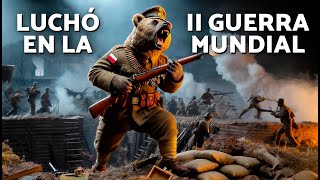
Wojtek was a bear adopted by the Polish 2nd Army Corps in World War II who became a sergeant and fought at Monte Cassino. The video tells his story while questioning what it meant to use an animal as a soldier and the cost of war on creatures who had no choice in it.
During World War II, amidst the chaos and destruction, a story of friendship emerged that continues to move us. Wteg, an orphaned bear, found an unexpected home in the ranks of the Polish army. But beyond WTEC's tenderness and bravery, his story raises important questions about animal welfare and the place of animals in wartime. Was it right to use a bear in a war? What impact did this experience have on his life? Today we know that animals need natural environments to thrive and should not be used as tools. Wagtec's story serves as a reminder of the importance of respecting all living beings and challenging practices that harm them. In 1942, World War II was in full swing. Following the invasion of Poland by Germany and the Soviet Union in 1939, many Polish soldiers found themselves without a homeland, fighting in scattered units allied with the British. During this time, the Polish 2nd Army Corps, commanded by General Wladislaw Anders, was in the Middle east as part of the Allies. It was in Iran, in the mountains near Hamad, that Watchtech's story begins. There, soldiers found a Persian boy carrying an orphaned baby. The mother had been shot by local hunters. The Polish soldiers, led by Sergeant Pio Prender and Corporal Ecniyut Marinsky, bought the cub in exchange for some provisions. The little bear, hungry and helpless, began a completely unexpected life. From the very first moment Wotech became part of the unit, the soldiers fed him condensed milk from a bottle, and the bear quickly began to behave like one of the groups. He earned his place with his playful and friendly nature, and in fact, he even learned to drink beer, something that the soldiers considered a funny gesture for which we condemn today. Over time, Wacht grew and began to mimic human behavior. He would wave his paw, play with the soldiers, and even share their tent. However, his role was limited to being a pet. During the Italian Campaign in 1944, the Polish Army's 2nd Corps took part in the historic Battle of Monte Cassino, one of the most brutal battles of the conflict and key to opening the way to Rome. It was there that Wock demonstrated his strength and bravery. He helped load crates of ammunition, some so heavy that they often required several men. His participation in this battle made him a legendary figure within the military. Ensuring that Wacht could accompany troops to military ships and receive his rations, he was officially enlisted as a soldier in the Polish Army. Later, following his heroic deeds, he was promoted to sergeant, a recognition that the soldiers considered fitting for such a valuable member of their unit. The emblem of the 22nd Transport Company, to which Wokt belonged, was redesigned to include the silhouette of A bear carrying a shell. This symbol became a lasting tribute to Wi? Tec's unique role in the war. But while Wi? Tec's story may seem endearing, it also leaves us with important questions. W? Tec was a brown bear, a species that belongs in the forests, not on the battlefield. Although he was lovingly cared for by Polish soldiers, his natural place was not among men and weapons, but in the wild and free nature. World War II didn't just affect millions of people. Animals were also victims of the conflict, used as tools or forced to live outside their environment. Wi? Tec's story reminds us that while the connection between humans and animals can sometimes be incredible, we must always prioritize the well being and rights of living beings. After the war, Wach? Ti was taken to Scotland with the rest of the unit. When the second Polish Corps was disbanded, Wu? Ti was transferred to Edinburgh Zoo, where he spent the rest of his life. There he was frequently visited by his former comrades who would throw him cigarettes as in the old days, although these were only a reminder of the human customs that should never have been a part of his life. Wotec died in 1963 at the age of 21, a relatively young age for a bear in captivity. But his legacy lives on in monuments, books and documentaries that commemorate his extraordinary life. W? Tec is a symbol of friendship between humans and animals, but also a reminder of what happens when animals are torn from their natural habitat. Don't forget to leave us a comment and let us know what you thought of this story of Wotek the bear who went from soldier to sergeant. See you in the next video. Experts.