Don't Just Search, Find! Advanced Techniques in Fastcase
Erin Page, senior law librarian at Fastcase, walks through advanced search strategies in the platform's Mars edition. She covers Boolean connectors (AND, OR, NOT, proximity, wildcards), explains how to avoid common pitfalls like synonymy and ambiguity, and demonstrates the interface's filters, type-ahead suggestions, and batch downloading features.
Chapters
So welcome everybody to today's learning objectives. And for a special membership appreciation month, we have Erin Page from Fastcase. And Erin is going to walk us through some of the mo— more advanced search techniques in Fastcase, which is a member benefit of the North Carolina Bar Association wherein you get access to legal research for free as a benefit of your paying your dues. So it's not exactly free, but it's a lot lower cost through us. At any rate, Fastcase, as their name would suggest, has been steadily improving the product over the years and has a lot of new things to show in the Mars edition, which is the newest edition. Aka version 7, and they also just merged with or had an acquisition of their competitor, Casemaker. So we can continue to look forward to new improvements going forward, which is very exciting. But Erin, I'm going to let you tell us about what we can do today.
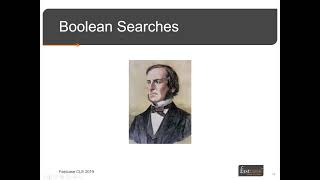
Fantastic. So hello, everyone. As was mentioned, my name is Erin Page, and I'm the senior law librarian from Fastcase Legal Research, and it's a pleasure to speak to you today. I will be going over some advanced techniques, especially dealing with Boolean keyword searching, but I also wanted to mention up front that a number of the techniques that we're going over for Fastcase will work in other major databases as well. So if you find yourself needing to research journal articles or you're finding yourself using, um, PACER or other engines like that, a number of the techniques we'll be going over today will also work in those search interfaces as well. So with that out of the way, let's get talking. So the first thing I want to mention is a little bit about databases themselves. There's actually two major types of databases: what's known as an indexed database and what's known as a full-text database. An indexed database is a database where the information that's a part of that database is organized according to a specific subject matter or concept. So if you recall to the days when digest searches were popular, this is a form of a digest search as well. When you're using that database, you would enter a concept or look for the header that matches the concept that you have in mind. So using the example that you see on the screen, if you were working on a landlord issue, you'd go to the landlord section of that database and look up the case that way. The information is pre-sorted into specific categories, usually based on that particular database's editorial preferences or structure. Now this is great because this type of database is very easy to use. You don't have to think about your search phrase, you don't have to think about how you would search for a particular item, you just go to the section and read what's there. However, it has a couple of major drawbacks as well. The first drawback with that type of database, it is almost instantaneously out of date. And that sounds ridiculous, but it takes time for an editorial team to review a work, categorize it, and decide where it belongs. That's one of the reasons why there's— when there's a new book at your public library, it's not immediately available. It takes a week or two before it becomes part of the system because somebody has to do that categorization work there. Same kind of issue in any indexed database. Second issue with this type of database is that it can be a little tricky to get used to. You know, you might have a particular category in mind, you might be thinking landlord, but the database editor might be thinking that it's a tenant issue. So there might be a little bit of a vocabulary or a little bit of a categorization type problem when you're first using an indexed database. And the last issue with this type of database is it tends to be more expensive, and that's because you have to pay for that editorial staff to do all that wonderful organizing for you. So a couple of major drawbacks with that style of database. This is as opposed to what's known as a full-text database. In a full-text database, you enter a term or phrase or a concept that you're interested in, and the database searches the entirety of all of the materials in that database including all of the text of those materials, looking for those words or concepts. So instead of it being pre-sorted into a category, you're searching the entire database every single time. If you've used Google recently, Google is a form of full-text search. It searches the entirety of web pages, not just what category people stick on it. So instead of going to the landlord category, you type in the word landlord and look at all the cases and documents that have the word landlord as a part of their category. So you, the user, specify the terms that you're going to search by. And that means that you have to do a little bit of the work of coming up with the search phrase in the first place. Now, unlike an index database, it's always going to be very up to date. Again, you don't have to wait for that editor to do their work. So the second the document hits the database, it's a part of it, you can search it, you can do whatever you need to it. Also, the search is not limited to someone else's categorization. However, it doesn't have that convenience of having those, those search terms, those categories pre-done for you. And it also tends to be a much more affordable database as well. In case you're wondering, Fastcase for the most part is a full-text database. We have a couple of categories, but they're optional. So again, just giving you a little bit of an example of the two different types of databases we're talking about. This is Yahoo back from the 1990s. Yahoo made a valiant attempt at categorizing, categorizing or indexing the entirety of the internet. They failed miserably. But if you remember these categories, you were able to click on them and then go to a subcategory. And then a subcategory until you went to a website. So that's just an example of what an index database would look like. And of course, as we mentioned, Google is a good example of a full-text database. All right. So now that we've talked a little bit about the types of databases involved, let's talk a little bit about the different search types that are involved with the database as well. There are 3 major categories of search that you can run in a legal database. The first one, which everybody is familiar with, is what's known as a citation lookup. So if you have the official type citation for a particular document, whether it's a case, a statute, a journal article, you can enter that citation and go directly to that specific document. The second type of search is what's known as a natural language search. In a natural language search, you enter your term or concept phrased as if you were speaking to another person. So anything that you can enter as a statement or as a question can be entered as a search phrase. Once you've entered that natural language search phrase, the system looks for the terms that are a part of that phrase and returns those results. However, even though that's the easiest way of running a search, all you have to do is literally ask a question, there are a couple of minor drawbacks. Mostly the issue is going to be that a natural language search is always going to be a broad search. You'll get relevant results, but you might get more results than you desire and more results that are tangential to what you're looking for instead of precisely on topic. And that's because in a natural language search, you're not providing any context to the search engine, to the algorithm that's running your search. You haven't told the system that you're only interested in specific circumstances, that you're only interested when one word is within a certain distance of another word, or when all of these words appear in this exact word order, or when this particular word does not appear. You haven't provided those specifics to the system, so the system is giving you everything. So this type of searching is best when you're looking at a topic and you want to see everything. You want to see an overall view of how this issue is treated in the law, but you don't mind reading quite a bit. You don't mind doing a kind of a survey of what's out there. The third method of searching, and the one that we're going to be focusing on for most of today's session, is going to be what's known as a Boolean or a keyword search. This is going to be the most precise method of searching, and most search engines will have some form of Boolean. It won't necessarily be all the connectors that are available, but it will have some form, whether it's just as simple as saying that you're interested in this word or that word. Yes, the OR term is an example of Boolean. So just giving you a little bit of a definition for Boolean. A Boolean or a keyword search is one where you have specific terms that you're interested in, and in between those terms you're entering connecting words that tell the system exactly how you want those words to be related to one another. So in our example from a moment ago, I could say that I want the exact phrase "mens rea." I don't care about a case where the word "mens" is on page 1 and the word "rea" is on page 32. I'm only interested in the documents where it appears as a phrase right next to each other with that word order. That really does cut down on the number of tangential or extra results that you get. It means that you can get very precise results very quickly. So a Boolean keyword search is always going to be a more specific and probably faster in the long run way of searching. You have to do a little bit more work up front in crafting your search, But after you've crafted your search, you have something that's going to tell you very specifically what you're going to get. Now, just a little side note before we get into the complexity of Boolean, and that is it does not matter how perfect, how fantastic, how excellent your search phrase is. If the database that you're using doesn't have the document you're looking for, you will never find that document. So just as a side note, maybe an important thing to consider before you get started, all databases have what's known as a scope of coverage that tells you what's in that database and what isn't. The one for Fastcase is available on our main site, fastcase.com/coverage. But that just gives you an idea of what's included in the database and what you might need to find in another location. Now, generally speaking, Fastcase does provide access to primary law for all 50 states, all federal materials, and as members of the bar, that's what you would get access to automatically. We also have secondary materials. If you have questions about those, just reach out to us. All right. So let's get into the nitty-gritty of running an effective and efficient search. Two things to keep in mind regardless of which search method you're using, and that's synonymy and ambiguity. And both of them are problems because of the way the English language works, especially synonymy. The English language is full of words that mean exactly the same thing or very close to the same thing depending on context. So the problem with having so many words that mean the same thing or close to the same thing is that there is no requirement that the author of the document used the term that you have in mind. You might be thinking, this is the perfect search term to find this issue, to find this result, to find this document I'm looking for, and you might be right, but the court might have chosen a different word just simply because that's the that's the one the court preferred, or that's the one that came to mind, or a number of reasons. So let's use an example, the one that's on the screen right now. I might be searching for a car accident, and I've entered the phrase and I've gotten great results. But I'll be missing results because I'll be missing the results where the court decided instead of using car accident that they were using motor vehicle accident. Or a vehicle accident, or an automobile accident, or a truck accident, or a van accident, or a Ford accident, or Chevy accident. Again, the words may not always mean the same thing, but they might mean close enough to the same thing in that particular context that the court used that term instead of the one that you had in mind. So if you find yourself in a circumstance where you're just not seeing a case that you expect to, Most of the time it's because you've used one term and the court's used a synonym. So if you include synonyms as part of your search phrase, you'll expand your results and you won't miss some of the cases that you'd otherwise miss. The second issue, again, problems with the English language. There are words that mean more than one thing, especially in a legal context. So if you've run a search and you find that you're getting cases from a type of law or from an area of law that you're not expecting to, or that you're not intending to, usually the issue is that one of the terms that you've used in your search phrase is ambiguous and has one meaning in one area of law and a slightly different meaning in a different area of law. The example on the screen is a good one. Negligence has a very specific meaning in a criminal context and a different standard or a different meaning in a civil context. So if you find, again, that you're getting way too many cases from an area of law you're not familiar with or that you're not intending on receiving, you can remove some of those cases depending on how you phrase your search to deal with that ambiguity. All right, so I'm going to dart a little bit into the search process itself, and then we'll go into the Boolean process. So when you're running a search, and this does not matter if you're using a Boolean search, natural language, sometimes even a citation lookup, the very first step and the most important one is to actually identify the issue that you're searching for first. It is almost impossible that a client will walk in the door and give you your fact problem, your scenario, your issue, and have it actually be boiled down enough for you to start searching immediately. It might help to do a little bit of writing out on a piece of paper or separating the issues on a piece of paper, but it's really super important to only search one issue at a time. 99% of the time when somebody reaches out to me who's frustrated and can't find what they're looking for, It's usually because they're trying to search more than one issue or more than one problem at the same time. And let me just go ahead and use the courts themselves as an example of why you don't do that. When you read a court opinion, it's a very rare opinion that only cites to one other case, and that's because one case will address one issue perfectly, another case will address another issue perfectly, and the court cites to both so that the person who's reading the case can get the best understanding of what the law actually is. Same thing. You have to run the searches separately to get to those best results. It's a very rare case that's going to have both issues at the same time and therefore will show up in your complicated search phrase that's dealing with both issues. So always, always, always, you're better off just simplifying it, dealing with one issue at a time, and then if you absolutely need to, trying to tackle them together later. Once you've taken that step of identifying the issue, you do need to take a moment to identify the concepts or the terms that you're actually going to be searching for. These include the legal terminology that you're going to be using, but also keep in mind that it might include facts that are relevant to a particular case. Those facts especially can help you narrow down the results that you're getting so so you get the most specific result you're looking for. After you've done that identification of concepts and terms, it's time to craft your search. It's time to put those terms into order, to put connectors in between them, and to actually run your search. Once you've run that search, the next important step that a lot of people skip is to actually review your results. And I'm not talking about reading each of the cases in depth. I mean, just skimming the top couple, 20 or so of your results, and making sure that you've got a good set of results, that the cases appear to be on topic, that there isn't anything that's an immediate, oh no, that shouldn't be in there. And if there is any issues like that, moving on to the next step where you refine your search, where you adjust your search phrase, you change the connectors, you add a term, you remove the term, until you get to that state where you have a good set of results. I will tell you up front, even though I research every single day and I have for the last, god, decade or more, my first search is not usually the best one. And that's coming with all of this experience spending all day researching. Everybody needs to refine their search a little bit, no matter how good you are at the process of researching. So don't forget to do that step to make sure that you don't waste your time reading things that are off topic or that are just not what you're looking for. All right, just focusing on that concepts and terms and facts step for just a moment. I mentioned that you're going to have to do a little bit of brainstorming, and I'll be upfront with you, your own experience is one of the best things that will lead you to crafting good searches.. So, things that you're familiar with from law school, from other CLEs, from your practice, from a journal article you read, from newspaper—anything that's a part of your legal experience can help you craft or think of some legal terms to use up front. So, don't discount any of your experience. Keep that in mind when you're coming up with terms and thinking about how the court would speak to an issue. Is there a particular term of art that might be useful? The name of a particular statute or a name of a particular regulation? Is there a concept or a way that the court just speaks to that type of issue over and over again? All of that is very valuable experience when coming up with a term to use in your search. But don't forget to throw in a couple of those facts as well. The facts can help you focus your search. So instead of just dealing with a case that deals with drugs generally, you end up with a case that deals with marijuana specifically, or whatever issue you're focusing on for your particular search. I do recommend going back to your high school days and remembering the 5 W's plus how. So who, what, when, where, why. Just go through them really quickly and decide if there's something from those facts that you want to throw into your search to make it more specific. So let's take an example. And yes, we will run part of this example live towards the end of today's session. The government is trying to force a wife to testify against her husband. They were married just prior to trial. Well, first step is to simplify that. We've got a pretty simple fact pattern, so let's go with it. Second step is to brainstorm on those legal principles. Off the top of my head, I'm thinking testimonial privilege. But immediately, keeping in mind our synonymy issue before, I think some courts call it a communications privilege, not a testimonial privilege. So we're going to throw those two synonyms in. The court is trying to— or the prosecution is trying to compel testimony, so that should be an element of my search. And this is a common law issue most of the time, so I'm not looking for a particular statute. Then I stopped and I thought about the facts that were involved with this case. We're talking about a criminal context, so I want to make sure I get criminal results. And we're talking about spousal issues, so I don't want to get attorney-client privilege cases or priest-penitent cases. I'm looking just for those spousal privilege cases. So that's an example of those couple of preliminary steps before you get to the point of actually crafting the search. Speaking of crafting the search, I mentioned we were going to focus on Boolean for a bit of today. This happens to be Lord Boole, a mathematician from the 1800s and the guy that this particular method of searching is named after. He came up with the idea that you can write anything as a formula that would explain to the other person who's reading that formula what you're asking or what you have in mind without having to give a long paragraph-long explanation. So he did a lot of work of simplifying mathematical expressions, and he's the basis of the expressions that get run through computers as well. So I mentioned that the next step is crafting the search, and that means that we're going to start adding connectors. The chart that you see on the screen right now is the chart of all of the connectors that are available in Fastcase. However, don't panic. First off, you can have a set of today's slides if you'd like, but this chart is also available in the Fastcase system. So if you're in, in the system, at the top of the page you'll see a couple of small icons, one of which looks like a question mark in a circle. That's the help and support dropdown. And if you click on that, the first option down is Boolean tips. And it'll show you a chart like this showing the connectors, an example of how to use them, and an example of the type of results you get from using that search. So full chart is available there. We'll be going through these connectors though quickly so that you can see how they would work together. The first connector is the AND connector. And what this connector does is it tells the system both of the terms that you've entered must be present for the document to be relevant. And yes, that's a Venn diagram, so for anybody who's a visual learner, we'd only get the set of results that are in this overlapping section where both terms are present. Now keep in mind, both terms must be present in the document, but they don't have to be anywhere near each other. The word dog could be on page 1, sentence 1, and the word bite could be on page 237, the last sentence.. They just have to both be present in the document for it to be relevant. So now that we've talked about AND, the next connector is OR. The OR connector tells the system either of the terms or both can be present for the document to be relevant. And this is the connector that we'd use to get those synonyms into your search phrase. So our example before, car OR vehicle OR truck OR Chevy OR Ford. It does not matter how many synonyms you want to throw in there, just keep adding an OR in between each of the terms. The third connector is the NOT connector, and what the NOT connector does is it tells the system I'm interested in the first one. I'm not interested in the word that appears after the word NOT. So in the example on the screen right now, if I was doing a free speech case, I've decided I'm not interested in school speech cases. I can just write speech NOT school, and it'll exclude all of those school speech cases. However, be careful when using the NOT connector. You can accidentally exclude things that you intended to use in include just simply by using it, simply because the system does what's known as a full-text search. So let's say that the word speech appears all over the document and it's a perfect document, exactly what you're looking for, except for the fact that on page 32, footnote 3, the word school appears. That perfect case would be excluded from your results because of that itty-bitty footnote. So do be cautious when using NOT you can sometimes exclude things that you didn't intend to exclude. You might be better off using a proximity search or some other connector to specify what you are looking for instead of trying to get rid of an entire category by using NOT. And just really quickly showing you how you can use these in combination. Same free speech case, but now I've decided I'm also not interested in political speech. I can write speech not school or political, and as you can see, I can exclude as many terms as I'd like to just by connecting those connectors. Incidentally, you might notice at the top of the screen it's using capitals for the connectors. That is not required. You can enter lowercase or uppercase, no requirement that it be uppercase. It's just in uppercase on the slides for clarity. And another example of combining the connectors we've talked about so far, I can use speech AND public to emphasize or encourage public speech cases and exclude school OR political to the point where the only results would be from this section up here. Everything else would be excluded. The proximity connector, which you're seeing right here on the page, is my personal favorite connector. And what the proximity connector does is it tells the system you're interested if only if the words appear within a certain distance of each other. So unlike AND where they can appear at the beginning and at the end of the document you're looking at, they must appear in close proximity. Specifically, the proximity is determined by the number that you enter as part of your search phrase. [NOISE] Never fails. Sorry about that. So in the example on the screen right here, custody/5 interrogation tells the system that I want the word custody to appear within 5 words of the word interrogation. So all of the examples that you see on the screen right now would be relevant results for that particular search phrase. So in custody interrogation within 1 word, 'in custody police interrogation' within 2 words, 'interrogation while in custody'—3 words. You get the idea. This connector can be written 2 different ways. You can write it just as slash and then the number that you have in mind, or w slash and then the number you have in mind. Both will work in our system. And I point this out because this is the best way to ensure that the words appear close to each other and hopefully modify each other, but does not require that the court use the particular phrasing or the particular wording that you have in mind. Courts like to throw in adjectives. They like to throw in adverbs. Sometimes the court writes in passive voice. Sometimes there's a prepositional phrase in there. If you're not certain of the exact phrasing that the court is going to use, just that they're going to use these two words, you are best off with a proximity search like this one. Now, a proximity search is in contrast to a quotation mark search. In a quotation mark search, you're telling the system you only want that exact phrase with that exact word order and that exact spelling. So if we enter the example that's on the screen right now, quotation mark marital space privilege close quotation mark, it tells the system I only want that exact phrase. However, this can be a great search. I mean, it means that you get exactly the phrase that you're looking for, but if the court threw in a different spelling, if the court threw in a different ending, Maybe you use singular and the court used plural. That's exactly the problem that you'll see right here. The spouse may enjoy marital privileges, plural. That would not be in your search results because there's an extra S on the end. So it has to be the exact spelling and the exact word order. Let's say instead of saying it was a marital privilege, the court said it was a privilege of marriage. You would not get that as a result for this search because it has a different spelling. And a different word order. So do keep that in mind. This is great if it's going to be exactly that phrase. So if it's a term of art, or if it's a proper name, this is a great way to search for that. But for anything else, I recommend a proximity search with a very short proximity instead. So instead of using marital privilege in quotes, you would use marital, say, /3. Privilege, and you would get additional results that you would be missing from the other search. So do keep that in mind if you have a particular phrase in mind and you're not getting the number of results you have in mind, make sure that you try a proximity instead of a quotation mark search. Speaking of plurals, the FASTQ system assumes that you know what you're doing. So if you enter a singular word in Fastcase, the system will search for the word in singular format. It will not automatically search for plurals. However, there is a connector that you can use to tell the system that you want those plurals. That's the root expander connector. So what the root expander does is you put it after a word. Or a portion of a word, and it tells the system that you're interested in any ending for that particular word. So let's take the word "marry," M-A-R-R-Y. There are a ton of different endings for that word: marry, marrying, marries, married, marital, marriage. There's a bunch of different endings. You could go through and search for every single one of those endings one at a time,. You could go through and put them in as OR terms, so marry OR married OR marrying. That's a lot of typing and a lot of work. Or you can take the word down to the root it has in common with all of its endings, put an asterisk after that root, and let the system do the work of doing the searching for all of those different endings for you. So MAR asterisk, or you can use the exclamation point, both of them work in our system. But MAR asterisk would do all the work of catching those plurals, different tenses, gerunds, all of those different endings. So again, if you're not sure, did the court use this ending or that ending, use the root expander to take care of that. One cautionary note, and you can see this in the diagram here on the left, occasionally when you take a word down to its root, you'll pick up an extra word or two that you didn't mean to. So in this example, MAR would get marital, it would get married, it would also pick up maritime, which you did not intend. So do keep that in mind. This is a good opportunity to use that NOT connector because you can use that and say NOT maritime or NOT this extra word that you didn't intend to pick up. But otherwise, using a root expander is a great idea. [NOISE] All right, almost done with the connectors and then we'll go back to our example. The other wildcard is what's known as a question mark or a spelling wildcard, and the system uses this in place of one of the letters that's in your word to tell the system that you're interested in any variation on that letter. So Again, this is an issue with the English language mostly, but there's many opportunities or many occasions where there's more than one acceptable spelling for a word. So let's take the common word gray. There's the American spelling, G-R-A-Y, and the just as common British spelling, G-R-E-Y. If you search G-R-A-Y, you'll miss all of the times where the court used the other spelling. Same thing in reverse. If you use G-R-E-Y, you'll miss all of the times the court used the other spelling. Using a legal example for this, marijuana has two spellings, one with a J and one with an H. If you use the spelling with a J in any jurisdiction other than Texas, you'll get most of the cases. If you use the spelling with a J in Texas, you'll be missing three-fourths of the cases because the spelling with an H is more common in Texas. So do keep that in mind. There's of course perfectly acceptable alternative spellings. If you replace the letter that changes between the two spellings with a question mark, the system will do the work of pulling both of them for you, so you don't have to use the OR connector. And strangely enough, there are also circumstances where even though you'd think that they would, nobody has used spellings spellcheck on a court opinion, or it's an older opinion when spellcheck was not available. Regardless, there are typos in final opinions and other documents. The one that you see on the screen right now is one that gets misspelled fairly frequently. As you can see, if you replace the letters that get misspelled— so the correct spelling on the left, the incorrect spelling on the right— If you replace those letters with question marks, the system will do the work of finding and pulling both spellings of the word. So do keep that in mind, especially if it's a word with a common misspelling or common alternative spelling. All right, I'm going to throw a pro concept at you. This is a little complicated, so if you have questions on it, please, please please feel free to enter them into that question or into the chat box. I will be delighted to answer that in more detail. What we're talking about now is how a search engine digests the search phrase that you entered and what it does with that search phrase. So unlike a regular sentence where you read it from left to right, or if you're reading Japanese, you read it from right to left, but extra detail there. Unlike in a regular sentence, a search phrase works more like a mathematical expression. That's due to our favorite friend there, Lord Boole. And just like a mathematical expression, it doesn't necessarily read from left to right. Instead, it reads in order of what the connector is. So if you remember back to your high school math days when you're teacher was trying to drill through your head, multiply, divide, add, subtract, my dear Aunt Sally, to tell you what order to do the mathematical expression in. Search phrases have a specific order that they're done in as well. And the example that you see on the screen right now is the order that Fastcase does the expression in. Specifically, within operators are done first, and operators are done second, NOT operators are done third, and OR operators are done last. So this is why sometimes when you run a phrase, you've run a complicated phrase and you're like, wait, I'm getting results that don't have my entire search phrase in them. Usually the culprit is the order of operations or how you wrote your search phrase. Let's take the example we have on the screen right now. You remembered my point about synonyms and you're like, "Oh, I'm not just looking for a getaway car, maybe it's a getaway vehicle." So you've thrown in an OR, car OR vehicle AND getaway. Well, there's an issue with how this search phrase is written. Specifically, what Fastcase actually sees because of the order of operations it's going to do vehicle and getaway first, and then it's going to do OR car. So instead of getting cases where you have getaway car, you'll have cases where you have car all by itself. All of the cases with vehicle, on the other hand, will have the word getaway in them. So you'll only manage to do half of what you intended to do in that search phrase. How do you fix this? How do you tell the system you want that OR done first and the AND done after it, you use parentheses, just like you used in those mathematical expressions in high school. So if you put parentheses, car OR vehicle, close parentheses, AND getaway, that will tell the system do the OR first, do what's in the parentheses first, and then do the remainder of the search phrase. In fact, I will recommend upfront anytime you use an OR connector to put that part of your search phrase in parentheses. It'll need it. Now, if you want to see how extreme this can get, let's take a look at an example. These three search phrases have exactly the same terms and exactly the same connectors. They're just in a slightly different order. If I ran these 3 search phrases in Fastcase, for the first set of results, I get 150,000 results, way more than I was intending, because the search phrase would actually be pretty much broken in half right here at this OR. And I get results with the first half of the search phrase, and I get results with the second half of the search phrase. So that's a ton of results. And not what I intended. The second phrase, believe it or not, is even worse. This one would give me about a million possible results. And that's because, again, the search phrase would be broken at this OR. It would do the entirety of the second half or the word knowledge all by itself. Not what you intended, way too many results. The third phrase here has parentheses around that OR that tell the system, do the OR first and then go back and run the rest of the phrase. So you'd only get results including the full search phrase or about 99 results, which is much better than either of the other two phrases. So again, I highly recommend if you're using an OR connector to put that OR in parentheses. And this is something that applies to every database out there. Parentheses are always an option, and they always tell the system, do what's in the parentheses first. All right, so back to our example for just a moment. For those who have forgotten it, including me, the government is trying to force the wife to testify against her husband. They were married just prior to the trial. We have our brainstormed legal phrases: testimonial privilege or communications privilege, compelled testimony in a common law situation. And we're dealing with facts— with the facts that it is a criminal context and it's a spousal context. So we take all of these connectors that we've just gone over in detail, and we start stringing these concepts together. We have my two synonyms. I go ahead and put those— an OR in between them, and I have parentheses because I'm using an OR connector. And it occurs to me that I'm not sure if it's a privilege of testimony or testimonial privilege, so I've taken that word down to its root and added the asterisk. I also want either of these words to be in pretty close context to the word privilege, so I used a proximity connector. Because that's what— I'm not sure if they're going to say it's a communications privilege, a marital communications privilege, or we're going to throw in a couple more adjectives in there. Not sure, so we're using a proximity connector there. And I'm not sure if it's going to be privileged, privileges. I've gone ahead and taken that down to the root and added an asterisk there as well. And because I want this concept to be present as well as these concepts, or to the word compelled testimony. But as I'm putting this phrase together, it occurs to me maybe the government is compelling the testimony, or maybe they're requiring the testimony. So I'm going to throw in that synonym as well, because we have an or, it's in parentheses, and again, I'm trying to catch as many endings as possible. And I want these words to be pretty close to the word testimony, but again, I'm not sure which ending the court is using. So I've taken that down to its root again. And we're dealing with a spousal context, but I'm not sure if the court is going to say spouse or husband or wife. So I've thrown in a couple of adjectives there as well. And finally, it's a criminal context. I'm going to try and see if I can exclude as many civil cases as I can, because I'm not interested in them. And I've used a NOT term for that. Now this seems very complicated, and when you look at the length of the search phrase, you might be like, ah, very long! Boolean keyword search phrases do tend to get long very quickly, but they're not complicated once you understand how to put the connectors in. So this is what it would look like if I were to enter this phrase with no further modifications, and running this across the entire FASTCASE database, I'd get about 1,000 results. Not bad, not great, but not bad either. But remember our original circle where we're talking about the search method? I'm not quite done at this point. I would not stop and start reading at this point. I have some more refreshing, restructuring, refocusing that I can do with the search phrase. So Let's do that last step in the circle. Here are the pieces of my first search. And over here on the right are the pieces of my second search. And we'll go through why I changed what I changed. So I glanced at a couple of those first results, and I realized that they're not always talking about testimonial or marital privilege in the context of a husband or a wife. I want those two terms to be closer to one another so they modify each other. So instead of having the AND connector that we had before, I now have a proximity connector there to encourage this to be close to this phrase. Now, I didn't modify this phrase, but the phrase regarding compelling or requiring testimony. Even though I'm at the stage where I'm trying to narrow or focus my search, It occurs to me that there's another synonym that I should throw in there. Maybe the government is trying to force the testimony of the wife. So even though I'm trying to work on focusing my search, I've actually added another synonym just to make sure I'm not missing anything. Finally, our NOT term. When I glanced at my results, I saw that I was still getting a number of cases involving attorney-client privilege. So I've decided to try and exclude that particular type of privilege specifically as well. When I put that search together, it's still longer than my original one, still not that complicated though. And as you can see, I've gone from having 1,000 results to having about 400 results. Way too many for my particular tastes, but better than our first search. Now, the number of results is individual to each researcher. So I personally, as a rule of thumb, prefer to have somewhere between 20 and 80 results. Less than 20 and your search phrase is probably too narrow. You're probably not getting all of the relevant cases on the topic. You might need to expand or adjust your search so you're not excluding something by accident. More than 80 and your search is probably too broad. There's probably too many irrelevant results and you need to focus that search a bit more. Now, I can do another round of focusing using the connectors that I've been doing, or at this point I might choose to focus the search in a different way. This current search is run across the entire Fastcase database, but at this point I might choose, say, to run my search across North Carolina case law. Which would cut down my results considerably. So it depends on what type of research you're doing, how many times you go through the process of checking a look at your connectors versus just picking a particular jurisdiction or making another selection. But you can get your results very quickly to be very focused and very specific. Now, one tool I want to mention before we go into our little demo for the end of today The suggested terms list. The suggested terms list appears on the left-hand side of your results page at the bottom left. And what this list is doing is it's showing you terms of art and common legal phrases that are appearing in your current results. So if you're having a bit of issue brainstorming what additional terms you want to add, maybe there's ambiguity or there is, a synonym that you want to throw in but you can't put your finger on it, you can always take a look at this list for things that you might want to add to your search phrase. To pick one of the terms, all you have to do is click on the plus sign next to it, and that will modify your search phrase at the top of the page as well as filtering your results to include that additional term or phrase. Same thing over here on the right-hand side. It's going to show you the number of results that you get if you applied that filter. Finally, you can also use this list to exclude terms from your results. So if you're looking at this list and you're like, oh no, I didn't mean to pick up spousal privilege. Okay, hit the minus sign next to that, and that'll remove that particular phrase from your search. So you can always use this kind of as an inspiration or a brainstorming tool if you're not familiar with that area of law, if you are familiar but you're just stuck, or if you're just a novice at doing it and you want to get a little bit of feedback or ideas of where to go next. All right. So let's do a little bit of live demo. And hopefully— can everybody see the Fastcase screen now? It should not be the slides. Yes? Yes, perfect. Okay, so just as a reminder, this is the screen that you will see when you first log into Fastcase. So the search bar we're talking about is the one right center here on the page, and over here at the top right corner of the page, this is that question mark icon that I mentioned before. When you click on it, the first option here that says Boolean tips will show you the chart of the connectors, how do you phrase it, and what examples you would get, or an example of what you would get after you ran that particular search. So I do want to make sure you're aware that that's up there, top right corner. This is the search bar. And another thing to point out as we're talking about this little bit of live demo is anytime you're typing into the search bar in Fastcase, you'll actually see a tool in Process that we call Type-Ahead. Type-Ahead is a form of predictive typing, and it looks to what you've typed so far to make suggestions for either search terms or specific documents that you might be interested in based off of what you've entered so far. So if I began entering a particular citation, you can see that as I begin typing, the system makes suggestions underneath the search box. So I don't even have to enter a full citation in before the system will suggest the document I have in mind, and I can click on it and go directly to that specific document. So if you have a cite in mind, or if you have party names in mind, or if you're just running any search for that matter, keep an eye on what's going on underneath the search box for those suggestions. You can click, go directly to it. You might actually be in Fastcase for less than a minute. I've timed a couple of people doing this. Just start entering that cite, click on the suggestion when it pops up, go directly to the case, maybe hit download so that you can get that case, be done with your research in a minute, literally. And as I just mentioned, this works for not just case law citations. This works for citations for any type of document. And it also works if you have party names.. So for example, if I was looking for Marbury v. Madison, you can see by the time I hit that B in Marbury v. Madison, it knows what I'm looking for. I can click on it, go directly to that doc. Now do keep in mind, the more common the party names, the more likely you're gonna have to enter more information. So like if your case is Smith v. Smith, well, you might have to enter more information about this specific case you have in mind before you'll get a relevant suggestion. All right. So we were just talking about a Boolean search. Your Boolean search can be literally as simple as putting a phrase in, in quotes. It can be as simple as having OR connectors between the terms you're looking for. Whatever you have in mind, those connectors are telling the system to look specifically for that particular term, phrase, or to exclude that particular term or phrase. So for our Miranda warning search, I can enter my search phrase right there. Now, I mentioned during this presentation you might want to filter your results by particular jurisdiction. Don't forget that you can do that right here on the starting page. Just hit jurisdictions and sources. The search scope selector will pop up. On the left-hand side of the page, you'll see the different state and federal jurisdictions. On the right-hand side, you'll see the different document types. I also want to just mention right here, down here in the bottom corner, this is content that's not in your FastCase subscription. It is something you can add on if you choose to. But this is an access to Docket Alarm, our sister product. DOCKETALARM interfaces with state and federal dockets to pull the rest of the information about the case, so pleadings, briefs, motions, that kind of information. You can run the search without being signed up for that upgrade, but if you try to look at one of the documents, it'll let you know that you need to do the upgrade. But I just want to point out that that's available in that bottom right-hand corner. For this example, let's just grab North Carolina. And cases. I do want to remind you that you can select any combination of jurisdictions that you'd like. So, you can search multiple document types at the same time. So, I could search cases and statutes and regs, or I could search North Carolina and South Carolina and Virginia, whatever combination makes sense for your search. If I hit save and continue, the search phrase that I just— the jurisdiction that I just selected will be here underneath the search box. And incidentally, if I want to make this my default jurisdiction, so it's what's visible every time I log in, all I have to do is click on the star. So this is where the jurisdiction appears. This is the star. Hit Save as Default. And now every time I log into Fastcase, I'll see North Carolina as my default jurisdiction. Once I've done that, I've entered my search phrase. I'm ready to run the search phrase by hitting the orange Search button. I'll end up on the results page. And as you can see, my search phrase is still present here at the top of the page. So if I need to correct a typo, add a term, remove a term from my search, I can do so right here on the results page. Hit the search button and have my results update live right here on the results page. These are my results, complete with the total number available here at the top. Over here, it's showing what jurisdictional filters I've added to my search, currently just North Carolina cases. And I wanted to point out to you where you would see that suggested terms list. So here is the filters, and the last option here on the filters page is suggested terms. When I click on that, it's going to show me those terms of art and common legal phrases that are appearing in my current results.. So I could click on one of these phrases, have it added to my search phrase at the top of the page, and have my results filter automatically for me. These results are currently in relevance order, so most relevant is pushed to the top, less relevance gets pushed to the bottom. But I can change that at any point I choose to over here in the top right corner of the page. So where it says Sort By, I can click on that dropdown and we sort according to date order, according to alphabetical order, or by the number of times it's been cited to. Incidentally, that last one tends to push those seminal cases to the top of the list. All right. I think that's everything I wanted to show you live. But does anybody have any questions or things that they'd like me to go over again?
Excellent. Okay. Now, I'll ask you the questions. And so, can one run a NOT search that considers proximity? So Smith but not Jones, where Jones is within 5 words of Smith?
Yes, but when you do that, the proximity search would need to be in parentheses, just like the OR phrase. So if you did NOT parentheses Jones within 5 of whatever the extra term was, close parentheses. And that's important because you want the system to do the proximity first and then do the NOT portion.
I noticed that you stacked parenthetical expressions. Yes. And so we'll have these materials so you can look back at that and see how you can build out fairly complex parenthetical expressions. For your proximity search, you don't have a within sentence or within paragraph, do you?
We do not, and that's deliberate because actually nobody has it within sentence or within paragraph truly. What they do is they automatically convert within sentence to either 10 or 15 and within paragraph usually to 100 or 150 words. Yeah. And that's because there are so many different variations on what a sentence is and so many different variations on what a paragraph are that there's no real good way to do it algorithmically. So we decided not to pretend we were doing it and just—
Fair enough. I've been duped this whole time. And it's funny, just as an FYI, you can do a proximity search in Google, but it's around and all— and you have to use all caps for the stop words in Google. And it's around and then paren, the number of words and close paren.
Fun useless stuff.
Hey, not useless, it'll come in handy. I, I, this, I love this stuff. I have a library science degree, as does Erin. So this is the, we probably, she probably remembers learning how to do dialogue searches back in the day, which, which is the geekiest level of search you can possibly do.
I'm looking for some of the other questions. I can— and this was directly, so I'll go ahead and read that one off too. Okay. Are the order of operation rules that we sketched out generally applicable to all Boolean searches or Fastcase specific? They actually— every system will have their own order of operations. Most of them are going to be the same as the Fastcase one, but you'll occasionally get a system that does something odd. But it's usually available somewhere in the documentation for that system. You just might have to read the entire user guide from end to end to find it. And the FASTCASE one is in the user guide, by the way, in case you need to see it there as well.
And I've, I've got the MARS user guide, the quick reference guide. We're going to have Erin's wonderful slides that'll kind of help remind you how all these things build together. Obviously the video, the video that she did for us before. So you'll have tons of Tons of reference materials. Plus, Erin, how do they get in touch with a reference librarian at Fastcase?
I'm glad you asked. Dun dun dun. The last slide. We're available from 8 to 9, Monday through Friday. You can call us 866-773-2782. You can email us support, S-U-P-P-O-R-T, at fastcase.com. And most especially, in the bottom right corner of the screen when you're logged in, there's a chat button. And that's what I recommend if you're having a research question, because as you saw in my slides, the phrase gets long very quickly. Instead of having me read the phrase out loud to you when I'm making my suggestion, if you use the chat, I can copy and paste it to you so you can see it and copy and paste it. And I can also send you links that way so that you can go directly to the results page. So I 100% recommend using the chat function for any reference question.
Perfect. I know one person had a question that was a bit tangential. So if you all want to stick around, please do. If not, I'll go ahead and ask this question. It's not necessarily related to search. It's related to printing. And so I know that you can kind of stack up a bunch of opinions to print out all at once.
Can you do that with statutes? Yes, you definitely can. There's actually two different ways you can do that. So let me go ahead, hopefully you might be familiar with this, but you do have an option for a browse button. This takes you to the index for documents. I'm just going to switch to North Carolina in a moment here. The reason why I'm doing it this way is so you can see one of your options for downloading a bunch at the same time. Hey, don't do that. Alright, so there we go, reset to North Carolina. I'm going to grab the North Carolina Statutes. Here we go. And all I'm doing is I'm going down the index for this particular statute. So I've selected my edition, it's going to show me the different titles. And you might notice as I'm going down that there are little icons that look like downward pointing arrows. What these icons do, if you click on them, it gives you an option to download the entirety of that segment of the document. So if I click on Yes, Download, I'll get this entire Section 1.1 through 1.7 from the code automatically. So I don't even have to add them one at a time. I can just get the entire chunk automatically. That's one of your options for downloading a batch. The other option, as you might have just guessed from the hint there, I can go to the sections that I'm interested in and come up here to where the download arrow is. Just to the right of that is the sharing icon. If I click on that, it'll give me an option to add this document to my export queue. So I can individually add documents to my queue and then download them as a batch.
Perfect. All right. Well, thank you so much, Erin. Does anyone else have any questions? You can chat them to me or chat them to Erin, and otherwise we will let you get on with your day and we'll send you all this stuff. One of the, I think, the best benefits of Fastcase is having that live chat. So if you get stuck, you can ask, how do I, how do I, you know, what's going on? Why can't I get this to work the way I want it to? Because Boolean, while super powerful, one misplaced paren will mess up your whole search. And so, you know, these, these are folks who understand the system in and out. Of course, you can do natural language searches, but I'm sure all of you know that the results of a natural language search are usually a big old mess. I also love the suggested terms. Because you can start with something generic and then it starts pulling out terms of art that you can add or remove without having to think about it. But when I was a law firm librarian a gazillion years ago, that was a big part of our job was helping people construct searches. So Fastcase does have that help. So don't get frustrated trying to go it alone. Just use the chat and get what you need and don't—
spend a lot of time getting frustrated with things. We would 10,000% prefer to help you towards the beginning of your search process than after you've been trying it for an hour and are totally frustrated.
So please, please feel free to reach out. And then you all get to go back and teach any associates in your firm if they haven't gotten a good background in Boolean search, because, because of Google, I think people tend to just default to a natural language search. But quite frankly, Google results are better if you know the terms and connectors too. And any results are gonna be much more refined if you start the right way. So, okay, well, thank you again, Erin, so much. And Erin, do you have, I guess if anybody needs Erin in specific, I will forward any emails I get to her. From you because she supports the entire country. I support y'all. So we, we will get any questions that you have after this, um, to Erin and see if we can get some help for you.










