How to Start a Non Profit Law Firm
Mark Atkinson walks through launching a non-profit law firm with 501(c)(3) status. You'll learn the models (legal-aid, sliding-scale, grant-only, hybrid), the paperwork (articles of incorporation, EIN, IRS Form 1023), and how to build a sustainable practice that serves the missing middle of modest-income clients who can't afford traditional lawyers.
Chapters
So welcome everybody to today's learning objectives, and we are going to be talking to Mark Atkinson about nonprofit law firms. I first really, I've been aware of nonprofit law firms for quite some time because I worked in the legal incubator space starting with the Chicago Bar Foundation about a decade ago now. But there seems to be, um, and then it kind of died down conversationally. And then I was at this Legal Desert Summit that Marc was at, uh, and heard some people talking about what they had done to get theirs started. So we do have some existing nonprofit, um, law firms in the state that are doing well. And Marc, um, just wrote a book about this. And so I thought I would invite him to go over and share what he has learned about this. So I will take myself out of the mix and let Mark go ahead and get started.
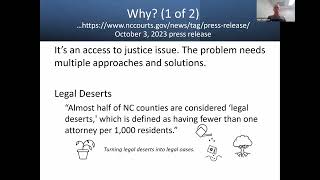
Thanks. Thanks, Katherine. And good afternoon. I was about to say good morning, but it is afternoon now. So yes, I'll be talking about the nonprofit law firm, what, why, and how, or how to start your own nonprofit law firm. And it is true, I did write a book, and I think that just proves that anybody can write a book. In a DIY world, any one of you out there could go out and publish a book if you invest a little bit of money and a little bit of time. But I'm going to talk through a good bit of this presentation is taken from that book. And that book reflects conversations and meetings I've had with actual practitioners and founders of nonprofit law firms over the last several years. So I hope this next 45 minutes or an hour will be helpful to you all, and we'll jump into it. So a little bit about me. That's, I think, my kindergarten picture in the middle there, the younger picture, and then I think at Duke campus maybe last winter. But I'm the executive director of the Incubator for Legal Practice and Innovation, and that's a legal incubator that helps entrepreneurial attorneys start financially sustainable practices that improve access to justice. And one innovative or entrepreneurial thing to do would be to run or to start a nonprofit law firm. But so during the day, I'm the executive director of that incubator. I'm also a part-time attorney for Law Office of Mark Atkinson PLLC. Nothing fancy there. I, I focus on small businesses and nonprofits. I got my JD, my law license, later in life. I went to North Carolina Central, graduated 2020, um, took the bar in the pandemic. It was a horrible experience. So I've been practicing a little over 4 years, but I had a prior career in consulting engineering, and specifically on the business management side. My, my undergraduate degree is electrical engineering, but I was mentored by some really great business professionals and had a 25-year career in consulting with Kinley Horn Associates, which is the best company that you've probably never heard of. It's been ranked in the top 100 best places to work in America on the Fortune list for the last 15 years. And it's headquartered out of Raleigh, North Carolina, a great place to work. I had 25 years there. I loved it. Um, so I've got a little bit of business background, a little bit of consulting background, a legal background, and that's all kind of come together with what I'm doing now. So that's a little bit about me. Uh, some disclaimers, you know, we're all attorneys, so we understand disclaimers, and, um, I'm, I'm not offering legal advice. Uh, I'm sharing some things that I've learned along the way over the last several years, and I'm I'm not a nonprofit law firm expert. There's a lot about tax law and accounting that I know a little bit about, but I'm definitely no expert. And tax law can be arcane and tax-exempt requirements can be onerous at times. But my point is you need to do your own homework. And I'm laying out this presentation as an overview We go wide and we don't go super deep. So I'm just going to lay out some principles and I'm not laying out legal advice. So hopefully that makes sense. So this session, there's kind of 4 main topics that I want to— 4 main areas. What is a nonprofit law firm? Why create it? Why do it in that model? What are the benefits? And is it right for you? So if the answer is maybe it is right for you, or maybe it is the right business model, how do you create a nonprofit law firm and how do you operate it? And then to kind of wrap up, what are some good resources that you can, if you want to go deeper, what are the good resources? So that's the 4 main objectives that we, I hope to cover in our time together. In simplest terms, a nonprofit law firm is an entity organized as a nonprofit corporation with a 501(c)(3) determination. So nonprofit corporation, that's typically with the Secretary of State, and a 501(c)(3) determination, that's where you get your tax-exempt status, and that's through the IRS. And beneath all that The nonprofit law firm must serve a charitable purpose, and you can find all sorts of definitions of that, and we'll get into that a little bit. But that's basically what I'm talking about. Organized as nonprofit corporation, typically— well, not typically, but through the North Carolina Secretary of State and with 501(c)(3) determination, and the entity must serve a charitable purpose. So what are the different types of nonprofit law firms? The one you're probably most familiar with and may not think of it as a nonprofit law firm is Legal Aid of North Carolina and PISGA Legal Aid or PISGA Aid out in the western part of the state. Those are nonprofit law firms and they fall typically under the legal services banner where they get federal and state funds and different grants. And the restriction with, particularly with them, the Legal Aid of North Carolina, Legal Aid of North Carolina, is that they serve the very poor, those at 125% of the federal poverty guidelines. And you can see in 2021, for an individual, that was a little over $16,000 or $33,000 for a family of 4. So a nonprofit law firm is, Legal Aid of North Carolina is a nonprofit law firm, but there are other nonprofit law firms as well. And I'm focusing more on the, I guess, the revenue or income side, but there's a sliding scale nonprofit law firm where you're allowed as a nonprofit law firm to accept client fees on a sliding scale. And the IRS ruling 78428 and precedent allows you to do that. There are also nonprofit law firms that rely exclusively on grants and donations. Justice Matters here in Durham, they have a Durham office and Raleigh office. They do a lot of work with immigrants, human trafficking, victims of human trafficking, immigration, and family law. They have roughly a $2 million annual budget and they rely 99.9% on grants, federal grants, state grants, donation. They have a staff of 6, 8 attorneys and paralegals and support staff. And so they are serving people maybe at the 125% below the federal poverty level, or maybe above that, but they do it on, not on a fee basis, but on a, they provide their services for free, not for a fee. Other types of nonprofit law firms might be a very hybrid or combination of sliding scale and a donation or grant-based. So those are some different types of nonprofit law firms. So, as I said, Legal Aid of North Carolina is a nonprofit law firm, but in a special category, a public interest law firm. So why create nonprofit law firms? Why consider it? Why do we have them? Well, I'm going to say, first of all, it's an access to justice issue. The problem of people being able to afford or access legal representation is a serious problem in America and requires multiple approaches and solutions. And a nonprofit law firm is one tool in the toolbox that can improve access to justice for people. There was a study done a couple years ago. I should have referenced, I realize I've got a quote there and I think this came from maybe North Carolina Courts or Office of Administrators, Administrative Office of the Courts, but half of North Carolina counties. So North Carolina has 100 counties across the state, almost half. So I think the number is 43. Are legal deserts and that there's one or fewer attorneys per 1,000 residents. There are several counties in remote areas of the state where there's 4,000 to 5,000 people per one attorney. So one attorney per 4,000 to 5,000 people. And in some counties, there might only be one or two attorneys. That's a problem. That's a legal desert. And there's been a, a movement in the state recently where you'll hear the phrase turning legal deserts into a legal oasis. And that may be a little bit hyperbolic, but the point is a legal desert from an attorney's perspective can create opportunity in terms of there's not as much competition. There's definitely a need to provide the services. So there's a movement afoot to turn the legal deserts into legal Oases, which is to try to bring more attorneys into those areas that have fewer attorneys. And it may be through a nonprofit law firm model that that's done. So that's one, a couple of reasons why we need to consider nonprofit law firms. And this slide, I think, is helpful as well. And this is from— there's a great organization or network. It's called the Above the Line Network. It's out of Denver, but it's a national organization. Of like-minded people that are looking for ways to improve access to justice for the missing middle class. There's a huge market. And let me just explain this graphic a little bit. So the rain that you see that's falling on people are the legal problems that people run into, whether it's the need to hire an attorney for divorce, a domestic violence situation, an immigration issue, a landlord-tenant issue, a contractual issue, starting a business, any family law matter, a bankruptcy matter. So that's— those are the problems, the legal problems that people— they— that rain down on people. You'll see to the left, the umbrellas represent legal representation. So if you're to the left, or those that are under 125% of the federal poverty level, they get some legal protection through pro bono services and through the legal aid, like say the Legal Aid of North Carolina. But you see there are holes in that umbrella and the Legal Aid of North Carolina and similar organizations can't do everything. They're underfunded, understaffed, and the good that they do is just not enough. So a lot of people still get wet or still get affected by legal issues, legal challenges. And on the right-hand side, you have the higher wealth individuals, higher wealth corporations and businesses that can afford robust legal representation, and they can generally be shielded from the legal issues in their life, whether it's they can afford an attorney to write a will and a stout, robust estate plan, or if they have a family law issue, they can afford an attorney to represent them in a divorce. And so they tend to not get rained on or as wet. Again, that's the metaphor. And then you have the big middle,, that can't afford $200, $300, $400 an hour attorneys that, you know, they've got good jobs and they just can't afford the market rate. And they tend to have to go pro se or they just don't get any legal representation at all. So the Above the Line Network is focusing on this, helping attorneys see the opportunity to help these people in the middle and on the lower income and the middle income and to find creative ways to deliver legal services to them. The nonprofit law firm is one creative way to provide legal services to more and more people at affordable rates. So that's a little bit of the why, and we could spend hours more talking about the why, but just want to give you a sense of an answer to that. So what are some of the benefits of a nonprofit law firm? First, I mentioned it's a means to improve access to justice as a public service, a community engagement where you're feeling you're a part of the community, serving the people in need and supporting them in their challenges. Also a benefit, a potential benefit, there are some financial advantages. We're going to talk a little bit later, potential law school debt relief that is available for those who work in public interest-oriented nonprofit law firms can in some cases get their law school debt forgiven or reduced. And also there are vendors out there, Google, Clio, others that will provide some of their services for free or at a discounted a discounted rate. And another benefit is just the sense of mission that you are focused on a group of people and you have narrowed your services to do what you want to do and you can do well and at the same time do good. So that's the potential, some of the benefits, which all sounds great, but is it right for you? And this is an important question to ask if you're cons— if you're on this call wanting to learn about nonprofit law firms and wondering, is it right for you? That's a good question to ask, and you should ask that question because, uh, do you need to start a new nonprofit law firm? My point in asking that question is there may be— it might be better to join or partner with an existing law firm. So as you consider the possibility of a nonprofit law firm in your future, do some exploration and some research. What's already out there? Who's already doing this work? And could you go work for somebody that's already doing it rather than start your own, start something new? Maybe, maybe it's better to partner with somebody who's already doing it. Likewise, rather than start a nonprofit law firm, maybe it makes sense to join or to start a for-profit law firm. And there's some advantages to that, but that might be the right solution for you. And then I'll make this point a couple of times. The— I don't want— well, I'll say it this way. A nonprofit law firm comes with some reporting and governance burdens that are not overwhelming, but we just need— you need to be clear-eyed and understand what those are. So those are some questions to consider as you think about the nonprofit law firm. Is it right for you or right for your future? So as you think about those questions, one way to figure out if the nonprofit law firm is for you whether it's starting a new nonprofit law firm or partnering with one, is to figure out the mission statement of this law firm. What are its objectives and purpose? And the mission statement or the purpose statement, I mean, there's whole books written about how to, and you can Google it and find good articles online about how to write a mission statement or a purpose statement. Think of. It's what do we do, how do we do it, or what do we do, who do we do it for, and how do we do it. If you can answer those questions, that's your mission statement. And importantly, and I've highlighted this here, your mission statement— or I'm going to use the term mission/purpose statement interchangeably in this conversation— the IRS will use your purpose statement or mission statement to demonstrate your charitable purpose for their 501(c)(3) approval. So you need to think through your purpose, your mission, because you're going to have to show it off to the IRS, so to speak, and it's going to have to satisfy them to meet their 501(c)(3) approval. So a little bit more on how to create a mission statement, just a couple of quick thoughts. I talked about The way I think about it is what do we do? Who do we do it for? And then how do we do it? Keep it simple and clear. And this third point I think is very important. Get input from otherwise, from others, sorry, get input from others, otherwise you may do more harm. My point there is you live in a community and you think you know what the issues are. And you may have a good handle on what the issues are and how to help deliver better legal services to your community. But you may be clueless and you might have a misunderstanding of what the real issues are and how to best, what the needs are and what sort of help the community really needs. My point here is that talk to community leaders, talk to church leaders, talk to organizers, talk to people And before you decide what the solutions are from a legal perspective, from a legal delivery perspective, make sure you've done your homework and talk to people in the community and understand what the needs are and how to best deliver it. And take your time. Sometimes a mission statement or a purpose statement needs to be discovered rather than created. And so you discover it by taking time and talking to others as well. So If you hear nothing else in this talk, here, get input from others. Otherwise, you may do more harm. And then sometimes a mission or purpose statement, whether it's for your law firm or for yourself, is more discovered than created. Hope that makes sense. So I want to go through just a couple. I have 4 examples, and hopefully if your screen's big enough, you can read some of this. I'm not going to read all the detail. But there's 4 nonprofit law firms I want to just kind of flash up their mission statement or where they describe what they do, who they do it for, and how they do it. So the D.C. Affordable Law Firm, that's in Washington, D.C., delivers accessible justice to modest-income D.C. residents who do not qualify for traditional services. And it goes on. So you'll get the slides and you can look these up, but this is This is one example of a mission statement from the D.C. Affordable Law Firm. Um, they're a good organization. You can look them up after the presentation today. Bull City Legal Services, that's a nonprofit law firm here in Durham. Rich Giddings is the director. Bull City Legal Services is a nonprofit law firm that offers legal services with income-based fees. To assist individuals and families that earn too much to qualify for legal, for free legal assistance, but who cannot afford. So he's perfectly, he's positioned himself to serve, he and his attorneys to serve that big middle market. They earn too much to qualify for legal aid and they can't afford the higher market rates. So he's positioning himself for that big middle. And I know this is small print, but Interbanks Legal Services, it's a small nonprofit in Little Washington in eastern North Carolina. 3 attorneys, they do bankruptcy, immigration, some family law work, and started by Sarah Beth Withers. They're dedicated equal access to justice, qualified believe in quality legal counsel. This doesn't give so much of their mission statement, but it does show kind of where they— whoops— where they provide services. It's clipped off at the bottom what counties they work in. You can see they have below-market rates. I'll show you their— I guess I don't have their sliding scale fee, but they have a tiered fee structure based on a percent of the federal poverty level of what they provide their services for. The market rate's $250. They give $250 an hour for the market rate, and they will reduce their rates based on your income, based on what tier you fall into. I'll talk about sliding scale again in a minute, but they use the classic sliding scale fee structure. The Commons Law Center, they're out of Portland, Oregon. Their mission statement is to revolutionize access to basic legal services, education, support for underserved Oregonians. In the process, we provide robust practical training for law students and new lawyers. And then it goes on talking about a sliding scale fee for those that are below 400% of the federal poverty level. And I'm going off the top of my head, but just so you know, understand if you're not familiar with the federal poverty level, 400% for a family of 6 is over $100,000. So as a family of 6, you know, 2 adults, 4 kids, let's say, or I guess could be 1 adult and 5 kids, $400,000, $100,000 sounds like a lot of money to some people, but they would still struggle to afford $250, $300, $400 an hour services for a legal need. So there's a couple of sample mission statements. So as I said, that's fundamental, and the process to create a nonprofit law firm is this flowchart, and the very first step is just what I talked about, is determining the mission statement. What is the charitable purpose of this nonprofit law firm? Then I'll just kind of talk through this flowchart. So we've transitioned to Talking about mission statement, you know, why nonprofit law firms? What's your mission statement? What's the mission statement? How do you create a mission statement? And now we're gonna talk about, okay, so how do I do it? How do I create a nonprofit law firm? Step 1, make sure it's the right thing to do. Step 1B is to determine the mission statement. The next step would be establish a board of directors. It's a nonprofit corporation. You have to have a board of directors. With the bylaws. Third step, you incorporate with the Secretary of State, file the articles of incorporation. You apply for a FEIN or Federal Employee Identification Number. That's through the IRS. It's amazingly simple, but you have to do it. You have to do that for your bank account and all those things. And then you prepare and submit the IRS Form 123. And this is a critical document because this is what the IRS will look at to determine your eligibility for tax-exempt status. And this is where you, as I said, show off your charitable purpose and make sure it satisfies their checklist, their, their criteria for a tax-exempt organization. And if you're starting small, there's the 1023EZ form It gets reviewed. It's actually a couple of weeks, maybe it's like a month or so to get— you submit it, reviewed, and you'll get approval or not within a month. If you have a full organization, a more robust organization where your budget's over $50,000, it's a more complicated form and it could take 4 to 6 months to get approved. So you would have to— you would want to allow for time. You can start operating as a— but you better make sure if the tax-exempt status doesn't get approved, then that's a problem. So it is possible to start before you get the approval, start operating the approval on the assumption you're going to get approved for your tax-exempt status, but it is a risk. So you submitted your IRS Form 1023. There's some time to review, but I say that's the critical document that the IRS is going to determine your eligibility. Um, and then you apply for a charitable solicitation license. Um, that's through the state. That's to make sure you can solicit charitable contributions. And then there may be other documents that you'll need to file depending on the size of your, uh, the nonprofit law firm. Maybe employees' workers' comp, unemployment benefits, things like that, property tax exemption. And then there's going to be an ongoing annual reporting and maintenance that's going to be required for your tax-exempt or nonprofit law firm. That's how you create your nonprofit law firm. Again, those are block by block, step by step, basically how it's done. The devil's— there's some devil in the details, but that's the big picture. And then you run a business, then you have a business. So before we get into how you operate the business, I want to talk just a little bit, some tips and best practices that are relevant for a corporation, specifically a nonprofit corporation, in this case, a nonprofit law firm. Business corporation. So some best tips and best practices. So this is all good legal stuff. Your 501(c)(3), your nonprofit tax-exempt organization, cannot benefit private interests. If you're the executive director, if you're a member of the board, you can't garner private, you know, personal benefit from it. And I'm going to hit very lightly on these. You can have, um, you want to be careful to not, um, have unrelated business income, or you could have taxes on that. So if you set up a nonprofit law firm and then you start selling t-shirts that are unrelated to that nonprofit law firm, that can be a problem in terms of an unrelated business income tax. That's a lousy example, but, um, You don't want to commingle different businesses and run into that problem. Obviously, with— you want to maintain records, transparency, and accountability. One of the annual forms that the IRS requires you to submit is a 990 that reports your financial information, who your board members are, and that's public information. So the 990 is one example of annual report that has to be submitted. And then sliding scale and low bono fees. I want to just a quick touch on a quick word about sliding scale fees, just so we all understand sort of what that is. And this is an example of a structure that would satisfy the IRS because it's— this is what Interbanks uses, something like this. The Charleston Legal Access uses something like this. So when I say sliding scale fees, a typical arrangement is having some kind of tiers of your client's income. It could be those that are between, you know, more than 125% of the federal poverty level to less than 225%. So 225 to 325%, and from 325 to 400%. So you have, you know, categories of where their income falls in, and then you provide a discount a discount rate based on the market hourly rate. So, for example, and this is illustrative, but if your market rate for the services you provide is, say, $250 an hour, you have a client who, based on their income and their family size, falls, you know, they're greater than 125% of the federal poverty level but less than 225%, then your rate might be $75 an hour. If they're more than $225, their rate might be $100 an hour, $150 an hour, $200 an hour. So you can see how you have a tiered structure, a sliding scale that reflects the family size, the income level, and then you're providing discounted rates based on what the income level is. So that's a quick overview of one possible way of creating a sliding scale. So back to best tips or tips and best practices, and this is specific to running a nonprofit organization, whether it's a nonprofit animal rescue or nonprofit law firm, you're going to want to have a conflict of interest policy where the organization's decisions are made in this organization's best interest and not for, say, the interest of the executive director or one of the members. It makes sense. Gotta maintain your tax-exempt status, stay up to date on IRS rules, guidelines. You might have a public support test where typically the IRS is gonna wanna see the revenue for your nonprofit come from multiple sources, not from just one source. That's good business diversification, but it's also, I'm not saying this would necessarily apply to your nonprofit, law firm, but some nonprofits do have a public support test that shows that they're getting income from different sources. And also, you can't be lobbying as a nonprofit, whether you're an animal rescue nonprofit or a law firm that's a nonprofit. The last couple tips and best practices for a nonprofit is beware of mission creep. When, you know, Interbank's legal services provides legal services in specific counties and specific practice areas. And what can happen to an organization is that it drifts from its original mission. Maybe that drift is on the clients they serve, the practices that they deliver, or the legal services they deliver, or they start doing something totally different from what they started out. That could change your charitable purpose. That could change your mission statement. That could have impact on your tax-exempt status. I'm not saying you don't grow. I'm not saying you don't add new services, but you have to be aware of mission creep that could affect your charitable purpose. If you're accepting charitable donations, obviously you have to provide receipts and good documentation. Good board governance. I've been on several nonprofits, and fortunately the ones I've been on have had good governance. If you're gonna have a board of directors, Use them for strategic planning, accountability, compliance, decision-making. Help them help you, and that's what good governance is all about. And then a final word, a good CPA is your best friend. So as, as your nonprofit grows, as it matures, you're going to want to have a good CPA as a partner to make sure you're doing the right things. Okay, so you have your charitable purpose, you've created your 501(c)(3), you've established your board, you understand everything about good governance. You have a nonprofit law firm, but it's still a business. Don't let nonprofit fool you. It's still a business and you have to operate it like a business. So in operating your law firm or operating your nonprofit law firm, and this is very treetop I'm going to hit a couple of slides on just the major areas of operating your law firm, from business plan to marketing, operations to employees. I know this is tiny, but a business plan, you have to have a business plan whether you're a for-profit or nonprofit. This is an example of a lean or simple business plan. It's a one-page and it shows you It's good to write down what your mission statement is, the problems your firm is going to solve, what solution is your firm offering, target market, marketing activities, revenue streams, key partners, expenses, competition, et cetera. So I gave an example here of Jubilee Legal Services, and I'm not going to read all this. It's in the PowerPoint slides, which I think Mary Katherine will be— not Mary Katherine, Katherine. Sorry, I know Mary Katherine. That Catherine will be sending out after the presentation here. So this is one example of the business plan. You can spend weeks, months, years on a business plan and plan it, you plan it to death. This gives you focus and 15, 30 minutes you can fill this out and give yourself some direction as a good start for a business plan. Branding and marketing, whether you're a any kind of business, and even a nonprofit business, nonprofit law firm, you gotta think about your brand or your reputation. What do you want people to think of when they think of your nonprofit law firm? So that's what branding is. And again, I'm not gonna try to answer this. Books have been written on it. And in terms of marketing, you wanna make it easy to find you, whether that's online or out in the community. And it's about network, network, network. Meet people and develop the business. Again, this is very treetop. This is not a session on branding and marketing, but just to give you something that's going to be true for whatever law firm you work in, whatever business you're in. And it's true for nonprofit law firms as well. So operations. So I talked about in marketing, make it easy for people to find you. In operations, one point— I don't have this in the slide, I'm going to add it later— is How do you make it easy for people to pay you? But operations includes everything from intake and client service. There's a phrase you hear about client journey. So put yourself in the shoes of your client, that mother looking for a custody issue, that tenant who's looking for representation in a difficult landlord dispute, that person seeking bankruptcy support. What is their— how are they going to call you? How are they going to contact you? And then when they do contact you, what do you say? How do you take them through the process from that first conversation to, to taking on them as a client, to delivering services, and then ultimately to closing it out and then maintaining contact with them? So that's all part of operations. How are you going to price your services? That sliding scale. How do you bill? How are you going to manage your financials, the profit and loss, the cash flow? As I said, you're a nonprofit law firm, but you're still a business. So operations, the infrastructure, do you need a brick-and-mortar office or can you do it virtually remotely? Depending on the clients you serve, you probably, you may need a brick-and-mortar place to meet clients. And then at the end of the day, how are you going to deliver exceptional client service, represent your clients well? So again, this is very treetop. I'm just kind of throwing out the issues that are going to be true for a law firm, whether it's nonprofit or not, but how to operate your law firm. And then a big part of a law firm is, you know, you may— a nonprofit law firm or for-profit law firm are the people. In the organization. And it may start out just as you or as one person. You might have a team of multiple attorneys and support staff. But as you operate your law firm or as you're part of a law firm, you're thinking about how to find and retain good people and compensation and benefits. And here, and one of the benefits of a nonprofit law firm is law school debt relief. And one example of that is the Public Service Loan Forgiveness Program. Where eligible federal student loans may be forgiven after 120 on-time monthly payments to the program. So yes, that's 10 years, but if you have a large law school debt, you work for a nonprofit law firm— or it's true also if you work at Legal Aid of North Carolina, a public interest law firm— so if you work at a nonprofit law firm, if you make 120 monthly payments to your federal student loan and you've done all the right paperwork, after 100— after 10 years of doing that, your federal loan, law school loan may be forgiven. Again, I make it sound easy. I know there's 10 years of making those payments, but there are ways to make minimum monthly payments and there are programs set up to do that. Some schools have that as well. Some states have similar programs. So That's one benefit, and that's that you can offer as a nonprofit law firm to yourself or to your employees as well. And that's no— depending on the size of your debt, that's no small thing. So, operating a law firm, operating a nonprofit law firm, one of the things that we emphasize at the incubator is sustainability, financial sustainability. And for the nonprofit law firm, sustainability would be important as well. I mean, maybe, I guess the first question to answer is define success for your organization and determine how long do you want to, what does success look like? One, Interbank's Legal Services with Sarah Beth Withers, She, uh, one of— one way she's defined success is that she's a, um, she's a mother with kids and she wants to have a life outside of her practice. So she's defined success as, I want to do, uh, I want to generate an income, a salary, I want to serve people in need, and I want to have defined hours, a beginning and an end. I don't know how many hours a week she works. I know it's not 60 or 70. But I know she has, you know, she doesn't work late into the night. She's set boundaries on how much she's gonna work. And I think she's setting herself up to have long-term for her law firm to operate for a long term because she's collecting fees on a sliding scale and she's also getting some grants from state sources as well. Diversifying her income. Uh, so she's taking care of her people. Um, so financial sustainability, uh, is long-term sustainability, and there's— that's related to budgeting and understanding where your income's coming from, where your revenue is coming from. And, uh, at the end of the day, it is a business, and expenses have to be less than your income, or you're not going to be sustainable for long. And one issue with grants, just to be aware of sustainability, and this could promote the idea of sliding scale, but state, federal, local grants can rise and fall. They might be for a year, they might be 3 years, they come and go. So there's some advantages to build your, your model around grants and donations, and there's some advantages to build, you know, on client fees. So you just have to think through that as the grants and donations may come and go based on funding levels. You've got to manage your expenses. So final thoughts on a nonprofit law firm, yes or no. When I say yes or no, is it right for you? Or what are some pros and cons of a nonprofit law firm? Well, I'll say a couple of pros. One, it's, it is by definition mission-driven or purpose-driven or charitable purpose-driven, and that may resonate with many of you all. Secondly, you're the boss. I say sort of. You do have a board of directors that is providing oversight and accountability, but if you're running the nonprofit law firm, you're the boss. Again, with that caveat, you do have a board of directors you have to answer to., and you can focus and narrow your mission so that you can have, you can do well and do good in life. Again, one pro, one benefit is the possibility of loan forgiveness if you set it up correctly. Again, that sense of meet directly meeting legal needs in the community. Also a benefit is the access to free and discounted tools like I mentioned Clio, Lexus can provide some tools at discounted rates. Google and some vendors with hardware will provide discounted rates for some of their, you know, whether it's PCs, laptops, different equipment. What are some of the cons? Quite bluntly, you can earn more if you work at a private practice. I'm not going to deny that. You can earn more if you go in the private, private sector. A con, I mentioned the ups and downs of grants as, as the different organizations have money, or one year they have money, the next year they have less, or they have, you know, they give you a grant for one year and then that's all they're going to give it to you. So you got to be— that's a con, or, you know, a downside, a potential downside. And then the ongoing compliance and renewals are not necessarily a con, but you just have to be aware there's going to be some time and attention that has to be focused on your 990s, running your board meetings, you know, creating the right oversight tools for transparency of running a nonprofit. So at the end of the day, no matter what, a nonprofit law firm is a business. It's got to generate revenue, whether it's from grants, donations, or sliding scale fees, and you got to manage your expenses. So, with that, I want to give you a list of some resources. And again, if you get the PowerPoint, these slides after the presentation, you'll see this. And this is just a few of the people that I've talked to and met and heard from. Gabby is the director of the D.C. Affordable Law Firm. I mentioned Sarah Beth Withers and Rich, who's in Durham. Chalice is in Chicago, South Side Chicago. Alana is— that's Charleston, South Carolina. Amanda, she may have taken a new position, but the Commons Law Center I mentioned there in Portland, Oregon. So this is across the country. As far as I'm concerned, I think there ought to be nonprofit law firms in every big city. We should have hundreds of them to fill that niche and that role. But it works for some. It's been working for these folks. So reading list, I'm not going to— I just want to show you what's in the PowerPoint. These are— this slide is a helpful resource list of helpful list of resources, whether you're in a nonprofit law firm or a for-profit law firm. And you'll see Katherine is a co-writer on the Design Your Law Practice with some other folks there. So some great books, some good podcasts to listen to. And then if you want, if you need, if you're interested in getting, looking at what bylaws for a sample, the North Carolina Center for Nonprofits has some sample nonprofit bylaws, and that's a great website. So ncnonprofits.org, they have some free resources, one of which is a sample of a sample nonprofit bylaws, but that's a great organization that has some good resources, some free, some for a fee on how to start and operate a 501(c)(3) nonprofit. Great, great place to get information. Articles of Incorporation, you can get all the forms you need from, you know, as if you're familiar with North Carolina Secretary of State, they've got great information there. And then finally, As Catherine said, I wrote a book, but anybody could write a book. So a lot of what you heard, most of what you heard today in this presentation is in my book. It's a thin book. I'm not going to say it, but if you're interested in getting it, there's a QR code and find it on bookbaby.com, How to Start a Nonprofit Law Firm. So, That is all I've got on, I mean, that image of that door is sort of, maybe it's your future. I don't know. It's not me leaving the building, but it's, I guess I wanted to convey the image of, you know, what's next, what's on the other side of that door, and maybe a nonprofit law firm is in your future to be either to be a part of one that is already existing, or maybe it makes sense for you to start one. Wherever you put down roots, whatever community you're in. So thanks for your attention. I hope I didn't lose anybody. So Catherine, I'm, I'm done. I don't know.
Oh gosh, I didn't look at the chat box. Don't worry about that. So we recorded the session and I'm going to stop the recording in a second. I threw in some links to other resources. Mark has the links and I've got his slide deck already, so I'll share that with you. Some of the stuff that I put in there when he mentioned that nonprofits get big discounts on technology, there's a whole portal called TechSoup and you can get incredible discounts. So I have worked for bar associations now for 25 years. Bar foundations are all 501(c)(3)s. Bar associations are 501(c)(6)s, but the bar foundations, we we were able to get really great discounts on technology. The legal vendors are not often in TechSoup, so if any of you want to do this and need help getting in touch with Clio or MyCase or LawPay or whomever, please do let me know because I've got contacts, as does Marc. And, and then the other resource that I really like is formerly known as GuideStar. It's called Candid, and you can go and look at examples of other 990 filings, which is helpful just to see how people have filled out their, their Form 990s. And you can also see, you can search through other nonprofits. One of the things that I will note is it is a good way if you are seeking grants to get yourself out there through this Candid portal. So with that, I'm gonna stop the recording. So if anybody has any questions, we won't record you asking them. And if not, thank you so much for your time.
And thank you, Mark, obviously. Yeah, I was gonna thank










