Keep In Touch Email Marketing
Jesse Lipson and Rachel Walter from Levitate explain how law firms can grow through plain-text, segmented emails to their network rather than mass newsletters. Referrals drive most new legal clients, and weak ties provide the widest reach. The session covers list organization, tagging, and personal touches like birthday notes that boost open rates and generate referrals.
Chapters
Welcome everyone to today's learning objectives from the Center for Practice Management of the North Carolina Bar Association. Today we are going to talk about how to drive referral business and organic growth for your practice. Today presenting for us are Jesse Lipson and Rachel Walter of a company called Levitate. That basically helps you with email marketing. So I'm gonna let them take it away.
Alright, thank you very much, Catherine, and appreciate the collaboration here with the North Carolina Bar Association. So today Rachel and I, we're not, we're not gonna be selling Levitate or promoting our product as much as really just trying to talk about something that we're passionate about, which is growing through referral and word of mouth. I think a lot of people in services industry, particularly law firms, know that referral and word-of-mouth business is kind of the lifeblood of most of your firm's client acquisition. And also clients that you get through referral and word-of-mouth tend to be the best kind of clients, kind of highest quality clients that you work with. And so Today I'm gonna just give a little bit of background about some kind of theory behind— start at a really high level, get into some theory behind why relationship-based marketing versus kind of a sales-based marketing is, is effective, and some of the kind of unexpected reasons why keeping in touch with certain parts of your network that you may not think about are, are really important. And then Rachel is going to talk about this area that we call keep-in-touch marketing, how that's different from traditional email marketing. Because I think a lot of you are probably familiar with traditional email marketing of, I'm going to create a newsletter with a bunch of graphics and just blast it out to everybody. That's not what we're going to be talking about today. I mean, we're going to hit on it as a just more of a contrast to more keep-in-touch type marketing, but what we're really going to be presenting today is a little bit of a different way of looking at the world when it comes to, to how to attract new customers. So Rachel, you can go ahead and just flip to the next slide. So I'm going to be covering the first part. Like I mentioned, I'm the founder and CEO of Levitate. Rachel is our director of marketing. We are a North Carolina-based company and we're actually based here in Raleigh. And for some of you who may be in the Raleigh area, prior to Levitate, I was the founder of ShareFile, which is a business file sharing solution. Maybe some of you use it, but it was acquired by Citrix and kind of started the presence of Citrix here in the downtown Raleigh area in the warehouse district. So with that, we can go ahead and just jump into the presentation. Like Catherine mentioned, you can feel free to chat if you have questions throughout. We have a smaller group today, and so we can definitely have plenty of time for Q&A and make it interactive throughout the presentation. And definitely we have— we've left plenty of time at the end to get into discussion or questions. So feel free to chime in in the chat. All right, let's go ahead to the next slide, Rachel. So yeah, so the first thing just I wanted to talk about is relationship marketing versus kind of a traditional sales approach. I think this is probably something that's pretty intuitive to you all as lawyers. Most law firms are not particularly sales-oriented, and I know there's even some kind of laws and best practices around advertising in the legal profession. But I found this statistic to be pretty interesting, which is, it's an old study, but of kind of Fortune 1000 companies, that the companies in the Fortune 1000 that were growing the fastest were the ones that really were focusing more on relationships and relationship building rather than traditional, a traditional sales approach. And for me, the inspiration for building Levitate was that in ShareFile, we worked with about 70,000 customers and we focused on relationship-based businesses like accounting firms and law firms and financial advisors. And one of the things I noticed is that typically these relationship-based businesses grew mostly through more of a soft sell approach of just keeping in touch in an authentic way and getting referrals and word of mouth versus a traditional sales approach of let me go cold call a bunch of people or, you know, do a lot of advertising and email blasts and that kind of thing. And so I think that this is probably really intuitive to a lot of you on the call that— and kind of the validation is that the approach that you're taking with focusing on relationships versus a really salesy approach is an approach that works. I think as a law firm, I've been on the other side, I've been a customer of a lot of law firms being in ShareFile and Citrix and nobody really wants to get a call from somebody saying, hey, you know, are you interested in working with us as a law firm? That's not really how it works. It's more actually, you know, an example with Levitate, I had 5 years when I was at Citrix and so, I was, I didn't make the decisions at Citrix, but with law firms we worked with. And so, but there were some law firms that I talked to and they just kind of kept in touch over time and said like, hey, let's grab a drink here and there or check in every quarter. And eventually I left and started this company and the law firm we decided to work with was the one that kept in touch with us over the course of time. And so, you know, really, really kind of powerful concept of just building relationships, being there. You don't have to always be selling something. You can just be keeping in touch. And when the time is right, people will recommend you to a friend or they'll recommend, or they'll maybe be in a position to use your services. They change jobs or something like that. So if you could just go to the next slide, Rachel. This is amazing. This is Clio. In 2019, did a pretty big legal trends report. Clio's a very popular practice management solution if you're not familiar with them, but they took a look at thousands of law firms and clients and prospects and saw that 59% of prospective clients look for a referral when they're shopping for legal services. So, one of the things that sometimes we forget in the whole process of kind of keep in touch marketing and relationship marketing is that a lot of it happens kind of invisibly. And so you may be keeping in touch with someone and say, hey, I'm just, I'm keeping in touch. Like, I'm not telling them about my services. This isn't working. Like, I'm just, what is it doing just to, you know, wish somebody happy holidays or check in and see how they're doing? But behind the surface, you're getting to be top of mind with those people. And when they have a friend that asks them about, hey, I need an estate lawyer, then you're much more likely to be recommended. And most of the time, as you see here, people are seeking recommendations when they're finding the right law firm to work for, to work with. So Rachel, could you go to the next slide? So last piece here, I'm gonna get a little bit more theoretical before Rachel starts to get into some more details about Keep in Touch marketing itself and actually give you some real tips that you can walk away with and use. But I find this to be very, very interesting. So there's been a bunch of research on networks and how people kind of make recommendations over time. And there's really 3 types of relationships that in the kind of network theory that people cover. One is called strong ties. So this is pretty intuitive. Strong ties are like your very, very close relationships, your best business contacts, your best best friends. Typically, people have a pretty small number of strong ties, maybe 10, maybe 20 at the most, and these are usually the people that you don't need to work very hard to keep in touch with. They are your kind of close network. Then you have your weak ties, and this could be 1,000 people, 2,000 people. The best way to think about weak ties are these are people who they know your name. So, you know, maybe they've come across you somehow at a networking event or a wedding, or, you know, maybe you went to school with them but you weren't close friends. So they would recognize your name if they heard it, but not necessarily a very close relationship. But there's a lot of these. So if I look at my LinkedIn, I may have 2,000, 3,000 contacts. I actually probably don't know all of them, or I don't remember all of them. I might have worked with them at Citrix or something, Then the third type of contact is what we call dormant ties. These are people that used to be strong ties at one point. It's the kind of person where maybe you went to high school together, maybe you went to college together, you were friends, and you could probably pick up with them. It may have been 10 years since you talked to them, but you could pick up with them right where you left off, and there's a much stronger connection than a simple weak tie of somebody that maybe I met once or twice at a networking event and I know their name. And so the interesting thing, there's been a lot of studies that have been done about networks and one kind of case study about people looking for new jobs finding that actually kind of counterintuitively, it's the weak ties and the dormant ties when people are either trying to find the answer to a question or trying to find a job or, you know, finding new clients or things like that, it's actually the weak ties and the dormant ties that typically provide the most value. And the main reason for that is just kind of the math. So your strong ties, you may only have 10 of those, and your strong ties are much more likely to be strongly tied to your other strong ties. And so it's a little bit of a tight-knit circle that doesn't get you that much exposure out to a big network. Whereas the weak ties, if you do the math, let's say you have 1,000 weak ties and each of them have 1,000 weak ties. Well, the friend of a friend network is— that's a million people, 1,000 times 1,000. And so if that weak tie is strong enough to be willing to go out to their network to answer a question or to help you, then you have pretty broad reach. And same thing with dormant ties, where you may have 100, something like that, 100 dormant ties, 200 dormant ties. And so that if those each have 100 to 200 200 dormant ties, it's still a pretty big network that you have access to. But the thing about these dormant ties and the weak ties are that they do decay over time. So you may have somebody that you've met, they know who you are. If you don't keep in touch with them, then maybe 5 years from now they won't remember who you are anymore because they met you once or twice. And so the key to kind of this being really successful in relationship marketing or keep in touch marketing is making sure that you focus on the dormant ties and weak ties and just keep them warm with valuable kind of connections on a consistent basis, which Rachel will talk about a little bit more. But this is a little bit more about kind of the theory of why it works. And the other interesting thing to remember is oftentimes I talk to businesses and they're like, yeah, I need to go buy a list or something because I need to get new clients. I need to like go buy a list and reach out to that list. That tends to just be not very effective. And you think about yourself, how often you respond to cold outreach. It's just much, much more difficult. And right in your kind of your own backyard, with— you have thousands of contacts that you could reach out to, and not necessarily in a salesy way, but just to keep the relationship going. And those will all become referral sources.
To you.
And so usually you have plenty— if you just focus on the people that you already know, you usually have plenty of people that you can build relationships with and kind of be the foundation for, uh, for growing your business. So that's the philosophy that we take at Levitate and what we're going to kind of talk a little bit about in the following section with Rachel.
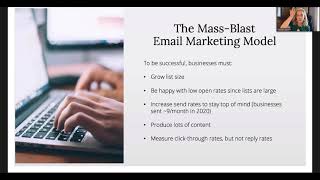
All right, thanks so much, Jess. Great to be with you guys today. As Jess mentioned, I'm our Director of Marketing here at Levitate, and I really love that setup that Jess just gave me because as a marketer, I have a very cool role at Levitate. When Jess brought me on board about a year and a half ago, he told me a little bit about, you know, some ways we were serving our clients at the time. We discovered that a number of our small business clients really needed help with, you know, figuring out exactly what to say what to say and how to use our tool as they reach their clients. So looking into building out a content library and understanding what these small business owners should communicate about was an early area of focus for me. And the belief there really being that the best way to grow is by delighting your customers and really focusing on, you know, nurturing that relationship, delivering the best value that you possibly can. And it's become a very core central of my work, the idea of delivering what we talk about as a sort of a magical experience for our clients so that they will then refer people that they know to our platform. We certainly have an aggressive sales team and, and do our own prospecting, but that is a core focus for us. So I can assure you that we walk the talk on this, this strategy. So before I get into Some of the really tactical ways that you can apply this strategy and theory behind keep-in-touch marketing to your business. I think it's really helpful to provide some context about where we are today from a marketing standpoint, from an email marketing standpoint, so you can have a better sense of how we came upon the tactics that we'll speak to you about next. So if you have an email address, which everybody here likely does, this slide will likely resonate with you. It is an incredibly noisy time to be a consumer and to be a business trying to do any kind of sort of business-oriented email outreach. Email volume was already growing before the pandemic. Businesses were averaging 9 emails per month, and it exploded. In 2020 as a result of the pandemic, overall volume growing 270%. Also during this time, paid social and Google ad spending grew 52%. So there's just a lot of noise, right? And part of the reason why that sort of traditional marketing lead acquisition model can be so ineffective is precisely because of this. There's so much advertising. There's so much volume that people tuning it out. The best example as to why people are, or the best demonstration as to how much people are tuning it out, are average open rates on mass blast emails. Despite the fact that email is still the most preferred method for people to hear from the brands and businesses that they trust, 97% of people saying it's essential to their lives over texting and social media, but 78% of email of emails in the legal industry specifically ending up in junk or spam folders, according to the most recent report from Mailchimp. So we've got this really effective medium that we know can be used in the right way to reach people. But the tools that have dominated the space for so long are just not very effective. And the tactics and the way that we're trying to message to people is just not landing. So how did we get here? This is just a little slide I like to share with folks to give some background on how email marketing became synonymous with the idea of sending a mass blast email. And we use that term to refer to graphics-based HTML emails that you would send through a provider like Mailchimp, Constant Contact, those types of tools, and email marketing has become very synonymous with that approach, right? Um, so just a quick background on sort of that timeline. The first group email, uh, interestingly was sent in 1979 by a gentleman named Gary Thuerk. He earned himself the title of the founder of spam. Um, and throughout the '80s and '90s, email is still being sent, but primarily by universities and corporations because there's a expense involved. But in 1998, Hotmail was launched and we have the explosion of these free personal email providers. Suddenly millions of people can have email addresses and send this communication for free. Also at this time, right, marketers identifying this as an opportunity to reach people affordably and incorporating HTML in order to be able to make emails look more like advertisements, right? So very, very important aligning of events there. Also the word spam getting added to the Oxford English Dictionary, marketers leaning into this tool, taking hold of it, and email just starts to explode. Throughout the early 2000s, we have the rise of the email database, people acquiring email addresses and just continuing to up quantity, up quantities. 2005, Google Analytics launches. And in 2013, the promotions tab is introduced. This to me is a very pivotal moment for anybody trying to send these kind of mass blast looking emails. Because what happens is even if emails pass spam filters and aren't going to trash, they're still landing in that promotions tab. And if you're like me today, you're not spending much time there. You're going into your promotions tab if you're looking for a coupon to spend somewhere, but it's not in your main feed in the way that those emails were once upon a time. So today, email marketing is synonymous with mass blast email. Send rates are increasing while open rates are falling year after year. Again, you saw that 22% average open rate in mass blast for the legal industry, which is actually, you know, pretty high compared to some of the, the comps that we see for folks that we work with coming in from using some of these tools. So incredibly noisy and, um, you know, a model really built on like a more is more mindset. However, this model just really doesn't work for small legal practices that we work with. Um, and for many of the other small businesses that we work with, why? Because to be successful sending those types of emails, um, you've got to have a big list and be happy with low open rates that you're almost guaranteed with this HTML-based model because your list are large. And, you know, as Jess mentioned, even if you can acquire lead lists, you know, it's akin to sort of trying to, trying to get a quick win, which the most successful legal practices that, that, you know, that we've worked with are not based on that, right? They're, they're based on nurturing long-term relationships with, you know, their current clients and referrals that come their way. These massive lead lists, trying to acquire, you know, completely cold contacts is just rarely a strategy that works well. And it's very expensive to, you know, experiment with without guaranteed results, right? And again, you've got to be sending a lot of content to have this be an effective tool because of how little of it lands in the primary inbox and how little of it people are engaged with. When you layer in the fact that they require all these graphics, it becomes very labor-intensive and requires resources that most of the law practices that we work with, you know, don't have on-staff graphic designers to help them crank out these, you know, beautiful emails all the time. You know, it's just, it's maybe a model built for a national corporation, but not for, you know, a legal practice really trying to nurture relationships. And ultimately, with these emails, the big measure is a click-through rate, and they don't often talk about reply rates, which for us is the ultimate measure of the success of an email, right? You want to be starting conversations with your clients, not sort of blasting from a bullhorn. And the best way to see that it's working is to have somebody feel compelled to, to follow up with you. So contrast all of that with this. I think about keep in touch marketing as sort of the art of the personal email, um, married with some of the science and technology behind today's platforms, Levitate being one of them, that enables you to scale the use of personal email to grow your practice and really sees personal email as a, as a tool for quote unquote marketing. If nurturing relationships and sending personal outreach and having personal touchpoints with your network constitutes marketing, which in our mind it does. It's the best form of marketing. It's just taking care of your clients and inspiring that growth. This is what it is, and it leads to the kind of organic quality growth that, you know, legal practices really need to sustainably grow and to find the right opportunities that are in line with your specialties and your ideal client profile. I'd like to share a few tenets behind this philosophy because it is a little different from, again, that sort of mass blast model and how we've traditionally thought about email marketing. Um, the first being quality over quantity. From list size to the number of emails you send, it's the quality of your interactions that matters, not volume. I work with practices at Levitate that average, you know, comparing to that, you know, 22% open rate to 60% open rates in some cases, precisely because they are not blasting their clients with a lot of fluff. You know, they're sending maybe 1 or 2 touchpoints a month depending on whether they have something of value to share or want to touch base, you know, around a holiday or just, you know, simply check in. But they're not sending 10 emails. They're being very thoughtful about how often and when they reach out. So when their clients or referral partners see their name and their in their inbox, they're not tuning them out immediately, right? Becomes very easy to get tuned out too quickly when you're blasting people with a bunch of content. So really focusing on quality, both in terms of the emails that you send and your list size, you're going to be much more effective, as Jess shared, when you're focused on either your current base or perhaps it's a slightly warmer prospect list, people you've engaged with at some point in the past and believe that there's, you know, some, some reference point that you can make. It's, it's not just a totally cold list that you've never had any sort of engagement with. The second tenet that we share is, is the idea of providing some value. And this speaks to that, you know, being thoughtful about what you send out. We call it the golden rule of keep in touch marketing, which is don't send anything you wouldn't want to see in your own inbox. Becomes a very powerful litmus test when you feel so, you know, pressured to, oh, I've got to be sending this. And I've gotta, I've gotta send 6 pieces a month, or, you know, I've gotta do direct mail and I've gotta do billboards and I've gotta do XYZ. Um, really being thoughtful about how often you want to hear, you would want to hear from your lawyer or from a, you know, a lawyer interested in doing business with you, what kind of messaging and what kind of brand image would appeal to you. Um, so being very thoughtful about that. And last but not least, being consistent. Um, you know, that sort of shout from a bullhorn, you know, batch and blast email approach that, that can, that can happen when you get stuck into the routine of a mass blast tool. It's just not consistent with the demands of nurturing a really high-quality relationship with someone in your network. So making sure that you're building in touchpoints throughout the year and making it a routine practice, either through, you know, tools that you may have on your own that help you with this, or in our case, we have sort of built-in touchpoints in our app we call Keep in Touch reminders that, that assist with this as well. And again, just before, just quickly here before I touch in or jump into the tactics that we're hoping you guys can take with you today, certainly want to call attention to the fact that, you know, you always want to ensure compliance with the rules of professional conduct contact from the NC State Bar and the adopted opinions stemming from the ABA passage of the changes to the Model Rules in 2018. And obviously, you know, highly encourage you to become familiar with the specific wording within those rules, but one of the posts I read in researching this through the ABA site, a gentleman sort of summed it up Compliance in 3 words. When you go to craft an email and reach out to your network, pass it through these filters. Is it false? Is it deceptive? Or is it misleading? And if it's not, you're going to be good to go. This may not protect you in 100% of the cases, but these are the primary filters you should be passing it through. And when you're being thoughtful and sending some of these really simple touchpoints, it becomes a lot more straightforward to sidestep any concern over crossing into this territory when you're sending a happy birthday email, right? So when you're not out there doing a bunch of prospecting, making claims, comparing yourself to your competition, we're better at this, we're better at that, and instead focusing on, okay, how is this email strengthening this relationship? How am I providing some value to this client by educating them about, you know, a recent court case and how it may be relevant to the field of estate planning. Again, just becomes, you know, even more assurance that I think these activities will help you steer clear of some of those violations. So just something to be aware of and familiarize yourself with. And I think provides hopefully some further comfort about diving into the, the keep in touch strategy. All right, so now we're going to get into the tactics portion. This is my favorite information to share with our clients and, and with any of the, the groups that we get the opportunity to, to speak to, because as a somebody who came of age as a marketer, you know, doing the old school kind of email marketing This has been really such an incredible aha moment to see how effective some of these strategies were, are, that are sort of counter to the messages that we've been told about how to do marketing, right? So very cool, and in so many cases just brilliantly simple, right? And really speak to how easy it is to overthink advertising when instead you should be focused on just building relationships. So the first tactic I'll share is just starting out by trying to get as organized as possible with your list. And we know that this isn't always easy. This sometimes takes a real upfront investment to do some segmenting. But your categorization of your contacts will help you tailor and segment your outreach. And if you have a CRM that you're using, some of this may be built in, you know, what types of services you've offered these clients. If you have an opportunity to, you know, categorize them as coming from a certain referral. In our tool, this is just one of the, the ways that our clients are able to segment. We have these tag features, so folks will, you know, Tag, tag clients, you know, help set up an LLC, marking somebody as keep in touch will mean, oh, I want to make sure I reach out to this person every 3 or 6 months. And even categorizing people with less obvious tags and segments, something like, for example, Duke, Duke basketball fan or wine drinker. We have some of our financial clients will use that. And if you've got a small client list, you know, maybe you're working with some high net worth folks and businesses that have been doing business with you for quite a long time, and your firm regularly buys Duke basketball tickets, season basketball tickets, and every once in a while you want to invite some clients to, you know, to offer up those tickets. You can reach out to that group of clients and, you know, just always have that information readily available that that's an interest area of there. So lots of creative ways that you can take advantage of, of sort of tagging and segmenting to make the communication as personal as possible. And next is kind of a foundational principle behind some of the most effective email content we see for lawyers is the power of plain text. So while 64% of people say they prefer image-based HTML email, emails, plain text emails receive 42% higher response rates. So again, these HTML-based emails, typically something that you see coming out of a Constant Contact or MailChimp, um, plain text emails being what you would see coming through your personal email, right? Um, which is the platform that our, our tool sort of sits on top of your personal email. Those emails generate 42% higher response rates. And why is is that email is the one quote unquote marketing channel where you have the ability to create a one-to-one interaction. And even if you may be sending a plain text email to 200 or 300 people, if you're able to kind of scale that one-to-one touch, they may very well feel like you only sent this email, just, you only sent that email to them. You're never going to achieve that personal feel with, you know, an HTML newsletter that has your, you know, your headshot on the top of it, right? Nobody thinks that was sent just to them. And I love this example here, um, is actually a template that we call the check-in template, and it's 3 sentences long. Um, and it's simply, check again, it's been a while since we last connected. And it just, again and again, the tens of thousands of emails I've sent I've seen using this exact copy is just a top performer and people feel compelled to respond. They think you just sent it to them, even if you happen to send it out to a number of people. So plain text, incredibly effective. And again, so simple, you know, it's incredible how much you end up overthinking your marketing by relying on this HTML-based model. So plaintext, absolute great place to kind of start your strategy. HTML, we do have some clients who do see success with HTML, and there may be some elements of that that they want to hold on to and complement their plaintext strategy with some of those pieces. And that's, you know, that's just It's just something that we always recommend that it be a complement to your plain text strategy because plain text tends to be by and large so much more effective. Another tactic that I'll share is the idea of sort of educating and reminding people of your various practice areas. I loved this statistic that 35% of clients using only one practice area leave after 3 years compared to just 5% of clients who use 4 or more. Um, I mean, just what more case do you need to be trying to do more business with your current clients, right? Um, to, to invest in the longevity of that relationship. And time and again, we see that it comes down to clients really just not being aware. And if they are aware in the beginning of all of the areas that you offer, it's quite easy to lose sight of that, right? If they're only engaged with you in one practice area, you know, are they going to immediately think of you when, when somebody— when a real estate issue comes up down the line that you also offer real estate? Um, you know, no, you likely need to build in some touch points to make sure that you're staying top of mind and highlighting all of these different areas that you offer. Um, so this is something I highly recommend, and it can just be a once or twice a year check-in As part of one of those casual check-ins, you know, as a reminder, we also offer services in XYZ. If I can ever help you or a friend or colleague out in any of these areas, don't hesitate to give me a call. Very simple, but obviously really important to investing in, in that sort of organic quality growth from your current base. Next tactic I'll share is the idea of being a trusted resource. This goes back back to the principle of providing value and choosing, being very, very thoughtful about what content you choose to send out via email. And while we are strong advocates for some lightweight sort of touchpoints, which you'll see some more of in the coming slides, sometimes providing a really important resource is also very much is worth interrupting somebody's day over. If you have personal injury clients and, you know, it's tax season, you may want to provide some education in this case around, you know, considerations for filing taxes if you've received some kind of settlement for that. With the new Biden administration coming in this year, there were implications on estate planning this year resulting from the CARES Act and, you know, a number of pieces of legislation being put forth and that have been passed. So sharing some insights on that, you know, what you're predicting, things you may want to check in with your clients about, really show that you are keeping up with current events, things that may impact them, and, you know, just staying top of mind even when you're not immediately looking for ways to do new business with them or they're there may not be immediate ways. You're just really building in a touchpoint to stay both stay top of mind and establish yourself as a resource. And for some of our real estate lawyers, during COVID there were obviously a number of really difficult conversations between businesses and landlords over rent negotiations. And we worked both with some of our commercial real estate clients and some of our law clients to put together some content around guidance for those conversations, ways to approach those negotiations, things to keep in mind that were a very helpful resource. So just another thing to keep in mind as you're choosing what content to send out. Another one that I'll share, and this was really enlightening to me. I was not aware that this, you know, was a real— had some of these kind of severe consequences. But because the duty to communicate is so important for lawyers, failures to communicate can have real consequences. In 2018, over 15% of disciplinary cases in North Carolina included findings of a violation of client communications. And so, you know, these cases where a long drawn-out legal case may, uh, you know, present potential for months to go by where you're not communicating with clients, leaving them, you know, wondering, are they still working on this? You know, have they forgotten about me? Where does this stand? Um, so becoming really, really important to build in touch points for that reason alone, right? Let alone growing your business, but making sure that, that you are communicating with clients. We actually have some automation tools that some of our clients use. Again, in the personal injury, the personal injury case example, we have some automations that after 30 and 60 days or 90 days will automate just a checking in, letting you know we're, you know, we're still working on the illness, touching base if there's, you know, something they want to say about the recovery process, if this person is dealing with a, you know, really challenging recovery that they want to check in with them about, but ensuring that you're building in those touch points to, to cover your bases at a minimum and ensure clients feel that you're adequately communicating with them and also have that opportunity to show them that you're going above and beyond, that you care, they're there and that you absolutely have not forgotten about them, but you're hard at work doing whatever you can to further their case. On a much lighter note, the other surprising— I think one of many surprising lessons that I've learned from working with our clients is just how different they all are and how effective certain strategies can be for some clients. I certainly work with a lot of folks that are very formal and very professional, and they would not touch a GIF like this with a 10-foot pole. If that's your style, then that's your style, and it's got to be authentic and it's got to sound like you. But I do also work with some lawyers who really like to use some lighthearted content.. And it can be incredibly effective. This template across the board was one of our top performing templates last year. The subject line of what a year was, I think, very appropriate for the year that we all had and averaged some of the best open rates and reply rates of our whole content library. Why does it work? It's very casual. It's 2 sentences long. The shorter the better in many cases. Faces, you know, just feels sort of personal and authentic and puts a smile on someone's face. We actually, you know, I thought when we moved into, into legal as a company that the lawyers I would work with would not touch this. I've been so surprised. We have a lot of lawyers that love, love injecting some of this into their keep in touch outreach, and it has been really effective. Effective. So this was just one testimonial from, from one of our clients who said, you can choose to sound very serious, or you can be a silly guy who likes to send gifts. His clients seem to respond well to it. So I just think this one's really fun and to not shy away from, from doing something like this. And another tactic is the simple idea behind helping them sell We are big proponents of not only what you see here, which is our happy birthday email that we've sent to at this point over 100,000 people, and it averages very high open and reply rates again and again, but also even very simple holiday templates. You know, those create a perfect opportunity to, to just touch base and wish somebody a happy and healthy holiday season. Thanksgiving, you know, I'm so appreciative of your business. Um, you know, thanks for trusting us with your legal needs this year. If I can be of any assistance, don't hesitate to reach out. Um, non-salesy. You're not asking for anything. You're remembering them at a time of year that, um, you know, it's just totally outside of the need to do business, right? Um, just very thoughtful. And heartfelt and simple. And it just is so well appreciated. To me too, this is another great example of how small practices can really play to their advantage of being personal. A big corporation is never gonna make somebody feel like they sent them a personal birthday email. They're gonna have their HTML-based template and it's gonna come from American Airlines or whatever. But if you are a small practice and you are personally teeing up these birthday emails to your clients, then, you know, they're going to know and feel very much like this came from you because it did. Our tool actually builds in an ability to map out birthday emails 30 days ahead of time. So we We have folks who tee these up for their clients year-round, and it becomes just a behind-the-scenes way to make sure you're touching base with somebody in a personal way at least once a year. So just, again, another sort of lightweight thing to keep in mind. And the last sort of really specific tactic I'll share here is the idea of rethinking the news letter. So, you know, those graphics I showed you in the beginning of, you know, typical, the legal newsletters that you might see is, is what I come across most often, you know, a number of lawyers that we work with weren't doing any email marketing at all. But if they were, maybe they were putting together like a quarterly newsletter or a monthly newsletter. And they can be labor intensive if you're trying to make them look good and dragging photography in them and trying to to write blog posts potentially that you're linking to from these module-based HTML templates, right? And if, you know, you're not seeing very high open rates, then you've got to look at the ROI on that, right? As a small team or a 1 or 2 person shop, is that worth your time? In this case, I actually worked with one of our clients who was a little bit, off vertical for us, we would say, was a recruiting company. He worked with C-level executives, and he had come in with a mass blast newsletter, and we rethought it as more of a checking-in letter and just really made it a, you know, hope you're doing well, it's been a crazy year, we haven't connected. And then And then we went through some very simple, straightforward highlights. So things he would have tried to build out as blog posts or something in this mass blast letter, but instead just turned into, you know, here are some high-level things I thought I'd share. When you get a chance, let me know how you've been. And he just had phenomenal results from this, this transition, 76% open rate. 36% reply rate. So again and again, I see that with the replies. People almost never reply to HTML-based emails. They assume it's coming from a no-reply email address and that, you know, they're going to get a bounce back. This plain text format, even if you kind of know in the back of your mind this went to a bunch of people, you're still going to feel compelled to respond. You're going to be a little more likely to respond if you were, you know, had the inkling to. Um, so something that I love working with people on because it ends up taking this weight off their shoulder of, oh, I've got to do our quarterly newsletter. And instead making it a very simple, like, let's just put together a little letter to update our clients. And, um, you know, not worry about how pretty it looks, cause we're going to worry about it being personal and just having great success with it. And then the final note before we'll open this up for questions, I highly recommend creating a calendar when possible. I know this, this can be an overwhelming prospect and, you know, looks like a lot. And this may, you know, this is a sample content calendar for, for one of our clients. This wouldn't necessarily be the right fit or the right content for you. But, you know, making sure that you've built in some touchpoints and planned out a mix of educational pieces with, you know, a holiday thank you can be a really great way to make sure that, you know, this doesn't become a, oh, when we, oh, we got to do something this month. Oh, we got to do something this month. So whenever you can, kind of mapping that out and scheduling is a very effective way to plan out how to be most successful with your email strategy. All right. Well, we've got 10 minutes here, so welcome any questions or feedback you guys have.
So, okay. Anybody have any questions?
Yeah, I'll jump in real quick, Katherine. Appreciate the presentation, Rachel. I'm a solo practitioner and I'm not familiar with facilitate. So is there, uh, some of the concepts that you're talking about by way of email marketing makes sense to me, but how does that work in the context of, of a sole practitioner?
I'm try— I'm trying to understand, um, the question a little bit here.
So you, you're talking to the founding partner, the senior associate, the junior associate, the, the administrative assistant, the paralegal. And at the end of the day, if I'm really good, the janitor.
Okay. Yes, yes, I hear you. Um, we work with, uh, superheroes like you in our client base all the time. Um, and, you know, I think I, I realize we sharing a number of, you know, educational strategies and tactics today that are nice to be able to execute when you've got a team behind you. Our platform, one of the great things about our platform is that we do provide free, uh, included with the package is a success coach that partners with our folks hand in hand year-round to like choose this pre-written content and even craft some custom content on your behalf for up to 4 pieces of that as well per year. And come up with a strategy, you know, find out what do we need to do to get your data organized together. You know, how often do you want to reach out to folks and when, what kind of tone of voice, you know, do you want to bring to your, your marketing. So, you know, I hear you loud and clear. That's, that's really a lot of the vision behind our product is to support small businesses that don't have a lot of these resources. How can we help fill in in the gaps.
Yeah, exactly. Just to add to that, we're trying to be more educational than promotional in this webinar, but it's very, very common for relationship-based businesses. A lot of the reasons why people tend to kind of nod their head and say, yeah, you're like, I know keeping in touch is valuable. The problem is finding the time to do it. And so So with Levitate, like Rachel mentioned, we have our success managers and we create, we have a lot of templates that we're always creating that are topical and check-in templates. And so our goal is essentially with our product to take about 90% of the effort off of your plate. So you can just meet with somebody once a quarter and configure a calendar and approve some things. And, or if you have an idea for a custom piece to throw it over to us, and we'll help write it and you can send it as your own. So that's kind of how we close the gap for those small firms. You can certainly not use Levitate and do a lot of these things yourself, but that's the reason we built the product was to try to make the keep in touch just a lot easier for small companies.
Any other questions? I— okay, so let me, um, yes, they're messaging them to me, so let me, um, go through them. And this is— there's two, uh, comments/questions from the same person who I think is a Soul Practitioner. Um, he said the frequency of contacts via email is much higher than I expected.
Affected.
Seems like you can be top of mind without hitting people once or twice a month. So is there any data on minimal impact frequency? So basically to him, it sounds like hitting somebody up once or twice a month is a good— is too many. And so you probably have statistics that indicate whether that's actually successful or you're just bugging people.
It really depends on the client. We highly recommend starting slow. So as I mentioned, you know, it's a lot more difficult to get somebody to start opening your emails once they've decided that you're emailing them too much than it is to kind of feel out, you know, what they have an appetite for. So as you send that first email or their first two emails, we're looking with you at opens and replies.
To see, you know, what, what people are telling you, right?
Um, if you sent a piece of, you know, guidance around tax season, that personal injury tax season resource I, I mentioned earlier, um, and you get a bunch of replies from people saying, this is great, thank you for sharing, you know, I, I had questions about this, um, then you may feel more comfortable following with something you're inspired to say send, you know, sooner rather than later. I really, I think it really depends on the client and the nature of the relationships that you have with, with your, your network today, how often you've already been reaching out. But you're exactly right, you may not need 1 or 2 touchpoints a month to stay top of mind with them. That may not be what's right for your business. It can, it can often be simpler, as long as you're really thoughtful and strategic about when you do out.
Yeah, I'm sorry, go ahead, Katherine.
Oh, I'm just laughing because I get an email from an attorney in Chicago who sends me a— and this is kind of, you know, goes to the point of when you're creating your list, getting as much information as you can to give contacts to your contacts, because he sends me basically literally happy Father's Day, happy Mother's Day, happy Rosh Hashanah, happy Kwanzaa, happy Christmas, happy— he sends me every single conceivable holiday. And it's so obviously not targeted or specific to me, and it's just a blast that I've begun to ignore them. And, and there's never anything useful beyond that. Um, so, you know, even if this kind of keep in touch thing needs to feel authentic And I feel, and I'm sure you'll work with your clients on that, but as, as people, even if they want to create this on their own, just keep that in mind. There's a beauty to automation, but there's also, um, doing it well.
Yep, exactly. Yeah, I would say that, um, we have definitely clients who are law firms that say, hey, I just want to reach out a few times a year, and that may be totally fine. It gets back to the kind of golden rule that we mentioned at the very beginning where you don't send anything that you wouldn't want to receive. And I think you probably have a good intuition of, for different groups, referral sources may be a little bit different than past clients, maybe a little bit different than other contacts. The one caveat I would add to that is, I think what we found working with clients is that they're a little bit overly gun-shy. They assume oftentimes that people don't want to hear from them very much, and sometimes people do want to hear a little bit more. And like one example I would say is birthdays, where a lot of people are like, well, you know, they don't necessarily want to hear happy birthday from me, but actually they will send it and actually get a much better reaction than they expect. And so I think the key, like Catherine mentioned, is ultimately it has to feel personal and authentic and, you know, and add value. And so you may check in a few times a year. Maybe, you know, the other thing on holidays that we really try to do is apply that golden rule of just saying happy, you know, Memorial Day. That's limited value, although maybe if your office is closed or something, you need to provide some information that can be helpful. But being able to say, hey, like, here's a really cool recipe I found, you know, if you're grilling out or something like that, like that. Or like, for example, for Father's Day, we do one that's dad jokes, you know, and like, because it's kind of like the corny jokes that dads tell. And so something that like somebody would get it and, and like it and enjoy it and get value from it. And, um, you know, depending on your personality, there's like, uh, and kind of self-deprecation, there's definitely lawyer jokes you can, you know, you can, you can send people if you want to around holidays and things like that. So, yeah, I totally agree. I think it just really depends on the client. And we would just say, no, don't go above 1 or 2, but sometimes people think like once a quarter or a few times a year is plenty for a particular segment.
And kind of thinking about segregating the personal messages from content, one of our participants ask, my contacts that want to have my thoughts on new developments follow me on LinkedIn. So he's looking for a way to kind of sort out the optimal blend between email, emailing that type of information, versus a vibrant LinkedIn feed.
Yeah, I would do both. I've noticed that the problem with LinkedIn is— the great thing about LinkedIn is you can reach all kinds of people maybe who are not even in your contacts. But the problem is, you know, they have their own algorithmic feed and a lot of people may not see it. I see some law firms that are like, hey, we do social, and they'll post something on LinkedIn and it'll get like 2 likes, you know. Meanwhile, if they had emailed a paragraph or something to their contact list about here's what we think about, you know, what's going to happen with non-compete legislation, that's a hot topic right now, right now with some of the information that Biden kind of put out recently, you're much more likely actually to get your point of view seen. And oftentimes if you have an amazing LinkedIn presence and you're getting hundreds of likes consistently, then there's no reason you can't do both. But I think I've seen people fall short and assume, hey, just because I'm posting on Twitter and LinkedIn, that means everybody's waiting with bated breath in their social media feed to find my thing and read it. And oftentimes, just like, people get— those feeds are so crowded that oftentimes— so I would take a look at your engagement, your likes, and everything on LinkedIn, and then try putting some of the content in a little bit of a readable, easily readable email and seeing what you get in terms of views there. And, and, uh, definitely no reason you can't do both.
I agree. And the funny thing is, the most popular LinkedIn post that I've had, I think, ever was a completely personal vignette. Normally I share my blog posts and, you know, thoughts on things, um, that are kind of third, third person and impersonal. And apparently LinkedIn is somewhat shifting, um, not always in a good way because we liked the distinction between LinkedIn and Facebook. But at any rate, I think, yeah, looking at your metrics and recognizing that the LinkedIn feed is not hitting everybody equally and recognizing an email may be a more direct communication. I don't know why you couldn't do both and figure out which one's working best.
Yeah.
Yeah.
And personally, I mean, just putting the golden rule hat out of I'm a client of legal services, like I would love it if my corporate lawyer sent me an email and said, hey, you've probably seen some stuff about non-compete, here's what we think. And it makes me have just confidence that they're kind of following what's going on and I would welcome that and like to get it. And so, and whereas if that person posted on LinkedIn, I don't know, probably a small percentage chance I would see it.
Right, and less personal. Any other questions? Yeah.
Yeah.
Okay, well, seeing none and hearing none, I appreciate your coming and talking to us today about this kind of keep in touch marketing concept. It's definitely very interesting. I took a lot of notes. I'm actually going to share it with our marketing team because I think everybody could get some pointers about how to authentically and effectively market and, you know, how to contact people to keep top of mind. So thanks so much, and I will— produce the recording and send out the link to everybody, and I'll get Rachel and Jess to share the slide deck and send that to you as a PDF as well. So thanks for participating.
Yeah, thank you so much to the NCBAR for making this happen and for all of you who attended.
Yes, thanks for having us.
Bye. Bye.










