Pro Bono for Professional Development
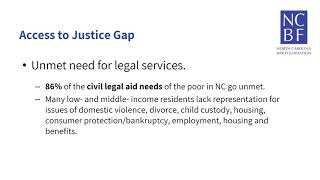
Kim Bart Mulligan, Senior Director of the North Carolina Bar Foundation, explains how pro bono work builds lawyering skills and networks while addressing a critical gap: 86% of civil legal-aid needs for low-income North Carolinians go unmet. She walks through the Bar Foundation's programs, from free legal answers to wills for heroes, and how new lawyers can start with no prior experience.
Chapters
All right.
So thank you. Welcome everybody to the Learning Objectives Program from the Center for Practice Management today. And today our special guest is Kim Bart Mulligan, who is Senior Director of the North Carolina Bar Foundation. And she is gonna talk to you about how you can use pro bono for professional development, which is something that I've been looking at, especially when I've talked to attorneys who are looking at how do I expand my network, but they're the kind of people who are not comfortable working a room. They're the kind, you know, it feels a little weird, and especially now that we don't have cocktail parties, but just a natural way of meeting other attorneys in an environment that is collegial and lacking any particular ambition other than to help. So Kim, I asked Kim if she would introduce herself because one of the things that everybody should have ready to go is their elevator pitch. So Kim, take it away.
Sure. Hi everybody. Thank you for inviting me here. I have a slide presentation to share, but we are a very small group like Katherine noted. And so I invite you to ask questions, interrupt me if you don't want to talk into the presentation, feel free to throw something into the chat. I'll keep an eye on the chat box as we go through too. I'm glad for this to be a conversation as much as a presentation. As Katherine mentioned, my name is Kim Bart Mulligan, and I am the senior director of our North Carolina Bar Foundation. The foundation is— I think of it as the charitable arm of the Bar Association. We help create pro bono and public service opportunities to engage NCBA members in service to their communities. We further our values of access to justice, service through the profession, professionalism, and civic education through our programs, and we work really closely with NCBA sections, divisions, and committees to figure out what type of service our members want to do and help them connect in meaningful ways to serve the clients that they most want to serve in the ways that they're most interested in serving. My background is I've been with the Bar Foundation now for about 5 years. It'll be 6 years this summer. Prior to working with the Bar Foundation, most of my career was spent in legal education. I was a clinical legal professor for just over a decade. I most recently worked at Duke Law School as their Dean for Public Interest and Pro Bono Programs and their externship programs. So I love talking about ways to use your experience, to your experience through service, to develop your resume, to improve your own skill sets, to basically help you advance in your career. I spent years working with students in that vein, and now I do that work with attorneys. It is really fun to talk about pro bono as a professional development opportunity because Like Katherine, I sincerely believe that there are lots of ways that you can grow through service, and the good news in the pro bono community is that we already have a lot of ways to support lawyers, new lawyers or experienced lawyers, in getting into new and different pro bono fields. In fact, I often talk at the Professionalism for New Attorneys program, and one thing that I encourage new attorneys to do especially is think about their pro bono work as a second practice area or a second specialty. By day, you might be a mergers and acquisitions attorney, but by night, you might do landlord-tenant work as your pro bono practice area. And like any area of law or any new thing, you have to step into it. You have to wade into it. You have to push through the discomfort of trying something new and different and learning it as you go. But you will get through the shallows and into the deep end of pro bono work if you commit the time that it will take to get you there. And then you can operate as an expert in your area, your pro bono area. And to get there, there's a lot of support. There's a lot of training. There's a lot of mentoring. So it's not a deep dive. It really can be a step into pro bono practice. Some of the things I want to share about today are the questions of why lawyers get involved in pro bono work. There's a lot of different motivations for getting involved in pro bono. I'll talk through our Rule of Professional Responsibility 6.1. I'll talk a little bit about the unmet need for legal services, particularly civil legal services. You've probably heard this referred to as the access to justice gap. And then finally, I'll round out with some talk about professional development, skills building, networking, ways that you can grow yourself, grow your skills, grow your resume through pro bono work. And I'll point you to some directions for getting started in pro bono work, whether you are new to pro bono or looking for new ways to expand your pro bono work. I'll present a lot of different options. So first, let's review the rule of Professional Conduct 6.1, which is our North Carolina voluntary pro bono public service rule. In North Carolina, pro bono is a voluntary but aspirational rule that every attorney aspire to render at least 50 hours of pro bono service every year. The rule does encourage that a substantial, if not all of your hours, in pro bono work are given without the expectation of fee to, to individual clients who otherwise would not have access to an attorney and not be able to afford an attorney. So most often we think of these as legal aid qualifying, legally qualifying clients. But also you might work with individuals or groups through other organizations that are seeking to change law or even do appellate-level litigation advocacy work. There's lots of different ways and different organizations that are looking for lawyers to help them do the nonprofit legal work that they do. The reason that we have a rule of professional responsibility relating to pro bono work is because it's sort of an acknowledgment that with great privilege comes great responsibility, right? We have been admitted to a very select community in our— as a member of our profession. Only lawyers can do the work that lawyers do. And in that way, we have a bit of monopoly on access to justice, access to legal services. And so this rule acknowledges that out of that responsibility and given that monopoly, that we have an obligation to give back to others by using our legal services in service. In being a lawyer and serving and serving through the profession is really what differentiates pro bono work from public service work. Pro bono work means that which we're doing as a lawyer. So anybody can serve and everybody should serve as a volunteer for Habitat for Humanity or with a soup kitchen or what have you. But only lawyers can do pro bono work, which is why it's so important that when you think about serving in your community, think about ways that you could use your legal skills to provide that service. So another reason that people get involved in pro bono work is to help address the access to justice gap. And like I said, I'm sure all of you have heard of the access to justice gap. But you might not realize exactly how big it is. We know that 86% of civil legal aid needs in North Carolina among the poor go unmet. There just simply are not enough legal aid attorneys to go around to meet the need. And I will say, especially right now on the heels of the pandemic, legal aid is having to turn away a lot of clients. So basically, if you are a client seeking assistance from legal aid at this point, If you are not in a, in a true safety situation, if your issue is not eviction or landlord-tenant, they are unable to help you right now. They are so stretched for assistance that they're really hyper-prioritizing their caseload right now, which means all the more your time matters to serving those who otherwise would not have access to legal services. And as I'll talk about later, this doesn't always mean that you need to step into the big role. You do not have to play the part of a legal aid attorney to provide assistance. There's a lot of ways that you can help without having to show up in landlord-tenant court tomorrow, and we'll talk about that as well. The other thing I'll point out is that when we think about the needs of lower-income people, they don't differ very much from the needs of upper-income people. I sometimes invite people to think about if you yourself in your life at some point need to hire a lawyer, what's likely to be the issue that causes you to do that? And the answer is probably a family law matter or an estate planning matter, wills, powers of attorney, trust, that sort of thing. Perhaps a landlord-tenant matter or a bankruptcy question or concern, hopefully not, but The issues that low-income people face are really no different than the issues and needs, the legal needs of those in higher income. The only difference is they can't afford the fees that most lawyers charge for those services. Let's talk a bit about professional development because that's what brought us here today. As you've probably discerned by now, there's pretty much two main avenues for advancement in our profession. The first is gaining experience and developing skills, and the second is knowing people and being known by people. And pro bono experience can help with both of these. So let's talk about skills first, right? So a lot of younger attorneys, especially if they're in a large firm setting, are, are lacking opportunity to really dive deep into some of those major legal practice skills such as client contact, case management experience, advocacy-focused writing, legal research and argument development, and litigation skills such as motions practice, depositions practice, trial work. And pro bono work can give you all of this, as much as you want. It is there for the taking. When you take on a pro bono matter, it is your case. It is your case. You are self-supervised. Most organizations that you'll be working with to provide pro bono practice, give you training, mentoring support, access to libraries of material, but it's your case. You own it. You initiate client contact. You manage that client relationship. You advance the case from intake through to case closing. It's a great way to sort of build up not only your skill set but your confidence in working with and on behalf of a client. And at the end of the day, you truly own the accomplishment all to yourself because it was all your own doing. So it is— pro bono work is a really great way to just get those, you know, kind of hardcore transferable skills that help you further your professional development and frankly your career. And like I said, training, the mentoring that's available to help you get there gives you the support that you need to succeed in the undertaking. And of course, networking is critical to our professional development and advancement. And I agree with Katherine, it's definitely a word that most lawyers despise. I know it's cringeworthy for me, but not all networking is of that exhausting small talk, work the room type experience. Simply being engaged in, particularly in a clinic-based pro bono experience alongside other attorneys, is really a great way to network. It's how you meet other lawyers, and I would say it's even more fun because it's meeting with other lawyers who, who by definition, because they're there, are interested in a similar thing that you're interested in. And, and I would say, what better group of people to be hanging with than people who want to serve others. So it's a real, it's a real feel-good networking opportunity as well. And I'll note that one of the best ways to become involved in pro bono activities is actually through NCBA sections, divisions, and committees, which are ready-set avenues for expanding your network. If you are not already involved in an NCBA section, division, or committee, that would be the first place that I would direct you to become involved. To network for sure, but to also connect into service experiences. In particular, if you're eligible, I'd recommend that you get involved with our Young Lawyers Division. Oftentimes we think of the YLD as the service arm of the association. They are creative and entrepreneurial at coming up with public service and pro bono projects and opportunities, and I'll share a little bit more about the ways to get involved with them. One thing that you might not think about, though, is professional development as a chance to gain leadership skills as well as recognition opportunities. So like I said, if you are part of a section, division, or committee, there's going to be an opportunity for you to be involved in leadership in that section, particularly if you're interested in supporting the section or division or committee's work to develop pro bono opportunities. Most every NCBA section has a pro bono chair position, which is a member of the section council who's charged specifically with identifying pro bono interests and opportunities. Some sections and divisions actually have whole pro bono committees for you to get involved on. So again, this is a great way to get involved in pro bono while building your professional network and upping your leadership resume. Recognition is also important. I'll acknowledge that few of us do anything simply for the recognition. That's not the point, right? But it's really nice. It's really nice to do some really good work and then be recognized for it, especially when your bosses or your colleagues can take notice of you and your accomplishments. Pro bono recognition is a nice resume boost. It's kind of just that something extra that might set you apart from those, your colleagues who are at your current practice level. So I'll have you know that the NCBA Pro Bono Committee has an entire subcommittee dedicated to pro bono recognition, and they do that in a number of ways. So one of the things that we work on are NCBAR Pro Bono Blog Spotlights. And if I could get my screen share to cooperate, I can show you some of those. So our spotlights. So this is our, our pro bono blog, and you can see that we have a number of volunteer spotlights up here. When we put up a spotlight, We highlight the volunteer, we highlight his or her areas of service, we do a little write-up, and then we push all of these out on social media. And then oftentimes what happens is a volunteer's organization or family or friends or themselves pick up that social media tag and spread it out. Again, this is not why people do pro bono work, but it is a really nice way for them to get a little bit of recognition for what they're, what they're doing on behalf of others through the legal profession. Another way that we showcase and spotlight and recognize and celebrate pro bono accomplishment is through the pro bono awards. So the NCBA Pro Bono Awards are given out annually, and we have many categories for awards. The nomination deadline is early February of every year, and then those awards are presented as part of the June annual meeting. We have an individual attorney pro bono award, legal services attorney pro bono award. We have a younger lawyer pro bono award, a law firm pro bono award that often gets divided. We do two recognitions, one for a small law firm and one for a larger law firm. We have an outstanding collaborative pro bono service award. This generally goes to an NCPA section or a local bar association. Or just a group of attorneys who get together and collaboratively work to provide pro bono service. And then finally, we have a Law Student Group Pro Bono Service Award. Again, these are given out annually, and it's a really wonderful way to be recognized or to recognize somebody else for their pro bono accomplishments. Another way that we help recognize and celebrate volunteers is through our social media channels. You, if you follow, you should follow the North Carolina Bar Foundation on Twitter, LinkedIn, and Facebook. You will occasionally see a post like this where we are recognizing and celebrating a pro bono commitment. We put up volunteers, again, little write-ups. We often tag their firms, and then that gets shared around. It does a couple of things for us as a program. It helps get out word and do some volunteer recruitment on behalf of our programs. But certainly, it shares much deserved recognition for the volunteers who give their time and share their expertise in our pro bono programs. Then a fourth way that we do recognition in our state is through the Pro Bono Honor Society. The Pro Bono Honor Society is run through the North Carolina Pro Bono Resource Center.. And it invites lawyers to report their hours, their pro bono hours every year. There is a March 31st deadline for reporting your hours from 2020. So if you have pro bono hours to report from 2020, I encourage you to get those in in the next couple of weeks. You do not have to report 50 hours. In fact, the hope is that you will report any level of hours that you have committed to pro bono work in any given year. But those who do report 50 hours of pro bono legal service in any year will be inducted into that year's cohort of the Pro Bono Honor Society, which comes along with a certificate from the Supreme Court of North Carolina recognizing your contribution. Again, we don't do it for the recognition, but it sure is nice to have that certificate to put on your wall. Right. Let me stop there for a second and see if anybody has any questions before I move on to ways to get involved. Feel free to throw it in the chat if you have a question. All right, cool. So there are a gazillion and a half ways for you to get involved in pro bono work in North Carolina. It is a wonderful community of people to get involved with. Again, one major way that you can start tapping into that community is through an NCBA section, division, or committee, but you need not go through that avenue. There's lots of more direct ways to touch base with pro bono experience and to get involved in pro bono services. The NC Bar Foundation's pro bono public service programs is an obvious, easy way. I'm always glad to share about those programs and tell you more about how to get involved, and I'll go through each of those in just one second. NCBA sections and divisions, legal services providers throughout the state, all of them have a pro bono program, some way to engage private attorneys in service to the clients they are serving. The North Carolina Pro Bono Resource Center, which we just looked at their website. Your law schools. So if you are an alum of any of the law schools in North Carolina, consider going back to your law school. If you recall, as a student in those firms, or I'm sorry, in those schools, you may have wanted to do pro bono work, but law students can't engage in the practice of law unless they are supervised by an attorney. And you are that attorney. So consider going back to your law school and offering your services as a supervising attorney to work with students who might want to engage in pro bono work. Then finally, some of you may have a law firm pro bono coordinator at your organization, and that person also is charged with coordinating finding opportunities for you to get involved. So there was a great question submitted in the chat. Someone who's a new lawyer, which is quite honestly most of the people that I work with, and some concern about not having enough experience to share in pro bono work, kind of feeling like you don't have enough to contribute. And that's a very real feeling, and honestly, it's not exclusive to young lawyers. I speak with mid-career, even late-career lawyers, trying to engage them in the interest of doing pro bono work, and they kind of freak out, right? They're like, but I don't know how to, I don't know how to do it. I don't know, I don't know how to be a pro bono attorney. But I'll tell you this, and, you know, there's lots of things that I can say to help build up your confidence, but let me tell you this. You— what you have right now, what you have having come from a law school, and the person asking the question in particular has some law school clinic experience, you have so much more to offer to somebody who otherwise has access to no service than you understand. And again, you do not have to go from 0 to 100 in your pro bono practice. You can baby step your way into building up your experience in pro bono. And I'll share about that right now. But I don't want your sense of— your sense that you don't have enough experience or know-how to do pro bono to be the thing that stops you. Because all of the organizations and opportunities that I'm going to talk to you about over the next 5 or 10 minutes assume that you come in without experience. I don't assume that any of the lawyers who come to work with us through our pro bono programs have ever done this pro bono work before. In fact, you know, I assume that they're coming at baseline, no level of experience in these particular areas of law or with these particular types of clients. Now, that being said, there are some areas of pro bono obviously that it behooves you to have a bit more experience or sometimes requires you to have some experience, An example of that would be the Bar Foundation runs a patent pro bono program. If you are not a patent-trained lawyer, then probably that program is not the best fit for you. So you do have to have some baseline experience for some programs, but most of these you don't. So let me go through them and talk you through some of the options and opportunities. So the first, the Bar Foundation's pro bono programs, they include the For All Statewide Service Day, NC Free Legal Answers, NC Lawyers for Entrepreneur Assistance, which we call NC LEAP, the Patent Pro Bono Program, and our Wills for Heroes Program. These are our pro bono programs, which means you have to be a lawyer in order to participate in them. We also have a number of public service programs. Most of them are centered around civic education opportunities. But I'm not going to talk about those today since we're focusing on pro bono as professional development. But you can learn more about those on our website, which is at the top of the title screen there. So let me, let me go through each of these in turn to tell you a little bit more about them and hopefully pique your curiosity and interest. So the For All Statewide Service Day is an annual program. And this was just held about 2 weeks ago on Friday. And we hold it every, the first Friday in every March every year. We're going on our 15th annual For All Statewide Service Day. And in a nutshell, this program involves, it's like a lawyer telethon. It's a lawyer callathon. We partner with TV stations across the state, typically associated with the sites listed on the screen. And we broadcast a phone number and we invite lawyers to sit by those phones and answer the calls. In our traditional 4ALL setup, as you can see from this picture, lawyers are sort of sitting in there, crammed side by side, answering calls. Whatever comes through, the lawyer tries to help with. This is extremely brief advice and counsel kind of service. Most of the time, all we're doing is providing basic legal information and referring the caller on to a place where they can get some deeper level of service. So the expectation is not that you will actually be able to provide legal advice or counsel as that call comes through, and in fact, I don't want you to. I'm more asking that you listen to the client, try to identify legal issues, so legal issue spotting, one of those 1L skill sets, and, um, try to direct them to a place where they can find assistance. We support the volunteers in this program with a hefty manual as well as a condensed spreadsheet that if you can find the issue on the sheet, it will tell you where to send them for assistance. Now, owing to the pandemic this year, we had to hold For All in a virtual format, and through this virtual format, we used a new call system The call system actually allowed us to screen calls and identify the issues at the front end so that we could direct callers to a lawyer who was more likely to be able to assist them with their question. For example, if a call came in related to family law, we could direct them to the family law queue. If a call came in related to wills, trusts, and estates, we could forward them to the estate planning queue. It worked out really well and helped a lot more attorneys feel comfortable taking calls because they felt more confident that the caller would be asking about a question that they might actually know the answer to. We do intend to move back into the in-person setting next year, which would be, you know, our traditional setup, but I do hope to continue to offer a call service that will allow attorneys to designate the practice areas where they're most comfortable taking calls. The NC Free Legal Answers program is, is one where if you have not gotten involved in pro bono at all, I would encourage you to start here. So NC Free Legal Answers is an entirely online pro bono Q&A platform. It's anonymous. You do not share your name and your name is not shared with the client. Likewise, you do not see the client's name. The way it works is once you register as an attorney on the site, you can log in and you can browse a queue of questions. And it could be anything. The clients are all income qualified, so they're below 250% of the federal poverty level and maybe asking questions about housing or consumer protection or bankruptcy or health. I saw one about military and veterans benefits. They can really be anything. But here's the beauty of this program. Unlike For All, where you are instantaneously on the line with a caller and you need to assist a caller in real time, with NC Free Legal Answers, you can pull a question from the queue. You can hold on to it for up to 3 days while you go do some Googling. You can Google some answers. You can do some legal research. You can call a lawyer friend. You can do your best to find the answer and, and be confident in what you share back to the client. And when you share it back, you simply type it into the web portal and push send, and that relationship with the client is over. Again, it's a very brief advice and counsel kind of service, but we find that it actually is extremely gap-filling for the access to justice gap because A lot of people just have a simple, straightforward legal question that usually involves, can I, how do I, where should I, do I? They don't necessarily need a lawyer right now, but they need to know whether they should engage a lawyer and where to find a lawyer and whether, whether what happened to them is actually a legal issue or not. So there's a lot of opportunity for new lawyers, especially to get involved in assisting people in pro bono through free legal answers. It allows you client contact and client communication. It allows you to expand your legal research skills and also start to develop your knowledge base in your pro bono area of practice. So again, maybe you have an interest in serving clients who have been affected by eviction. It's a big area of law. But NC Free Legal Answers is a great place to start because you can take a client's question and do some research and start to develop your understanding of that particular area of law. You could do the housing, you could do that with health law, you could do that with very basic family law. So there are ways that you can build up your own pro bono skillset, your own legal knowledge base, even short of face-to-face engaging with a client. And NC Free Legal Answers is the way to do that. Our NC LEAP program serves entrepreneurs. There are two main ways that we are engaging lawyers in the service. This program is really great if you are a transactional attorney, somebody who is not comfortable even contemplating the world of litigation. If you are used to contracts and advising on structure and that sort of thing, then NC LEAP might be one place for you to start looking for pro bono opportunities. Right now, we are focusing our NC LEAP services on brief advising counsel clinics. Right now they're virtual, but we hope to be moving back to in-person clinics. Basically, the way these look is we partner with an organization serving low-wealth entrepreneurs, such as Prospera in Charlotte, Carolina Student Legal Services in Chapel Hill and Mount Biz Works in Asheville. And we set aside a couple of hours of time and we set up half an hour, 45-minute, 1-hour counseling sessions between a lawyer and a small business owner or entrepreneur. We get a small sense of what their question would be in advance, such as they might have an employment contract question or a a corporate formation question, and then they sit down with the lawyer and kind of talk through their issues, their concerns, their questions, and that is the end of the engagement. We do hope as we move into non-pandemic times to broaden our engagement from brief advice and counsel and allow the volunteers who participate in those clinics to take on more, a deeper level of pro bono engagement with those clients who are served, but right now it is just a brief advice and counsel service. We're also doing webinar presentations. So these are presentations by lawyers on topics of interest to startups and small businesses. We've done about 6 of them so far. You could see them on our NC LEAP program page. We've covered topics like contracts— why do I need them, why should I have them— business insurance, corporate formation, Employment Law 101. So these are 1-hour webinars where we invite anybody to participate, and we rely on the pro bono service of lawyers to create the presentation and make it into a short Q&A as needed to address the questions of people who join us for those. Our Patent Pro Bono Program, which I mentioned already, is a way to engage patent attorneys to provide pro bono legal services to low-wealth entrepreneurs. Most of the time we're helping with a straightforward patent application. We don't do any patent litigation. It is just the patent application services. And then finally, among our programs is the Wills for Heroes program. So again, this is one that I would say if you have never done pro bono work before, this is a place to start. I do not expect that you come with any wills, powers of attorney, or other estate planning experience or know-how to engage as an attorney volunteer with this project. We have worked with an app development company called Afterpattern to actually create the easiest in the world to use app that guides you as a volunteer through an interview conversation with the first responder client We literally script it out for you to draw out the information needed from the client in order to produce the documents that we are serving them with, which include wills, healthcare powers of attorney, and durable powers of attorney. We also do a training in advance of the clinic, and we have expert estate planning attorneys on call. So if you do hit a snag in a conversation with a client, just basically raise your hand, and we send over an estate planning attorney to help you talk through whatever concern or issue that might come up. We have been doing the Wills for Heroes clinics virtually, and I anticipate we will do that for at least the next 6 months or so. But as we come out of the pandemic, we do these in person. We do them typically in spaces like community colleges, law school spaces, libraries, and we invite first responders to come with their spouses and sit down with an attorney. To go through the app, answer the questions, produce the documents. We do document review, execution, and notary, and the first responders all leave with a complete set of documents. We typically do these clinics on Saturdays. We've tried to do them on weekdays before, but volunteers have a hard time sometimes giving up their weekday time. But Saturday mornings typically work really well for our volunteers. So stay tuned for more information about ways that you can get involved in Wills for Heroes going forward. If you want to get on our volunteer list to receive information, go ahead and shoot me an email at pro bono at NCBAR.org, and we'll put you on our Wills for Heroes volunteer list as we kick things off into more normal non-pandemic times this fall. As far as NCBA ways to get involved, I've already drilled home that sections, divisions, and committees are the way to do that. On the screen is just a smattering of directions have taken up. Some of these are more active than others. They tend to come and go with volunteer leadership. I just got a weird notice that my audio quality might be affected, so I apologize if that happens.. But if you are somebody who has an interest in doing a particular type of pro bono project, then through the section and division would be one way to do it. All of these projects correspond pretty directly with the interests of members of that section. And of course, our legal services providers throughout the state— Legal Aid of North Carolina, Charlotte Center for Legal Advocacy, Physical Legal Services. They each run their own version of a pro bono program. All of them are looking for ways to engage you. These are wonderful programs for a couple of reasons. Like all the NCPA and all the NCBF programs, they provide malpractice insurance coverage for the volunteers, which is essential. They also provide mentors. Oftentimes there will be a legal services attorney who is on call to you as you work through the issues with your client. This is also great when you are new to a practice area in pro bono and you just need to lean on an attorney, an expert attorney, to help get you through a case. You might need to lean on that mentor attorney for maybe your first 3 or 5 cases until you're feeling a lot more comfortable moving forward on your own in a pro bono case, and they fully expect that that will be the case. I noted there, URLs on the screen. And then finally, one of the last places that you should look, or one of the first or last places, but the last one I'll talk about is the Pro Bono Resource Center. The Pro Bono Resource Center actually has a new tool called Pro Bono Go. It is an online tool that you can search by keyword for pro bono cases and things that suit your interest and your time, your geographic and other availability. It's a constantly updated catalog of pro bono opportunities. It's where I post Wills for Heroes and hotline opportunities and For All opportunities. So everything that's going on across the state, you can find in the Pro Bono Go catalog. So that is a really excellent place to start looking for pro bono opportunities. So I'm going to stop the share there and invite any discussion or questions that anybody might have, either through the chat or through, um, through the Zoom.
So I'm gonna, I'm gonna thank, uh, him, and then I'm gonna stop the recording. So if being recorded makes you nervous, you don't have to worry about that. So Tim, thanks so much. Um, this, this gives me even more ideas about how to leverage pro bono to reach out to other attorneys, even if it's not for networking, but also looking for mentors, trying to figure out what practice areas you find interesting and fulfilling, all that kind of stuff. So thanks again so much, and I'll get the recording up, but we'll stop it so people will— can hopefully feel free to say whatever they want.
Thanks.










