Virtual Practice
Merlin Jeong-Louis, who runs a multi-six-figure virtual law practice, walks through the setup: choosing a business entity, handling addresses and malpractice insurance, picking your tech stack (Google Workspace, Clio, LawPay), and marketing strategies like blogging and networking. He founded Gambit Academy to help other lawyers take calculated risks in going solo.
Chapters
So welcome everyone to today's learning objectives webinar. Today we have Merlin Jean-Louise, who is a founder of Gambit Academy for Lawyers, and I met her through Ebony Bryant, our new DEI director. She's a graduate of Duke Law, which is how I guess she knows Ebony, and, and also NYU, and admitted to practice in New York and California. So as you can already She's virtual in that she can be anywhere interacting with multiple states, but she has a consultancy that provides coaching and courses and communities for attorneys who can, who want to be successful and fearless in building a virtual law firm. And she's also a business and entertainment lawyer since 2015. So I'm going to hand it over to her and y'all can chat questions at me or to her directly. We'll save some time at the end.
Thanks so much, Katherine, for that introduction. I forgot that you were going to introduce me because I also have a slide representation that talks about who I am. Katherine, thank you so much for having me. Hi everyone, my name is Merlin Jeong-Louis. I'm just going to get started with this presentation because I know your time is precious. Let me go ahead and share my screen. Okay. This presentation is called Virtually Perfect Practice: Making Your Virtual Law Firm Succeed. It's presented by my company, Gambit Academy for Lawyers. And let me see. Yes, about myself. Catherine gave you a little bit of a snippet, but here's a more in-depth one. Yes, founder of a virtual law firm. I founded my law firm in 2015. I've been a lawyer since 2012. So 11 years in the game. I'm also the founder of Gambit Academy for Lawyers. I'm a virtual law firm coach. Like she said, licensed in New York and California. So happy about California. Took a while to get that, that license, but I'm very proud of myself for getting that. I'm also a commentator. I've had the pleasure of being featured on Bloomberg, CBS, The Verge, and Fast Company. Like she said, I'm a proud graduate of Duke Law. I know we're in North Carolina, so we may have some Tar Heel fans. Please do not be upset with me. I went there for grad school. It's different. All right. NYU doesn't even have any sports, so I had no choice. Okay. I'm happy to say that I operate a multi-six-figure law firm, and I've consulted with over 400 potential clients. So I've learned a lot these past 8 years having a virtual law firm. Again, from the beginning, I've been virtual since the beginning. Okay. So, oops, no, going back. Okay. So that was about me. I do want to get some knowledge about who's in the room. I know this is being recorded, so if you don't feel comfortable talking, that's fine. Could you put in the chat where you are currently in North Carolina or outside of North Carolina? What kind of practice of law do you have or you want to have? And what stage of development is your law firm in? I'm going to stop sharing real quickly my screen. Anyone wants to come off video and say those things, or if you want to go in the chat and put that information as well. I'm going to put in the chat where I'm from, where I am, and entertainment law, New York entertainment law, and virtual law firm owner for 8 years. Okay, we have Highland, Raleigh, looking to get the corporate life and do small business. Awesome. Chapel Hill, Chapel Hill, uh, immigration law, part-time practice. We got, um, North Carolina. Every time I say North Carolina, I want to see the song, that rap song, North Carolina. Go ahead and raise your hand. Uh, virtual owner. Okay, focus on employment law. Amazing, amazing. I wrote it to you, Catherine. My bad. To you and Wilmington, solo practice, hybrid firm, estate planning, North Carolina, in-house title insurance company. So we sort of have like a variety of types of law here and a variety of stages in which people are in as well. Super, super excited to have you all here. Appreciate you. Okay, so let me go back to sharing my screen. Okay, thank you so much for introducing yourselves to me. I don't know why it's been going fast. He's been skipping an actual slide. So I just want to give a slight overview of some of the things you should be concerned about when starting a virtual law firm. Um, we only have about, I think, less than an hour here, so I can't go too much in depth, but I want to give you some overview of some important things to think about when it comes to respect to forming a law firm which applications you can use to manage a law firm, and marketing. Okay, step 1, forming your law firm. First thing, one of the first things you have to consider is what kind of business form you're going to have. Um, the factors that come into play with that are cost, like how much money will it take to operate underneath one form as opposed to another? Legal liability, right? We're lawyers. We assess risk for a living. What kind of forms are more legally advantageous, i.e., they reduce the legal liability or risk you have if you're sued by someone else? Taxes, right? If you're a law firm, you're a business, and so you have to be concerned about how you're taxed. Some forms are more advantageous to others when it comes to respect to tax liability.. And so that's a consideration as well. And finally, your firm goals. Are you going to be doing this for the short term, long term? You're not really sure. You want to test things out and put your, you know, basically dip your foot in the water and then see how it goes and then proceed. Like, you just want to think about your long-term firm goals. And so with that in mind, here are the most common types of business forms when it comes to having a solo law firm. And a small law firm. I'm gonna list them right here, and then I'm going to go into depth of how each one is formed and what are some of the advantages and disadvantages associated with each type of form. Okay, first up, sole proprietorship. This is easy. You start taking clients. As soon as you start taking clients, you automatically have a sole proprietorship. I actually— you can just start to operate. Without even forming a DBA. So what I did when I first started my law firm, I didn't want it to just be my name. I wanted to have the Jean-Louis Law moniker, a law trade name. So when that happened, I had to go to the county which I was formed. I'm from New York, and that's where I am, and sign up for a DBA, a Doing Business As name, assumed name. You can do that. You don't have to, but that's what I wanted to do. So I did some— an advantage of that pass-through taxation. You don't have to worry about a legal— another additional tax liability as opposed to some other forms. So straight taxes on your form, your business activities as well as your personal activities are all reported on one tax return. So that's a great advantage. But what comes— when it comes to a disadvantage is that you can be personally liable for your lawsuits. Against the business. So if anyone was to sue you for your business activities, you could be held personally liable. I put a note here that that may not apply to virtual lawyers because you're always going to be held liable for your, your malpractice. I'll talk about that more. That being said, you could be sued for other reasons, right? You could be sued for copyright infringement. You could be sued for, you know, like, I don't know, say, for example, you have someone come to your house for one reason, or you go outside and meet a client you choose to meet a client outside for some time, if they are injured, they can still sue you. And so this is why a sole proprietorship may not be advantageous for that reason. Okay. Limited liability partnership.
Okay.
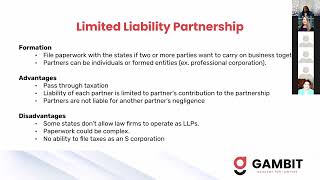
So if you and someone else, so 2 more parties go on and carry business, you're gonna have a partnership. But that happens automatically. But if you wanna have a limited liability partnership where, you know, you are not going to be liable for the activities of your partner, then you need to file paperwork. You need to file some paperwork with your state. Interesting part of partnership, limited liability partnership. The partners involved in this type of entity could be an individual., or it could be a professional corporation. I think a firm that, a big law firm like you see Kirkland Ellis LLP, some of these other law firms. Full disclosure, I used to work for Kirkland before I went to law school as a paralegal. And so if you look at the partners, some of them have other entities, some of them are individuals. And so that's something that you could keep in mind. Passive taxation advantage. Again, you don't have— you're not liable for your partner's contribution to the partnership or their liability. And the disadvantage is that some states don't allow LLPs. This is what it is. Paperwork could be sort of complicated if you're not familiar with it, and there's no ability to file as an S corp. I'll discuss that more when I talk about the future, then I think the next type of business form. Okay. A professional corporation that is formed by filing paperwork with the state. So for your state will be North Carolina. You wanna make sure you have some formalities. You have a minutes book, you have bylaws, etc. Advantages. So distinct legal and tax structures, right? So you're the owners, the shareholders of this business form are not gonna be held liable. Held personally for lawsuits against the corporation itself, right? That is great. But again, lawyers are held personally for their malpractice. So the same thing that doctors, they can't— despite the business form they have, they cannot escape malpractice. Same concept applies to lawyers, which is why we're going to talk about malpractice insurance later on. Okay. Disadvantages: double taxation. So for the revenue that is earned by the corporation, it's going to be taxed at the corporation level, and the shareholders who are most likely going to be the owners of the corporation itself, also going to be taxed as well. Caveat there, there's something called S-corp designation. So people sometimes say they can form an S-corp. You can't form an S-corp. You can form a corporation. Or an LLC and then choose to be taxed as an S corp. There are some major tax advantages when it comes to having an S corp. And so even though you form a corporation, professional corporation, you are going to be able to be taxed as an S corp and have the tax advantage. But I know this knowledge because of my own entities, but definitely talk to an accountant to get more information about that. A disadvantage is that you have to follow certain formalities. When it comes to the corporate form protection. If you took business associations in law school, you know that there are certain formalities you have to follow. You have to have bylaws, you have to choose officers and directors, you have to have at least one annual meeting. Because if you don't, if someone was to find out and sue you, if you— the corporation doesn't have enough assets to cover the liability, then someone can pierce corporate veil protection and go after you personally. So make sure you follow formalities. Despite the fact you have a corporation and it's just you, you have to make sure you follow formalities. Another thing when it comes to formation for professional corporation, you have to make sure that you are in good standing. If you're not a lawyer in good standing, you cannot form a professional corporation. And some states like New York and California will require that if you are an attorney, you can only form professional corporation. You can't form a regular corporation. Okay, so professional limited liability company, similar to a professional corporation in that you are forming it by filing paperwork with the state. You also have to be a lawyer in good standing because you have to provide that certificate to actually get the PLLC designation. Separate staff structures and legal structures. But as compared to a corporation, the advantage is that there are less formalities to follow as compared to a corporation. Disadvantage: some states like California don't allow law firms to operate as PLLCs. You have no choice but to be a PC. Okay, let's go talk about the address of your business. Okay, so I am really adamant about following the ethical rules of the states in which I'm part. Why? Because I worked really hard to become a lawyer, and I'm not going to do anything to jeopardize that. I don't want to lose my license. And so I'm really gung-ho about making sure I follow the rules. And so when it comes to an address, you have to first see what your state says. I'm not barred in Cali— I'm sorry, in North Carolina. So I don't know what it says, but I know in New York you have to have a physical address. That's what it is. You have to have a physical address. And so look to see what the rules for North Carolina, what they say.
I can actually speak to that. Go ahead. In North Carolina, you can use a PO box with the state bar. However, if you file an entity with the Secretary of State, they're going to want a physical address. It could be your home address. The downside to listing your home address with the Secretary of State's office or with the state bar is that it is available to anybody who wants to do a search. So what I tend to suggest is go to UPS or FedEx or Regus or WeWork or iPostal and get a physical address, a street address, so that you don't list the post office box, but you're also not exposing your personal address, which you have there on there.
So. Okay. Yes. Thanks, Katherine. Yeah. So that was a concern of mine, right? Privacy, right? If you had— I already listed several of them here. One that works really well for me, I'm part of New York City Bar Association and they have a virtual law firm program. So you're able to get a box from them in their actual physical building that receives mail and has a lot of activity going on, but you're not there. So some bar associations have provided that service for them. But like Katherine said, coworking spaces like a WeWork, like a Regus, GreenDesk is here in NYC. She's touched on the point of having your home address. I wouldn't do it. I just, I personally would not do that. And so you want to make sure that you're, you're anonymous. And so having a UPS box or FedEx box is a great, great way to keep your anonymity, which is great. Okay. Final thing here, malpractice. Get it as soon as possible because your coverage starts from the first day you get it. So if you've been operating for a year and you just get it, it won't cover the activity that you did in the past., but that's fine. Make sure you get it regardless of what form you have, whether you have a sole proprietorship, a LLC, a PC. Just make sure you get it. Um, the fee will depend on many things. Um, for me, I practice IP law, entertainment law. Those are very, uh, litigious areas to practice, and so my insurance rate is going to be a little bit higher as compared to other types of practices. How long you've been practicing— the longer you practice, the more clients you get, the more likely you're going to be sued. That's why as well, here are some tips. There are some discounts. The bar association— see if your bar association has a discount code. And another, another tip: if you're first starting out, you are probably working at a reduced rate in terms of the eyes, as seen from the perspective of the insurance company. And so your rate will be lower as compared to someone who has a full-time rate. So ask that out for sure when you are looking for practice insurance. I'm gonna answer your questions at the end. I wanna make sure I get through all this information. So definitely, if you have questions, you put them in chat or just hold off until the end. Okay, let me see what's going on. Okay, perfect. Step 2, an application is to manage your firm. If you're a virtual law firm, you're gonna have to be comfortable using technology. It is what it is, right? Okay. So a nice thing about that, I like when it comes to having these applications, it's much easier to manage your law firm. For that reason, you'll have more time, more time to, you know, spend time with your family, go out and travel. I think also too, if you have more time when it comes to actually run your business, you're going to have more time to bill, to make money and market, which I think are probably two most important activities when it comes to having a virtual law firm. Accessibility. If you are running a virtual law firm and you use applications, you could access these apps on your phone, you could access them on your laptop, which means you could like go traveling and still be able to work. It's great. Okay. I'm a huge fan of Google. I have an Android. iPhone users make fun of me all the time. It does not matter to me at all because I'm a fan of Google Workspace. It's been called many things over the years. Right now it's called Google Workspace. I manage my firm through Gmail, Calendar, Drive, Docs, like all these Google apps, and it makes it very easy for my team to assess, to access information. Um, I've used it for years. It's been great. Um, Google Voice, if you don't, well, want to use, uh, or you want to get a free number when you're first starting out, you can get a Google Voice number. Um, and I actually, the number that I have for my business, it's a Google Voice number that I've had for years. Uh, my brother, uh, basically he suggested that I get a Google Voice number like way before I had my business. And when I had the need to use it, I transferred it over to my business, and it's still the one I'm using. It's still the one I'm using despite the fact that I have answering service now. Doesn't matter. I love it. It's great. Okay, client file and team management. So sort of a tenant that I go by, a tenant that I go by when it has come into running a virtual law firm, is that you have to be organized. And so making sure that your client information is organized and readily accessible to me is very important. So here are some apps that are, are used by myself and other attorneys to store information. Dropbox, been using since law school, hasn't failed me. I will continue to use it. Box is another very popular one. It used to be called HelloSign, but now it's called Dropbox Sign and DocuSign. Uh, you want to make it as easy as possible for people to hire you. Uh, when I first started out, I did not have an online, uh, signature software that I used, and it was very difficult for me to retain people. So the easier it is for people to, you know, sign up with you, the easier for them to become your client, the easier it will be for you to, you know, get money and run your law firm. So highly recommend having at least one of these, uh, signature softwares. And when it comes to team management, I'm a, a lover of Trello. It's a Kanban board, so it has columns and it has cards. You're able to, within each card, write activity and write notes, so the team, your entire team, will be on the same page. So I'm a, a lover of Trello. I've heard some great things about Airtable, which is very similar to that. And so you want to have this type of software, this project management software, because you wanna make it easy to delegate to others when you have a team, because with delegation comes more time, right? The theme here is more time. Calendar management and automation. It's interesting, Catherine, we're having a conversation about going back and forth to schedule calls and having calls immediately, and I'm a big fan of calendar software. Um, every single type of event I have, whether it be a potential call with a new client or potential client or current client, networking call, I just run them through my Calendly because it scours all my availability to find out what a good time is for me to talk. Um, at this point I've scheduled over 1,000 meetings, and that's time saved, right? All that time I would have spent going back and forth scheduling the meeting. I'm skipping all that, not doing it, because for me it's not worth my energy, and for me it's also mental energy as well. I'm not doing it. Acuity is also a very good comparative calendaring system. Zapier. So this is one of my favorite tools. It sort of creates integration. So something happens in one app, it's going to trigger another activity in another app. One of my favorite ones that I listed here— hey, if someone schedules a call with me, via Calendly, they're automatically going to be added to my mailing list in Mailchimp. So I just like, if something happens in this app and it's gonna be trigger another activity in this app, great way to save time, great way to become more efficient. So I'm a huge fan of that integration software. I think it's Zapier. Zapier. What just happened? Okay. Payment, right? If you have a business, a law firm business, you have to get paid. And so, um, I'm going to talk about some of my favorite forms of payment or manners in which I get paid. LawPay. LawPay is phenomenal, phenomenal. Uh, so as lawyers, you know, depending on your area of practice, you may be required to use a trust account. What I like about LawPay is that it does not run afoul of these, the rules, right? You can't use, you can't use trust account funds to operate your business, right? You can't commingle the two. So what happens is if someone pays you in a trust account or pays money to your trust account, the operating fee for LawPay is going to take it from your business account. They are ultra-friendly. So I really am a huge fan of LawPay regardless of what type of area of practice you actually practice. For like Stripe or PayPal, I like those for consultation fees. I like to— you can't talk to me unless you pay me first. And so, um, Calendly or other types of scheduling software for consultations, they use Stripe or PayPal, um, to receive payment. So I'm a huge fan of that. And if you work with large sums of money, a bank transfer is a great way to, to get client payment as well. Okay, so at some point Um, you gotta become busy enough and have enough clients that it warrants having practice management software. I didn't have what I had for years. I now use Clio and Lawmatics, but I did— it took me years to get to the point where I felt that I needed it. One, because, because I was a paralegal prior to going to law school, I was very efficient and knew how to organize my stuff, so it didn't— I didn't require it. But I got to the point where, despite that fact, it made sense to have this software. Clio, I like. There's some other ones, Practice Panther, that I hear are really good. Um, Lawmatics I really love because I have a particular way in which I onboard clients and it requires some automation. Lawmatics is the only platform that I've seen that sort of been able to replicate my process without me being involved. So I really love Lawmatics. I've heard about Smokeball, popular amongst other attorneys, has many integrations, and if you have a flat fee practice Monday and Dubsado are really good as well. Okay, step 3, market, market, market. So you won't be able to have a firm if you don't market. And so that being said, I want to talk about this. I'm going to read it verbatim. Marketing is constantly telling anyone and everyone what you do. You offer great services to others. They will not know about them or you if you remain silent. This way you'll be top of mind should they or someone they know have a need. Why am I so— why did I make this my mantra? When I first started my law firm, I felt marketing or telling others that I had a law firm and provided services was boasting. It felt weird. It didn't feel natural to me. I didn't feel comfortable doing it.. And until I had the mindset that, hey, why am I doing what I'm doing? Fun fact about me, I used to be a dancer. I went to law school with the intention of being the lawyer for Alvin Ailey, a famous dance troupe. And so that was the goal. Go to the law school, work at a big law firm, and then work for Alvin Ailey. I want to help the creative person because they work so hard. And what I saw, what I saw as a dancer that they were taking advantage of. So when I saw my law firm, uh, 3 years after graduation from law school, uh, I still had that mindset. I wanted to help that kind of person, a creative person who had power, didn't know it, but didn't have knowledge, or taken advantage of. And to me, that's like a phenomenal mission, right? Phenomenal mission. I want to protect the creative person. How would they know about me if I don't talk about myself and I don't— if I don't market myself, if they don't know who I am or what I do, then I have this awesome mission. How would they know about me? So I literally have responsibility to put myself out there. And so if you are having trouble feeling comfortable marketing yourself, put this in your mind. It can help you because it definitely helped me. Because once I had that mentality, I was like, oh, this is great. I'm gonna tell anyone what I do because I never know who's gonna need my help. Okay, so what are some things to think about when marketing? Blogging. Blogging is a great way to market yourself. It also is great for putting yourself out there as a sort of an expert in the area of law which you practice. Some great ways to talk about— to get some topics to talk about. You can look at Google Alerts, you can look at Answer the Public, and it's really good. So it can help you get media appearances. I'm going to tell you a story about what I did about 6 years ago. Rihanna came out with her beauty line, Fenty Beauty, for makeup. It was great. I went to the store. I went to go buy some products, and I noticed as a trademark lawyer that she didn't have the R symbol that meant that the product was registered in the Trademark Office. And so I wrote like a fluffy blog post about that, like, hey, here's what I went to buy makeup. What is registration? What does this mean? I gave a lesson. If you were to Google Fenty trademark or Fenty Beauty trademark, that, that blog post that I wrote, number 1 page is great for SEO. Like, I just did that, and it's still giving me returns years later. I'm a huge fan of blogging. If you don't want to start your own blog, you can also be guests on other people's blogs. They want content. They want content as well on their website. So if you provide content to them, they're gonna be super happy. Okay, I'm also a big fan of listeners, um, whether it be your marketing to other, you know, lawyers or other, you know, people in the community. For example, I'm a podcast lawyer. There are podcast groups out there. I, I just basically scour the, the, the chats from time to time about questions I can answer and provide the value, right? You provide value people are going to remember you and they're going to talk to you when they need you. Same thing with the listserv. I'm part of a podcast radio listserv. So I think any type of area of law you practice, you're able to find a corollary group on Facebook that you can be involved in and be the only lawyer in or be one of the few lawyers to participate in. Okay, email. I am a huge fan of email. Marketing. So my favorite, my favorite marketing form is email. I have a mailing list now that has about 3,500 people on it. And what I do now is every 2 months to send out a newsletter. Hey, I'm gonna be, I'm gonna be speaking here. Here's a blog about information about, you know, trademarks or contracts. Any type of professional milestones. I, when I passed the California Bar, um, I let people know on my, in my newsletter, I think 3 times. I was excited. I wanted people to enjoy my journey and feel happy for me as well, you know. Um, any type of jobs posting out there, anything to come to that, you didn't, uh, any conferences that you may not be attending but you know that will be good for your audience, let me put it out there. And I like WiseStamp. It's sort of a cool way to market yourself in your email signature. So you see mine, it has a picture, it has the areas of law that I practice, and it has where I've been featured. So it also has a link to schedule a consultation with me. So that is a great tool that I love. Okay. In-person virtual networking. So I think now people are more, they're more inclined to network virtually. I think before the pandemic, it was still sort of seen as being a little bit weird. That being said, I loved going in person to network, although as a virtual law firm, a lot of my networking was done in person. And so if it's done in person, one of the good things to have is a memorable business card. My tip for that is have the picture of yourself. Get a nice picture, put it on that, because people are going to remember you for that. And a good thing you can do as well is after you have your business card, you can create a mock-up of that digitally in case you're on Facebook groups and want to, you know, easily pop in your information, just putting your, your, your card virtually as well. Mine is cool too, because it has my media appearances on the back of it. And so I present that first, and then I turn around and it has a picture, and I've gotten a lot of comments that it's a cool business card. I did put this on here now, but HiHello. HiHello is a great program that lets you have multiple business cards virtually. So it's a great, great way to network. Conferences, go to them, whether it be targeted towards your potential clients or other attorneys. Definitely attend them. Collect as many cards as possible, but realize you may not be able to connect with everyone. That's fine. That's okay. And if you're presenting at a conference, connect with other speakers. I actually spoke at a conference in Vegas last week, and I made sure to connect with as many speakers as possible prior to the actual conference itself. And so definitely keep that in mind. Virtual networking. I am a big fan of like solo law firm groups. I don't know how many exist in North Carolina, but there are some here in New York that, you know, it's like if you're a solo lawyer or a small law firm group, um, there may not be many people understand what you're going through, right? And so it's good to have support system. And so I'm part of a small law firm group here in New York City. So Clubhouse, RIP. RIP to Clubhouse. I don't know if it's as— people use it as much as they used to, but during the pandemic, it was amazing. I still use LinkedIn Audio. I think it's great. Twitter Spaces, I think, is probably the king/queen of the area now. So for me, I am an extrovert, and so I get my energy through people. And audio was great because even though that's the case, I felt if I did a video on a reel on IG or TikTok, people were not really seeing me who I was because again, if I'm not getting interaction, you're not going to see who I am. And so I think these platforms, social audio, has been a really great way to actually put yourself out there and network and put your name out there. Yeah, connect outside the platform. So even though you are meeting with someone online, have a phone call, have a video call with them. That's a great way to connect as well. Okay, social media. You gotta use it. You gotta choose a platform. You just choose what, what works for you. I've never on Twitter. Like, I look at what happens on Twitter, but like, I know for me that it would be exhausting for me to write my thoughts out there often. For some people it works. For me, it does not. I like IG. I like LinkedIn. I like Facebook because I actually was one of the first ones to have Facebook in '04. And so I've seen how it's changed and whatnot. So I'm a huge fan of those platforms and I use them. I make sure people know what I'm doing, but I'm also social. I actually go to people's— I actually go to people's stories and say, this is great. This is— I'm actually very social about what I— how I interact. And so people are going to remember you. If you create content, make sure it shows people who you are. Show all of you, right? People are going to like the fact that you go traveling, that you're a biker, that you're a swimmer. That you have kids. Show people who you are because they're not, they're not going to hire you because you're smart. They're automatically going to assume you're smart because you're a lawyer. You went to law school and you passed the bar. That puts you like edges above people, right? They know that you're smart, but they don't hire you because they think you're smart. They're hiring because they like you. And if you show who you are, they're going to like you. When it comes to creating social media, have a calendar. Programs like Hootsuite, Later, or GrowUpPosts are there to sort of— you can sort of batch your content and post them on a scheduled time. So totally create that if it's overwhelming. Okay, repurpose content, right? There is no reason it should be hard to do social media because if you have a blog, your blog is, you know, a couple paragraphs long, you could repurpose each one of those sentences into a post. It should be easy. And you can also use programs like Canva to create some cool graphics. If you don't want to do it, just somewhat like me, Hire someone to do it for you. There are ways, you know, like if you don't want to spend that much time— again, time is— you get to spend your time as you want to. If you don't want to spend it creating the content, hire someone else to do it. There are so many good social media managers out there now. Okay, clients. Don't forget about them. Don't forget about them. If you do great work, which I'm sure you do, they're going to love you, and they're gonna— you'll Uh, they're going to be your biggest proponents when people they know need work. So make sure you do your tracking, you treat your clients correctly. Um, I don't know, like, for me, it's like I'm so indebted to my clients because they literally give me a life that I, I never even dreamed of. And so I owe it to them to put my best foot forward, not only my work but how I treat them, right? I— they have birthdays, I say happy birthday when I'm able to. I provide, you know, beginning of the year gifts, you know. I want to feel connected to my clients, and because I'm so dedicated, I'm so grateful for them. I've had clients who have children recently. Best believe I'm gonna give them a gift. I'm gonna have a gift for this milestone. Absolutely. Okay, so that's, uh, some things when it comes to starting a law firm. So I want to go a little bit more into how I can help you with that. So who we are is called the Gambit Academy for Lawyers. Like Catherine said, we help lawyers by providing coaching courses, communities to them so they can successfully and fearlessly build their own virtual law firms. Okay, so I want to get into the word gambit because that's to me what this is all about, right? I chose that term. After a brainstorm session with my brother, because the meaning of the word— it's an action that you are taking to achieve a certain goal, a certain advantage, but it usually involves some type of risk, right? That is why I think it's like to start a virtual law firm. When I started my law firm, I didn't know it was going to work. I was afraid what people were going to think about me because I went to this, this law school that was prestigious, but I couldn't find a job because of the recession. I was concerned about all that stuff. It was very risky. But in the end, what I get— I got the ability to control my own career. I got the ability to make funds on my own, the ability to travel what I want to, to do whatever I want. So like, the gambit is okay. And this is why I think that I exist to make it less risky for you. I did it for 8 years. I made mistakes, costly. I've made a lot of mistakes. But in the end, I'm still here. I'm helping other lawyers live their best lives. Okay, we do that again through courses, your strategy sessions, the one-on-one coaching. That's what we provide. And 2 weeks, I have actually a virtual webinar happening to find out more about how we can help you. So if you go to this website, I'm going to also plop it into the chat at some point. Webinar.gibbetlawyers.com/webinar-registration. If you don't attend in person, no worries. You actually get the follow-up link with the recording to see at your own pace. Authwell. Okay, that being said, any questions? I'm gonna see any questions.
Stop sharing. Marlon, I'm gonna stop the recording so that people can feel free to ask questions without being recorded. Thank you so much for your time.
And I'll—
oh, let me quickly just share my information then if you're going to stop recording. I'll, I'll give it to them when I send out the link.
And, uh, okay, I can put it on the website as well.
Yep. Yep. Awesome. So I will stop the recording and then if anybody has any questions, um, I will let you ask without being recorded.
So one moment.










