"Going in Circles" dealing w/the PTSD of 2020 | Mogul Moments w/CDJ & Guest Mogul Sherry James S4 E5
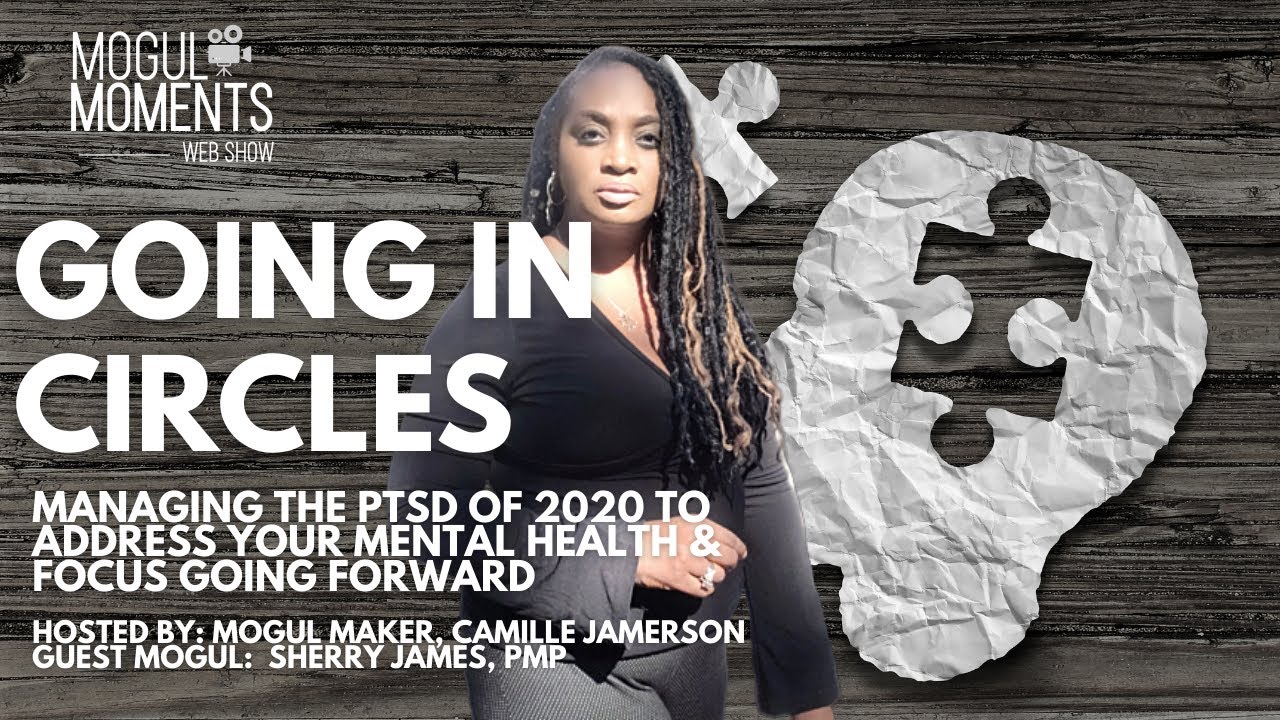
Sherri James, founder of Phoenix Speaks Inc. and 2020 Lives Changed, talks about the lingering PTSD from the pandemic and how her parents' suicides drove her into mental-health advocacy. She shares coping tools like equine therapy and water therapy, and pushes back against the lie that everyone's fine.
Chapters
Well, hello everybody, welcome back to Mogul Moments. It's your host Camille D. Jamerson, and it is a pleasure to be back with you. Um, I have a really great show lined up for tonight, and we're gonna dive right in, so I'm gonna try to keep my intro really, really short. But there's something that I've got to show you that's coming this summer. Can you guys see that? I know it's a mogul Mogul in the Making mug, and we've got— we've also got Mogul in the Making water bottle that's coming this summer. And they literally— these are the, um, sample ones I ordered. They literally just came today, so I wanted to make sure that I, I showed you that again. Um, these are going to be available for you to get this summer, so if you are interested in these, make sure you let me know in the comments, um, and, um, I'll, uh, make certain that everybody is made aware, um, when it is time to order. So those will be ready this summer. We're also going to have t-shirts and hats for this summer, and then in the fall we'll transition to, um, hoodies and sweatshirts and etc. Okay, so just wanted to let you guys know what was coming down the pike, and, um, I'm really, really excited about that. So, um, today's show Um, I entitled it Going in Circles, and as you know, all the, um, shows for this, uh, season have been named after songs. And if you don't know Going in Circles, then I just don't know what you're doing with your life. But anyway, um, I, I named it that because we're going to touch on, um, some things that might have you spinning, um, in this particular episode. And, um, when at all possible, I try to bring on experts to fill in the gaps for the things that I don't know. Um, I don't have a problem with saying what's outside of my box, and mental health and, um, all of its tentacles are outside of my box. So, um, I met someone, um, at another event, and we got to chatting and talking, and I saw, um, one of her many expertise, and I'm like, oh my gosh, you would be a really good fit for the show. And thankfully she obliged me, and she is here tonight, and, um, her name is Sherri James, and, um, she is going to— I'm gonna let her introduce herself, but I'm gonna bring her into the chat. Can you guys put your hands together and welcome her to Mogul Moments? Hello!
Hello, how are you?
I'm well, thanks. How you doing?
I am great. Uh, just letting you know, we've got a whole monsoon tsunami thing happening in Dallas, so if I just like take off Right, right.
So for those of you who don't know, I'm in Michigan, she's in Texas. So, um, it's cold here, but I'm looking outside, we don't have any rain, but stay tuned. It's Michigan. By the time this show is over, we could be in a snowstorm. So, Sherry, I'm gonna yield the floor to you for a second. Could you introduce yourself to the folks? Let them know who you are, what you're about, what you're doing.
Absolutely. Thank you so much for having me here.
Oh, my pleasure.
Um, I understand our meeting came through one of the people that I mentor, um, through Maylynn, um, who is the president of the Dallas-Fort Worth PMI chapters. I hold that so dear. Oh, I love them. I love them. I love her so much. Um, but my name is Sherri James. I am the founder and chief executive officer for Phoenix Speaks Incorporated, as well as our nonprofit, which is 2020 Lives Changed Incorporated. So we want to focus on being advocates for mental health, making sure that people have a safe space to have conversations around diversity, equity, inclusion, belonging, and how all those things fit into mental health and the impact of mental health of all of those things. So we were born in October of 2019. So we're still— Wow.
Well, congratulations on your baby.
Thank you. Just learning to walk.
Oh, I know. I know. It's something, isn't it? And we're going to get to the entrepreneurial side of your journey, too. But just in talking about 2020, the 2020 Lives Initiative, Gosh, I was reading on your website some of the things that you guys cover, and it's pretty vast. But I mean, gosh, I don't even know where to start. It's so much. Okay, let's start here. Let's start here.
Okay.
Tell me what the endgame is with that initiative. What are you looking to accomplish with that?
That's an awesome question. And there is no endgame. So I'm so glad you asked that, right? So our start and our start, beginning, and end are all about removing the stigma of mental health in communities. And I did not limit communities, right? Because our community is one community. Some people could be living in— I have neighbors who are from Pakistan, for example. Wow. Their families will never talk about mental health out loud. Right? So much so that some, some places, even in India, um, if you've been diagnosed with— if you said you have any problems with mental health, um, then you can't get into a university, you won't have a marriage arranged for you. Which, if you understand the way that, you know, the way that, that a culture is, not being able to be married off is a big deal, right?
Right. Yeah.
We want to make sure that people in all communities, the global community, have the opportunity to have these conversations, to say, you know what, today I'm not okay. It's okay to have a day, okay, or 2 days or a week or whatever it takes. Um, so yeah, so that our end game is to make sure that we normalize conversations around mental health, mental wellness, uh, coping mechanisms. Uh, we go so far as to talk about epigenetics and how generational curses show up. Wow. In our bodies, right? Um, and so we just try to get them—
okay, wait, wait, wait, give me an example. I know, right? Okay, wait, give me an example of that. What does that look like?
So epigenetic— and so I'm no epigenetics, like, you know more than I do though.
I got $5 on that.
Oh my, sorry about that thunder. Oh wow, you do?
I do, I do. It's okay.
Okay, um, so the theory around epigenetics is that trauma, specifically trauma, that it exists at a cellular level, right? So what we'd like to think is, oh my gosh, Sheri went through some stressful things in her life, she went through some trauma, but that's just Sheri's lifetime. She's only 49 years old, how much trauma could she possibly have gone through? And the study of epigenetics actually shows that whatever trauma my mother went through and my mother's mother went through and my mother's mother's mother went through, these are things that exist in our very cells. And so when people, specifically people who are, you know, kind of anti the BIPOC movement, right? Oh, they should just— they never experienced slavery, so they shouldn't be upset. There is scientific evidence to show that the trauma of our parents and our grandparents and our ancestors not only does it exist in ourselves, but sometimes it drives our behavior. So it explains a lot, you know, when it comes to— wow. Um, just, you know, I'm— I, I didn't have a slave owner, right?
Right.
However, I do still have kind of the chemical makeup in my cells of a slave, which show— which, knowing that, shows up differently when I am talking to my therapist, um, about the challenges that I had when I was still in corporate America. So I like to tell people that I am recently recovering from corporate America. Um, I—
ma'am, that's a whole journey, is it not?
Seriously, ma'am, it really is.
Oh my God. And it's funny that you say that because I'm writing a piece that talks about, um, transitioning from an employee mindset to a CEO mindset. So We probably need to swing back because I definitely— we need to have— you need to be quoted in that, that piece. But yes, that's a whole journey in and of itself, recovering from corporate America and all of the, all of the issues. And, and I'm just, I'm just cringing thinking about some of the things. I mean, I left a job, I left a job once because it was run by an Indian owned company, and they were really— um, I didn't notice it really at first because I was just in there doing my thing, doing what I do, but I noticed that they had little respect for me or my role. And I was head of global offices, right under the, the, um, director for the entire, you know, unit, including North America, Europe, you know, and I was head of global offices managing all the administrative stuff right under him. And they had no respect for— and, you know, you just kind of take that stuff on the chin because you're like, oh, that's just how they are, or because I'm a woman, it's because I'm— whatever. You just can't. But after so much of that, they would— I would tell them a directive, give them certain things that had to be done based on what my boss had said. And then they would go behind me and go talk to him as if to get their— exactly— as if to get verification, as if what I said, um, was significant. And that takes its toll on you. Absolutely. After a while you don't think so, but it, it does. So I'm, I'm really glad you talked about, um, the trauma from, from corporate America as well. So now in talking about, um, mental health, and you mentioned, um, normalizing, um, having those conversations and normalizing not being okay. Um, how do you go about that? How do you transition from so many norms, especially in, in cultures like you mentioned, the Pakistani culture, or in our culture, where mental health is just not— that we just don't do that How do you start making those transitions?
So I want to talk about before we move to the transitions, I want to talk a little bit about your example.
Right.
So you talk a little bit about having to deal with that day to day. Oh my gosh, that's just how they are. That's just— yeah. So culturally, one of the things that my team tries to do when we go in and coach leaders or train teams is to understand microtraumas. So back to what we talked about earlier, we talked about the impact of there being generational trauma. And it's not just for people— it's not just for African Americans. So people who had parents who were great-grandparents or ancestors who were, uh, in, um, a part of the Holocaust, their trauma shows up generations later. And actually, that study is the one that kind of kicked off all the work around generational trauma.
Wow.
But what you just brought up is important, and I don't want us to miss that because there's also something called microtraumas. And a microtrauma is something that we don't necessarily understand, is in addition to all of the, the drama and the pain and the trauma that we had beforehand before we even got to work, right?
Right.
Um, but microtraumas are things like that, um, not being listened to, being spoken over, my, my opinions not being taken as valid. There's a lot of little like very small. It's very difficult to document somewhere to say, here's the issue, here's what happened. But because cultural biases still exist, and we're not going to change those in our lifetime, sure. But what we can do is find comfortable ways to start uncomfortable conversations, right? So, um, it's a better— it's a conversation in that scenario with you and the person that you directly led to empower you Right. And so what that takes is not just you being the person going to follow up with your team, but it takes the person that you lead or that you report to saying, hey guys, the only way I get any information is it has to come through Camille D. Jamerson. Don't come asking me. Like, my job as a leader is to say, oh, have you talked to Camille about that already?
What was good? Right.
So it's a very small, very minor way to course correct that. So I didn't want to move on.
No, I appreciate that.
I'm giving you that kind of feedback, right? Because culturally Some places on the planet will never respect a woman of color. They'll never respect a woman in leadership. We can't change that. All we can do is just be that change that we want to see. And by saying, hey, you know, C-level executive, whatever, it's a lot easier if people know that they should come to me versus me having to tell them that. More often than not, your C-level executive will understand that and hopefully change that behavior. So then that it's now it's sticky. It's something that will reside, and it's not just one situation, um, and then the next situation they're still back, right?
That's good.
Um, so I want to make sure we covered that.
No, I appreciate— that's good. No, that's really good.
Um, so it's a lot of, um, the work that we do now is a lot of consistency, is adding the same message in every single thing that we do. So my title is Sherri James PMP. That's Project Management Professional. Camille, I will tell you, I cannot tell you how many times people are like, is that short for pimp?
I mean, seriously, my husband's a PMP and I call him a pimp all the time. All the time. I mean, it's hilarious. And even because when I saw the acronym, I'm like, are you kidding me right now?
I'm gonna have a field day with this.
But I mean, when I saw the level of study that was necessary for him to get that, so I applaud you as well because I know it was no joke and it's a pretty intense certification. So kudos to you.
Well, thank you. And thank you so much. I appreciate that. I started out in human resources and I did training for AT&T way back in the day, like a long, long time ago. But one of the things I noticed in new hire training is that people would have all these awesome, amazing, innovative ideas, but they were new hires. So no one was really listening to the ideas of new hires back then. And this was so many years ago, like a new hire at AT&T, we put them in a room for like 12 weeks to teach them their job before they actually moved out into the actual sales floor. We don't do that anymore right now. It's like, welcome to the job. Here's your laptop. Good luck. Um, kind of unfortunate. Um, but I had the opportunity to learn the importance of, of leading people and coaching them and teaching them new skills, and I love that. Um, moving into project management in 2005 made sense because people— I could, I could take the things that people were passionate about, like, oh my gosh, I want to build a, you know, I want to build a high-rise in Frisco, Texas. That's a project. There's a start date and a budget. And so what we do— you know this because your husband, right? So that means that I can help you get to that end state. The same expect— I have the same expectation for my company and my nonprofit is that we will normalize the conversations, even if it's us coming in. Like, I was— I reported to senior-level executive, you know, the executives for the last 15, 20 years. Yeah, they don't want to hear that something's wrong with their organization. And so that's why— oh, please, no, not that.
No, you're perfect.
We know that you're perfect. Your competitors might not be so good. Yeah, but never you. But it really is that kind of partnership to go in and do a kind of peeling back the layers of the onion to see where is the issue here and how do we fix it. And sometimes it's just uncovering, just like I mentioned, microtraumas. There's also microaggressions. And there's a certain way that I could say something to you and it completely changed what I said, right? Like, I could say, yeah, yeah, let's do it, I'm ready. And you'll be like, man, she's really ready. Or I'll be like, let's do it, I'm ready.
Same words, same words, right?
Body language told me something totally different, right? So using those skills from human resources, from also from project management, our goal is to make sure that we are encouraging those conversations. And if we can't encourage it for people who are in organizations or even just by themselves, then we will equip those people to do that, right? To go in and hear a conversation with someone that maybe reports to them, and that's like, okay, this person's been late every day for the past week. That's unlike them. That's not normal. Um, and instead of saying, hey, what's going on? Because a lot of leaders don't want to get into that— that's HR space. I don't want to talk about people's business. Um, but there is a way to say, hey, I've noticed some things have been going on. I want to let you know that I'm here for you. And here to support you. What can I— how about if we change your schedule for the next couple of weeks to make sure that you can still get your work done, right? So that's another one of those, like, how do we change it? It's one situation at a time, one person at a time, you know, one, one day at a time. So it's not like you flip it and you're like, everybody here is mentally well.
Yeah. And I think a key point that you made there is that it may not be the same for everybody. It's not this cookie cutter template that you can use that's going to work on everybody, because everybody comes with their own set of stuff, you know. So I, I really appreciate that. So speaking of trauma, let's just talk about the biggest one that's probably happened to all of us in a while, and that would be 2020.
Yeah.
Um, how has— and I know we're, we're still on the tail end of, of that, this is just 2020 junior right now. But, um, just based on what we went through last year, everything from the grief that we experienced, the isolation, the uncertainty, all of those things rolled into one. For some, the loss of their businesses or the loss of their livelihood, the loss of their jobs, all those shifts and moves. How does that affect you mentally? And when When does a person know when to say, you know what, I need help sorting this out? Um, because we'd like to say, oh, we're good, we're fine, you know, 2020 is over, you know, I'm straight, let's keep the party going. You know, we put on our, our Superman cape and try to keep pushing forward. But I just— and that was one of the reasons I wanted to have this episode is because I don't know that it's healthy to do that until you reconciled what has happened in that year. Am I— you tell me what— if I'm, if I'm on target there.
You're absolutely on target. So, um, we won't see the effects of 2020, or we will see the effects of 2020 for the next 20, 30, 40 years, right? So there's no real way to quantify at this point other than, other than normalizing the conversation. All we can do right now is normalize conversations. There's not enough data, whether it's, you know, um, contraction of, uh, COVID-19, having it and, you know, healing from it on your own, having it, getting the immunization, not getting it again. Like, there's so many data points that are still being, uh, compiled that, you know, when people are like, oh, this is the new normal, that we don't know that, right? Because there's—
wow.
Who much we don't know, right? Um, but I will say that like this is the first time in the history of any of the people that I know that are living that therapists had to go through the exact same struggle that their patients are going through. It's never happened before, right? And I'm also tired of the word unprecedented because we keep hearing that.
I know.
Um, but this is the first time ever that a person who is in the work does the work of listening to, helping, coaching, helping others to cope. Now they are going to their therapist who they were going to see anyway, but now they're asking their therapist, how do we cope? How do we deal? How do we—
wow.
And that therapist is going to their therapist, right? Right. And so it seems to be this unfortunate kind of none of us know what we're doing right now because none of us have had to do this. Right, to this degree. It's a positive thing from 2020. And the thing that I appreciate more than anything is that we now understand how important, uh, the importance of like being present. Because if I could be in a room with my girlfriends right now and we could just like hug and just—
that's everything, isn't it?
Like just a hug, just like hugs would be great, right? So I don't know that a leader like myself or any of the other people that I've been working with over the past 2 years would be comfortable even having this conversation had 2020 not happened. In their mind, just like, you know, they'd be like, oh, my company's fine, everyone's mentally healthy, everyone's safe, don't have any problems. But we know for a fact that that's not true, right? At an all-time high, mental health and mental illnesses right now are going unchecked. And one of the things that makes me so passionate about this work that we do is that I— my past was very traumatic. My dad died by suicide when I was 7. My mom died by suicide by 27. I raised myself for the most part. Well, I know what it's like that, like, deal with this kind of residual trauma from before you could even really remember. However, right now is the only time that I've ever experienced where people are like 'Can you tell me what I should do to help my mental health? What should I do? What should I— how do I fix this?' Whereas before, and you made this point excellently, people are like, 'Nope, I'm fine, I'm great.' And you're like, 'I mean, but you just had these things happen in your life.' And we're like, 'Nope, I'm good, I'm great.' Especially as women, especially as women of color, especially as women of color as we move up the ranks. The higher up you go, the less human you are expected to behave. Wow, wow, that is— wow, it's a, it's an unfortunate truth, right? I mean, yeah, especially for people who are genuinely nurturers and genuinely like mothers of the earth, right? We're like, yeah, make sure you have everything you need so you can be successful. Why is this not enough? I will say, if this is the bright side, that people who led by fear, people who led by yelling and screaming and intimidation and being nasty, they're going to have a very difficult time rebounding post-2020. For people who lead their teams in a very mentally healthy way where we're like, hey, Camille D. Jamerson, what's up? Do we need to talk? I feel there's something— there's something going on. I don't know what it is. It may not be me, but we probably should. But people who lead with relationships or lead with a servant's heart are thriving right now.
That's good, because—
because nothing's changed for us. Like, we always loved our teams more than ourselves. We always gave, like, without thought of reciprocation. We always wanted to build something bigger than ourselves. So something like COVID gives us a positive opportunity. It gives us the velocity to say, hey, we're all messed up. We all struggle through 2020. I don't care who you thought you were and how perfect you thought your life was. Your life has been changed. And so now that's the case. While we're changing, why don't we do some things to change for the better? Let's normalize talking about, like, depression. Let's let— you know, I saw a post on Instagram, and it took these pictures and it said, this is what depression looks like. And it's like Robin Williams smiling, it's, um, smiling, it's, um, um, Anthony Bourdain in a full-on belly laugh, right? So people believe that you could look at me and say, oh, she seems to be happy, she doesn't seem to have any kind of— but we don't know what people are struggling with, we don't know the the luggage and the baggage that they have to carry. So we just pretend that they don't have any. And then subsequently, we get to a point where we act like we don't have—
we haven't either. Wow.
So it's this cyclical process, right? Like, how are you? I'm fine. How are you? I'm fine. And that's the end of the conversation. Whereas, you know, since we've been doing this work, people know to call. And I'm like— they're like, how are you? I'm great, I'm great, are you? And I'm kind of upset that I taught them to do that because now they do that to me, right? I'm like, no, no, everything's fine. And they're like, like, ma'am, okay, I'm not okay, but dang it, don't do me to me, right?
Like, you listen? Really? So Now, should everyone start at going to see a therapist, or is it a gradual thing to get there? Is it some things you should do, and then if these things don't work, then you need to probably see a therapist? You can't—
yeah, no, I don't— every situation is different, like we talked about, right? Um, I'll give you two different scenarios to answer your question. If you are For example, hypothetically speaking, if you were a woman, um, in an abusive marriage, right, and your husband was either physically, mentally, you know, harmful in any way, right, then the answer is absolutely go get help directly.
You sure?
Do not pass go, do not collect $200.
Run.
Right, right. Um, and these are my opinions again, so absolutely. And we're gonna put a disclaimer, so, um, I don't want them like Sherry James said Um, but if you are in a situation where you're not safe, right, there's a lot of situations that people don't think about, like child abuse. If people have sexual predators who live in their home, and with this, uh, coronavirus pandemic, now your, your, your abuser is in the home with you all day. Or sometimes, you know, these people could only get away to go to work and only get away to go to school. So, so those are— it's not straight to therapy necessarily. But there are some situations where you absolutely need to take your, uh, well-being and safety to heart immediately, right? Um, one of the things we're trying to do at 20/20 Lives Changed is we're trying to offer different mediums and we're trying to offer different ways to deal, right? So maybe therapy just isn't my thing, and it wasn't 5 years ago, to be completely honest, right? So, um, but I would find other ways, like travel was my catharsis. I could go travel somewhere and go sit in the, in the water, in the ocean, like literally release my— and I would just sit in the water and cry. And I'm like, okay, I left all of my, my issues in the ocean and I'm good. Yeah, I'm good, right? Go somewhere. Um, but it— I still had never dealt with my actual trauma, right? I still hadn't gone back to deal with the trauma. So, um, you know, there's things like equine therapy for people who love courses. And like, and so, you know, there's yoga for people with PTSD. So I don't believe that therapy has to be the first step. I think it's an individual choice. It's based on your family dynamic, your faith dynamic, right? Because that gets, that gets a little slippery.
It does, it does.
Sometimes the church is like, oh, you don't need a therapist, just come let me pray for you. I'm like, I need you to pray for me, and I'm also going to therapy. I need prayer and also therapy.
That's right. And you can put $5 on my copay. Thank you, because I'm going.
Yes, right, right. People are specially trained to help me cope with the drama and the trauma and all of the things that hit me every day. Um, when I— and I'll use this example really quickly. My— so I have 2 children. My daughter is 31 for a couple more days. She turns 32, uh, June 14th. And then my son is 13. So I've got a 31-year-old and a 13-year-old.
God touch Jesus.
Wow, I don't even know what to say.
If y'all know what to say to it, put it in the comments because I got nothing. I mean, I got like a 33-year-old and a— no, 34-year-old in September, and then a 24-year-old. So that's like my gap, and then it's like 3 in the middle. But that's— that's— I, I don't have the words for that. 13.
Yeah, I— God has a sense of humor, and he loves—
isn't that hilarious? I love it, I love it.
He loves me, he loves me. That I've learned a lot from my son, right, when it comes to mental health, when it comes to having conversations. You know, we talk about these things. So he's— I spoke at his school like twice the last couple of years, and I go and I talk about suicide prevention, and I have them talk to me about suicide prevention. And how I— the reason I know that God is so good is all the things that I learned to do. If you remember, I said I worked in HR at AT&T a long time ago. Those same skill sets that I used back in '89 and '90, right, I use now when I'm talking to younger people about, you know, mental health. And what do you do to manage your mental health? And do you know anyone who's died by suicide? And I think I saw well over 100 students the first time I went to my son's middle school. And I would tell you that of the children that cycled in and out of my classroom, 60 to 70% of them were either— had either considered suicide, attempted suicide, someone in their family had died by suicide, or there was someone that they knew, you know, closely, right? Which completely floored me because I didn't go in prepared for that. Like, I went in prepared to tell them, like, here's what might be happening. To hear these middle school students—
so you're talking 6th, 7th, 8th grade?
But we don't know that, right? So we assume that like depression and anxiety doesn't show up till college or post-college, or like these children are stressed. And, and you know what, Camille D. Jamerson, I learned how I was messing up as a parent, right? So my son only came to one of the sessions, right, obviously because they were scrolling in and out. One of the young ladies, beautiful young lady, she's like, I work so hard to get great straight A's and good grades, and, um, I'm also on the cheerleading squad, and I play basketball— oh no, she plays volleyball, and she has like 3 other things. And I was just like— she was talking to me and I was stressed out just with like, girl, you are in the 7th grade, like, right? And she's like, um, and then when I get home and I complain that I'm sad, my parents tell me that my life isn't anything like their life. I should be happy because I live in a beautiful home in Texas. I should be happy because, uh, you know, we don't have to scrounge for food. Or I should be happy, but I'm not. And so what happens is that our children, or people period, feel like there's no place for our sadness. There's no place for us to feel what we are just naturally feeling. So we try to live our lives turning that off, as opposed to saying, hey, I've got a lot on my plate as the 6th grader. Yeah, um, I'm going through, you know, changes in my body physically. As a parent, I am, I am just as, you know, guilty of saying the same thing to my 31-year-old, right? I was the— I'm like, girl, you don't understand what these streets were about. Like, I had to be raised and, you know, pillar to post and doing this and doing that. But that has nothing to do with it. It's like if my if my child had cancer, would I say that? Would I say, you should, you should not have cancer because you, you grew up better than I did?
One thing has nothing to do with the other.
Nope. And so, um, so I am getting to people earlier and earlier, which is a blessing. It is also, um, I have a good friend of mine, Brad Brzezinski. So he does a lot of work with the military, um, as it applies to mental health and suicide prevention.. And there's almost like these 10 steps that a person takes, um, before they choose to end their life, before they die by suicide. And most programs are focused on like that 7th, 8th, and 9th step before 10 being the actual, you know, the episode. And so what we're trying to do is talk to people well before they get there, right? To give them coping mechanisms well before, because by the time you get to step 7 Well, it's gonna be a lot more difficult.
Yeah.
So if we can start understanding and listening for things that we need to, you know, listen for and go, hey friend, how are you really? Like, let me look at your face when you tell me that you're really okay. Um, let's do FaceTime. Nope, not a phone call. I need to see you. I need to know you're okay. Let me bring you coffee. Um, and it's a lot of work, but the work that it is on having the conversation is nothing compared to the work of feeling like, I wish I'd had that conversation, right? That survival is a real thing. So knowing that, you know, you won't know— there may be someone that who dies by suicide in the, in, you know, recent—
soon.
But know that there's nothing that, like, you can't stop them from doing that. You can hopefully give them some options and some coping mechanisms and some things. But we are under so much stress right now as a planet with the microaggressions and the micro traumas. I'm hoping that our organization can teach others how to, to not make those mistakes. So we just did a small business class. We did a Taco Tuesday for small businesses to try to teach them, like, here's the things you don't do, uh, running a business for your own, you know, and some of the things that might stress you. And a lot of them have never been in a leadership position in a corporate organization where they taught you, I don't know, sexual harassment or crucial conflict and all the classes that we had to go through.
Yeah, mandatory.
Mandatory for us.
Right.
But then you've got people who came as an individual contributor to now become a business owner, and they don't— the mental stress that it's putting on them because they always had a marketing department or a payroll department. So the stress— my business partner, Dr. Stacia Alexander, I love that she has a product that she created. She's been seeing people for 30 years. She's had her practice for almost 30 years, um, and she talks about the emotionality of success and how stressful that is, and the fact that most people aren't prepared emotionally, psychologically, mentally for our success because we've been so downtrodden. We've been so told that we weren't ever going to make it past this, or— and so we believe that. Yeah, when it's time, when we are all of a sudden successful, whatever it is, whatever that looks like. Yeah, whatever that looks like for you, right? And then it's like, well, some of the people that you used to be cool with aren't going to be cool with you before. And on the same note, people who you've never met before all of a sudden be right here. Yeah, right here.
That, that's interesting. I remember reading a book years ago, um, it's one of Bishop Jake's older books, and, um, that was the first time that I really heard about that concept because, I mean, in my head all we're thinking about is getting successful, doing what we need to do, meeting our goals. And I'm very goal-oriented. And his book was called Can You Stand to Be Blessed? And he insinuated kind of the same thing, like, okay, but do you have the foundation and the character that's necessary to withstand what success is going to bring you? What that blessing is going to bring you. So I, I'm very interested, um, in hearing more about the emotional— emotional quality— is that what you call it? The emotionality of the emotionality of success. So we'll definitely put that in the chat. Want to hear more about that. Um, okay, so, oh my gosh, so this is a good transition because I do want to talk about your entrepreneurial journey too. So how did you turn this passion of yours? And, and you alluded to some things that have happened to you in your past that I'm sure had— that played a part in it. But how did you get here from corporate America?
Uh, uh, so I will— again, we talked about how, how God has a sense of humor, right? Um, so I, I started writing a book in 2000 and, uh, 2018. Actually, I started in 2017 and then I just dropped it. Um, but then people were encouraging me to finish my book. I had been traveling and speaking for years, so speaking on stages, it's one of the things that I learned when I was at AT&T all the years ago. They put me through Toastmasters and they were like, you will be—
yeah, right.
I still have dreams about that little bell going off if I said, um, too many times.
Those filler words.
So Um, but I, I was blessed to have the— have had the opportunity to speak at conferences and conventions and, you know, I don't know, schools and universities. I've been doing that for over the past 15 years. That was my way of giving back because I had a great job. My 9 to 5 was great, it paid well, I felt very fulfilled in the work that I was doing. But I wanted to show others how to do that, and I wanted to show others specifically I have a passion for millennials, uh, because I've got children in the next two generations, right? Like, I'm— right, right, I'm invested. Like, I have to make sure that they're okay. Um, I feel like God was like, you need to be invested in these after 2020. Who knew, right? And I'm grateful for both of my children. My son, for being able to teach me the importance of how to communicate with him at 13. About his mental health, because that's what we do.
Well, but especially a son, I mean, that, that's so powerful.
It's, it's, uh, it's still a challenge, right? It's not that easy. He's still a 13-year-old boy. He still eats more than I can afford for him too. Um, but he— I will tell you that I take him to my speaking events, and so I think that helped me as well. So my son being a part of building what we were building and him seeing how many people were like, can you just come back and talk to us again about mental health? Can you just— you know, the fact that I would have a line of people waiting to talk to me when I was finished speaking, he was like irritated about it because he was ready to go home. But then, right, um, he's, he's, he's a very bright kid, so he's like, thank you for helping people. Like, that's very— it's kind of cool that you're And sometimes it's just like, here's the number to call, text 741741, referring them to another resource. But I believe that because of my challenges, because of my trauma, that I was uniquely created to do this work.
Right.
Who else can show up in front of any number of people on a stage and say, both my parents died by suicide, and no one would have known that had I not told them.
And you still be coherent. I just— I've got no room in my head for that.
Yeah, it's hard. And but the good thing is that, like, we're always sufficient— not just sufficiently, but more than sufficiently prepared for whatever God has for us, right?
That's right.
So I, I needed to be comfortable on stages speaking because what I talk about on stages now, nobody wants to talk about it. If I also had no Toastmasters training or no 15 years of experience, I wouldn't be able to get on a stage and be truly authentic and truly transparent to say, I get it. I didn't want to go to therapy either.
Either, right? Here we are.
Here we are.
My appointment is right after I leave you guys. As a matter of fact, I need to hurry.
Absolutely. Wow.
So what does, what does Sherri 2.0 look like? Where, where, where, what, what's— and I know I, I call it the end game, but what's next? Do you see expansion? Do you see growth? Do you just see, um, different tentacles of your scope? You mentioned the book, so it's like you got a lot of things. I know.
Yeah. Um, and I noticed you used the word tentacles before, and it's so funny because yes, I do have multiple tentacles and multiple things. But so does anyone who aspires to be successful in anything, right? Because we're not— we should not be an all eggs in one basket kind of organization. And so between the training courses that we do, that brings me so much joy. And the way that I facilitate training is not a lecture, it's a conversation. It's back and forth.
That's good.
I learn just as much, if not more, than any of my students do. Because every situation is different. All of our trauma is different, backgrounds, experiences, right? Um, but Sherri 2.0 for me, um, puts me back to where I thought I would be last year, right? So I had this— I had a business plan that I was going to have at least 5 to 7 speaking engagements a month. Um, they would keep me traveling because I used to travel all the time anyway. So I'm like, if I were to go to Michigan or Detroit, for example, to speak at an event that's a paid event, then I would also come to a, a children's shelter that was there, or a military base.
Wow.
A place that— so that we could give back. And so that's what 2.0 looks like. 2.0 looks like we've got people paying for us to come in and do the coaching, and as a result, not only do those people get blessed by that training, but some other organization that's a community organization that's a, you know, an organization— Boys and Girls Club— they also will get a very similar version of that same training so that we can start to build out this kind of grassroots normalization of mental health, right? If you hear about it at the Boys and Girls Club and then you also heard about it at your mom and dad's, you know, job or whatever, now we can actually impart some change because it's not coming from one direction, it's coming from those who have the least Yeah, and there's people who have money to make a difference, right? So I could— my plan is if I'm in Detroit and I'm speaking at, I don't know, a company that's located there, but whatever that is, it's like GM. Okay, there's that little company, little kitty company downtown. Yeah, I hear that they're moving some of their operations here though.
Did you hear that? Yeah, I've heard that too.
We'll share. Um, but yeah, so it's like it's something that's good for that organization as well. Because you've hired us to come in and do this training for GM, we are also then going to give that in-kind sponsorship. So we're going to then say, if you spend $10,000 for a keynote, for example, right, then we will give $10,000, that same amount of time and effort, to the Boys and Girls Club that happens to be in the neighborhood, right? And so that's what 2.0 looks like, is us empowering leaders and mental health advocates. And people— and again, an advocate doesn't mean that I've got an LMFT or, you know, that I'm a certified therapist. I'm a person who is going to make sure you find the resources that are necessary.
Yeah.
Um, and but the Key 2.0 is all about normalization. It's all about communication and not being afraid to, to like share. You don't have to share globally with everyone, right? Um, sometimes it's— I— you don't know how many messages I get, Camille. People are just texting me or sending this, you know, DMs to Instagram going, thank you for talking about this, I need XY blah blah blah, right? I, I'm so blessed to have that opportunity. Like, I wouldn't have done that 5 years ago, right? I'd have been like, girl, go find a therapist, I can't help you because I got a bunch of stuff going on.
And I, I would venture to take that a little bit deeper. I don't know that you would be doing that had you not experienced the tragedies agreed, that, that you experienced. And that's the piece that's sometimes hard to reconcile, um, because I think about— I know it was the death of my dad that, that really catapulted me, um, in, into business. And I sometimes I wonder, you know, if that hadn't happened. And, um, my dad died of pancreatic cancer. We knew he had a terminal illness. We knew um, he was in hospice, so we were all there and, um, you know, prepared, as prepared can be. And then when he passed, you would have thought Iraqi soldiers came in there and shot my dad. We act like we didn't know what was gonna happen. We just fell apart. Um, but I said to say that kind of catapulted me into starting my business. And sometimes I wonder, like, okay, you know, if that hadn't happened, you know, would I have a CDJ and Associates now? Would I have the Camille D. Jamerson Company now? What it took that, that shift. So, um, can you speak just a little to how tragedy can sometimes catapult you into kind of what your purpose is?
Absolutely. Um, I, I will tell you that I don't know that I knew what my purpose was before, you know, 3 years ago.
I didn't.
I, I will tell you that I didn't. I had no idea. Excuse me. Um, and you ask the question, like, you know, um, I, I wrote down why me versus why not. So I'll tell you that maybe at 45 or so, um, I— there was a paradigm shift for me again. And I'm, I'm like headfirst in therapy, like, I'm in a lot of therapy. I actually had some other health things that happened, so I'm in like physical therapy and also therapy therapy. So, okay, there's always someone talking to me. I was like, okay, I get it, I get it, I get it. Um, but what, what happened, I think, is that I had a pivotal moment in my life where I had to switch from, um, victim mode, right? Um, I can't go back and change the trauma that happened to me when I was younger. I can't go back and undo the feelings of abandonment or move. I can't do any of those things.
Come on, that part I can't.
All I can do is say, hey, this happened to me when I was 7. Here's how I believe it impacted my life, but I honestly don't know. But let me tell you something, Camille D. Jamerson, it is such a refreshing mindset when you wake up and you go, everything happened exactly the way it was supposed to, right? Like, God is the best project manager. Like, he's got a plan already. Now he doesn't need. And, and for me, I have to catch myself from not being like hypocritical, right? Like, the end product looks like—
show me what end game. That's me. What's the bottom of the paper? Yes, that is so me. I get it.
But I believe, I honestly believe that needing that is the opposite of faith. So if, if I have to seek proof that I am going to be successful living in my purpose then that means I'm living in my purpose minus faith, and I need to rethink all of it, right? And so, you know, to answer your question, like, I don't— I don't know what Sheri Tudano looks like, and I'm okay with that. I know that it's going to be the one part of me that's always been there, the want to help other people, the ability to just kind of pull stuff from people even if they didn't really want to get it done. Um, you know, I'd never really talk about it. And ultimately, for us, like, to, like, be on one accord. So those are skills that God has given me, and I've used them for managing multi-million dollar portfolio offices down to managing a team of millennials who were interns, right? But the same servant leadership mentality works every time, right? And the more that you choose to believe that all of this is happening on purpose, every single thing— the good stuff, the bad stuff, the things we can't explain— we know that there's a plan.
That's right.
We're either okay with that plan or we're not. So we can't be like, okay with the plan, but I need to see line 537.
Right, right. It's like, what's gonna happen down the road there? I just put that so I can see. Yeah, yeah, you can't have it both ways. And that's tough for people like me who are administrators by trade, um, because I, I work with the end in mind. So I usually work from the end backward, and not knowing what that end is, it it really difficult, um, to trust, um, that everything is going to be in place the way that I need it when I need it. And, and it has been, um, I, I— it has been. So I don't know what other proof I need, but you know, you said it perfectly.
I didn't even have to say—
it's just like I just heard myself. So, okay, and I knew this show was I was gonna— oh my gosh, okay, I asked this of all of my guests. So if there is any book that you are reading or podcasts that you're reading or can recommend, um, please share that with my readers, with my watchers. I always encourage, um, people to read. I, I tell them leaders read. And so when my guests are on, if there are podcasts or books that you are reading, um, please feel free to share them because, um, first of all, I want to get them and I definitely want to put them in the chat. I'll put that in the comments, um, so you guys can see that.
Got it. Okay, I'm looking up this, this book. So I happen to meet, uh, I get to meet some really amazing people. Um, I met a young lady by the name of Kara Golden. Have you heard her? Yeah, it's, um, that's that hit water Like, yes, yes, you have to read her book Undaunted. That is like my number one on my list of you have to read it. Okay, I'm a huge Kara Golden fan because I love that she had to do things that were the complete opposite of what everybody told her she should do, and she's a multi-millionaire now. Yeah, love it. Um, so definitely get Undaunted. That's okay, that book. Um, and then the other book is written by a gentleman by the name of Uh, I don't remember his last name. I'll have to find it. Um, but he wrote a book. I can't— I can't— I don't want to navigate away from my screen.
Okay.
Um, but anyway, so there's a, uh, Leaders Eat Last by Simon Sinek. Yes, I love Simon.
I like Simon.
Between Simon Sinek and, uh, Brené Brown, I'm pretty sure that's been how I've been able to get through these last several years.
I know, I know, right? I love her stuff.
Yeah, they're both, both phenomenal. Um, and then I'll try to find— I'm gonna try to find this, this gentleman's name, Joel, um, who wrote this book. And I just met him on a call the other day, and he talked about why he wrote this book. Um, and it's just about understanding what, like, what the new— how our bodies will be at the end of all of this, like It was, it was amazing. Like, I was literally on the Zoom call, like, and there's like 100 people of us on the call. I was like, um, I'm gonna tell you the name of— I'm sorry.
Oh, you're good. Actually, while you're doing that, guys, I'm putting on the screen now, um, Sherri's um, website. So you can definitely make certain that you connect with her there, um, see all the things that they have to offer. Consider her— for those of you who are still in corporate America particularly, definitely consider her and her organization, um, for what they've got going on. But go ahead, Sherry. I found it.
Oh good, I did. Um, so the gentleman's name is Dr. Joel Bryant. And, um, the name of his book is The New Being.
The New Beanie?
Being. B-E-I-N-G. Okay, you've got to pick it up.
Yeah, it was my gosh, both of us, all three of us. But now I've read Simon's book, so just the, um, Kara Golden's book and The New Being. Okay.
Those two are like— and that's only until I get— until my book is out. So my book won't be out until the end of this year, right? And so that's, um, After the Suicide, Leading with Love and Light. Um, it is going to be, uh, but it's going to be like poetry and short stories.
Really?
It won't be a hard read. People see the word suicide and they're like, oh, I don't want to hear it.
I know, it's like, oh.
Yeah, of Love and Light. It talks about how my— I have no siblings and no parents, and I have the largest family of anybody you'll ever meet. I just adopt family members everywhere I go. So, um, so yeah, so those are the three that I would, I would talk about. And I do want to make sure that we mention, you know, we are, you know, we're a nonprofit organization in every sense of the word. Uh, we had literally zero paid classes last year. My team volunteered for all of last year. No one got to pay—
never—
no one got paid. Uh, no one's gotten paid this year either. Um, wow. So definitely, if people are interested in a place to— even if you can only donate a dollar or $2, right? Um, if you could just donate, it's tax deductible. We're a 501.
Nice.
Um, and know that we have that certification, but we are still struggling with We're in capital— we're trying to drive capital right now. So, okay, um, we've got the opportunity to partner with an app which is a telehealth app. Uh, the guy who founded that, um, it's called MediGuru, M-E-D-I-G-U-R-U.
Okay.
Um, and it's a platform where we could like just, I say, stuff it with all kinds of good people, right? With therapists and, and talk therapists and yoga instructors so everyone can come to one site and see what it is that they need. It might not be a therapist, to your question earlier. Maybe it's a hair stylist. Maybe you just need to get your makeup done. So, um, so we have made this partnership. We are working with them, but of course there's a cost to build out this website at the, uh, um, to the vision that we have for it. So if you do have people who are listening and watching, even if the classes aren't something that you feel like are, you know, that you're ready for for, that's fine. Um, but any donation is definitely great. Absolutely. Very grateful for whatever help. And that's another thing, because I wouldn't have asked for any help 5 years ago either. I would— my pride, I had that pride monster sitting right here.
So, wow, look at you.
No more pride. We're done with that. Just go for it, right?
Because the end game is that you're trying to help people.
You're trying to save lives.
You're trying to save lives. And the work is too important to allow pride to get in the way. Now, what other ways can people get in touch with you aside from the website? Do you guys have social sites, or—
Yes, so we are active on— well, we are, we are on all social media platforms. Um, uh, Instagram, you can just look for Sherri James PMP. Um, you'll see, um, pretty much all of our shows. So I've got an IGTV station that's got 3 different shows on it from 2020. Multiple episodes of those. Camille D. Jamerson, I would love to hear your feedback on those.
Oh, I will. I'll go. I love that. I would definitely do that. Yes, yes, yes, absolutely.
So they're there, and I'm on LinkedIn. Um, I always appreciate LinkedIn, so you'll see a little bit more about the corporate side of me on LinkedIn, of course. Okay. Um, but you'll see it kind of all the times that I worked in diversity and inclusion and spoke at all the conferences and did all the things. I'll be doing all the things now, but we're doing all the things with the specific goal to save lives. Absolutely.
Well, Sherri, oh my gosh, this, this was— this felt like therapy. This was so good, so good. Um, I mean, I felt like there was so much more we could have talked about, but I'm so grateful for, for your time and for sharing with the Mobile Moments audience, I just felt it was really important that we just don't skip on past 2020 and act like, you know, we came out unscathed. Because just because you may not have succumbed to COVID, there could be some post-traumatic stress that you need to address and deal with, and your company needs to deal with. And if you're an entrepreneur, your business needs to deal with, your family needs to deal with, and you need to be prepared to be, um, able to not only minister to yourself but to your family. So, um, I definitely wanted to, um, to have this conversation, ask those questions, and if nothing else, get those conversations started. So hopefully we're in the comments and in the chats right now really talking about this, normalizing it like Sheri said, and, um, having the conversations that need to be had. To save lives before things get too far. So, Sherry, stay in the studio. I'm gonna just close out the show, so hold on just a second, guys.
Oh, please.
Yes, go ahead.
Sorry, I can't believe I forgot this. No, but I was on two— I've been, uh, on two different Amazon Prime Video shows, and so I can't— I know, I know, don't do me like that.
I'm sorry, can y'all— I didn't know y'all could see me. I apologize.
I can see your face.
Two whole Amazon shows, you gotta get that.
Okay, so, uh, this show is called Speak Up, um, and it's a 15-minute— two 15-minute episodes. The first one I talk about kind of my story and, you know, my dad's story. And then we just filmed a new episode, so we'll be season 3, I'm not sure what episode, one It's myself and Dr. James Pogue. We talk about how the disability of mental disability should be included in diversity, equity, and inclusion.
Wow.
The two of us are on stage together, and we just— that'll be out on Amazon Prime Video in a couple of weeks.
Awesome. I want you— we'll get those links from you offline. And so guys, hopefully by the time this airs, I'll have all that and put it right in the chat. If I don't, I will definitely make sure that that gets to my audience because I mean, it's just Amazon Prime. I don't know why she would remember that, but like, what?
Sorry, it's late.
It is, it's late, it's late. You're right, y'all in the thunderstorm. You got a lot going on. But Sherri, thank you so, so, so very much. Um, I hope that, that we have an opportunity to do some things together, um, in the future. Um, You're just such a sweet spirit and just a wealth of information, so we truly, truly appreciate you.
Thank you.
Oh, it's my pleasure. Um, stay in the studio and I'll be— I'm gonna end the show and I'll be right back to talk to you. Oh my gosh, guys, right? I don't even know what to say about all of that. Was that not amazing? I mean, from the very beginning when she started talking about microtraumas, all the way through to the books she recommended. Just chock full of information. I can't wait to go and edit this video just so I can hear it all again and really take in all of the things that, um, she was saying, all of the, um, advice she gave, um, and, and just, just the, just the conversations that need to be had, right? Um, we can't can no longer just assume that people are okay. Um, we need to take that extra step, go that extra mile. And I hope that this show, um, for my viewers and my friends and family and my circle, this is kind of my way of like knocking and making sure, hey, you good? You all right? But let's, let's have a conversation. So I hope you guys enjoyed Sherry. Please make certain that you follow her on her social channels. I'll make sure that you guys have the link to her Amazon show, her Amazon— on Amazon, her Instagram, all of that will be in the comments and in, um, the show description so you can get in touch with her. Your company is interested in bringing her in, or you know a company that needs to bring her in, um, make it happen. Let's chat, um, and we'll include her contact information and we'll make a connection. And, um, the other thing that she mentioned that definitely want to reiterate is if you are looking for someplace to donate, someplace that you know is going to really make a difference in the lives of people that really, really need it, please consider them. I'm definitely going to make a donation on behalf of CDJ and Associates, and I would highly recommend that you guys do the same. Like she said, it doesn't have to be a whole lot. Some of us don't have a whole lot right now. It's not that, but we want to invest, and we want to invest in someone that we see is doing a mighty, mighty passionate work and can make a difference in the lives of people that we may not be able to reach. Okay, all right, so with that, um, I'm gonna let you guys go. Um, next week, I have no idea what we're gonna be talking about next week. I've got two shows to tape, and, um, my head is just full right now. I have I have no idea, but whatever it is, I'm gonna put it up like right about now, um, in a wonderful graphic. And whatever it says, it's going to be wonderful. How about that? So don't forget, coming this summer, a Mogul branded, um, water bottle and mug as well as shirts are coming. Got a really cool hat. So if you're interested in that, make sure you drop that in chat. And I just showed that again because I I showed it right at the beginning, so if you didn't join in till late, you might have missed that. But we've got some really cool stuff coming this summer, and, um, can't wait to share it with you. So with that, I'm gonna go lay down. So how about that? All right, all right, good night guys. Thanks so much for tuning in. See you next week.
More from Camille


My First, My Last, My Everything | Mogul Moments w/guests Brittney Major and Jai & Angela Anderson

Escapade! Mogul Moments with Mogul Maker Camille Jamerson & Guest Mogul Tenita Johnson