95% AI Pilots Fail: The Enterprise Paradox Leadership Fix | Leadership In The Intelligent Age #tech
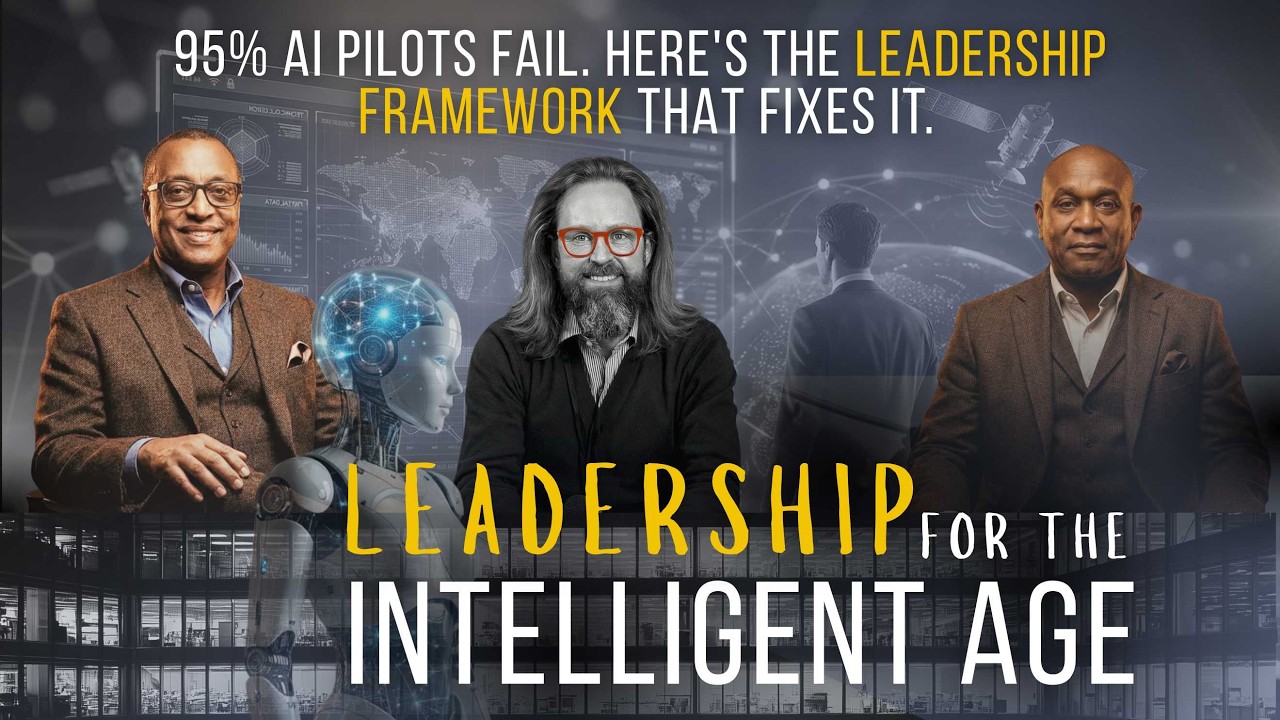
Charlie Hugh-Jones and Jonas Johannes explain why 95% of AI pilots fail: organizations buy technology faster than they can govern it. They propose a leadership framework that embeds ethics and governance from the start, with case studies showing HSBC cut false positives by 60% and ING shortened decision cycles by 35%.
Chapters
Does it aggregate in real time?
It does.
We can adjust parameters on the fly.
All inputs are synchronized and context-aware. I'm ready for your directives.
And welcome to the Leadership for the Intelligent Age. We've heard rumblings about a lot of things these days with regards to AI and about the need to recalibrate. Think about everybody from my wife to CIOs and CEOs have been talking about. What's happening with AI? What's the risk? And when I say crisis, not that, you know, leaders are going insane, but they just need to make sense of things. So for this discussion, I'm the host. I'm going to be talking with 2 very well-versed gentlemen in the topic of not only AI, but leadership AI. I have Charlie Hugh-Jones. Charlie is an executive coach, advisor, Author, Charlie's worked with senior technology leaders navigating and accelerating kind of complex organizational transformation and solutions. And Charlie has a great background. I won't go into all of it, but everything ranging from attorney to private equity to a bunch of stuff. Charlie brings a wealth of information to bear as it relates to leadership, specifically with AI. So Charlie, thank you for joining us.
Appreciate it. Thanks, Jay. Good to be with you.
And also Jonas Johannes. Jonas is interesting because Jonas has done a wealth of things as well. Jonas can churn out white papers about AI in, I think, a matter of 10 seconds. I think that's just because he's done a lot of things across the board as it relates to AI. Jonas, he's CEO of a new startup. Ajent Aurum. And I had to bifurcate saying that, Jonas, because I want to make sure I focus on the Aurum part, which means gold. But also, Jonas has been a McKinsey partner. He's been CIO for some of the major banks. So again, he brings a wealth of information and experience as it relates not only to AI, but transformation. So again, great guys to have this conversation about complexity as it relates to AI and Leadership. Talked about CIOs are having problems, job displacement, risks associated with how do you use technology? Do you have the right infrastructure in place?
Ethics.
Right.
Huge.
You know, how do I actually discern when and how to use my own kind of intuition as it relates to how to guide AI from an ethical perspective? So a lot of things that, you know, CIOs, CEOs are trying to navigate. So with that, let me start with a question. I have a question for Charlie and Jonas. I was reading an MIT study, and the MIT study, I think it said something like 95% of AI pilots might fail due to value being delivered or lack of value. As we've talked about this, I think in the past as well, the title of your executive briefing, From Infrastructure to Innerstructure, suggests a shift, right? How do you, the two of you, help folks given this shift, given the challenges we talk about. So talk a little about that. And also, if you could, for the audience, how'd you guys meet and why are you working together? And, you know, how did you find each other? How did this come to pass?
Well, Charlie and I first connected because we were staring at the same problem from 2 different vantage points. In a way, I think he mentioned some of that. In financial services, the capital velocity is insane, meaning money and innovations are moving faster than ever. And so many companies are still struggling to actually integrate AI into their products and to actual solution portfolio in a meaningful way. If you look at the research from places like MIT, McKinsey, and I think it's Gartner, I think you mentioned that. you see the same pattern, right? Roughly about 70 to 95% of all projects failed to meet their goals at scale. That was alarming to both Charlie and I. It was clear to us that we needed to get together and this need to be discussing and perhaps develop, ask the question, is there, is an old framework for leadership Appropriate? Should we really look into that and come up with a framework that helps all the leaders which are navigating the AI new era? So we are watching the economy model shift from simple technology adoption to intelligence as an infrastructure, right? And AI infrastructure investments is projected to jump from the low trillions, about $1 trillion, To $5.2 trillion, right? But underneath all that capital, there's a very human constraint. And it's really 2 parts. We say it's a talent gap, but I think the talent gap, which is really important, is the leadership talent gap. But also I think, you know, the talent, the proper talent that allows you to operationalize AI, particularly in highly regulated financial services or healthcare kind of industry. The key issue is that we are concerned, and the reason we launched this leadership series is, you know, what Charlie and I see as the big leadership gap. A lot of organizations are still relying on governance and leadership models which are of old, right? And we don't think that those frameworks are adequate for the new normal of AI. So you end up with a paradox. Organizations, organizations, organizations have the capital to build intelligent infrastructure, but not yet leadership and talent capacity to, with the capacity to architect, govern, operationalize in a very reasonable and scalable way. That's the space that Charlie and I are focusing, and hopefully we'll get a framework that helps leaders to know how to really execute in this new intelligent era.
Thanks, Jonas. I think, Jonas, you missed out how we met. I reached out to you on LinkedIn. I was conducting research of CIOs and Chief AI Officers and what have you. And I reached out to Jonas and said, Jonas, could you enter into this research-style interview with me and answer? And it was his questions and the way that Jonas was approaching this issue that really piqued my interest. And we began to think, hang on, what if we blended some of our thinking, integrated the way we look at organizations And that's when, you know, what really struck me and what brought us together to start working and collaborating in this manner was that leaders— we both recognize that leaders are operating in a world where capital and compute are accelerating faster than the human capacity can metabolize. Now, let's just take that in for a second. And as the paper shows that we wrote together, this is the one that we're working through today. 78% of FSI institutions have deployed AI. But only about 31% of them have actually connected it coherently to their strategy. And that's not a technology failure. That's, that for us, when we boil it down and synthesized our insights, was that's a leadership and alignment failure. So while Jonas was watching the outer structure speed up, the hyperscalers, the neo-clouds, the agentic systems, I'm watching sort of the inner structure destabilize. And that kind of turned into watching trust thinning, watching psychological safety shrinking, and as leaders are making decisions faster than they can actually sense what's happening in their organization. So the foundational challenge, the one that kind of gave birth to this work that we're talking about today, was pretty simple. And we kind of framed it like this. We've built astonishing technical infrastructure, but we haven't built the inner structure required to steward it. And the core measure of leadership in this new era will be, the extent to which we align kind of Jonas's outer structure with sort of the inner structure of leadership, the values, the awareness, integrity, some of the things that you referred to earlier, Jay. And where the industrial era was defined by capital expenditure, you know, that portmanteau that we condensed to the word CapEx, and that helped scale machines and technology, this intelligent era demands we pivot to a new framework. And that's where And so, Jonas and I have been introducing our new framework, which we're also using the same letters, but not as a portmanteau, not blending the 2 words together, but as an acronym, CAPEX. So it's a familiar word, it sounds well. So if you're listening to this, we are going to use the term interchangeably throughout. One is CAPEX, capital expenditure. The other is an acronym, CAPEX, which is conceptualize, assess, plan, and execute. execute. And we're going to take you through a little bit of that at some point today. Anyway, that's enough from me, Jay.
No, that's great. That's great. You kind of stole some thunder that I wanted to have you guys talk about, but it's good because I get a ton of minutiae in the mail and email about certain stats. There's another institution, I think it was McKinsey too, that said like 67% of CEOs cite cross-functional alignment as the biggest challenge in AI implementations, which is interesting. It kind of speaks to some of the stuff you guys are talking about. But I'm interested and intrigued by this CapEx term. I'll call it that. It's really a framework that you guys are introducing. And Charlie, the point you made is insightful and interesting at the same time, because when you think CapEx, right, you think old terminology as related to capital expenditure. However, I think you guys have developed this new CapEx framework that hopefully will help dispel some of the apprehension and anxiety. But maybe talk a little bit more about the framework and the key elements for success associated with how you implement something like CAPEX. Other than the capital expenditure term, what does it mean and how does it work?
As you rightly say, the old CAPEX model was designed for a different era. It's the logic of buy more machines, build more infrastructure, drive more efficiency, add more personnel. You know, that mechanistic approach kind of made sense when work was predictable, and most businesses are modeled on predictability. So absolutely, that's why we have it. But in the intelligent era, it's become a drag on performance. performance because it optimizes the outer system while ignoring the inner one. You know, it scales physical assets and compute while neglecting the ethical, cognitive, and relational capacities leaders now depend on. And that's why Jonas and I reframed CapEx into something new. Sounds the same, but it solves a completely different problem. So we wanna use it as a leadership discipline. And the point isn't to add yet another process. People have got frameworks coming outta their ears in one sense at the moment. You know, you can't look for Oh, there's a new model for something, but there's also a new framework that somebody's released. So we're not trying to just add more weight to that. We just wanna give someone something really practical and more of a compass for people to navigate their way through. So the real thing with this model is, or this framework is, to help leaders slow down internally so their organizations can adapt safely. CapEx shifts leadership from linear planning to kind of the adaptive sensing, from pushing speed to building coherence. I think I'm repeating myself if I say it, but the CapEx model, the leadership version that we are trying to introduce, scales meaning alignment and ethical capacity where the former CapEx just scaled machines. So in a world where systems are acting with moral autonomy, you know, we have to acknowledge that when we're talking about generative AI and how we're deploying it. The real measure of leadership is gonna be how well you can align the outer structure, all that compute Jonas talks about, with the inner structure, your values, awareness, and integrity. We think that's an operational shift that this era demands.
That's interesting with kind of the leadership and kind of the operational shift. I saw another stat. I'm like peppering you guys with stats, but there was a stat I saw, 70% of organizations view technical debt as having a high impact on their ability to innovate, right? And it kind of speaks to this operational shift and how critical It is. You have all this capacity and the inability to kind of leverage that capacity strategically. You want to maybe talk a little bit more about that? You know, how can folks start to unlock that, given the fact that technical debt is kind of stifling the ability to innovate, given you have all this kind of pent-up capability? How can you, how can leaders navigate that?
So Charlie and I are dividing things up in a pretty simple way, right? Charlie frames the why, and I obsess over the how, specifically how this actually turns into ROI for FSI leaders. Now I say FSI, this actually applies widely to all industries. We have been focusing a little bit on FSI. That's what I'm saying, FSI. We have a name for this issue that you're talking about. We talked for quite a while now about technology debt in the transformation that was led by the digital transformation during COVID and post- COVID, right? And technical debt being one of the frictions or barriers to actually speed up.
Okay.
So right now, I think the issue that we're seeing, it's not— it's still the legacy that we mentioned and we have been seeing for a few years now. But a key element that's rising, we know it's a paradox. We call the enterprise paradox. What is that? That is— this paradox shows like the capital velocity is that it's in fact, it's outrunning the organizational metabolism, meaning The organization is unable to leverage and adapt at the same pace that the capital it is actually bringing the technology to you to bear, right? In plain English, you can buy all the compute you want per quarter, say GPU platform, Copilot, you name it. But if the human system cannot absorb it, govern it, and actually use it, your return on your spend Is zip zero, right? So you didn't buy AI; you bought very expensive tech, the core, to add to your past technical debt. That's where your CapEx approach comes in. Our CapEx, which Charlie and I put there, right? So it forces a disciplined way of digesting the AI through a plan and execute phase of CapEx. Instead of just throwing technology at the organization and hoping for the best, right? So let's review. The old strategy question says, can we afford this investment? And we go through the I&P and I&FI, all kind of beautiful stuff. The new strategic question has to be, ought to be, can the organization successfully and sustainably absorb, govern, and metabolize this continuous flood of new AI capability? Answering that Takes about 3 points. You need to do 3 points. One is you need to balance, balance your CapEx, the regular accounting CapEx intensity with a strategic scalable operating model that can actually absorb and run AI at scale. One, 2, you need to be designing governance in from the start as part of the architecture and operating model. This is crucially important for FSI. In fact, the fact that we are talking relative to FSI, it really elevates the design and your mindset to the most regulated entity, which will be very helpful to all other industries like healthcare and so on and so forth, right?
Yeah.
3 is building a continuous feedback loop. So the system keeps learning and adjusting instead of doing an annual AI postmortem and asking, so what happens after the fact? Because you think that you're measuring AI success faster, but you're not. What you're measuring actually is risk, right? And you have no ability to understand the value of your AI. Indeed, I think this may amplify your risk as we know them.
So it's interesting because we talk a lot. We've been talking a lot about infrastructure. Another issue, and this is kind of across the board regardless of which industry, is talent. There's a stat I was looking at that said 78% of FSI firms struggle to hire the critical talent, like, say, AI ethicists, right? So in a way, it means, kind of reflecting what you were saying, Leonis, all this compute power is being deployed. Right, without any type of moral expertise to govern, you know, what it is and how it's working, which is kind of scary in a way. So I guess, Jonas, on one side, what is the liability technically of this type of shortage? Right? And then, Charlie, how do we use kind of the trust imperative to turn governance From, and this happens in every organization, they see governance as bureaucratic, it's red tape. So not put the brakes on delivering value and executing and kind of almost act as an accelerator, you know? So maybe Charlie, talk about that, you know, talk a little bit more about the technical liability and shortage.
Oh, sure. So let's talk a little bit about what the risk is. The critical risk is misalignment. of leadership and inadequate governance. Okay? And actually the understanding of what is in your portfolio of solutions today, right? And that's where misalignment takes place. So here is the uncomfortable truth. The biggest bottleneck to responsible AI at scale isn't GPUs, LLMs.
It is leadership.
And again, leadership Leadership, which you can put it as a part of talent gap, but that's leadership is on top of it, right? Specifically leadership with a real ethic and compliance mindset, right? Not just, I need to have this kind of just like a checkmark, right?
Right.
This isn't just let's hire an AI ethicist and move on, which is really a checkmark, right? It's a new leadership mindset that sees the new AI normal as a transformational change for the entire company. With real impact to your customers downstream, right? And the impact can be positive, which is what we want. But you also have to be very negative, will have critical implications on your credibility and actually a position in the marketplace. That means treating AI as something that needs robust governance across the entire value chain of your company. Data more, and specifically for AI, the technology construct of value chain, which includes data, models, decisions, and customer impact. And as you design, always you need to ask the question, what's the implication to the downstream end user? Could be customer, team members, and whoever leveraging your new solution model that leverage applied AI, not just checkbox. In FSI in particular, that defines 3 things. Needs a new talent. And that's why we talked a little bit about a talent gap, which includes leadership, by the way, right?
Mm-hmm.
New thinking and mindset. Again, that's a framework and the thinking that leadership have to develop, you know, in the new normal and a new operating model that weaves responsibility and trustworthiness into how the business actually runs. But many leadership teams today are still using old playbook. Governance is an afterthought.
Right.
While folks like Jay are busy spinning up more models and then wondering why there is— so the mindset has to flip. We should assume the model will fail somewhere into the lifecycle, into the process, and build governance into the engineering itself, into the pipelines. Workflows and how humans interact with the outputs. So you're, for example, when you build a solution, both your human-to-agent and agent-to-agent communication collaboration protocols must be well-defined, which are consistent with your company itself. You know, the primary risk isn't just the model might hallucinate, which is what people, a lot of people talk about. The real risk is that the model is powerful and often right, but the organization can't safely manage its truth because the governance operating model and leadership maturity are not there yet. This is not, this is no quarrel of models nor of GPUs. The fault lies not on the machines, but in our leadership and mindset. And what the new operation model ought to be. To deliver safe, responsible, and transparent solution set to the downstream end users, customers, team members, and other stakeholders. Did I answer the question?
No, you did. You did. You provided a lot of interesting thoughts, one of which you talked about me building models, and I'll come back to that in a minute. But what are your thoughts?
I'm sitting there just, just marveling at the way Yonas' mind works. I mean, like you say, that's why you write so many white papers, Yonas. I love the way you think. And that's one of the things that draws me to you and to work with you. There was an analogy that you used in an offline conversation we have, which I want to draw in now because you absolutely tickled me with it. You were saying to Jay, we were having this conversation before, that LLMs and GPUs can buy you all the thunder your budget can handle, but without real leadership and governance, you'll never get the lightning to strike where it actually matters. And I love that. And I really—
Oh my, we should quote that in one of my papers, huh?
I thought, I hope—
I'm surprised you haven't already, Jonas.
Yeah, I thought you were going to say it here. But so that is wonderful. So your way of framing this stuff is wonderful. And Jay, what Jonas just laid out, that massive technical liability or potential liability is kind of, for me, exactly why governance can't be treated as sort of a periodic inspection. You know, governance as a periodic inspection is like checking your parachute after you've already jumped out of the plane.
Right.
I mean, that's too late. So the trust imperative, as we talk about, kind of reframes governance as something you build into the system from the beginning. And I don't mean the processes and this, you know, the standard operating procedures and the governance document you have. It's embodying and thinking, and as Jonas said before, mindset. You build it into the system from the beginning. Systemic trust, not box ticking. You'll hear me and Jonas saying that a lot. There's a lot of reason why we have checklists and checkbox in highly regulated organizations. It is Good. But the intelligent era demands more than that. You know, we move on from compliance to, I'm gonna drop a big word in here that we don't often talk about in this, is to conscience. I mean, let that land for a second. You know, we move on from box ticking to conscience because given about only 11% of firms have operationalized ethics beyond a document because we fucking feel it's safe. We've got the document, the policy's in place, somebody's holding it somewhere. There's an owner of that. The real gap still exists even if you've got the document. So here we go. Another big thing I want to drop in here that often comes up when we restore moral imagination, and that's asking questions like, should we do this before we ask the practical questions, can we do this? You know, leaders need to create the conditions where experimentation becomes safe. That's how they're going to move organizations forward.
Sure.
And organizations that embrace that sort of creative, bounded, guardrailed trust You know, they see approvals of their AI projects and their AI pilots accelerate by roughly about 25% is the data that we've been seeing. And so trust isn't slowing anything down. Trust is what makes responsible speed possible. Hope that kind of puts some of the leadership lens on it.
That was good. It's interesting too, because given what we're talking about, so when you have this kind of operational imperative you guys talked about, You got agentic AI scaling, right? What's the role of a leader and how does it, should it shift from what they're doing today to some type of decision stewardship, given kind of some of the stuff you were talking about, Charlie? What's the leader contributing to make sure that as machines are making decisions, how do you ensure accountability remains, say, 100% human? So it kind of ties to what you're saying about conscious and weaving that into how you actually provide leadership.
Yeah. And that's a great question, a really powerful one that organizations need to be asking because, you know, as we have more deployment of agentic systems, the leader's role doesn't shrink. A lot of people think, oh yeah, I'm gonna get more attention back. I'm gonna get more space to do other things. Actually, the leader's role becomes more moral. Now, this is not moral philosophy here. This is values-based agency we're talking about. The contribution that leaders make is deciding things that must never be delegated, no matter how capable their system becomes. So as we can see, agentic AI accelerates decisions, but only leaders can hold the values, the intention, the intent, and integrity behind those decisions. That's why accountability remains 100% human. You know, there is a risk of cognitive offloading. Let's not ignore that for the moment. You know, letting systems think for us and do things for us. But if that's the risk, the work is cognitive re-anchor, using the attention that our AI systems free up to double down on judgment, on ethics, on clarity. You know, this is kind of the real imperative that automation can never take over that task. So only leadership can carry the values that guide the task that we're setting our agentic systems to do. And that's the heart of when we talk about decision stewardship, ensuring the systems move fast, but never faster than the values on which it's based. Jonas, wanna add something?
Yeah.
So from the outer point of view, what we are discussing here is what I call distributed agency. And we are trying to look for accountability in this new distributed agency. What is a distributed agency of today in the new normal? That is basically from a system point of view, what we are really building is a distributed agency, which includes both people, the human side of the equation and the machine side of the equation acting together as co-actors to deliver some value-add products and services to all your end users. That's what we're looking for in this new normal. We sometimes not perfectly, we know how to do accountability on humans. What is accountability and what's the role of leadership looks like in this new normal? And my job in this new world is pretty simple. It is to describe, even if it's hard to do, I want to define control surfaces and the decision rights by articulating or actually enforcing who decides What, when, and with safeguard doing before. As this agentic system scale, particularly in banks, right? Presence becomes a new form of control. But what I mean by presence here is, you know, I'm talking about the human presence here. You need the right human in the loop, in the right place, at the right time. So we design governance so that every algorithm's action can be traced back to a clear human steward. The system can be autonomous, but we have to have accountability firmly on the human, right? That's how I see it. And part of the things that you do is, you know, there's a design aspect from the outer or technological aspect that you have to put there to aid the human using automation. For example, policy as code, you know, in all your systems embedded into your agentic structure. To trap and notify the human, but the final decision or action gotta have the same escalation model that we are used with that human in the middle.
That's interesting, you know, but there's one thing that I was gonna say my grandmother would say, but it's not, probably not my grandmother, but it's, you know, show me the money, right? At the end of the day, you know, there's payoff that's associated with why we're investing in all this. There was a survey done of global CFOs recently, and it indicated that investing significantly in AI You would more than likely see about an 80% increase in revenue, right? Think about that. That's interesting. I say that and Charlie's like, that's interesting.
I'm trying to figure out what's sitting behind that particular equation, because if I invest in AI, I'm going to see an 80% uptick in revenue.
You didn't say where you invest.
No.
Or how much.
That's right. Now, if you're JPMorgan Chase, but let's talk about payoff, right? What kind of payoff Does a disciplined, methodical approach, say, aligned with some of the things you guys are talking about, delivering kind of an integrated enterprise, you know, what's the payoff at the end of the day?
So this is a good question because, as you mentioned earlier, you mentioned, actually, I mentioned too, the 95% failure rate from MIT of pilot projects.
Okay?
So in terms of payoffs, you know, how we report and how we push there, we gotta be careful, right? The obvious thing there in the MIT study is that 95% of the pilots have failed. The reality is, you know, and the failure was measured by their ability to return, having ROI. The reality is pilots don't have ROI. Pilots is in your R&D phase for product development or solution development. Therefore, I think use pilots to learn and to have an effective solution later, you know, when you adopt or select the solution of product, which will be part of your product lifecycle, right? So we gotta be careful. That said, you know, the payoffs aren't abstract, right? They are measurable. For example, HSBC, you know, increased financial crime detection while cutting false positive by 60%. Citi ran a hybrid ops pilot and saw operational errors drop by over 20% and the employee confidence jump close by 20%. Now you can argue this is not ROI as an MIT study assumes ROI in dollars, right? And it's not only dollars. So what you have to do is you have to establish and stand up, well, you know, what is, what kind of values that you're looking for. In this case, you know, the reduction of the false positive by 60% is massive in a fraud space, right? And the reduction of errors by 20% is very significant because errors may have an impact downstream, which have actually dollar associated with it, right? Or impact to the customer, which may in turn have a not quite happy customer. It could be a team member, right? So the big idea is this: systemic alignment is the new foundation for speed. You get there when leaders stop micromanaging every step of the process and instead focus on designing clearly and safe boundaries that the employees can innovate and can experiment within control, right? So the system can move fast inside the guardrails without constantly putting its foot on the brakes. So now, as I mentioned earlier, you need to think that as a system, it's an ecosystem. As Charlie said, it is a living organization. It's a living being, right? And he used the word metabolism. And, you know, all parts of that equation, you know, must have within guardrails a way to flex, a way to respond very quickly. To the extent that you have agents, I think your response might be very quick, but not only the response.
Yeah.
You have the ability also to fast fail. And fast failures are the hallmark of agile service and solution delivery to your customer. And also in product development, if you are a product developer. So that is in general how I see it. How do you see it, Charlie?
I love it when I hear someone who is very technically deep in systems begin to talk about the organism and ecosystem. It's wonderful.
Yeah.
That is. Makes me smile a lot. But Jay, the cultural payoff, which is another one, is equally as important as the operational one that Jonas has just kind of painted the picture of. You know, when we looked into some of the cases that we were examining, we saw that when ING shifted to cross-functional models, they cut decision cycles by 35% and then lifted employee engagement by 12 points. So we're not just talking attraction-retention. When you lift, when you increase employee engagement, you up getting more creativity, more connective tissue connections within organizations that spark new ideas and more creativity. So that's why the cultural piece is really important. You know, Mastercard saw time to approval drop by 25% simply by building governance into the way they were doing prototyping. That's what coherent leadership delivers. Coherence becomes the heartbeat of integration. And the organization starts to behave. I'm gonna say it again, like a living sensing ecosystem. And that's where adaptability and creativity begin to show up for organizations. So that's how we're kind of looking to systematize and help organizations navigate this intelligent era type transition.
That's an inspiring message if you think about it, what you guys are talking about, the vision of this integrated enterprise and kind of bringing Trust and coherent leadership so that it's providing more ethics to decisioning. So everything's kind of working in concert. And Jonas, to your point, you're taking advantage of 100% capacity, right? On both sides. That's inspiring. So to conclude, let's, let me circle back with CapEx. So the CapEx that's still around, Continue using that because I don't want CFOs and finance folks saying you guys are introducing new CapEx. No, we're not. However, the suggestion is take a listen and understand what we're introducing as a new framework called CapEx. This new framework called CapEx can help do some of the things you talked about, Charlie, with in terms of building this. coherent consciousness, or in your understanding, it can also help in terms of extending capacity, right? So maybe end with some words on, on how CapEx is going to help with that type of acceleration.
Yeah.
Okay. Well, the systems, and I'm gonna go back to systems rather than, you know, living system, the systems we create, you know, will only ever be as conscious, coherent, and connected and they're vital underpinnings, they'll only be as conscious, coherent, and connected as the people who lead them. And as you rightly say, Jay, CapEx, that portmanteau, the capital expenditure will still matter. We do need processes, systems, ways to determine how we deploy capital. It's always gonna have a place, but its role needs to be reframed for this new era. And the next frontier of leadership won't be defined by how much intelligence or compute we deploy. For me, it will be defined by how much wisdom we embody. Because leadership at its highest form isn't about directing that intelligence or compute, it's about awakening intelligence. And that's the fundamental message that I want people to get, or we want people to get from this paper, and then showing them how to do that using the CapEx Playbook.
Ioannis, do you have any closing thoughts?
Yeah, actually, I'm going to do a quick thing. Charlie and I will release our episode 2 on the leadership series, which is what triggered this podcast. And we also collectively, the 3 of us with Jay, we have started the series on AI cybersecurity, which have in it tightly weaved The leadership implication, because we have entered what I call AI cybersecurity, the bridge economy, where the cyber attackers and criminals are having huge advantage. So the question is, you know, how does the leadership framework and thought process, thought leadership that we're building helps also on the security side there? So I just want to say that and thank the two of you for the partnership, your partnership.
Oh, well, thank you. Thank you, Jonas. Well, in summary, this has been a great conversation, a lot of insightful things to think about, and hopefully give more instruction and insight to leaders out there. On our next episode in conversation, I want to dive deeper into CapEx.
Mm-hmm.
And it's probably too much to talk about in one sitting, but maybe focus on the CMEA within CapEx so that we can again give folks Some instruction how to actually use the framework. That'll be our next focus. Charlie, thank you so much. Great conversation. Jonas, thank you so much. Great conversation. And I can't wait to talk more about CapEx and the insights you guys bring to the table. And Jonas, I'll probably give you more things to think about, especially given McKinsey and some of the stats that—
I think we should call you Jay Stat. We're going to call you Statman going forward.
I've been called that before. For another reason. I won't talk about that now. Okay. Thank you guys. Much appreciated. Appreciate it.
Thank you.
Thank you very much. Appreciate that.
Appreciate that. Bye for now.
More from Charlie

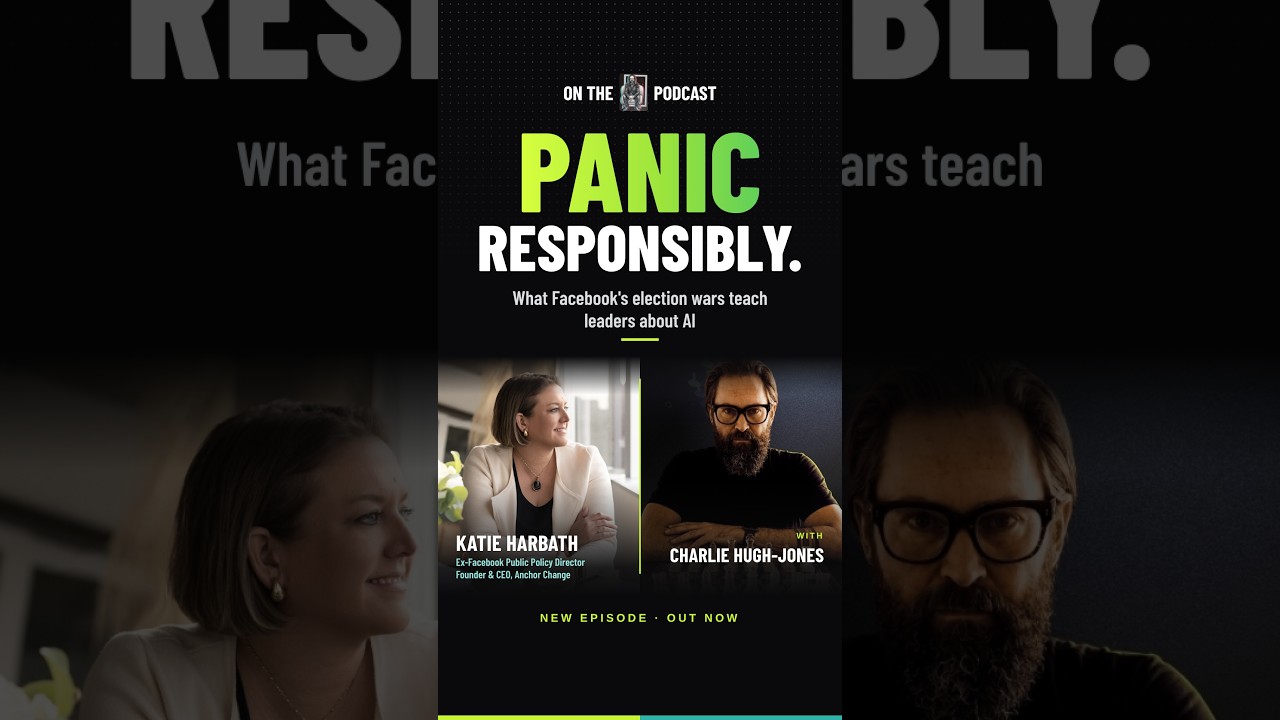


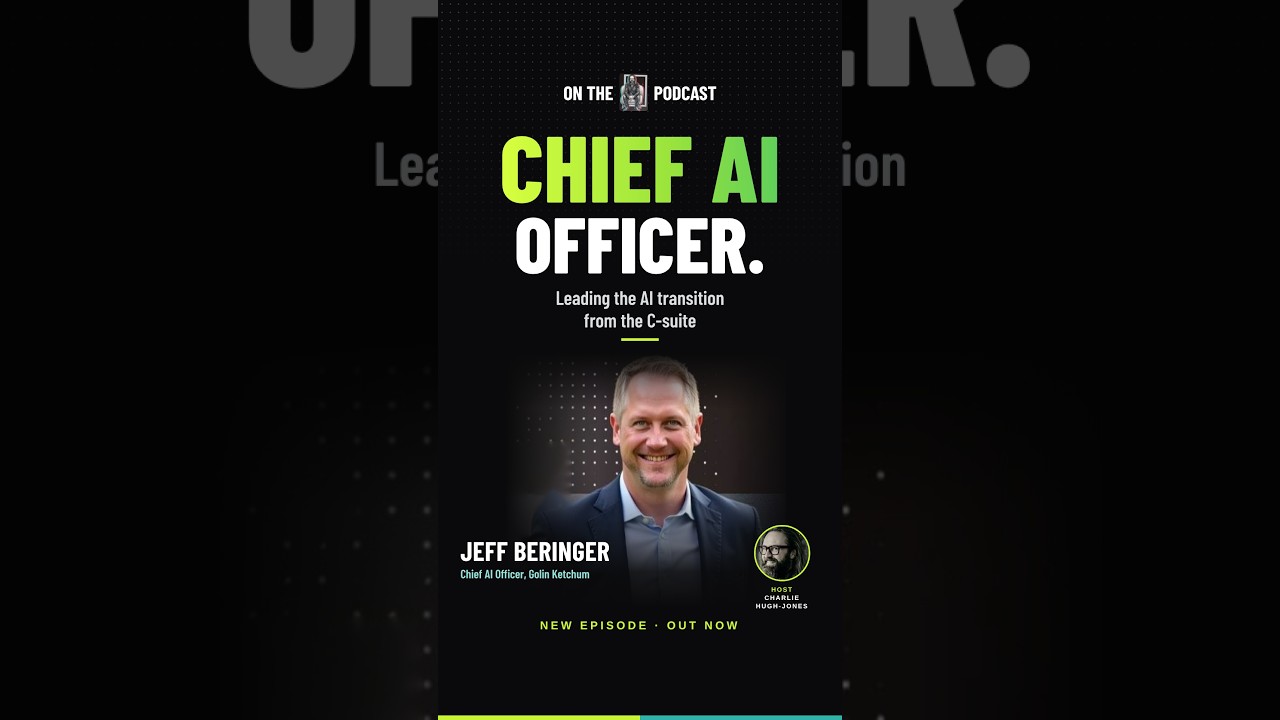
EP01: Intelligence Augmentation: Who Do Leaders Need to Become? Jeff Beringer | Golin Ketchum


Intelligence Augmentation (IA) It’s not just a phrase. It’s the human dimension.