Elevenses with Charlie - What 7 decisions do you make every day that impact your productivity?

In this solo Elevenses with Charlie episode, Charlie Hugh‑Jones shares a framework he learned from Dr. Jake Hyde about seven daily decisions that directly affect a high‑performer’s productivity. He walks through each decision—what you eat, what you drink, how you exercise, how you rest, how you breathe, what you think about, and how you connect with others—offering practical guidelines, personal anecdotes, and actionable tips. Charlie emphasizes the importance of real, unprocessed food, adequate water intake, regular movement and brief high‑intensity effort, intentional rest beyond sleep, conscious breathing techniques, mindset re‑programming, and genuine in‑person social connection. Throughout, he encourages viewers to apply these choices consciously to boost energy, focus, and overall performance, and invites engagement via comments, likes, and follows.
Chapters
Good morning, it is Charlie Hugh-Jones here, Elevenses with Charlie. If you're wondering what Elevenses is, check out one of the earlier Facebook Lives in this series because it'll tell you a little bit about it. It's a little bit later this morning than usual because we have work going on above us and we couldn't even hear ourselves think in the office today, but I wanted you to be able to hear what I've got to say because what I've got to say today is really important. I've entitled this Elevenses with Charlie as, what 7 decisions do you make every day that impact your productivity? Because that's what I want to share with you today. I had the privilege, the pleasure, um, of working with a group of people at a mastermind this past Saturday. It was held by Affinity Creative, hosted by Sozo Wellness, Dr. Jake, Hyde, and we had a fantastic time, and we were learning about million-dollar branding and how to work for small businesses. I was one of the resources there, one of the speakers, to help people unlock various decisions that would move them into greater realms of productivity, of success. And Dr. Jake Hyde was talking about wellness. See, there's a, there's a, there's a maxim that we all need to understand, particularly if you are a high performer or Or an entrepreneur running a business. If you want a healthy business, then you need to be a healthy business owner. So what's that got to do with the 7 decisions you make every day? Well, I am stealing this lock, stock, and barrel, the whole thing, from Dr. Hyde. I'm giving him credit. He ran through these 7 decisions, and I wanted to share them with you straight away this Monday morning so you can think about them a little bit more consciously this week to amp up your productivity and to begin to deliver on the things that you really want to achieve. So I hope that's of use for you. That's of value. If you do get value from this, please comment below, like the video, share it if you think somebody else would benefit from it too, and like the page and start following because you'll get more updates of when these 11Ts with Charlies are, when I'm live. Those of you who joined me live, thank you for being here. It's great to see you. Those who see it on the replay, thank you again for watching. So today we're looking at what 7 decisions do you make every day that impact your productivity? Well, I'm going to start with number 1. One of the first decisions you make every day, day in, day out, that impacts your productivity is what You eat. Now, the problem is there's so much conflicting information in there. I, and, and people have talked to me, I don't care whether you want to be paleo, whether you want to be vegan, whether you're clean eating, ketogenic, or whether you're just trying to eat well, okay? There are some fundamental guidelines about eating here in the United States in particular that are helpful to release more energy, To combat fatigue, to allow you to perform at greater realms of productivity. So that decision about what you eat every day is essentially eat something real, make sure it's not processed. As far as possible, for most foods, it's better to be organic than not, although some foods it doesn't really matter. So eat real food, don't eat too much. Don't eat too much sugar, and that includes carbohydrates, because that will have an energy drain on you. Sounds counterintuitive, but what happens is you get a spike, you have a dip, and the dip is greater than the spike of energy that you've got. So be careful with sugar. Vitamins, supplements, it's a really complex subject. If you're concerned about how you eat and the decisions about what you eat and how they impact you during the day, your energy levels, your emotion, your level of focus, your patience, all those things that really equip you to make powerful and really significant decisions every day to increase your productivity, to get you more quickly to your goals, then go see a specialist. Maybe a functional medicine specialist, or if you've got a really good physician who understands supplements, supplements, talk to them because they tailor them to you. So that's decision number 1. Decision number 2 that you make every day that impacts your productivity is what you drink. It's elevenses. I'm drinking coffee. I love coffee, and caffeine is good in measured amounts. Alcohol is good in measured amounts. What we all need to drink more of, and I am emphatic about this, I've been working with my kids in particular about this, is water. Water is incredibly powerful in our body's metabolism and its processes, in the modulation and moderation of the hormones, of our bio, all that amazing stuff. Yes, it's all very physical today, but it's practical. Drink more water. What are the current guidelines? If someone says to you, how much water should you drink every day? I reckon you know already, and I reckon— 8 cups. Most of the time you're not drinking those 8 glasses or having 1.5 liters or 2 liters, depending on where you are. We live in the south of Florida, which means we get through and lose a lot more water than people in other parts of the country. But don't let that fool you, because if you're in an air-conditioned office, that air conditioning may be sapping water out of you. So drink more water. If you're having trouble figuring out how much water you drink every day, Get yourself a water bottle that's a measure and figure out how you're going to drink that amount of water. Stay away from juices. I know you may have seen my post on LinkedIn about the common misconceptions about drinking juice. You go to the juice bar, you think it's going to be great, you've got your wheatgrass, you've got your apple cider vinegar, all the stuff that super health specialists are telling you you should have as well. You've got kale in there, you've got spinach, but then you load it up with orange juice, then you load it up with kiwi, then you load it up with a ton of sugar, not complex carbohydrates, and that ruins the effect of all the other juices. So be careful what you do with juices. Okay, you also don't get a lot of the benefits of some of the other fruits with juices, or some of the other elements that you could do. So just be careful. Think a little more consciously about your juices. Don't just go, juices are good for me, I'll have loads of juices during my workday. They will give you the sugar spike and the cycle of going up, going down, going up all throughout your day. That's the second thing. What do you drink? The third thing, the third decision you make every day that impacts your productivity is what you do to exercise. Now, a lot of my clients work with me and we look at their morning and evening routine, we look at their, the way they step through their day, and we look for opportunities to increase more active elements— walking, standing, having meetings while walking around the block, things like that— in order to increase the amount of movement we do. There is a phenomenal study that was done just 3 years ago which I was party to. We were doing some work for a health platform that was helping organizations figure out how to increase the wellness of their employees. What that study showed was that there is an increasing degree of negative energy, lack of concentration, fatigue, massive amount of reduced productivity because of something that got called sitting disease, the amount of time we spend sitting in a chair and sitting badly most of the time. So the decision we're talking about here is what do you do to exercise? And it's not about going and doing an intense, um, BodyFit or some high-intensity workout or HyperFit or PX90 or something every day. No, it is about walking. Is it about standing? We were built for Fairly steady exercise, just fairly light exercise most of the time, to keep our mobility. And then with short bursts of high energy in order to keep us in peak fitness. Not lots and lots of peak and loads of sitting. So get up from your desk more often, set an alarm on your phone, do a set of emails, and then make sure you get up and walk around the office, go get more water, That's another thing, go to the water cooler if that is part of your workday, just to make sure you move. So that's the third thing that you do, what you do to exercise. Okay. I think one of the things that Dr. Hyde was sharing with us was not just the high-intensity training, but one of the things that our body is really good at is once or twice a week or something, do something that stresses your body by lifting something heavier than normal. Now, I'm not saying lift with bad technique, ruin your backs, all that kind of thing. I'm just saying do something that deliberately is really intense for a short period of time and then stop and rest. That's one of the key things in order to manage heart rate, manage joints and bone density, manage great circulation, etc. So go explore more of this, but that's a decision you make every day, what you do to exercise. It doesn't necessarily when you schedule the gym, it's literally about getting up out of your chair. So that's number three. Number four, the corollary of that: What do you do to rest? Now resting is an interesting thing. Everyone thinks sleep. Yeah, yeah, yeah, yeah, yeah. I need to sleep. And as entrepreneurs and as high performers, often, and I certainly know this was the case for me for a long time, I'll sleep when I'm dead. That Hustler attitude that just says, I'll keep going, I'll keep pushing through. Rest is for wimps, for weaklings. It's not for the strong. I'm sorry, it's completely the opposite. You work with any of the world's strongest athletes, and they will tell you their coaches teach them a lot more about resting and how to rest well, not just sleep, how to rest well, than they do about lift technique or power technique or explosive, um, Movement. You have to rest in order to have the resources to do that. So think about it this way. You're in constant shifting state throughout a day. You need to be able to rest in the day. You can work, you can see clients, but from a state of rest. And that's an internal state of rest, both in heart rate, also in the way your mind works. So go learn something about Resting during your workday. And this isn't power naps. They're good things, they work for certain people. What I'm talking about is a state of rest where your stressors, the idea of always being on, always being available, always having to do the next thing, that sort of intensity level of energy is ramped back. Come on, roll it back. Where do I rest? So that's the 4th thing that— decision that you make every day. What do you do to rest? The 5th thing, okay, for high performers and entrepreneurs that they make a decision about every single day, and in fact they make this decision many, many times, is how do you breathe? Hmm. You heard me. How do you breathe? Okay, get this. This is a really interesting thing that I heard over the weekend. Okay, what happens to you If you don't breathe. Now, that's really simple. If you don't breathe, you're gonna die. Okay. But how many of you know that you— if you improve your breathing, you improve the way you live? Breathing is not binary. Breathing is a very complex systems approach. Breathing impacts every element of our body, from muscle regrowth to the way we respond to illness, to our immune system, to our metabolism, to the way our minds process thoughts, and the way we respond to emotions that rise up within us. So go find out about breathing. The decision you make every day is to just breathe on autopilot, do nothing, or you can be more conscious about it. Those of you who've seen a number of these 11 Cs with Charlie know that I— well, not recently, 3 years ago I took up yoga, and it has been one of the most profoundly powerful impacts on my productivity, my focus, my concentration, my energy throughout the day, the ability to carry myself, has been through yoga. And one of the key tools in that is learning new breathing techniques, because we have such a— vast continuum of the ways that we breathe, we're barely conscious of them. So go explore how you breathe, because that is a decision you make every day that impacts your productivity. So that's number 5. Number 6, we're going to move on here. What is one of the— what's number 6 in these decisions that you make every day that impact your productivity? Well, it's what you think about. And again, we often consider this is just autopilot. This is, you know, we don't do very much, we can't control our minds, but our minds are a They are not us. Most of my clients know that refrain, that broken record that I give them, that mantra that I get them to work through. Your, your, your mind is not you. It is a tool, and its primary role is problem solving and managing risk. I'm going to do a whole other Facebook Live about that because it impacts how we process thoughts. But I said that, didn't I? Process. In England, I'd be saying process, but you know. Okay. So how and what you think about. You see, your perception of your life, the way you think about the stresses coming into your world, the report that you've got to do, the sales calls that you've got to make, that marketing plan that you needed to write out, the strategy book that you haven't had time to read yet, the client deadline that's now just got moved up that you have to You're now gonna have to work late on to get finished tonight. Your perception about that, the way you approach it, the way your thoughts go round and round about that, all impact the remainder of your physiology. The energy available, the resilience muscles that you have, your ability to focus and concentrate. And if you get into the wrong ways— Of thinking and you get into patterns, which we all do. I've been there. I had to learn to reprogram my brain to move from always managing the negative to being able to offer myself new, more optimistic thoughts about what was happening. Rather than telling myself, oh crap, I'm gonna have to do this, it's, right, what do I need to do this? When I finish it, what am I going to get? That's a win. Do you see the flip there from oh crap? Yeah, you're going to feel rubbish. Okay, but you don't have to tell your mind those things. So there's something I'm going to do a whole another series on that. How do you reprogram your mind? But just that's the sixth decision that you make every day. You might do it on autopilot. You could be more conscious about it, and it will impact your productivity, the energy available. And your focus every day. Because you see, your thoughts trigger a cascade of chemicals, which then impact the way your body responds to every task ahead of you. So, that's number 6. We finally got to number 7. This is vital. This is really important. Decision number 7 that you make every day is around how you connect to other people. You know, Facebook and Instagram and Pinterest and Snapchat are like fast food. They look like food, they taste like food, but you and I both know that if you went on a diet of just fast food, you are not going to get the nutrients, you are going to become unhealthy very quickly, and you will risk exposure to all kinds of fatigue, to potential illness, because there's just not enough richness and nutrients in that to sustain a balanced diet. Remember, the first thing I talked about was what you eat. Fast food, great treat, not your sole diet. It's the same with the way we connect. Do not fool yourself that because you have liked so many pages on Facebook, because you checked out somebody's photographs, and you— it was great to see them with the kids, or whatever it was, that that is truly connecting with them. Yes, it's a great tool for keeping up with people, but connecting is physical. Being in someone else's presence, it's the, the mechanics and the biology of touch. Hanging around with people, hanging out with people is vital to how much energy we have available, how much patience we have, how much focus we can bring to any task. So that's number 7. How you connect. The way we are wired, the way we are built, is to be in community. And the electronic communities are great, but they are not a substitute for real community. So go build that. Make sure you spend time with people. Make sure you have eye contact, physical touch, you're actually listening to them. We've got to go. This was Charlie at An Ever-Seasoned Charlie. That's my cue. Sorry for the noise. Bye, everyone.
More from Charlie



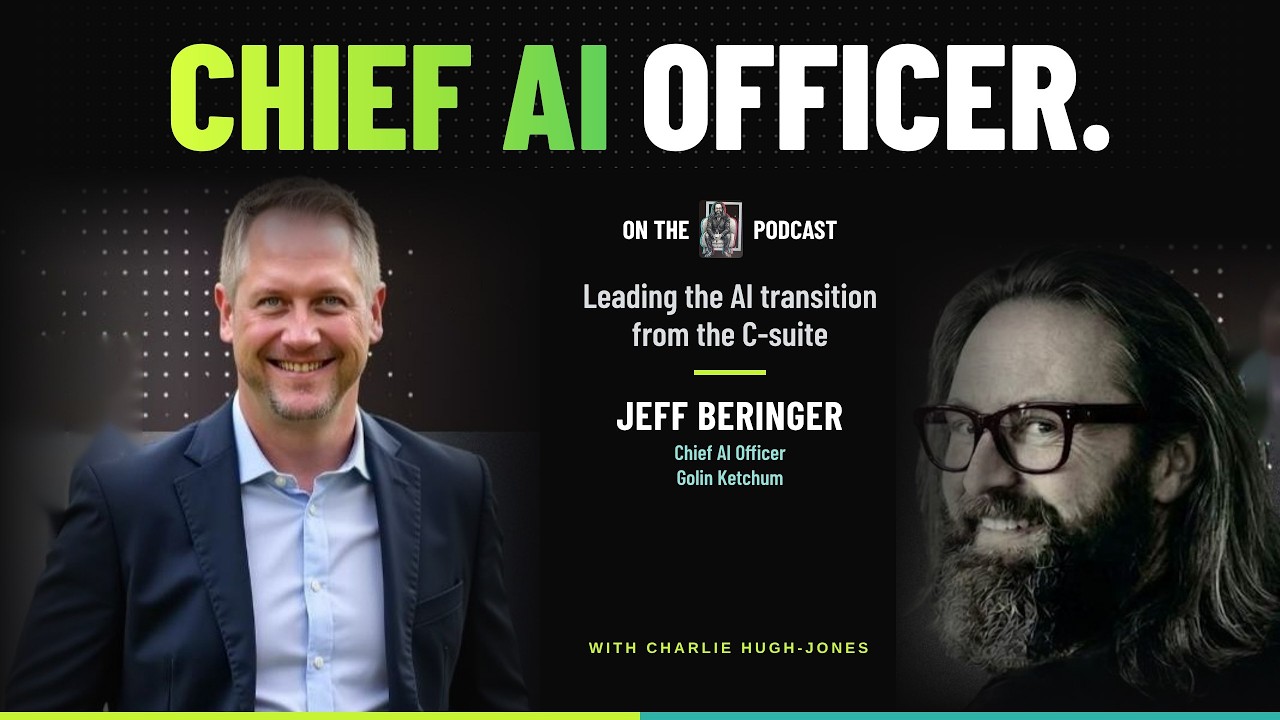
EP01: Intelligence Augmentation: Who Do Leaders Need to Become? Jeff Beringer | Golin Ketchum


Intelligence Augmentation (IA) It’s not just a phrase. It’s the human dimension.