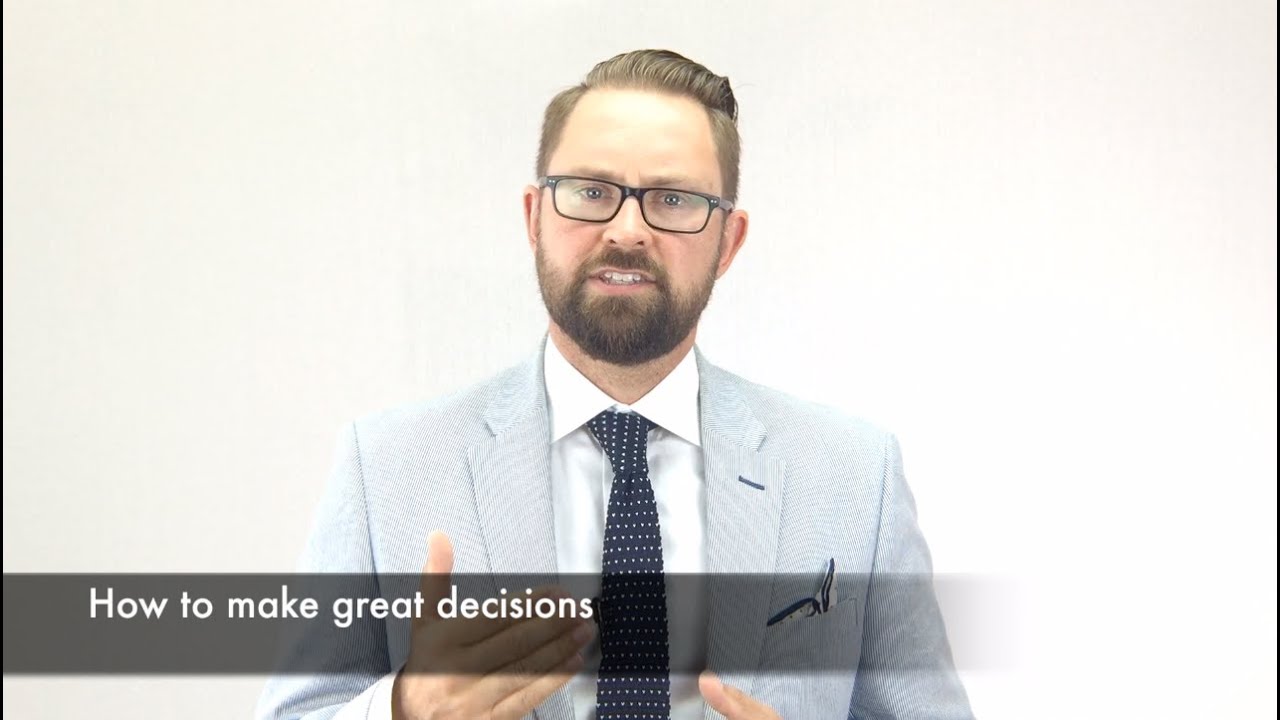
In this 12‑minute self‑help video, Charlie Hugh‑Jones, founder of the Living On Purpose programme, shares a personal story of loss and rebuilding, then presents a five‑step decision‑making framework designed to help viewers make better everyday choices and follow through on them. He first debunks two common myths – that more information and pure rationality are required – and argues that the right information, emotional engagement, self‑knowledge, and optimism are far more critical. The steps are: (1) Get the right information by asking what you truly want; (2) Generate alternatives and evaluate whether any existing option would satisfy you; (3) Engage your emotions, staying calm to listen to gut feelings and empathy; (4) Know your strengths, leveraging expertise or seeking external input when needed; (5) Be an optimist, aiming for a "good enough" decision rather than perfection and setting a deadline. He cites research supporting the role of emotion and empathy in decision quality, and he encourages viewers to apply the steps, manage stress, and subscribe for further content on anxiety management.
Chapters
Hi, it's Charlie Hugh-Jones, creator and founder of Living On Purpose, unlocking the power of inspiration, imagination, and innovation to live a richer, more fulfilled, and more abundant life. Welcome to this video. I help people who recognize that they want something to change in their life make powerful decisions and then follow through on them so that they experience more clarity and focus, more energy, greater contentment, and often financial freedom. In this video, You're going to learn how to make great decisions every day and follow through so that you feel more confident, don't doubt or second-guess yourself, and accomplish more. I always thought I made great decisions. I'd assumed that that was what had led me to be successful as a lawyer, as a husband, and as a dad, feeling like I knew what to do in any given situation. Then due to a personal tragedy, I lost everything and found myself not knowing what to do. As a lawyer, I'd learned great analytical skills, but when the bottom fell out of my world, I started to second-guess myself and ended up going round in circles, anxious about what was the right thing to do in any situation, scared of making the wrong decision, and often not making any decision at all. Well, at that stage, I didn't recognize that choosing not to do anything was a kind of decision. Anyway, out of the pain and frustration, I did manage to make one positive decision. I was going to find out what my life purpose was, and then I was going to equip myself to live on purpose every day. And in so doing, I learned how to make great decisions and follow through on them. One of the biggest mistakes that people often make is assuming that they need more information to make great decisions. Let's bust that myth right away. The truth is that you will never have enough information, but what you already have will often feel like it's too much. Knowing what to do with that information, asking the right questions of it, is one of the secrets that I'm going to talk about today. Another mistake that people often make is to assume that they need to be more rational, to take emotion out of the equation and become more like a machine and run a decision-making algorithm. Again, this is untrue. Research has shown that not only do we need emotions to make decisions, we need to engage them to make better ones. So what 5 steps can help you make better decisions today? Step 1, get the right information. As I've said, you don't need more information, you need the right information. And the only way to know how to get the right information is to ask the right questions. The most powerful of which is, what do I really want from this decision? That's because behind every decision is something you want. Often we don't think deeply enough about the outcome or problem we're solving before we set about making a decision. So spend less time amassing more information and more time defining what you want so you can get the right information or know how to better use the information you already have. Step 2. Generate alternatives. Making a decision sort of implies that there is more than one way to go. So if that's true, to what extent have you considered the alternatives? Many experts on decision-making agree with the statement that your final choice can never be better than the best alternative that you considered. So try this question: Would I be happy with one of my existing alternatives as a final decision? If not, then you better get on with finding other ways to make the decision. Step 3: Engage your emotions. Feelings are not your enemy in decision-making. Accepted wisdom has taught that good decisions are based on rational choice theory, basically taking emotion out of the equation. However, research has now shown that emotion is essential for, and even fundamental to, making good decisions. Being calm definitely helps make great decisions, but being calm, as opposed to being angry or agitated, is not the same as not having emotion. You see, being calm allows us to better figure out what we're feeling, taking a step back and listening to what our gut is telling us. That is engaging with our emotions rather than ignoring them or letting a single one, such as anger, overwhelm us. Being calm also allows us to feel empathy, and research has shown that feeling empathy for those around us leads to better decisions. Step 4: Know your strengths. One of the keys to great decision-making is knowing who you are and what you're really good at. You see, if you're an expert in something, you can pretty much trust your intuition. But if you're not, then a little more analysis is required, or you You may even be better off asking for a third party's opinion. If we look at our past history, we can see how good we are at making certain decisions. So spend some time considering how you've made similar decisions in the past and what results you got. Step 5, be an optimist. A perfectionist has to make the best decision ever. The optimist has to make a good enough decision. Research has shown that trying to make the perfect decision often makes your brain miserable, but recognizing that a good decision is good Good enough helps you feel more in control, less stressed and anxious. Case study after case study has shown that good enough decisions, if made consciously and deliberately, are regularly the ones that best match the outcomes that the decision maker wanted. Often, optimalists are driven by decision deadlines, so go ahead and set a deadline for your decision today. And if you follow these steps, it's likely to be a great, but not perfect decision. But sometimes we're so anxious or stressed out that we can't do any of the things I've listed above, and so I'm going to be exploring ways to reduce stress and manage anxiety in another free video that I'm going to release soon. But in the meantime, I hope you got value from this video. If so, please like it and make sure you subscribe to my YouTube channel. Feel free to share this video on your favourite social media platform and join me over at charliehughjones.com where you can stay connected and sign up for exclusive email updates and get access to more content from my Living On Purpose programme. Thank you so much for watching. I look forward to continuing this journey together in the next video, but until then, bye for now. Bye for now.