How Wall Street Is Tokenizing Real World Assets?
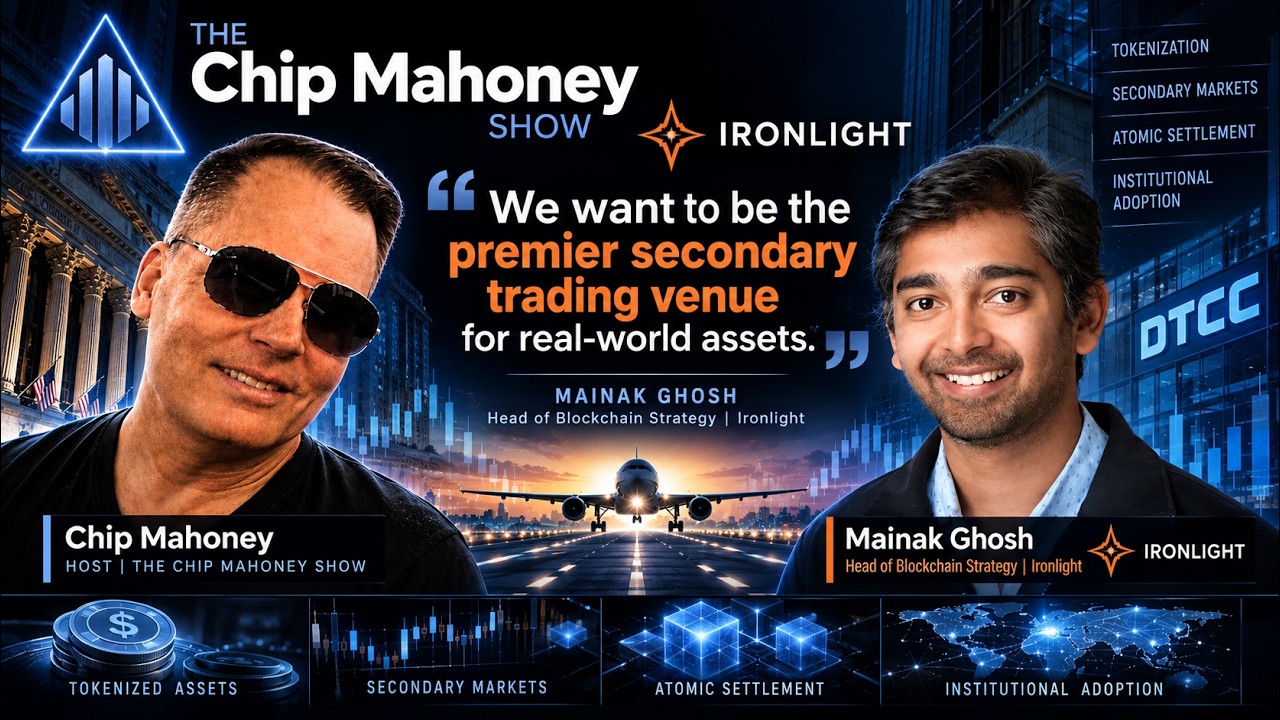
Manik from Ironlight discusses how regulatory changes like the Clarity Act are enabling Wall Street to tokenize real-world assets. The company is building a secondary market for tokenized instruments across multiple blockchains, partnering with traditional finance players like the DTCC while letting both accredited and retail investors trade with instant settlement and fewer intermediaries.
Chapters
It's a big day. A lot has been building up for that. How much of this regulation has been a stopgap for you? And is there anything still holding you guys back with what they're doing with Clarity?
Yeah, Chip, thank you for the question and thank you for having us on the show. I think regulation is really the prime blocker that's been holding back the blockchain industry, the crypto industry, especially in the United States. If you look at jurisdictions outside the US, the EU in particular, some of the Gulf states, Singapore, they've had crypto regulation, they've had blockchain regulation for years. You know, the US really is catching up in that way. Earlier this year, we saw the Genius Act come in, and that has really helped spur innovation in the stablecoin space. That's, you know, we've seen tons of stablecoin issuances coming up. We've seen all of the financial institutions joining to launch their own stablecoins. And we expect that Clarity will do the same for the larger tokenization industry. Right now, you see a ton of action on the Robinhood chain, not just Robinhood, but Coinbase and other sort of crypto leaders already tokenizing real-world assets. We believe that with Clarity, those assets will come on-chain and will come onshore into the United States, giving US retail investors the tools to, to actually get the investment outcomes that they prefer.
Last year at this time, RWA-Fi was still a thing, but now we're on-chain finance and it's like the new term replaced by institutions. So everybody talks about tokenizing assets, but putting an asset on-chain doesn't necessarily create a market for it. Who's actually going to trade these assets?
We at Ironlight actually are acutely aware of this problem. We want to be the premier secondary trading venue market for these real-world assets. And of course, on-chain assets have existed for a long time. There really aren't, I'll be very honest, liquidity is an issue. That being said, as markets mature, liquidity comes on-chain. If you know, in the crypto sphere, spot trading is far dwarfed by instruments like perpetuals. You know, most of the price discovery really happens in the perpetual space, and then that falls into spot trading. On the RWA side, we're actually starting to see more and more volume come on-chain as these products mature. So of course, the Bittle fund that BlackRock had is probably the largest fund, but it doesn't really trade as much on-chain. But as we saw in the last few weeks, really, when Robinhood created stocks on-chain, Those started trading at massive volumes. What we think, what our hypothesis is, that as these RWA products climb the maturity chain and the yield curve, so first you had the treasuries, you have stocks now. If you think about chains like Canton, where they are trading, you know, something like $1 trillion worth of repos, these are the markets that are the building blocks. of the finance industry, those are coming on-chain. And after that, some of the more exciting products like options, like structured products that Ironlight is tokenizing, those will be the ones that we believe will really unlock that secondary liquidity and will actually provide the outcomes that the on-chain investor really wants.
Well, I appreciate that. So sort of like Congress right now and the Clarity Act this year, I kind of wanna press the brakes for a minute. And just kind of see, you know, how you got into this.
I've really been in the financial, in the traditional financial industry for almost a decade at this point. Started out as a trader on the traditional side, as well as a venture capital investor. And that's how I sort of started looking into the world of on-chain finance. I realized, you know, there is a way to marry the principles of blockchain, of crypto, with the security and the outcomes of the— and the scale of the traditional finance world. And that's really what brought me to Ironlight. The founders of Ironlight have been in the traditional finance space. Rob, who's the CEO, he was the head trader at ADIA, the Abu Dhabi Investment Authority, for a number of years, as well as led a number of funds both in the US and outside the US. And Matt Selbusky, who is the president, he also led a number of trading desks over a few decades in the US as well as in the EU. So they really bring a wealth of traditional finance expertise. And our CTO, Jake Moilanen, was one of the people who worked on the IBM supercomputer. So really brings in that wealth of Silicon Valley and tech experience as well. And what, what I think Ironlight really brings is this insider's view, the TradFi insider's view of what works, where we think the real demand and the real product-market fit for this industry, for blockchain, really is in the industry. And that's really where we think we differentiate ourselves from some other tokenization solutions, which are more of a tech solution trying to be grafted onto the financial industry. We like to think that we are sort of more homegrown.
So yeah, I've said for a while now that we're already on the Dreamliner. We may not have taken off yet, but too much has been built to deplane everybody and go back to the TSA line of the former administration. The DTCC has a letter from the SEC that basically says they're not going to make them unpack their bags and go through the scanner. They're moving toward tokenization in production. Regulated markets like yours are being built, and the exchanges are becoming financial operators, in my opinion. Yet the average person still doesn't really see what's happening. Are we beyond the point where this can all be reversed?
I love that metaphor, Chip. That's amazing. I'm definitely going to use that going forward. I absolutely agree. We're all on the plane. We're strapped in. The pilots are just waiting for the runways to clear. I don't think we're going to go back to the days of yore. If you ask me why haven't we taken off, I really do think, you know, it's understating the message. You know, if you go on rwa.ca, XYZ, for example, every week, the number of assets tokenized, the volume that's tokenized is higher and higher. As I mentioned, the DTCC is piloting tokenized settlement. This would be something that if you had told someone 2 years ago, perhaps in the previous administration, they wouldn't be able to believe it. It's incredible how—
Yeah.
How much we've moved in a very, very short period of time. I think we're all impatient because we've seen this coming for a while, but these are regulated markets. Customer protection must be above everything. You don't want to rush into something and then, you know, perhaps there's an issue with a missing private key or there's a mistake and people lose funds. That would really destroy confidence in this movement. So I would rather that we do things maybe slightly slower, but in a regulated and safe manner and ensuring that customer protection always comes first.
So the DTCC is preparing to move further into tokenization in October. They mentioned CANT Network and they also mentioned Stellar for the first part of the year. Where does Ironlight fit into what the DTCC is building?
Yeah, so Ironlight, we have a blockchain agnostic philosophy. So we are multi-chain by design. We have a multiplexing system called the Unified Chain Service where we are able to take in customers, take in issuers, regardless of which chain they're on and present it on our system. Clients are able to come in and buy any tokens that they— buy and trade any tokens on any chain that they would like. Now, of course, there's reasons for several institutions that have started on Canton. Stellar, as you mentioned, there's BlackRock. BlackRock's Biddle is on a double-digit number of chains at this point.
Mm-hmm.
I do think that, you know, right now we're in this state of flux where people are still trying to figure out product-market fit for various blockchains. There's different purpose-built blockchains that are coming up, L1s, L2s. As I mentioned again, Robinhood Chain has made quite a splash in the last few weeks. I think we're still trying to figure out the difference between public chains, public permission chains, as well as fully private chains. It's not entirely clear which paradigm will win out in the end. That being said, You know, we are also starting to collaborate with several DTCC pilots. DTCC is partnering with several traditional finance institutions that we are also partnering with. And I do think that the way to get large scale onto tokenized assets is to actually work with traditional systems. So the asset managers of the world, the DTCCs of the world, to incorporate these existing players into the blockchain space rather than try to replace them. That's what we're hoping to do.
Yeah, I like what they've said, no more innovation by press release. They've been really bold with their moves, and what we're dealing with right now, September 15th and cloture and all these things, I just think about what they're doing for October, and they've been outspoken and they have that confidence, um, that you would never get in the former administration. So I think that's really important. And obviously with, um, you know, who's side by side with the president in the White House when he's talking about crypto, that really matters.
That's right.
But what does this all eventually give an ordinary investor what they can't get today? Because what I'm hearing is maybe there's some sort of integration with your typical wealth advisor who is so far behind this curve. And, you know, people will be left behind if they just don't know what to do right now and plan for that. So maybe you can give me some insight for listeners.
I think tokenized instruments will definitely give the retail investor or the accredited investor better returns because tokenized instruments will reduce the number of intermediaries. They will be able to have better underliers, more efficient processes. They'll give investors faster settlement. So blockchain obviously allows instant settlement as opposed to T+1 or T+3 in the forex markets that we still have. There'll be a more diverse range of instruments. Tokenized stocks can trade globally. So you can imagine an investor sitting in Abu Dhabi who wants access to US real estate or other US assets, they'll be able to do that, of course, fully KYC'd. These are real benefits that investors are able to get today. There's an entire generation of investors who have grown up being able to trade crypto back and forth. And now that they have perhaps matured a little bit, they might want more stability of capital. They are still looking to have high returns, but maybe they don't want to experience the volatility of a Bitcoin or of several meme coins that are out there that are looking to buy real assets, tokenization will give them that.
So as I understand it, does it mean like when I go to your website, ironlight.io, and I can click to use the app, does that mean that your ordinary investor at some point will be able to access these things through Ironlight? Or is there integration through a wealth advisor for your average investor? Tell me how that looks, because with people listening and on Substack, they wanna know how to maybe utilize it when things are ready.
Absolutely. And the answer is both, actually. So obviously there will be some assets that are limited to accredited investors or institutions. Those will be available via wealth advisors or things like that who are better placed to reach out to that demographic. But on the other hand, there are several instruments which are either publicly traded or that are, you know, issued under exemptions such as Reg A. These are exemptions that the SEC has where, you know, smaller businesses are able to actually raise from the public. So for those kinds of instruments, people would be able to join directly to our platform, which is ironlight.io.
Mm-hmm.
They would be able to KYC. So we are, as previously mentioned, we are a fully regulated SEC-registered broker-dealer. So we would, you know, we would KYC, uh, all of the investors, and then, um, they would be able to, uh, buy several funds on the platform that are open to retail investors. Uh, okay.
Yeah. Okay. So your average retail person might have access through you guys rather than some accredited investor, and it, you know, it's kind of in that old world system where it kind of curates you know, for the people who have a lot of money versus people that are trying to build something. Here it sounds like people can really try to build something with you through tokenized assets, um, if I understand that correctly.
Yes, that is correct.
Yes. So as we wrap up here, um, you know, next couple minutes, there's probably a lot of questions I can ask because your background is, um, you know, I'm starting to, you know, understand all your experience, and I can see why with Ironlight, what they're building there and the team that they have there with Rob as the video. Links will be in the description for anyone to check out further information. But as far as like Wall Street goes, I talk a lot about it on my Substack that they prefer what they prefer. Um, they will, uh, you know, say anything they can to make people believe that some sort of blockchain is going to rule all. And so when I think of Ethereum, you know, slow, everything, it's been preferred by them. That's where they settle, right? So it like has the nod of approval by big TradFi. Solana has a lot of issues over the years, and they're not in the White House. They're not standing behind the president. I saw Ripple behind the president, not Solana. So why is it with these big TradFi guys that something like Solana doesn't have to go through the litmus test as Ethereum? Don't ever break down Ethereum. You can't do anything wrong. Solana can get away with outages. Neo Bank gets hacked. Whatever. And somehow, some way, it's still a topic of conversation, mainstream media and so forth. Is that just kind of a setup for the future?
I certainly don't know all of the reasons for Solana's success and/or issues so far. What I will say is that, you know, we're in a big state of flux. As you mentioned, you know, there's other names coming up— Stellar, Canton. Tomorrow there might be another new name. We're really in a period of innovation. Ethereum has one specific path. You know, they want to be the censorship-resistant solid chain. That's an L1. Solana, I believe, has a very different vision for the future where they really emphasize their speed. They emphasize their low fees, and there aren't any L2s on Solana. I think different institutions are choosing different ways. You know, as I said, again, Biddle, I believe, is on Solana and Ethereum both. What lies in the future? Unfortunately, I can't quite predict that yet. I do think that, you know, Ironlight's position of being chain agnostic is the way forward where we welcome all comers. You know, we don't want to say, you know, if you're on Ethereum, you are better, or if you're on Solana, you're better. We think that issuers should make that choice. In fact, we allow our issuers who tokenize with Ironlight, we allow them to make the choice, and we don't force them into one funnel or the other. And I think eventually the market is going to win out. If Solana's features are what the market wants, what investors want, I think we will see slowly more and more people tokenize on that. And I do think that even traditional Wall Street will have to bow to public demand after all. This is the market.
Yeah, it is the market. I don't feel one way or the other about it. I just wonder why, yeah, that Ethereum can't make one mistake but Solana and other projects can do whatever and there's no backlash. And so I find that interesting. And also, again, with who's standing next to the president. And so we're, we're dealing with, uh, Clarity Act, if, uh, you know, that will be something. But certainly with the DTCC going forward with Cant Network. They mentioned in October they're very, um, bullish on Cant Network because they said their customers asked that of them. Now they did mention Stellar at the first part of the year. Now I've had Cant Network on Signals for over a year now. I've been talking about Cant Network for about a year if you've been on Substack. So now it's gaining more traction. They do mention atomic settlement, which is kind of an interesting term as well, and I know that's on your website. So I would appreciate you maybe describing what that is for listeners.
So I can talk a little bit about atomic settlement, which we believe is, you know, one of our features, one of our strong suits. Atomic settlement reduces settlement risk for traders or investors on our exchange. Today in the traditional markets, when you buy or sell any kind of asset, you only get that delivered the next day. There's a lot of backend machinery behind the scenes, which have to kick into gear in order for you to receive your one share of stock, or your money when you sell your share. And frequently in the traditional finance industry, that settlement breaks. Either someone doesn't deliver what they were supposed to do in that time, or someone has sold short some securities, and they weren't able to cover their short in the requisite time. On the blockchain, none of that is required. On the blockchain, In one single transaction, you can both send out your stablecoin, as well as receive the tokenized asset that you're interested in buying, in one transaction. And the term atomic means that either both of them succeed, i.e., both buyer and seller receive what they want, or neither does, which means that no one is worse off. And then you can retry that settlement again. During the 2008 crash, We've heard stories where several bond traders were not actually willing to trade because they didn't know whether their counterparty would be solvent 2 days later when that trade was going to settle. And that was one of the reasons why markets actually crashed even harder than they would otherwise have.
With technologies like instant settlement, atomic settlement, we believe that those kinds of liquidity crunches I've said in the last 5 years, no one has done more in crypto than Ripple and XRP. Um, they were the ones who were being, you know, sued by the government, you know, pay us $2 billion, say you're sorry, uh, pay us a billion. They got down to $100 million, then they said they're gonna wait, and then they end up buying Rail. There's our $100 million. Great move. No one has done more in crypto in the last 5 or 6, 7 months than Injective. Injective had recently that summit. They're now a registered SEC transfer agent for one of their businesses. And so curious to know what you think about Ripple and what you think about Injective over the last couple years, because when I was speaking about this on my Substack, people were thinking much different things. Canton has been there on my signals for a year. Um, Injective, I was like, pay attention to what they're doing. And that was in January. So I kind of just want to get your feeling about some of these other projects we haven't talked about today. It's not like I don't like one versus the other. Speed is always a sell in technology. Whatever is fastest rules the game. What do you think about Ripple, what they've done, and maybe even Injective?
Yeah, so, uh, unfortunately I don't personally, uh, have not followed, uh, what Injective has been doing, but I'll comment, I think, more generally. With Ripple, we have engaged with them a little bit. I know the Ripple team has innovated quite a bit. They have their own stablecoin now. Their vision has really evolved a lot from what their initial vision was for cross-border transactions to a more general-purpose chain. Once again, I think they are responding to this changing market. They're seeing this RWA tokenization wave coming. And I think they are trying. And as you mentioned, they certainly have some inroads with the administration. So I think again, they present an alternative version of a vision of the future. And Ironlight obviously is happy to work with any chains. On the injective innovation with the transfer agent, I think again, transfer agents are an underappreciated part of the traditional finance ecosystem. I think that the SEC has just very recently said something about perhaps modernizing transfer agents. Securitize has also created some open letters to the SEC on tips on how to modernize transfer agents. I think, you know, a new transfer agent or an on-chain transfer agent or more efficient transfer agents like this, we certainly welcome them. We have worked with several transfer agents over the last few years. We think that while they are a very necessary part of the ecosystem, they certainly have to innovate and modernize with the times. And I think that both the regulations changing as well as newer players coming in with better technology, with better vision, with other asset types that they want to tokenize will certainly make things faster, will help customers get access to better and more wider investment choices. And we're definitely all for that.
Well, good. Yeah, the reason why I mentioned that is just to go back to that analogy of being on the tarmac and the Dreamliner. You know, crypto needs a smooth takeoff because it's not going to the moon. It's going 30,000 feet. It needs cruising altitude, but it has to take off. You know, and the captain says, you know, sit down, buckle your seatbelt. And procedure today on a plane, you can't even get up to use the bathroom if the plane's on the tarmac. So that's why it's frustrating. But we're not going back to the previous administration, but there is a time limit, you know, here. And I think that's really important, particularly with these exchanges, which are like financial operators, in my opinion. So when people are going back into crypto because Bitcoin's a lot higher price drawing them back in, then I do think they have to be aware that the game has changed.
Mm-hmm.
Institutions are here.
That's right.
A lot has been built. The DTCC is doing what they're doing. So I think for investors, like a regular investor who's interested in crypto, they need to understand that, yeah, tokenization is a thing, but also the resources of what they're doing and how they're doing it. It's not just about going to an exchange to buy a token so much anymore, particularly when they're running validators, when they are standing side by side the president speaking about crypto. They have a lot more going on. I think you would agree with that. So as we finish here with Ironlight, people on my Substack and other people that will find this, that when they are thinking about getting into crypto— because so many people are not here, retail's somewhere else like prediction markets or something— but when they're back into crypto, that it's not just about, you know, buying a token, it's about being a little bit more sophisticated. And I think that's what I'm hearing with Ironlight is giving this bridge through tokenization Whether it's your website or maybe through a wealth advisor, I would imagine that a wealth advisor would have this sort of access for folks that have, you know, maybe not $1 million, but have money that they want to invest more sophisticated rather than just going in and thinking a token is going to be good because it's up because Bitcoin's up. So I think that as we end here today, if there's anything I missed or what you want to let people know, Please say that now. Otherwise, I'll end with just thanking you for being here. It's been an interesting conversation, and I know that people will probably learn a lot checking this out on Substack first and then the other platforms like YouTube. So if there's anything else, please let me know.
Thank you, Chip. Thank you for having us. This was an incredible conversation, and I'll certainly use that metaphor of us—
I've got a few other metaphors. I like to do that where where people can really understand, because the shift has already taken place. I think you might agree with me, we're not going back with everything. So maybe we can speak again in the future. Thanks, uh, Manik, for joining today over at Ironlight. Links in the description. Thanks so much.
Thank you so much, Chip.
More from Chip





Inside Uniblock | Co-Founder Kevin Callahan on Blockchain Infrastructure & Where Value Is Captured
