Inside Uniblock | Co-Founder Kevin Callahan on Blockchain Infrastructure & Where Value Is Captured
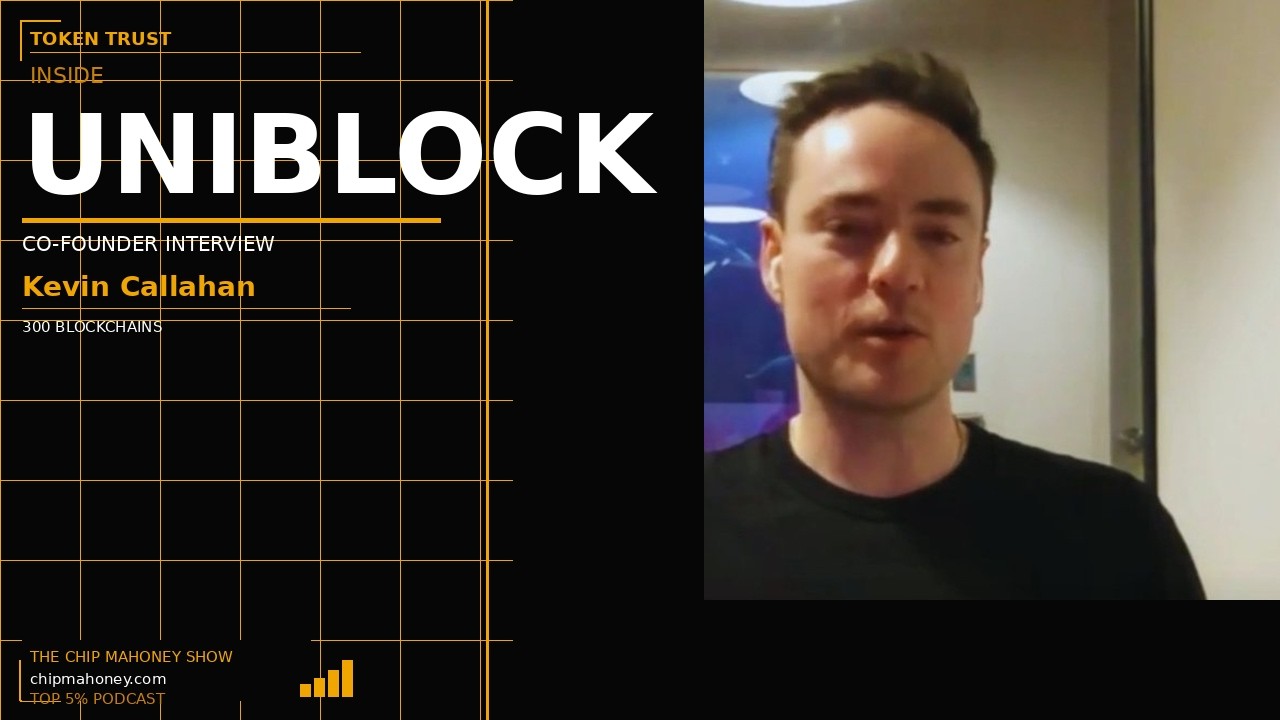
In this interview, Chip Mahoney talks with Kevin Callahan, co‑founder of Uniblock, about the company’s role in simplifying Web3 development through a unified routing and fallback layer that aggregates over 50 partner providers, 300+ blockchains, and thousands of APIs. Callahan explains why the real question isn’t which chain is best, but how to make blockchain infrastructure as invisible to developers as Stripe made banking invisible in Web2. He details the massive time cost for teams managing multiple RPC and data providers, and how Uniblock’s abstraction solves that pain point. The conversation moves to broader industry themes: the evolving landscape of chain specialization versus a single “AWS‑for‑blockchains” model, emerging value‑capture mechanisms such as token buy‑backs and dividend‑like structures, and the growing need for institutional routing layers. Callahan also touches on the strategic partnership with SBI Digital Asset Holdings, the potential for tokenizing the access layer, and the looming impact of AI agents generating massive on‑chain traffic. Finally, he reflects on Bitcoin’s founder anonymity and its cultural significance, and reiterates Uniblock’s focus on building a revenue‑positive, developer‑centric product while keeping a token‑future open.
Chapters
We are going to continue to invest in infrastructure. So when I say we, I mean kind of everybody in the space. So people will continue to increase the flow-through and throughput of the various chains. All the various infrastructure players are going to keep upgrading as well. So the answer is, you know, with everything, we break it, we get better at it, we break it, we get better at it.
Most people in crypto are still arguing about which chain is the best. I think that's the wrong question. And today's guest is building the reason why. He's Kevin Callahan, co-founder of Uniblock. Kevin, thanks a lot for joining me today. How are you?
Great, thanks Chip. Thanks for having me, appreciate it.
Well, it's great to have you. Let's get into it. Stripe is the payments leader we know of in the Web2 world. But it didn't win by becoming a bank. It won by making banks invisible to developers. Is that similar to what's happening right now with blockchains?
I think so. So one of my core thesis is that blockchain will essentially become the crypto rails of fintech. And so right now we talk a lot about blockchain and crypto and kind of all the tech, 'cause we're all a bunch of nerds and we love it. But in, in time, um, consumers will just be using it and not really realizing that they're using it. And so I think that kind of disturbs some people, but I think it's the, uh, the obvious, uh, path that we're on.
So it looks like, uh, Uniblock has the same number of team members as, let's say, a basketball team like the Toronto Raptors, because when I look at the photo, I think of a team. And so uniblock.dev reminded me of that. When I saw that photo, what does it actually cost a dev team to manage multiple RPC providers? Not in dollars, but in time.
Oh, great question. First off, we don't just do RPC, which is nice. We have kind of RPC partners, which are amazing. Then we also have kind of higher-level APIs. So think of a company like Zerion for wallets, or maybe CoinGecko for token data, and even Polymarket for prediction data. So we kind of have 50 different partners doing all types of things. But to answer your question more directly, it can be pretty expensive because, you know, most of those partners might have 50 to 60 different chains. And so if you have something outside of it, then you have to have, you know, more than one partner, but also because you have to have generally a fallback as well. So you might have like a primary provider and then a fallback provider just for RPC, and then you might need, let's say, CoinMarketCap or CoinGecko for token data. And so when you end up kind of sitting back, you see all these different providers that you're managing, it actually becomes pretty overwhelming. So you have one person that's kind of building out that entire routing system and the fallback system and also maintaining it. So it ends up becoming a fairly large percentage of someone's time and sometimes a small team.
Yeah, maybe like managing a sports team about, you know, setting plays and getting out there and performing. So my other question about AWS, you know, they didn't kill servers, they just made server choice irrelevant. Is chain choice heading in that same direction?
Yeah, I mean, I think with regards to chains, the amount of options that we have just continues to grow, and we're seeing numerous chains start to find specific use cases, uh, and new ones coming out all the time. So obviously Strike with Tempo, Robinhood has their chain. And so they're kind of picking those, those verticals or those niches or those specific use cases. And so I think probably when we start to talk about, let's say, you know, cross-border or stablecoin or something like that, then maybe you use a specific chain for that, for that use case. And maybe there's less general chains. However, as we start to move forward, yeah, I mean, I think like you can kind of see see a world where we're moving different data across and just becomes different rails as well. So in some ways, yes, but on some hand, maybe if you have a very specific use case and there's a chain that's specifically tailored for that use case, then it can be very useful.
That's good because I'm kind of thinking about my next question as you're talking about that cross-border stuff. So you went to the, uh, Ted Rogers School of Management in Toronto, and I know you got started early in crypto buying early projects and probably learning the hard way. Eventually just stacking Bitcoin. Here's something I've been writing about that I'd love your take on it. 10 years ago or so, an iPhone 6 was worth roughly 131,000 XRP.
Mm-hmm.
And at the top of the last cycle, an iPhone 16 was about 320 XRP. That ratio has closed consistently over time, never gone the other direction over the long run. So the question, if we ever get to a place where that transaction actually settles on chain, Closing in on that 1-to-1, 1 XRP for 1 new iPhone at retail. Where do you think that first happens? Bitcoin, Ethereum, XRP, or RLUSD?
Wow. I am not going to pretend to be a trader that can pick between all these different great assets. I will say, though, that I see a lot of people building in Solana, a lot of people building on lots of different EVM chains. But my heart will always be in Bitcoin. I think that was kind of a lot of our first chains and a lot of the first asset classes that many of us got into. So I'm a big fan of Bitcoin. But yeah, we're seeing a lot of usage across all different types of chains, everything from Base to Polygon, whatever it might be. And by the way, the usage is a leading indicator for kind of pricing.
Yeah, yeah, I like Base a lot. Um, built my token on that, and some people asked me if that was going to be irrelevant, but I think it's, uh, definitely see that activity there, and I think it's for the future along with some others. So Uniblock is a Toronto-based company, and maybe that gives you an edge to see where value is forming, maybe in a way that we can't see here in the United States. And I thought, you know, recently it was interesting to see Pineapple Finance, a Canadian mortgage company who who also has ties to the— become a dApp for Injective. Understanding where value is forming for the future of finance. Value always migrates to the abstraction layer. Is anyone in crypto actually seeing that yet or just still picking sides?
It's a good question. Uh, I think that what we're seeing right now is people are deciding on new and novel business models and value accrual in crypto. So we're seeing companies like PumpFund and Hyperliquid start to really ramp up the repurchase of their tokens. And so I think that's kind of an interesting mechanism. And there's a number of different companies that are kind of working with that to kind of like reduce the overall inflation and bring down the amount of tokens. We've, we've seen that, in my opinion, not necessarily be reflected in the price of the asset directly. But it's interesting. I recently got into a bit of a Twitter debate about that. And my take was that companies purchasing their stock through buybacks was not really appreciated from Wall Street up until kind of like the late '90s, early 2000s. So people would expect a dividend and the dividend yield and all these interesting kind of like metrics and Then we look at dividend yields and things like that. But, you know, purchasing of the stock via cash was not necessarily something that people liked, or, and even now there's not really a ton of metrics that people track. But in the last 15 years, it started to get understood. So I think it's similar to what we're doing in crypto. Yes, there are some regulation things we have to sort out, but the reality is that I don't know if the average investor is looking at the various mechanisms that are happening and understanding, okay, so now there's, you know, let's say a float of $1 billion, they're purchasing whatever it is, $100 million per year. Therefore, the asset is, you know, being repurchased over the course of 10 years. So my point to saying all of this is that I think that there are, there's new territory that we are currently figuring out. And It's going to look a lot different in the next couple of years around dividends and repurchases and that sort of thing. So it's, I think it's going to be very fascinating to see where the value accrues over the course of the next couple of years.
Absolutely. If the next users of blockchain infrastructure are AI agents making thousands of calls a second, could that break what's been built?
We are going to continue to invest in infrastructure. So when I say we, I mean kind of everybody in the space. So people will continue to increase the flow-through and throughput of the various chains. All the various infrastructure players are going to keep upgrading as well. So the answer is, you know, with everything, we break it, we get better at it, we break it, we get better at it. And we will definitely continue to progress as we see this because Yes, you know, various agents, various, you know, AI companies will be transacting. And so therefore that can become very large over the course of the next couple of years.
So as institutions move on-chain, do they need a layer like yours or do they build their own?
That is a great question. That is what we're kind of having discussions about right now. So up until Uniblock existed, Every institution, every company, every project that had any sort of success was building a mini version of Uniblock internally, not only just building it, they were also maintaining it. And so a lot of what we're doing is education. It's saying, hey, you don't need to do that anymore. You can kind of trust us to be that space. And so the answer is they have to have a routing layer 100% for sure. Routing and fallback and such. And what we're saying is, you know, we can be that layer rather than you buying it.
It's very convenient. I think that's attractive. Speaking of your background, your funding, I believe that SBI led your investment round and SBI Digital Asset Holdings is a founding super validator on Canton, which is where JP Morgan, DTCC, and NASDAQ are running like $9 trillion a month. Is that a coincidence or is that the roadmap?
So the SBI team is incredible. We've really enjoyed getting to know them over the last couple of months and quarters when they were looking at making investment during our previous round or the most recent round. And so the SBI team is quite massive in Asia, specifically Japan, but, you know, throughout all of Asia. And if you kind of look at their holdings and you look at kind of where they're investing, It is very much around blockchain and crypto. And so I have a sneaky suspicion that a lot of the things that they're working on are going to start to kind of become more mainstream. So yes, it's not by fluke that a very crypto-forward, but also frankly very TradFi-friendly as well firm was the one that kind of led our round, which is great.
Yeah, I think more will be revealed in the future, and I say that a lot about what's been built, the infrastructure, and I think more so will be revealed. Maybe that's the Clarity Act going through, I don't know, but certainly a lot has been built behind the scenes, under the surface, becoming more visible. So is there a world where this access layer does get tokenized and value flows back to the users?
Are you referring to Uniblocks specifically or just—
Yeah, I kind of see how you've built it and what it does, but maybe your average retail person who likes tokens, who likes to invest in crypto and Web3 doesn't know anything other than, does it have a token that I can get invested with through an exchange? So I think maybe that's the best way to frame it and say, will you have a token in the future?
Yeah. So it's funny, 3 years ago when we did our first round, we got started, that was what every VC was asking. And it was, it was very counter to say, hey, right now we're not focused on the token. Right now we're really focused on building, you know, revenue-generating business. And I think, you know, frankly, it would've made our round a lot easier 3 years ago if we had just said, yes, here's a token, here's the tokenomics and such.
Mm-hmm.
I think that a few things. One, we weren't ready for a token back then. And, you know, in this current round, and maybe it's the meta is shifting a bit, but very few people were kind of bringing it up to the same level as 2, 3 years ago. Now I think that there's this a bit, a bit of a shift where people are saying, okay, I want to, you know, invest in revenue, you know, cash flow positive businesses that are kind of growing and, you know, do it in an equity perspective. So right now we're really, really focused on, yeah, that, that business, which is people pay us, they pay us in cash, we, you know, give them data. That to say that it's not something right now that we're focused on just because If we play our cards right and do what we're doing right now, it's inevitable that we become like a multi-billion dollar company.
So as we finish here today, I want to ask you, as someone who knows Bitcoin, you mentioned it, and 300 other blockchains, as Uniblock says it can support with one interface. So the question is, is the best thing about Bitcoin that there's no visible founder, but at the same time, the worst thing? Because there's no one like Steve Jobs to stand on stage and tell us what it is, how to use it, and what it will do in the future.
I think that part of the aura around Bitcoin is that we don't really know who or what created it. I think that it is something to be said about the fact that everybody kind of owns it and nobody kind of owns it at the same time. And so I'm a big fan of, of that particular fact, uh, and I think that, you know, without that aura, it would just be a very different playing field. So I'm a fan of the fact that we don't know definitively who started it.
Yeah, yeah, anyone can step into the, you know, that spotlight because it is very successful, and it's already successful even at the price today. I think the time of this recording, probably about $75,000, and we know it's going to go up and going to please everyone on price sooner than later. Now, as far as your retail person that may be checking out uniblock.dev, or anyone else for that matter who might be listening, is there anything that you'd like to touch on about your offering and what people can expect for the future? Anything you'd like to say about that?
Yeah, so the problem that we're trying to solve is that in Web2, the tech stack is very hardened and there's multiple redundancy layers. And, you know, if you're, you're a dev in Web2 and you build on top of it that stack, you just generally know things are going to work. And Web3, that's just not the case right now. You as that developer at heart is expected to kind of manage that, that whole process themselves around the redundancy, the fallbacks. And I think that it's inevitable that that's not the way devs are expected to behave over the course of the next couple of years. It's inevitable that a company like Uniblock is successful. There's no way that You know, if you and I go on this call and, you know, let's say 2 years, that projects are still kind of stitching things together and managing everything themselves, it's just not going to happen. And so, yeah, I think that for us specifically, we sit on top of over 50 partners now. And again, they're Alchemy, Quicknode, they can be Zerion, Polymarket, kind of all the best players. We have over 300 blockchains, and for certain endpoints, we have over 1,000. And for the APIs, we have over 4,000 APIs. So the concept, like I said, is we are building that hardened layer. As a developer, you come to us, we're going to route it to all the best players, and you just don't need to worry about it anymore. You know, you're going to get the best bang for your buck, both from like a monthly perspective and just like maintaining a perspective. So if you're building anything in crypto and you need kind of access to any sort of blockchain data, Come check us out.
Well, very good. So what I take from this interview is that, you know, I got a good idea about what Uniblock is and what people are listening can find out about it. But it does sound like in the future there will be a token that's kind of on the table for you.
I would say right now that we're just heads down on building the best product and generating the most revenue for, you know, our ecosystem, which is kind of developers and the blockchains and you know, the project. So, um, that's like, you know, that's our main focus right now. Um, but you never know down the road, whatever kind of makes sense for kind of the business and our customers.
The website is uniblock.dev. He's Kevin Callahan, co-founder of Uniblock. You know, I really appreciate you joining me today. I've learned a lot, and I know that people that are listening and watching will as well. Thanks for being here.
Thanks for having me. Appreciate it.