Why Wall Street Is Quietly Buying Crypto Assets Now
In this monologue, Chip Mahoney argues that traditional finance (Wall Street) is quietly accumulating crypto assets, using the current October period as the first month of a multi‑month shift toward a new normal centered on tokenization and durable value capture. He explains that institutions are buying time, aligning infrastructure, and preparing for a future where crypto becomes a mainstream asset class. Mahoney highlights recent developments such as the DTCC’s involvement, the Cant Network, Stellar’s integration with Chainlink, and faster settlement expectations, contrasting them with the slow pace of legacy banking. He critiques the pervasive "bubble" narrative, preferring a "bull shark" metaphor to describe a market that is aggressive yet manageable. To illustrate his investment framework, he uses an analogy of a stadium’s $2 billion construction and its concessions, arguing that durable value capture—like fans consistently buying high‑priced beer and nachos—signals long‑term project viability. Throughout, Mahoney promotes his own research products (Substack newsletter, weekly Signals updates, Token Trust Network, one‑on‑one consultations, and an alignment engine) as tools for listeners to align with institutional moves and avoid being left behind. The overall message is that the shift toward crypto integration is already underway, and investors should focus on durable value capture and institutional infrastructure rather than hype‑driven price chatter.
Chapters
Wall Street has been buying time while crypto investors are running out of it. Now I know that doesn't seem too bullish for October, but that's what I think is going on for the most part. Big TradFi with big pockets buying a lot of time, getting their stuff aligned for their plans for the future. And that's why I've said that October is like month 1 of 4 where I see that, uh, right around the beginning of the new year, then it's less of a drip marketing campaign and more of a new normal. And that's tokenization and everything that I've covered on my Substack. And just yesterday, there was, uh, projects on Signals leading the top 100 yet again, on the way toward $1 billion in market cap, where it's been before. And that was a signal for me to say that, you know, it's just only a matter of time, but time is running out to get aligned. Because if you're looking for alt season, ALT is an alignment. You got to get aligned. You got to, you know, think of this as a business, uh, to learn as much as you can, because crypto hasn't been that bad. I know that influencers say a lot, that kind of slips into the macro conversation about what's going on with Bitcoin. They speak a lot about Solana on mainstream. But if you look at signals, uh, just like yesterday, top 100 leader on the 24. And so there's been a handful that have done that over the last 6, 8, 10 months and so forth. Top 100, top 250, 500, coming out of 1,000 into the 500 out of nowhere. And then, yeah, like 9, 10 months later, it's part of the macro mainstream conversation because they can see the price. They don't look at the commitment too much. They might talk value capture. They don't really talk about durable value capture, not so much about a rectangle of wrecked and things that I have mentioned. But that's part of the research, and that's why I do what I do. This Chip Mahoney, this Chip Mahoney Show, throwing more video at you lately. As the podcast is now embedded on my Substack. You can catch it there. And then of course, all the other platforms as well. And I appreciate no matter where you check it out, if you come back for more, 'cause I always will have more for you. Certified in DeFi and been doing this over 5 years. And yeah, I can honestly say that, you know, institutions are here, but they can't just give it to you all at one time 'cause that would just be too much for people to handle. It would be like that earthquake. You need more of a drip campaign. Mainstream is always using keywords. They're always bubble this, bubble that. I said that recently on Front Run the Week. Bubble has been the keyword last couple weeks. But even Tom Lee said just yesterday, Token2049 Singapore, he's like, hey, I've been in the business 36 years, never seen a bubble When people say it's a bubble, and that's true. I said that in my newsletter front run the week. You can get that for free. Just trade your email for that consistent over a year every week. Signals update every week as well. But I said that latest newsletter bubble this bubble that I'm kind of tired of that because it's more like a doctor giving you anesthesia. He controls the time. He decides when to wake you up. And then you don't know what happened in the interim. And that's kind of what it is. Just like Tom Lee says, yeah, I never seen a bubble when people say it's a bubble. So I really am, uh, you know, worried about that keyword, bubble or bull. I think it's more of a bull. And if you, you know, checked out Front Runner of the Week, you know that I talk about sharks. I talk about great white sharks a lot, but a bull shark is also very dangerous, can swim in fresh water. And that's kind of how I feel about it. It's a bull, but it's a bull shark and you got to be prepared, pay attention, and, you know, have someone that can, you know, possibly, you know, be there for you in those meeting rooms. You know, like a star quarterback never goes out to the field on game day without any preparation, even though they've won all the games before. I think you would agree with that. So don't go it alone in this business where institutions are here, um, you know, big orca whales, pilot whales. And don't go for a swim when you don't know where you're swimming. And I think that it's important because, uh, when I do look at signals, aside from the one yesterday which I won't name because I don't necessarily give it away. It's for people get signals and then Token Trust Network. If you need a meeting with me, like a one-on-one, we do that as well. All the information on Substack, but a handful of others. Now we do have the DTCC doing what they're doing in October, no longer missile tests. They're doing the real deal starting with Cant Network. They're going to get to Stellar first part of the year. Stellar is now embedded with Chainlink, and I've talked about Chainlink before. So yeah, it's like a new normal. We're just not there yet. We are getting there, and I think that it's a lot faster than the previous generations when we saw this shift take place. Like Swift took them four years to send out the first message. I've said four months, and I'm sticking with that. I think that's really important to remember. So. Time to get aligned. Crypto's been pretty good, but a lot of mainstream, a lot of influencers catch on to price a lot later. They're not doing the research, they're regurgitating price. So when the projects I talk about, you know, 10 months in, whatever, start to reach those conversations, then that's where I think I can offer you that value because the internet itself seems to be very expensive. So Substack's a good place to be. Price of a coffee on the upgrade of signals. You can get the commitment chain. That's also a very good thing where I have an offer now where you can get 90 days of signals if you get the commitment chain. So there's a lot going on. October is important in my opinion. Last October, before that I said it's abruptober. We had 10-10. I didn't necessarily think it was going to be that, but it is what it is. And Wall Street can buy a lot of time— Clarity Act and so forth, stopgap measures. They can point fingers. I believe in all that. Um, I happen to have a political science degree, but you know, it's just about them, yeah, being ready for what they're doing, but also to be able to control things so much. Even the, the labels, as I've said. Um, you know, with Bitcoin particularly, that's the, you know, main thing on, you know, mainstream. They don't know much about it, but they'll always talk about it as like one Bitcoin. They won't talk Satoshis. Um, but it's also, you know, the label. I've said recently, actually for a long time now, that Bitcoin is capital. Yeah, digital capital. Not a store of value. It can't really, you know, buy that argument when it goes in a 50% drawdown. And not digital gold. Tokenized gold is digital gold. And you'll find that, or at least when you catch my newsletter, you know, I've talked about that before. Tokenized gold is digital gold. Bitcoin is capital even if it gets cut in half. And another 50% from there is not going back to previous labels. It's not going back to, oh, we told you you can use it for collateral. We're saying again, it's a Pet rock. Sorry about that. Yeah, so you're not going to find that on the mainstream conversation. Um, so it's important to get aligned. Hopefully I can offer that to you. This Chip Mahoney, Chip Mahoney Show, of course now available on Substack. Get it on, uh, Apple, Spotify, and everywhere else. I appreciate, uh, the likes, subscribes, even some reviews, but sharing with others, others, because it's very important right now to discern between the mainstream conversation and what is really going on. Where I would say that, yeah, if I hear bubble all the time, I say bull, but I say bull shark because those things can swim in fresh water and they're very dangerous, very aggressive, and you would never think that they are swimming in the river that you're trying to cross. So, you know, consider that, um, And then also consider what Tom Lee said. I thought that was really interesting, telling the audience, listen, I've got 36 years in this business. He is the head of Fundstrat. He has his money where his mouth is with BMNR. Never seen a bubble when people say it's a bubble. And I think that is so important. Something, of course, is happening. There's a lot of fear. There's a lot of FUD. But TradFi is doing what they always do. And if new people come into the market and they are trying to swim in that river or that lake, and they're not aware that a bull shark can swim in fresh water now more so than ever, then they're in danger. So it's important to understand that the exchanges are more like financial operators, no longer just a place to buy a token. but financial operators. They are side by side in the White House with the president. We saw that recently. So things have changed. TradFi is playing their game, and crypto is a new asset class, and they are very bullish on crypto. They've been very bullish on tokenization. They just can't make it known, more so drip marketing campaign. But that's why I say it's month 1 of 4. Not necessarily guarantee; it's just an idea, an idea that it is possible that this shift has already happened in the previous generations of these changes within the financial system that we saw shift a shift happen, and we saw something like Swift be created. They didn't send out the first message until four years. Now I'm saying it's like four months in this. new normal, this new economy. And what I'll leave you with is something that I think that you could probably relate to because it is true and you can see it. And it is an analogy and I've talked about it a long time. I have a lot of analogies, but this one is true and I can kind of prove it because when others talk about value capture, like on mainstream conversations, and they are mentioning projects that have been on Signals for 10 months, Only now because the price is 5x or whatever. Then if they speak of value capture, I also speak of the commitment to the infrastructure, to the value capture, but durable value capture. And what do I mean by durable value capture that they do not expand on? I see it like this. I've mentioned SWIFT, created in 1973, first mentioned in 1977. The Buffalo Bills stadium was created in 1973 as well. I don't know if it was called Highmark, but that was the original stadium. They closed that stadium 2025, uh, 2026, because they're probably in the playoffs. But that was the last time they played there. They had built a new stadium called Highmark, the new version of Highmark, right next door. Open for preseason, uh, fans really didn't like it. But then the Bills, of course, do what they do and they started being good. They're a good team and they have been good. They just don't win the Super Bowl. But the builders committed $2 billion and it's not like they had a meeting during the preseason and say, you know, the fans don't like what we built. They move forward. They move to that value capture. But the durable value capture are like the concessions that They eventually get to the point where the Bills are good. They're not the Browns. They're not going to be 0-5. They're like, whatever, 4-1, 5-2. I don't know the record, but they're always going to be good. The builders count on that. And so the concessions are like $80 beers and $30 nachos. And the fans start buying it because they're drunk on the atmosphere. And that's durable. The difference would be that if you sold the beer or you sold the $30 nachos on the side of the road, No one would buy it because it's ridiculous pricing. Only inside that structure where $2 billion has been committed does durable value capture render. It would be a problem if the Bills were like 0-5 or whatever and fans were not buying the shirts. They're not buying the merch. They're not buying the $80 beers with the fancy cup with the Bills helmet or whatever it is. And they're not buying $30 nachos. But somebody— Agrees, thousands agree to those $30 nachos inside the stadium with all the fans, and it's electric and they're drunk on the atmosphere, and that's durable. So that's what I look for a lot when I speak of crypto. Then we get to narrative, then we get to price, but price, you know, ticks up sometimes and then it stays for a while. Sometimes if we get Beyond that, and we're showing that durable value capture. And that's why I think sometimes in the mainstream, that's why they would validate something on a higher price. And then I start to see projects that are in Signals in that mainstream conversation more and more. Maybe not CNBC, of course, it's not gonna be there, but some of the bigger podcasts and so forth. That's what research is. That's why I do what I do. And that's why I can honestly say that TradFi has been in this game for a long time. It's like building that stadium. It just doesn't happen overnight. They commit to it. They get going with it. But again, they have to have stopgap measures and they can do a lot of things like that. They can build speed bumps. They can build a bridge somewhere else or like kind of keep it half built so people can't cross it. They can do that. And so we're beyond that now. DTCC is one of the most vocal about it. No more innovation by press release. We're moving forward. Can't network. Our customers want that. That's what we're starting with. Doesn't mean the price goes up. It just means it's like a new normal where, you know, if you're somebody who pays attention to things, you can be like, hey, everybody is drunk on something else. This is something that I can align with. It's just not today. And I can kind of just think about the future. Also said that inside the bank, it's the old world. It moves very slow. It still costs like $25 to send a domestic wire. It still takes 30 minutes to fill out paperwork. It still needs time to talk to a person behind a computer at the bank to fill out the information, confirm routing, and then other numbers specific to addresses for domestic wire. And that's $25. It's not a Zelle. It's something that if you want to move $10,000, $20,000 or more, not even cross-border, but outside the bank, outside of the bank, the world is moving so fast. There are people on e-bikes on sidewalks. There are electric cars trying to take your lane in the turn before you can even make a move and you're in front of them. I think you would agree with me how fast the world is outside, how Uber put their business plan on everybody else. They're like, it's illegal, everything that we're doing, but we're just doing it because people are going to want it in the future. So, that's the Uber, like, business model. It's not legal. We're going to do it because we can do it. So the world outside moves fast. The banks need to catch up. They could, they could have caught up years ago if they wanted to. They just like that slow world. But more so than ever, the market is deciding about how it's going to look. And that's an important takeaway. So I have all the analogies for you, but I think you Would agree with durable value capture. Look for that. Check that out on Signals. Grab it out like on a 7-day look. Do the upgrade if you like. Become Tongue Trust Network member like dozens of people have done in order to have an hour with me and we go through that stuff. But also, if you're going to just bypass everything, I'll leave a link in the description to Alan, my alignment engine, which can help you just get kind of routed In the right direction. Kind of map what you got and go from there. And if you need anything beyond that, I'll be here. So, thanks for checking out the video today. Doing more videos on the podcast. Appreciate you stopping by, sharing with others. Again, important information because the shift has already happened. And if you're part of that drip marketing, then you're just going to get what everybody else has got. And you can't do that moving forward if you want to have some sort of prosperity. I think you might agree with me on that. So thanks for checking out. See you next time.
More from Chip





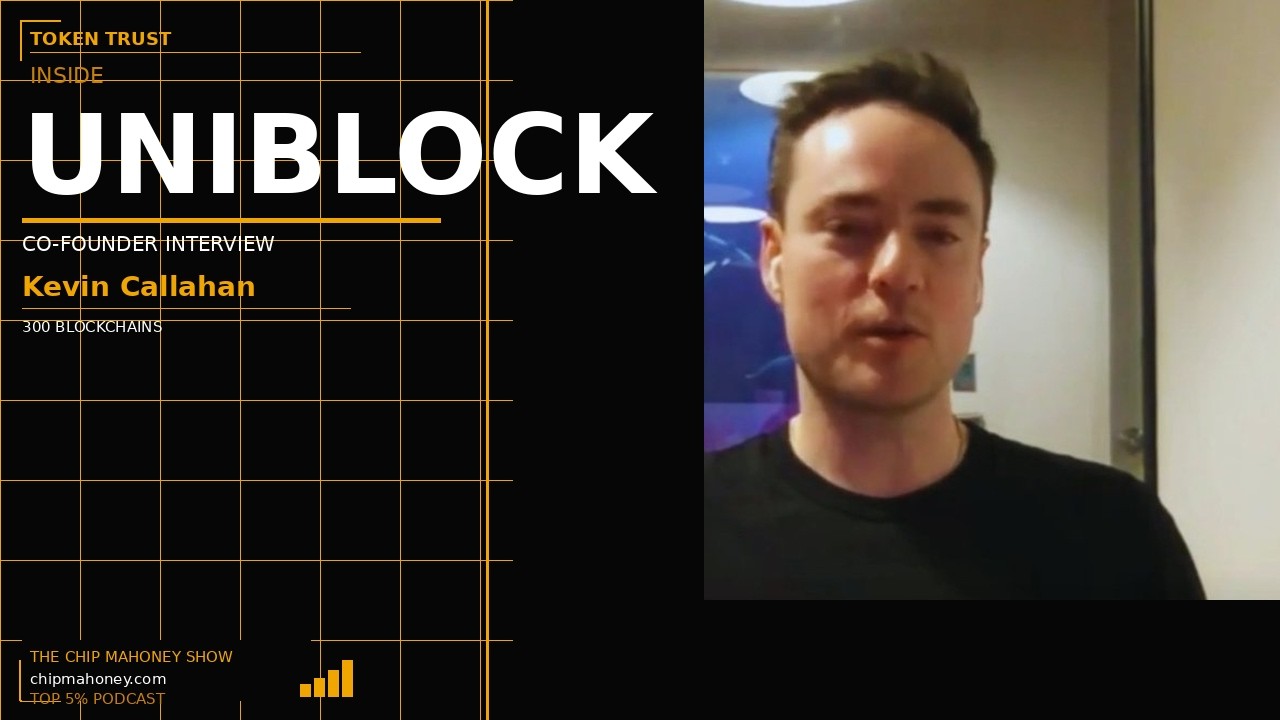
Inside Uniblock | Co-Founder Kevin Callahan on Blockchain Infrastructure & Where Value Is Captured
