Adam Conover's Number #1 Book of All Time
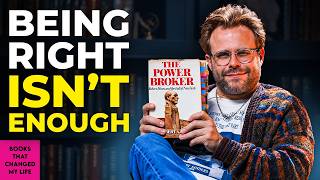
In this conversational interview, host Chris Collins talks with comedian, writer, and actor Adam Conover about the nonfiction book The Power Broker by Robert Caro and how it reshaped his understanding of power, urban planning, and the forces that shape everyday life. The discussion weaves through Adam’s personal reading habits—rejecting static reading queues in favor of impulse-driven book purchases—and his quest for literature that explores adult male masculinity and sexuality, a gap he finds in contemporary publishing. Adam reflects on his scientific upbringing on Long Island, his early fascination with the internet, and his path from a high‑school ADD kid to a sketch‑comedy performer and stand‑up comic. He delves into the craft of stand‑up, contrasting pre‑written material with crowd work, and muses on whether a comedy hour can become a book. The conversation expands to broader power dynamics, drawing parallels between Robert Moses’s consolidation of authority in New York, modern political maneuvers by figures like Elon Musk and Donald Trump, and the labor movement’s collective bargaining power, illustrating how power is accumulated, exercised, and resisted. Throughout, Adam shares anecdotes, personal opinions, and cultural observations, offering insight into his creative motivations and the societal structures he critiques.
Chapters
when Elon Musk was going around firing people in the federal government. And a lot of them said, well, I can't be fired. The law says you can't fire me. It's like, well, we've changed the sign on the building. We've locked the doors. We have told the public that you are fired. In what sense do you hold the position? And you can say it's right or it's wrong, but you actually It doesn't matter whether it's right or it's wrong. You can't argue with it. It happened. That is power in a true sense.
I'm your host, Chris Collins, and this is Books That Changed My Life. Today we have a very special guest. He is an actor, a writer, and a comedian, Adam Conover. And he's here to talk about the book that changed his life, The Power Broker by Robert Caro. What do you think of the library?
It's beautiful.
Do you have a lot of books at home?
Yeah, I do. Yeah, I had some shelving built, so I started buying a lot of books. You got to fill them up with something. And nice thing about books is, I don't know, they're nice to have whether or not you read them.
Yeah. Do you have a queue?
No, I tend to go to a bookstore and I like to go to a bookstore when I need a book to read, and then I try to buy a book that I'm moved to read at that moment. A queue doesn't really work because when you put a book in a queue, it's like, that's a book that I want to read, but not right now. But that means you'll probably never want to read it. You need, like, internal motivation to read a book. It can't just be, at least for me, it can't just be, like, on a list. And like, okay, now that's the next book I'm going to read. It needs to like fit the moment that I'm in and what I'm curious about it in the mood for at that moment. Like what season it is, you know, for instance. So like if a book is just in a queue, that means I'm never going to get to it. So I've become very comfortable with like buying lots of books and then reading. Like I'll go to the bookstore and I'll buy like 3 books and then one of them will be the one that I move to read. I'm like, I'll get to the other 2 later. And then I probably, I never do. And that's okay. Yeah, I still had some level of interest in the books. Yeah.
Someday. Yeah, we'll get to them.
Oh, look at this.
What's your favorite bookstore here in town?
Skylight Books in Los Feliz.
What season are you in right now in your journey?
Right now I'm reading— I'm finishing up Susan Orlean's biography, or memoir, that is, which is really beautiful. And then I'll probably try to pick up a novel. I had been reading, trying to read contemporary literary fiction, but most of it, most literary fiction I bail out of after 100 pages because it's boring and I'm not getting a lot out of it.
Yeah, that's great. I'm kind of the same way where if it's not working, it's not working. I have friends that feel like they have to finish a book.
Yeah, no, that's stupid when people feel like they have to finish a book. Reading a book takes too long. If you read 100 pages of a book and you're like, don't finish it. If you're like, I don't care about this. I was reading a book called Among Friends, which came out last year by a writer named Hal Abbott. Good friend of mine who reads a lot said it was his favorite book of the year. It was on a bunch of lists. I am trying to read books written by men about adult masculinity as an interest of mine, and that ticked all the boxes. And I got 100 pages in and I was like, I'm not feeling this. I don't like these characters. I'm not interested in what happens. I accidentally spoiled the big twist or the big event that happens for myself. And I was like, I don't want to read a book where happens.
What was it?
It's a book about two friends and their wives and their children, and they've been like friends for a long time. And then one of the men sexually assaults the other one's daughter, and it's about the fallout of that. And I was like, I just don't— I'm just not— that's not what I'm interested in. I don't want to read a story in which that happens. Not like that's illegitimate to write about. I was just like, oh, that's where this goes? No thanks. I'd rather read.
What's the fascination with male masculinity?
I think it's— well, it came about because I went through a pretty significant breakup about a year and a half ago. And as we were breaking up, my ex was reading Miranda July's book All Fours. And I read this book as well because she recommended it. And I was like, oh, this is amazing. And also, it was about written by a woman about her age, about what she was going through. And I read the book, I read the novel, and I was like, oh my God, this is what you're going through. And my ex was like, yes, I relate to the book. And I was like, oh my God, I understand her a little bit better. She understands herself a little bit better. I'm like, where's a book like this for me about a 42-year-old man going through what he's going through? And couldn't find one. Like, I literally— it's, you know, men seem to write a lot about, like, war and not enough about themselves. So I've just been, like, trying to sort of find, you know, find those stories a little bit.
You want me to tell you what that all means?
Sure.
Means you have to write the book.
Yeah, that's also part of it. Yeah. I'm also thinking about, oh, is there maybe something I want to write? And so I'm trying to read stuff around that area.
I wrote my last book because I just wanted it to exist.
Yeah.
And it didn't.
Yeah. I mean, that's the main reason anybody creative does anything, I think, is because they're like, well, this should exist, or I have an idea, no one's done it, so I'll do it.
So just kind of unpack what, at 42, in just reference to masculinity, what is your experience?
I think my experience is that I haven't put a lot of thought into it, and I was looking for someone for someone who did, you know?
What's the gap that you are looking for? That, like, what's the—
what a lot of my act is about right now as a stand-up comic, and, and what I'm writing about in other areas of my life is like, uh, sexuality. I think that a lot of men, straight men especially in America, are like really sexually repressed, um, don't like consider their own sexualities, uh, what they're, you know, what they want or what they are, or, you know, they don't experiment, they don't try new things, um, and I think that that is also evident in like male literature. So for example, I've read a couple of books that are literally sex memoirs, right? Memoirs about people's sex lives by women and by gay men. There's a wonderful writer, Edmund Wilson, who wrote a book called The Loves of My Life that I read last year that was about like, you know, he's like, I think in his 80s or 90s and it's about his sex life throughout his life, you know, and it's like fascinating. It's beautiful. You know, you talk about I met this boy in Italy and that, you know, And there literally is not a book by a straight male writer that I can find that focuses on the topic of sex at all, apart from like I read like Women by Bukowski, right? Which is like a famously—
one of my favorite books.
It's a wonderful book. It's also, you know, disgusting and sexist and everything that everyone says Bukowski is, right? But I read it because I was like, here's someone who's at least writing about this topic, even if it's in a way that like occasionally is repulsive. You know, he's at least thinking about his experience and trying to put something down onto the page, you know. Um, so, uh, it was a fascinating read. Uh, but, you know, that book was written, what, in the 40, 50 years ago, something like that. Um, like, I, I'm hard-pressed to find, uh, a book by a straight man currently about these topics. And that was what the, you know, the Miranda July book All Fours is about, you know, I don't know, a woman who is, you know, goes through perimenopause and has sort of her sexuality kind of bursts forth in ways that she didn't anticipate, you know, that upend her life. And I was like, "Oh, that's really fascinating, you know, for her to consider that." I'm like, "Oh, clearly she, as the author, went through some of that and is expressing that through a character," you know? And so many people are relating to it. The book is a big hit. And I'm like, I don't think men do this for ourselves. You know, it's— I think that it's either done in like in previous decades, it was done in a way that people found, you know, sexist or reductive or whatever, you know, and as literary trends have changed. And then I think men just sort of stopped writing about it. There's counterexamples that I don't know. But yeah, this has been what I've been sort of searching for. Yeah, I asked book seller at Skylight behind the counter, I was like, I'm, you know, can you recommend a book written by a straight man about his sex life? Right. In nonfiction or in fiction. And they like, you know, really thought for like 20 minutes, like looked in the, you know, catalog. And they came back with Anthony Bourdain's Kitchen Confidential and a Henry Miller book. And they were like, oh, Anthony Bourdain, you know, it's mostly about food, but he writes a little bit about sex in it. And then Henry Miller from like you know, the, the middle of the last century, right? So like, this is what this, you know, professional came up with. They were— and they like really put thought into it, and that was the best that they could find in the stacks of one of the better bookshops in LA. So, um, that's what I've been— that's what I've been looking for.
Do you find that, um, that's connected to other things that you see in society now?
Yeah, absolutely. I mean, I think, uh, uh, well, I think men in general are not very inward looking and not very thoughtful about their own experiences and tend to, when they are writing or making media, tend to do it about other things in the world, external things, but not having feelings.
Is that what you mean?
Yeah, absolutely.
Expressing them.
Yeah. Yes. Absolutely. Yeah, thank you. You cut to the core of it, that like men are detached from their own emotions, right? They don't discuss them with other people, with their friends, or with themselves. This is all stuff that we know, you know. And yeah, I think that's expressed through, uh, media. And it's sort of like this, this bizarre kind of like gap, you know. I literally Googled, uh, not to keep harping on this point, but I literally Googled like books by men about sex. And what I found was articles in, like, literary magazines that were like, why are men so bad at writing sex scenes? It was like articles like that. And nothing that was actually recommending books on the topic. It was like only commenting on the fact that what does exist is written ineptly and that there's a gap in the literature.
Huge gap.
Yeah.
They can't even— Yeah. You know, it's funny.
It's strange. And I think it's like, it's a stereotype for us about what exists in the media, but it's also, like, actually true and I think is bad.
Yeah. Have you ever watched Adam Curtis's documentaries?
Yeah.
The Century of Self.
I have not watched The Century of Self. I've seen, like, bits and pieces of his documentaries. I have too much attention deficit disorder to, like, make it through all of one of his documentaries.
Those documentaries are for us. Yeah, they just change constantly. Yeah. I don't know. I find them easy to watch. Yeah. It's interesting because in that they're kind of talking about therapy and how people feeling had this reverse effect and how when people were all buttoned up and tight, things were a little smoother. And then it was kind of the undoing of society in a way.
Well, like, therapizing was the undoing of society because people started focusing on themselves.
Yeah, he's just contrasting, like, in Europe there were still countries that were very buttoned up, and here in America we got housewives committing suicide, and the government's trying to roll out therapists, and, like, you're talking about your feelings, but people are just getting more and more neurotic the more they talk about their feelings. And I'm paraphrasing, but it's an interesting kind of insight into when people are that way, they're easier to manipulate. A part of the story too.
When people are therapized, they're—
well, when they're searching for something and when you're asking them, how do you feel? That changes. How do you feel is different than what's actually happening. And I find that that kind of is going on in the world right now in a sense of, like, if I tell you that I— well, I mean, I'm just going to give an abstract example, and I don't mean anything by this, but I'm just trying to make the point. If I tell you that I think we should invade Greenland, because I have a belief in something about that thing, automatically I am all these other things that go along with that sort of thing.
Right. I don't follow.
Like, I'm automatically MAGA and I'm automatically anti-abortion. Like, they're all lumped into one sort of thing in a sense, in that how it's very culty and you can't just talk about one issue without it having symbolism to other things.
Yeah, I guess that's true.
And the more external people are and the more they're searching for something, the easier it is to tell them a story that gets them to believe a certain way. I'm paraphrasing, but that's—
it could be.
And so it's interesting. To imagine a world where men were more expressive about their emotions. What are the changes that come from that? Is it better or worse?
I mean, I think it's better. I haven't seen the Adam Curtis documentary, and I think it's a little reductive to say that if people are thinking about themselves that they're more open to propaganda. I don't really follow that argument. I guess I should watch the documentary.
Are you familiar with Bernays? Propaganda.
Yeah. I know that Adam Curtis has done a documentary about Bernays where he blames all the ills of the 20th century on Bernays. I've heard this. I've heard of this.
Oh, no, I don't think he's doing that. He's just exploring the idea that consumerism in the— you know, there was a time where people bought jeans because they needed pants. And now we live in an era where the jeans you buy say something about who you are.
I think that was probably always the case to some extent.
I want to say marketing for sure, but Bernays was the first one to really put the lever down on it in a big way.
I haven't seen these documentaries, so I don't have—
Well, I'm just trying to say it's not that closed-ended in its conclusions. It's an exploration.
Yeah.
Oh, yeah, I'm sure it is. I'm sure they're fine documentaries. Yeah, yeah, yeah. I mean, my, my belief is that the fact that, you know, men don't reflect on our own experiences, don't like ask ourselves the question, why are we the way that we are? Right. Is I think it's bad for us. I think it results in a lot of the bad behavior that men exhibit. You know, I've noticed in my own personal life that the women I'm around are better at observing their own emotions and on a meta level and like reacting to them, you know, going like, oh, okay, I feel this way. I think I'm feeling this way because of this thing in my past and I'm having a reaction to that. So maybe as a result, I'll go, you know, remove myself from the situation or etc., right? Whereas men tend to just experience the emotion and it overwhelms us and we're not able to consider it, you know, how, how we might feel differently if we were to behave differently, for example. And I think it's because we don't reflect on our inner experience that much. We just sort of like have it, you know, we're a little bit more like animals in that way, in that, you know, our We're just experiencing the storm inside rather than going like, what, what is the storm and why is it happening to me and how might I adjust my behavior in order to feel differently? And I think that were we more in that habit, we'd be, you know, better equipped to make our way through the world. That's like, you know, emotional intelligence and agency and, and those sorts of things. That's a bit of growth I've been trying to do myself. And, you know, I've had this specific experience of, of, of experiencing this, this piece of literature that gave me a lot of insight into someone else's experience. I'm like, I would like to have that. And also seeing how that benefited her to, to experience that piece of media. I'm like, I'd like to, you know, do that myself. Where is that piece of media for me? And you're right. I think I probably do have to write it myself. That's, that's what I'm like working my way towards. Figuring out what that project is.
How much with us, with men specifically, do you think we are affected by the fact that our career, whatever it is we do, is our identity in a lot of ways?
Yeah, I think that's hugely important.
We become very one-dimensional sometimes.
Yeah. And that's a societal impulse that's placed on us that a lot of us just accept. Right. Another thing I talk about in my, uh, act is that, uh, men, we tend to believe every stereotype that the media tells us about what a man should be, right? Whereas I have watched over the course of my life women, you know, unpack those stereotypes, you know, and say, is this serving us? Is this correct? Maybe we should adjust the societal expectations of what a woman is, right? And if you look at from the '50s through today, there has been a change in how We think of— not every— it hasn't changed for everybody. Some people have a retrograde opinion. But, you know, in general, we have different societal expectations that I think a lot of people would agree are healthier. And I don't think men have gone through that process collectively. We have— of reflecting on what are the expectations we have of ourselves and of each other. I think one of the ones that is really built in is that you are your career. I mean, not to extrapolate too much, but if you want to look at like the, you know, sometimes almost violent reaction of some men to the inclusion of, you know, women in the workplace. It's because they feel their masculinity is threatened because somebody else is able to do their job, you know? And they're like, oh, does that make me less of a man? Well, it doesn't actually. But if your sense of your own masculinity is tied up in your career, then yeah, that could be— you could perceive that as a threat, you know?
Yeah. Or if you— yeah, if you have low self-esteem or, you know, just a crazy perspective on yourself, that could be a challenge. But it makes no sense. Yeah, we should be more collaborative in that way.
Yeah, more collaborative and more inquisitive and have a more investigatory approach towards our experiences.
Yeah, that's fascinating. Well, I hope you write that book.
I got to figure out what it is. Currently, it's my new hour of stand-up is about these topics, and I'm going to be doing that.
Have you ever thought about making an hour of stand-up into a book?
They're such different art forms. You know, for me, it's like, this is the topic that I'm thinking about right now. And as a stand-up comic, it's like worked its way into my act in that way. And if I choose to write a book, it'll probably be around that cluster of topics. But I don't think like an hour of stand-up can be made into a book. I mean, in the '90s, you know, Jerry Seinfeld, like a bunch of his material was published as a book. But that's just a transcript of his act. It's not like really a book, you know. George Carlin had a, had a couple of books that were the same way. And I don't think it like really translates that way.
You know, I would, I would just challenge that you might be able to change that in the sense that one of the things that comedians have this ability to do is to see things from a different perspective.
Yeah.
And that is the books that I enjoy the most. I mean, that's kind of like what this book is that we're here to talk about today. It's a different perspective. So I know because it hasn't been done, it might feel harder, but I almost would bet it could be pretty great.
Yes.
To me, that is to say, when comedians write books, perhaps we can bring that perspective to it. I personally feel, as a practitioner of stand-up comedy, that like the way a stand-up comedy act is generated and performed before the audience, it, it only really exists in the moment in which you're performing it, you know? Even when you record it, that's not really the thing. Like, the art is in the room, in the moment. So saying like, can stand-up comedy Could a stand-up comedy hour be a book? I'm like, yeah, it's like saying, you know the phrase, talking about music is like dancing about architecture. Have you ever heard this phrase? It's just the art forms are not like commensurate, you know? And so I could do a book about the same topic, but the book would be the book and the stand-up would be the stand-up.
Oh yeah, for sure. But you might have an ability to have a perspective on it when you do the book, or if you do the book.
I hope.
I hope.
Cool.
I hope. Publisher agrees, and they agree so thoroughly that they give me a lot of money to do it.
You don't need a publisher.
Oh, yeah.
I'm going to have a Substack.
No, just put it out yourself.
Amazon print on demand.
Yeah. Sell it on your website. I sell a lot of books and I'm not a publisher.
Yeah.
I would hate to have a publisher because they'd tell me that I can't do what I want to do.
Fair enough.
Because it has to fit in this mold. We live in a world today where that's pretty easy to do. So we're here to talk about The Power Broker. Curious, where did you grow up?
On Long Island, New York.
Long Island. What did your parents do?
My dad was a professor of marine biology at SUNY Stony Brook and later became an administrator of that university and some others. And my mom was a— she's a PhD botanist, but she went into education. She ran a small science museum on Long Island, did teaching. Things like that.
Oh, were you interested in any of that as a kid?
Uh, I mean, it was a scientific upbringing. Um, I didn't go into, you know, the family business, but I had, you know, it was part of my, uh, the way I thought about the world, you know, part of your development. Yeah, you know, science is fascinating. It just didn't end up being my, like, vocation. Um, yeah, I was drawn to comedy through a number of different forces.
Any siblings?
Yeah, I have a younger sister who is a, uh, science journalist. Um, so she is a little bit more in the family business, although she also has a PhD and then left academia to, uh, you know, be, uh, work in science communication. And, and, you know, she writes about new discoveries and, you know, shares them with the public.
What kind of kid were you?
Uh, I mean, I was a very ADD kid. I was really impulsive and loud and, you know, couldn't sit still, like classic sort of, uh, kid they they try to deal with and then eventually medicate. So, yeah, I was a handful.
Did you get in a lot of trouble?
Oh, yeah. Constantly. Yeah.
Oh, yeah.
Yeah. Just like being disruptive in class. You got to go sit in the corner or sit outside or whatever. Yeah, that kind of thing. That was a big part of my upbringing. Yeah.
What kind of grades did you get?
What kind of grades did I get? Not great until I got to college. When I was in— I went to liberal arts school, Bard College, and that was like an environment that really I flourished in. I was able to sort of decide my own studies a little bit more and pursue what I was interested in. That was a lot better for me than high school environments.
When you were in high school, were you into sports?
No. God, no.
No.
What did you do?
Played video games, had got very early connection to the internet. I was like probably the first person in my class to start using the internet first, like AOL and then like local BBS services. And I had like cable internet probably when it was first introduced. Like my memory is that the, the cable company like called our house and I happened to pick up the phone and they were like, we're doing a pilot program of cable internet. Do you want to participate?. And I was like, yes, we do. And then when the, uh, they came to hook it up, for some reason my parents hooked it up like directly into my bedroom. And I just from then on was just like on the internet, like almost every, every night. And we're talking in like 1998, you know. Uh, and, uh, yeah, that was my, that was sort of the world that I inhabited. Uh, and it was, uh, it was really cool and it was a really great time to be on the internet. You know, I learned a lot of cool things. I like, made my own websites. I like taught myself HTML and stuff like that, you know, um, which, uh, later helped me in comedy because my, my college sketch group, um, I was like the guy who, in addition to writing and performing comedy, created the website, um, you know, edited the videos, taught the other guys how to edit videos, learn how to ingest the footage and, you know, compress it into QuickTime files and upload them and all those sorts of things. Um, so, you know, the, the sort of general technical ability with computers, like, served me really well.
Was there a moment when funny connected with you, where you did something and people laughed and you were like, oh, I like this?
Uh, not a particular moment. I, I think it was, uh, something that I constantly liked doing. I always watched comedy, you know. When, when I was in college, a friend of mine started a comedy group, and I was like, I want to be in that, I want to do that, right? And then the more we did it, the more you know, we sort of realized we were good at it. It was a group called Old English. Um, we, uh, I remember that we, you know, we were just doing shows at our college for the other students, you know, and then there was a National College Comedy Festival is what it was called. It was at, I think, Skidmore College, like a couple-hour drive away. We go to it, we perform, and we were just so much funnier than the other groups. It was a moment— not that they were, they were bad, right? Um, but we were just doing something something that was different enough that I remember we got a standing ovation from the audience, which was made up of other college students who were doing comedy, and going like, "Oh, okay, we're actually, like, good good." You know? We had some success on the early internet and moved to New York City and started performing live. And, you know, I experienced that powerfully enough, you know, that when the group broke up, as of course it did, 'cause we were a bunch of, you know, 23-year-olds who were unprofessional with each other, and eventually wanted to do different things, I was like, "I want to keep doing this because I really enjoy it." And is that when you started doing stand-up? Yeah, around then, yes. I moved from sketch comedy into, you know, "Yeah, I want to be the person on stage making people laugh using nothing but the power of my mind and my voice." You know, something about that skill was, like, elementally attractive to me.
Yeah, I mean, I think the two hardest things probably to do are stand-up comedy and boxing. It's just you. You can't hide behind anything.
Yeah, I would say stand-up comedy is probably easier than boxing because people say— there is a funny degree to which people treat it like a daredevil activity. They're like, I can't believe you do that. I always say, well, you should do it. And people say, no, I could never. But I really believe this. I think there's open mics in every city. I think it's really valuable to go just try, get up in front of other people, try to make them laugh. It's difficult, but it's rewarding to do it. But the reason people don't do it is because they have a fear of bombing, and they'll say, what is it like to bomb? Like, well, it feels bad. And then, you know, you go home and you feel bad, and then you wake up the next day and you're like, well, I'm not dead. Like, it just felt bad for a little bit, you know? And in my case, like, well, I'll do it tomorrow. And I remember having a realization that, like, if I get through enough bad sets, I'll eventually mostly have good sets, you know? And I just need to get through the bad ones. Sort of 10,000 hours, you know, proto-Malcolm Gladwell. That book wasn't out yet, but proto-Malcolm Gladwell kind of attitude. And the term to be the case. But my point is, uh, boxing, when you do a bad job, you get punched in the head and you get a concussion, and, you know, eventually you're— you get irreversible brain damage and your face gets fucked up and you can't do it anymore. You know, like, you're, you're literally damaging yourself. Stand-up comedy, when you do a bad job, you just damage your ego. You, you feel bad for a little bit.
There are people that would rather get punched than damage their ego.
Yeah, those people are pretty dumb. Definitely better to not be punched. I've never been punched in the face, and I hope to keep it that way.
I've been punched in the face. It sucks, but you live through it.
Yeah.
So the first time you went up, how old were you?
Oh, doing stand-up? Depends on if you want to count my work in the sketch comedy group, but went up alone. I went up alone. Um, I, I have a date on my calendar that was like when I started doing stand-up, which is, was around July of, uh, of 2010. Um, so I was in my, uh, mid-20s. And where'd you go up? Um, where did I go up? Uh, just like open mics around New York City. There was, you know, uh, databases of, you know, here's where all the different open mics are, and you just go to one and put your name in the bucket. Um, bars, improv theaters, corners of restaurants, basements.
Do you remember the first time?
The earliest one I can remember was there was a taco restaurant somewhere in Midtown New York. I don't remember the name of it. It was at the back room. And I, uh, remember I tried to— this is so stupid— I was like, I'm going to act as though I'm an arborist, uh, who like trims trees for a living or like cares for trees, and I'm gonna write a bunch of jokes from that perspective. And a bunch of the jokes were about about how I hate bushes, I think.
That's funny.
And it's too high concept. And it's a thing that a lot of people do when they start doing stand-up is they think that they have to do something high concept in order to—
You're kind of hiding behind it a little bit.
Oh, 100%. You're hiding behind it. Yeah, yeah. And, you know, stand-up is a crucible. You go and you do it and whatever dumb shit that you have prepared to protect yourself, right? After you do that 3 times, you have to stop because it doesn't work and you have to find something else to do.
But does it ease the pain a little bit in the beginning?
No, it's humiliating to do that. Oh, really? Yeah. Oh, absolutely. No, I mean, I'm still embarrassed at the thought of doing so because I'm like, the other comments are like, what the What the fuck is this guy doing? Like, he clearly has no idea what this art form even is if this is what he brought in, you know? And, you know, the thing about stand-up, the best thing about it is that, you know, to do it is to do it is to do it. The only way to do it is to literally do it. So, like, what I tell people when they're like, how do you do stand-up, right? And where do you start? You start by getting up, by going on stage and trying to do it. The time that you spend in preparation for that, you know, the time that— a classic thing to do is to stand and look in the mirror and rehearse your act, right? That's wasted time. Like, you probably have to do it on some level, like most people do. Okay, I'm going to say this, I'm going to say this, I'm going to say this, right? But like, until you're doing it in front of an audience, You have no way of knowing whether what you're saying is good or bad or going to make sense or not. You know, like the time spent in the mirror gives you no information. You only get the information from doing it in front of people. You know, like, okay, that worked, that didn't work. Let me try to do more of the thing that works and more of the thing that doesn't work, you know? So it's really— it's sink or swim, right? And you being up there and just to avoid bombing, you have to figure out what works, you know? And to do that, you have to put yourself in the position where you're going to bomb over and over again until you eventually flail around long enough that you figure out how to be funny. And that's the only way to do it. There are some people who are so preternaturally gifted that like they they sort of step on the stage the first time knowing how to do it. Those people are rare. They do exist. For the rest of us, it's just like, yeah, you learn it by doing.
Yeah, it's a beautiful art form.
Thank you.
I think it's mostly a disgusting art form, but I do enjoy doing it, and I'm lucky to be able to make a living doing it.
Yeah, I guess just back to the point, it's just you. You can't hide behind much. It's a very pure art form.
Yeah, it is. I mean, it's interesting because it has sort of an illusion of purity that there's nothing other than you. In reality, there's the audience's expectations of what a stand-up show is that preexist, you know? And so there is a structure to it that you lean on. It's not completely freeform. You know, but yeah, it's just you up there with the microphone talking to the audience, and the audience can see you in a way that is, you know, deeper than you expect. You know, when I am watching a comic, because I've watched enough stand-up comedy, I can usually tell. For instance, I can tell when someone has a really good 5 minutes, but that's like their only 5 minutes. Tense, and they're sort of relying on each moment to go well. And if I see someone do that, I'm like, oh, that person's probably been doing stand-up about 3 years, you know? Like, you can sense how confident they are, what their sense of ease is, you know, all of those things about them. And I do that consciously because I've been doing stand-up for long enough. The audience picks that up unconsciously. The audience, in some way, You know, you can try to mask yourself as much— you can try to put on a false front of confidence, for example, but the audience can tell when you're doing that, even if they don't know that they can tell. They're responding to you automatically, you know. And that's— that to me is one of the sort of spookiest things about it, is that you can try your damnedest to do something specific on stage. But really, you're just kind of exposed as the person that you are. You're like standing, you're naked always in some sense, you know? And I think that's one of the sort of beautiful and terrifying things about it is to be seen. Yeah.
The thing that I think is so beautiful about comedy in that sense, though, is like that alchemy thing, right? Where the alchemist in the work in the mission of trying to figure out how to make lead something of no value into gold, something of value, learns more about themselves. And I've seen that a lot with comedians, is they learn more about themselves through that process.
Yeah. One of the things I'm happiest about with my new hour is that I started writing it. I was in the midst of this breakup, and I went to New York to fuck out of LA for a little bit and take some space. And I just was you know, was doing stand-up there and I just started writing, you know, jokes about what I was going through and the stuff that was like going through my head without thinking about, you know, here's the hour I want to create out of that, you know. And then I had some headlining sets booked around the country. So I'm like, okay, now I got to— now I have to like, okay, I'll do this joke and that joke and that joke. And maybe I got some new stuff, right? And the hour just sort of like cohered in a bottom-up way. And then I was able to, once I started looking at it, I was like, oh, there's like a theme here. And here are the issues that I'm talking about. And here's the stuff that, what I have to say started to organically emerge. And then I looked at that and going, oh, this is sort of what I think about this stage of my life. By looking at the material and seeing how it goes together. And it ends up being, you know, The Hour ended up being about identity and who you are and the gap between who you're expected to be and who you authentically are and how frightening it is to have to be your authentic self rather than to be the person you're expected to be. Which goes back to what I was saying about men. So many men just inhabit the person they're expected to be and never try to figure out who they actually are. And It's— they're being— honestly, they're being cowardly by doing so. But, uh, that's, you know, that ended up being something that I felt that I learned about myself, you know, and about men in America at large by writing jokes just about— here's a joke about online dating, here's a joke about, you know, what it's like to you know, go through this stage of a breakup. Here's a joke about, you know, what annoys me about liberals or whatever. And then putting those things together, I'm like, oh, there's an overall statement here. Oh, and that statement is helping me understand myself and understand other people. And that was in big contrast to my previous hour, which came out on Dropout about a year and a half ago and is now on YouTube. I was like, I'm going to write an hour about attention deficit disorder and my, you know, treatment for that when I was a kid. And I want to make a statement about it, right? It was very top-down. And I'm proud of the hour, but there was something about it that wasn't quite right to me. Or there was a way in which I wanted to grow. And it turned out to be that, that, you know, building from the bottom up is like much more rewarding than from the top down. So what you're saying has resonance for me is what I'm saying about, you know, it was what I'm saying in a long-winded way.
Yeah. The other thing that you said that made me think of Duchamp. So I have a pretty large collection of Duchamp stuff. Yes. Are you familiar with Duchamp?
The toilet man? Urinal?
Yeah.
Well, urinal is a kind of toilet.
Well, it's the fountain, but yeah, I'm aware of this. Yes. But one of the things he would say is, as the artist, if you put something in an art gallery, the person coming to the art gallery is forced to see it as art because they're in the art gallery.
Correct.
And you just explained that scenario about comedy is there's a certain structure that exists that if somebody's coming to a comedy show, there's already an expectation and a system around that. Yeah. In a way.
Yeah. It has the illusion of bareness, of purity, because it's like, well, it's just people looking at someone standing in the center talking, you know? But if you go to a stand-up comedy show, you will have different expectations than if you go to a storytelling show, for example, which is the exact same physical structure. You know, if you go to the Improv in Hollywood, a stand-up club, versus if you go to The Moth, right? Well-known storytelling show. You'll have different expectations of what you're going to see. You will— if you go to a stand-up show and you don't laugh for 3 minutes, you get uncomfortable. Like, why aren't I laughing? You know, if you go to a storytelling show and you laugh once every 3 minutes, that you're like, I'm delighted. I laughed so much, you know? And you have that expectation change without you really realizing it because you have a familiarity with the art form. Now, some of the best comedians are the ones who break out of that a little bit. You know, like For instance, Maria Bamford is a comic who transcends the format of stand-up comedy. She does it in a way that nobody else does and no one else could do. And she has sort of trained an audience to be aligned with the way that she does it, you know? And we all do that to some extent. But yeah, the sort of like underlying infrastructure of the art form is there. And yeah, I was like, what's the equivalent to Duchamp putting the urinal on the pedestal for stand-up comedy? Yeah, I'm not—
I mean, one variation, an abstract variation, would be crowd work. Sure. Because I'm assumed to be the comedian, and now I can interact with the crowd, which is inherently just funny if you pick interesting people. But I'm still the comedian even though I'm not performing a comedy act.
Well, crowd work is like the way that it's done now, which is sort of, you know, it's taken over a lot of what people think stand-up is. It's like really grown in its importance in the art form because of how well it clips out, you know, on the internet, et cetera. A lot of people have discussed this ad nauseam.
And there's people doing it at a crazy high level that's It's hilarious. Yeah, absolutely.
It's— I think people complain about it a little bit too much because it is an inherent part of the art form. Because as I said earlier, stand-up like happens in the room live, right? That is one of its defining characteristics is that it is— the audience is literally the audience that's in that room at that moment. And experiencing it simultaneously. And so any comic who is doing a good job should be doing justice to the room that they're currently in. You know, the way I do that, for example, is when I'm in a new city, I talk about the city that I'm in. I talk about what the weather was like that day. I talk about like, man, you guys, you guys are feeling like this, right? You want to be responsive to the, to the crowd that you're in front of. You know, if you're not doing that, you're not doing a very good job of stand-up comedy. You're just reciting your material. There are comics who do just recite their material, and they're— I'm not criticizing them, but I think there's something that's being left out or an opportunity that's being missed. And crowd work is just the maximization of that part of stand-up where it's like, I'm going to work with the audience that is here in this room with me right now is like the material that I'm going to work with. Um, uh, and so it's, it's like one aspect that's inherent, uh, in the art form. And the strange thing about it is that even though— even comics who are great at crowd work would agree material is the better thing. The thing that you've written is the art form that we prefer to practice mostly. We like to write jokes, perform them, think of something, think of an idea that no one has said before that is going to astonish people. The audiences still usually like crowd work better and they laugh louder. They laugh harder because it's happening to them in the moment and they're game.
They're rooting for it. Yeah. You're leveraging that architecture in a different way, but it still is a person at the front of the room that's the comedian. I don't know. I just find it fascinating, the variations of those sort of things.
Yeah, it plays on the audience's expectation. But I think if you were to think throughout your life, when have you laughed the hardest? It's often at something that happened to you and your friends in real life. You know? And that's irreplicable. And that is what sort of crowd work tries to reproduce, is let's have a moment in this room that's just for us, you know, that happens spontaneously. That's kind of always going to be funnier than anything that's preplanned, despite the fact that what comedians really treasure is the material that we've prewritten. You know? And so the balance of the art form is like finding a way to do both things at once, you know, to both do your pre-written material but have it feel like, to the audience, it's happening to them for the first time. It's kind of paradoxical, but that's, I don't know, one of the things I like about it so much is trying to square that circle night after night, you know, and get closer to it. Without ever actually reaching it. It's something I feel like I can infinitely try to get better at and will never quite conquer.
How old were you when this book came into your life?
Well, what's funny is I have my bookmark. This is the copy of the book that I read the first time I read it. And my bookmark is what it often was at the time, which is a Long Island Railroad receipt. And it's dated January 30, 2011. So I would have read this in 2011. That would have been my mid-20s.
Did you read most of it on the subway or just everywhere?
Yeah, I mean, I was—
well, it's a, what, 1,000-page book or even longer. Like, yeah, close to 1,200 pages.
Um, and so I was just carrying it around, I think, for a couple months probably. Uh, but yeah, in 2011, I would have recently gotten an iPhone, but there was not cell service on the subway. And so everyone on the subway would sort of like bring reading material with them, uh, in New York City. And this was my reading material. And also, at that time in my life, I was, uh, not so worried about my shoulder health. And so you were young and strong. Yeah, I was walking around New York with like a shoulder bag. I think it was even like this sort of like leather and canvas shoulder bag that this would be in.
What do you think this thing weighs?
This copy?
I mean, I'm not very good at weights, but I mean, this one feels like pounds.
15 pounds.
And that's a 15-pound barbell.
It's about like a gallon of milk. You know, that's, that's what it feels like to me.
I don't think— who introduced you to it?
I do not remember. No, I, I genuinely don't remember. I mean, it's, it's perennially, you know, one of the best non-fiction books ever written. You know, it's like on— it's just a book that if you are interested in books, someone is going to bring up to you eventually. And, uh, So I—
yeah, I cannot recall why I started reading it.
I think I had been— I had been living in New York at that point about 6 years, and I was interested in the city. And it's certainly one of the best books ever written about New York City and explains why the city is the way that it is, because Robert Moses shaped it. And it also has I think probably part of the reason I read it was ego to some degree, because, you know, it's a big fucking book. It's incredibly readable. Like, it goes down just like, you know, water. And so, you know, the appeal of like, I'm reading a real thick nonfiction book, I'm a real smart guy, I'm getting my knowledge, you know, it like feeds into that part of you. And it's really rewarding to read for that reason. You feel like you're really fucking doing something when you read this book. And I think that probably appealed to me at that age.
So you kind of just described that Robert's style of writing is pretty great. He thought he could write this in 9 months. It took him 7 years. He went broke. He had to double down a couple of times, mortgage his house, the whole thing. But I mean, he interviewed like 1,000 people. The work that he put into this shows in the writing.
Yeah, I'm not a professional historian. I'm sure professional historians have various opinions about his methods and the work that he does. The, the thoroughness, uh, with which he does his reporting, um, and the way that he turns that into a cohesive story is like really unparalleled, you know. Like, like these books are, uh, this book and his, uh, you know, a series of biographies of LBJ, um, are— I don't know another book like them that is A, an authoritative history, B, as readable as the greatest novel you've ever read, and C, turns up actual original information about the subject that no one else has ever had. You know, um, I'm sure there's historians of Lyndon B. Johnson who, you know, find these books maybe a little bit fluffy or whatever, right? Um, perhaps that might be an opinion one might have. There's still shit in these books that no one knew until he reported them. Uh, same with, uh, with The Power Broker. Um, and I think, uh, I mean, I wasn't alive when this book was first published, I believe, um, but He changed the way that everybody thought about Robert Moses as a figure, because it's not only a biography— it's not like everyone was like, "God, Robert Moses is so fascinating. Where's the biography?" You know, he made the case that this is one of the most influential people in New York and really American history via this book. And you read, you finish the book, and you're like, convinced, you know.
Yeah. So, so for somebody who hasn't read the book, what is the— what is the story about and what do you take away from it?
So Robert Moses was the most powerful person in New York State, honestly, for decades upon decades. And he built the physical infrastructure of New York City in a way that nobody ever had before and that has shaped the physical reality of the city ever since.
And could you say the experience, even the experience of living there?
He, he, he determined the material conditions of life for everyone who lived in New York City and who currently lives there, like on a fundamental level, because he determined how we move around the city. City and where people live and where businesses are situated and like every detail. And he did so despite never being elected to any office. He— the reason the book is called The Power Broker is because what Caro is really doing, he's talking— it's a book about urban planning. It's a book about this one man's life. But most importantly, it's a book about power, because what Moses did was he centralized power in himself. Himself in a way that no one else could usurp. That's what power is. Power is the ability to determine conditions for other people to change the world without anybody being able to stop you. So the book opens with— I believe it opens with— it's been a number of years since I've read it. It opens with an anecdote of one of the mayors of New York trying to fire Robert Moses. At— from one of his many positions that he held at the time. And Robert Moses goes to his office and throws the firing papers in the mayor's face and says, I'm not fired. And he in fact was not. Like, he continued to hold the role because he was more powerful than the mayor of New York City.
The mayor went through him. Like, to be mayor, you had to go through him.
Correct. Yeah. Because he controlled so many of these sort of quasi-governmental organizations called authorities, which have, you know, power over the bridges and the roads and the subways. He controlled so many of them and had so much— had so many stakeholders, you know, invested in his role at the top of the power structure that, you know, the mayor became an appendage to, like, his operation.
Essentially. So can I hand you this one? Yeah, sure. Let's go through some of the tabs. Yeah, absolutely. Now I'll just throw some out. And the first one is just about power and how addictive it is. Yeah. So page 19.
Sure. Oh, you want me to read this? Yeah. Okay, great.
And read it like you're reading Shakespeare. Okay.
In the beginning, and for decades of his career, the power Robert Moses amassed was the servant of his dreams, amassed for their sake so that his gigantic city-shaping visions could become reality. But power is not an instrument that its possessor can use with impunity. It is a drug that creates in the user a need for larger and larger dosages.
And Moses was a user. I mean, that's, that's the Yeah, man. And that is what the book is about, is it just— it is a study of power and how power shapes the world in which we live, what it does to a person.
How did the book change your personal views and thoughts on power in the modern times?
Well, the first thing that changed for me was, you know, I grew up on Long Island and then I moved to New York City, and it changed the way that I saw, uh, the, the city that I lived in. It made me realize that, you know, so much of what I saw around me was determined by someone else in the past, um, uh, by the decisions of a different person, uh, and that, you know, their, their whims were, you know, established my reality. And beyond that, it— yeah, I mean, it made me see power as something that, like, one can amass for its own sake and that, you know, allows one to determine living conditions for other people. Like, I had never thought of it, you know, quite that clearly. But, you know, some people— manipulate money in order to amass money. Some people manipulate, uh, creativity in order to amass, you know, arts that they've created and maybe prestige or creative influence. And some people seek to amass power so that they can control other people. Um, and, you know, that's what Moses did. And maybe see power as like this sort of invisible invisible thread running through the world, or invisible infrastructure that, you know, some folks seek to control.
Yeah. Okay, let's go to 85. And the— just the idea here is it's better to win than to be right.
The net result of all of his work was nothing. There was no civil service standardization, no great highway along the Hudson, no mother's shelters in Central Park, work intending to reform the city. He had worked hard and mastered with supreme mastery reform's techniques. Convinced he was right, he had refused to soil the white suit of idealism with compromise. He had really believed that if his system was right, scientific, logical, fair, and if it got a hearing, the system would be adopted. In free and open encounter, would not truth prevail? And he had gotten the hearing.
Uh, yeah, so this is from an early stage of his career, if I'm remembering correctly. Uh, uh, Moses was a new dealer. He had like come in with FDR and the progressives who were trying to make, you know, the, the city and the world a better place. And I believe this is from a time when he was trying to convince, you know, the powers that be I have the right, you know, my approach will make the world better. I have the facts on my side. We should do this, therefore let's do it, right? Here's my argument. You can't, you know, I've amassed all the arguments. Here they are. And after doing so, none of the things that he said took place because he didn't have power at this point in his career. So this is, I believe, in Caro's telling, when he when he learned that lesson, that being powerful is more important than being right.
And I've had to learn that myself in my own work.
I have talked a lot about, hey, here's what we should do in the world. Here's the facts about the world and how we can make the world a better place. And even if you convince people, it doesn't matter if the people in power— if you don't have power, right? Because the people in power will just do what they want. Yeah.
Yeah, I feel very frustrated by that recently, just living in LA.
Yeah. How so?
Just things don't work. Like, we pay a lot in taxes and you call the cops, they don't come. Just the basic necessities don't work. There's a fire and we can't put it out. And we're talking about all kinds of other stuff, but we've lost sight of just, no, hey, the reason why government exists is for these things to function and function well.
Yeah, well, the government doesn't serve that purpose. The government has served the needs of the wealthy, and specifically wealthy homeowners in Los Angeles, for many years. Um, and, uh, I mean, we— I could go on a tirade about the way that wealthy homeowners associations run by white people have, uh, you know, bent the political power in Los Angeles to their will for 70 years, which has resulted in sky-high housing prices the evisceration of city services, the racial segregation of the city, rampant homelessness. It's all because wealthy white homeowners, you know, wanted to— wanted the city to serve their purposes. And I could— we could go into that in great detail. I think, you know, we're talking about New York right now. But the perspective that this book gave me, right, of looking at why is the world the way it is? Well, who has had power? And why did they make the decisions they made, that helps you explain reality, right? When you're asking that question, well, why is that the case in Los Angeles? Well, it's because of who actually has held power in the city this entire time.
Yeah. And I have no power to change it. I mean, I could— you know, there's two ways to change it. One would be the power, one would be the voting.
But either way, Like, well, voting is power, right? Like, you currently don't have the power, but you could build power for yourself.
For sure. Yeah.
So, but I'll give you an example of this. You know, I'm very active in the labor movement in Hollywood. I'm on the board of the Writers Guild. I was very active in our strike in 2023, and we made a lot of moral arguments for why we needed what we needed, you know, in our new contract. Right. And we would make those both to the companies and to the public. That, hey, you guys are paid so much, you're making so much money. We're the ones who generate the work. You should give us the money. Right. But that argument doesn't matter, like, because they say, oh, yeah, that's true, but we're not going to do it anyway. What matters is that you have, as the workers, the power to extract it from them. And what is the soul of the labor movement? What is the point of it? Well, if you get the workers together and you can get them to collectively withhold their labor as a union, then they will have power over the bosses and can extract the concessions that they want. They don't do so to beg. They don't do so to plead. They don't vote. They don't donate. They do all those things too. But the main thing is you withhold your labor until the people in power say, oh God, I have to give you what you want because you're fucking my life up. Right? That is power.
And it's a great example.
So the question for you you, if you want to change something in your life, and I don't have any power, other people have power. Well, how do you get the power for yourself? You know, what do you actually do? And if you're a powerless person, if you're not, you know, wealthy and you don't already hold the levers of power, usually the way you do that is by organizing, by saying, let's get lots of people together to exert our will collectively. And that is a— that is a route to power for the people, is organizing. But that's not what Moses did. Moses— Moses got that power by by installing himself piece by piece, you know, as the guy who's pulling the levers.
I mean, yeah, the other one— the other way would be to write a check, right?
Uh, that's one of the ways, yes. That, uh, but money does not equal power, right? Um, it, it can buy it in some circumstances, but we often conflate the two.
Page 174. This is kind of where Moses starts to— you start to see that he's kind of on another level.
174.
Um, so one clause within Chapter 122 of the Laws of 1924, an act to provide for the location, creation, acquisition, and improvement by the state of parks, parkways, and boulevards in the counties of Nassau and Suffolk, end quotation. A clause buried deep within the act empowered the Long Island State Park Commission to acquire land by condemnation and appropriation, quote, in the manner provided by Section 59 of the Conservation Law. In 1925, appropriation had only one meaning in a legislative context: an allocation of funds by the legislature. Most legislators, probably all legislators, would, if asked, have said that that was the only meaning of— that was the only meaning the word had ever had. And since Section 59 of the Conservation Law had been passed in 1884, Most legislators had not read it, but the best bill drafter in Albany had read it. I believe that refers to Moses. And he knew that in that section, appropriation had quite a different meaning.
So this is a passage about Moses using his understanding of the law to use it for purposes that no one had used it before, to acquire power for himself.
Yeah. Yeah. And I find a lot of times in business situations, you gain a lot of leverage by actually reading the contract. Like, a lot of people sign a thing and they don't read it. Yes. And what if you read 3 contracts before that somebody else— sometimes people are fighting a fight and they don't understand that the rules are somewhere else.
Correct. And what he did was he looked at that law and what the rules were and connected that to how he could build power for himself. Just sort of skimming ahead of this, what it's talking about is how he used appropriation to seize land in ways— seize private land in ways that had never been seized before and in ways that gave him control over how that land was used. Which gave him unilateral power over, you know, broad swaths of the New York area.
Yeah. Okay. Page 368, where he fires everybody. 368. You don't have to actually— if you don't want to, you don't have to read it all, but it's just funny. I think it's funny. It's like, okay, you're fired.
At 5 PM that same day, Mayor LaGuardia swore Moses into office at City Hall. As soon as his right hand came down from the oath, Moses turned to the assembled reporters and told them he had an announcement to The 5 Borough Park commissioners and the 5 Borough Park superintendents, along with the commissioners' personal secretaries and stenographers and assorted deputy commissioners and other top-level park aides, were fired as of now.
Yeah, that's great.
Yeah, he literally is sworn in and he doesn't even tell the people he's firing that they're fired. He tells the press, right? And which of those is stronger? To tell the person or to tell the press and make it a matter of public record. It reminds me of when Elon Musk was going around firing people in the federal government and a lot of them said, well, I can't be fired. The law says you can't fire me. It's like, well, we've changed the sign on the building, we've locked the doors, We're not allowing you in. We have told the public that you are fired. In what sense do you hold the position? Right. And honestly, I thought about The Power Broker when, you know, the Trump administration was doing those things, because what they showed was willingness to change the material reality of what was happening in an organization to such a radical degree that nobody had before. Right. Like, literally, they were breaking the law. But like, well, if no one's going to stop you, what force does the law have? And if you can bar people from the building, you know, what are you— you know, if we take USAID off of the side of the building, then the organization doesn't exist to some degree. Right. And that showed an understanding of where power is actually vested that, you know, for instance, the Democrats often don't show because they're like, oh, well, it's very— well, we don't actually have the power to do that. Well, Maybe you do and you don't realize it if you are willing to do more than anybody has done before. And, you know, I think Moses and Trump are similar in that way.
Yeah, I like to— how you're referencing, like, you're just changing reality. Like, that's what power does. Yeah.
A technique that Moses used to use. Maybe you have it highlighted in here somewhere, but I believe Caro calls it wedge chalking or something like that. But basically, when he wanted to do a project, like he wanted to, you know, build a road, he would just send the bulldozers and start, you know, digging the road. Right. And if someone was like, well, you can't do that, you don't have the power to— well, we've started. The thing that you were trying to protect is gone. So what are you going to do about it? Right. Like, we can't go back now. We've already begun. We've changed material reality. Similarly to, you know, when Trump knocked down the East Wing of the White House,, you know, and literally people are like, this is illegal. He's not allowed to do it. It's protected by such and such a law. Well, it's not there anymore.
Yeah, it's dirt.
Yeah, it's dirt.
So like, and here's the plans that we drew up for the new thing.
It's been going to go there. It's been done. You know, that, that is, that is power in a true sense. And you can say it's right or it's wrong, but you actually, it doesn't matter whether it's right or it's wrong. You can't argue with it. It happened.
That's what power is. So 501, just kind of another, another idea on—
Now Moses had additional physical encounters, and the pattern continued.
This was at the opening of a section of the West Side Highway, Joseph Ingram of the Times recalled.
It was raining, and we had to go into some kind of tent. Some little old character, just a minor functionary in government, was there, and Moses said to me, wait till you see what I do to this guy. He went over and grabbed him and almost literally picked him up by the scruff of the neck and shook him. It was very embarrassing.
I said, "What did he do?" And he said, "He hasn't done anything yet, but I just wanted to head him off." Yeah, he would physically intimidate and bully people, which is, yeah, another technique of power. In the LBJ biographies, he also— Caro also writes about how LBJ would do that, how he would physically loom over people and, you know, go up to senators and get in their faces and buttonhole them. And yeah, that's a means of power as well, to, like, physically intimidate someone. It's not something that we often use in polite society, but like, it can work. You know, if you're scared of somebody you have to see in your daily life, you're more likely to do what they say. And it's a shitty thing to do, but you know, if you're trying to amass power in yourself, it can work.
7:02.
Poor LaGuardia. LaGuardia was eating alone in the corner, Binger says. I was eating at the center table, and I noticed that he was looking very gloomy. And after lunch, I went up to him and said, how's things, Mayor? He said he had just been thinking about the city, and then he said, 'Moses has got too much power up here now.' Binger, who hated Moses for what he had done to Isaacs and who had hoped in vain for years that LaGuardia would take a firm stand against Moses at last, said that LaGuardia looked so unhappy while he was saying this that he was moved to put his arm around the little mayor's shoulders. But he couldn't resist asking as he did so, 'Well, Major, who gave it to him?' At that, Binger recalls, LaGuardia looked even sadder. Finally, he says, 'Yes, 'But I could control him. Now no one will be able to control him.' The first part of the ex-mayor's statement was not completely accurate. The second part was.
Yeah, that's really sad. Um, LaGuardia, for those who don't know, was a, uh, a really important populist mayor in the history of LA. He was sort of like a mini FDR for— sorry, not LA, New York. Um, he was sort of a mini FDR for New York City, um, who did a lot to, uh, you know, build services and make the city more livable for, you know, working-class people, etc. Um, and he was enormously popular in the city. Um, and, uh, even he was, you know, dominated by, uh, by Moses. Um, and, you know, this is a very sad scene in which he's realizing his own powerlessness, that like after devoting his life to making the city a better place, this, you know, motherfucker who's amassed power in himself is dominating him.
Yeah.
8:22.
He wanted to awe, and he succeeded. Carol and I and the two kids were overwhelmed by our treatment last night and are most sincerely grateful, wrote Staten Island Borough President Bob Conner. Sometimes I am not quite sure why you built the Verrazano Narrows Bridge, since there are a number of us who believe that you could have walked across. The full text of Moses's reply: Dear Bob, walking on water is a solitary business. Cordially, Robert Moses, Chairman.
Yeah, I think it speaks for itself. Good writing.
Yeah, it's beautiful writing.
Do you think that there's a lesson for us today in this book?
Yeah, absolutely. I mean, the, the examination of power and how it's wielded and what it can do to the rest of us is sort of the most important questions about modern society, you know. Um, and, you know, the, the frustration that I think a lot of us have with the Democratic Party in the Trump era, that they seem feckless and unable to do anything, is because they don't have an understanding of how power operates. They operate according to the rules. They say, well, this is what the law says and this is how things are done, and so this is how we'll do them. And they have been unable to grapple with the fact that if someone ignores all of that and just tries to centralize power in themselves, that they will be able to do so unless you literally stop them. Right? Not like, oh, we passed a law, or like, oh, let's investigate. But like, you literally must stop them if you want to keep power distributed among society at large rather than invested in one person. You need to have a power analysis is what we often call in the labor movement. And if you fail to do so, you'll make mistakes, you'll fuck up. And that is a big part of what has allowed Trump to amass so much power in himself is he has an understanding of how power works. And if you don't, you cannot possibly compete with him. We also need to have the recognition that that, uh, I think what it helps me realize is that one person or one small group of people having too much power is bad. The way that society is more equal is not, oh, let's ask the people with power to give us more. Let's— oh, please, sir, may I have some more?
Right?
We need power to be evenly distributed among the population. We need, you know, we want the needy or the working class or, you know, the masses of society to have just as much power as, you know, those who seek to run the country. And that's sort of the idea of democracy is that everyone gets one vote, power is distributed evenly. But power has this like inexorable tendency to gather in on itself. You know, for someone to say, oh, I got a little bit, well, I can use the power I have to get a little bit more. And now that I have more, I can use that power to get a little bit more. And we need mechanisms in society to stop that from happening. And it seems like we've forgotten that lesson.
What are, what are those mechanisms, or what is the recipe to analyze power?
Um, hmm, I'm not sure I have the final answer to that question, but I can see areas in which, uh, we abandoned it, um, and we stopped doing it. For example, in, uh, uh, antitrust reform is something I care a lot about. Monopoly capitalism, right? When one company takes control of a, of a particular industry, um, we used to starting in, you know, the first part of the 20th century, have an analysis that the reason you want to stop a one company from controlling an entire industry is because it gives them too much power. It allows them to not just set prices for consumers, but to, you know, determine how much workers are paid, how much other businesses are paid, and it literally allows them to determine how life in the country functions, right? When AT&T was the only phone company, they could literally determine on how the public communicates. And so that was too much power in the hands of too few. And so the government used to break up those companies and say, well, you can't do that. We're going to use the power of the government, which is greater than the power of the companies, to, you know, spread that power around. Right. And if the government is truly democratic, then the power of the government is inherent in the people. Right. So the people elect the government. The government says, you know, AT&T has too much power, we'll break you up. Right. Around the '80s, we stopped doing that. A new legal regime came into place. In the Robert Bork Supreme Court that said all that really matters with monopoly capitalism is we don't want prices to go up. When monopolies happen, sometimes prices go up too much. And if the company that wants— one company that wants to merge with another can convince us that prices won't go up, let's just let it happen. Right. The result is that ever since the '80s, you've had merger after merger after merger after merger. And that means that we now again live in a world where so many sectors of our society has just one or two companies in them that determines determines how the rest of us live our lives. So for instance, Google has a monopoly over search on the internet. That means that Google determines how everyone else uses the internet, and that means they have power over every single business that exists on the internet. They decide who lives or dies. That's bad. We're starting to slowly turn the boat on that understanding of like in that one sphere of society. This is how power operates. This is when too much is too much. And we're beginning to understand the value of breaking those companies up. Um, but, uh, there's plenty of other spheres of society where we, we still don't get it, you know? Yeah. So you, you have to have, I mean, you just have to have your radar up for power at all times. Where is it inherent? You know, who is trying to collect it in themselves? Why are they doing it? And you need to rally the rest, the public and the other power centers in society to get them to stop that person from doing so. Um, and, uh, you know, I think our current political climate makes it pretty clear that we've forgotten how to do that.
Well, is it, is it one of the lessons in the book that we assume that the mayor is the power, but there's actually sometimes people that have the power that we actually don't understand where the power is.
Yeah, absolutely. I mean, the mayor in Los Angeles is a much less powerful position than most people think that it is. And that means that partially that's because There's plenty of parts of what people call Los Angeles that are not even part of the city of Los Angeles— Beverly Hills, West Hollywood, Culver City, all these areas that were carved out by rich people to exempt them from the mayor's power. So that means people elect, you know, a mayor like Karen Bass, and then they complain, oh, she's doing a horrible job, the city's going to hell. They don't realize that she actually doesn't maybe have the power to fix the problem that they are complaining about, but she ran on fixing the problem.
So it's an easy assumption to make.
It's the only way to run. How are you supposed to run for mayor and go, well, it's a powerless position, right?
That's the genius of this book, though. It's explaining that there's a gap there, that you can't take things at face value. Yeah.
And that you need to look for where the power structure actually is. And I'm not saying that the mayor of Los Angeles is a truly powerless position, but it's less powerful than most people believe.
Yeah, um, the city council has more power here than the mayor, I think, right?
Yeah.
Yes. And we have very few city council people, um, and so each city council person is much more powerful than the equivalent position in New York City, for example. But then also the county of Los Angeles is ruled by 5 commissioners, um, and each of those people represent, I think, over a million people, um, and there's, you know, 5 for the entire county. And so that is actually a much more powerful position than mayor, but most people know who Karen Bass is. They don't know who their county commissioner is because we are not trained to like look for where the power centers actually are. Um, another example of this is I remember being in New York, um, you know, the, the subway is in, you know, always disrepair, right? Because they've deferred maintenance for decades and decades. Um, and I remember, uh, one Once I was on the train, the train shut down. Oh, well, this train is not running. Everyone needs to get off. And we all got off the train and everyone's like, get in cabs with each other. Are you going to the city? All right, let's get in the cab. So I hop in a cab with this guy and he starts complaining about the MTA, which is the authority that runs the subway. And he goes, they're just sitting around giving each other pay raises instead of making the subway better. And because I read this book, I knew that that's not the case, because in this book it tells the story of the mayor and the governor and Robert Moses knew that they had to hike fares in order to make the subway, you know, run. But they didn't want to take the political blame. So they created an organization called the MTA that the purpose of which would be to take the blame for the subway not functioning. Right. So the organization, the MTA, I'm sure it has plenty of problems like every bureaucracy does. Right. But the reason the subway doesn't run isn't because of some problem at the MTA. It's because the MTA was specifically set up to take the blame for being mismanaged by the more powerful figures, in this case, the mayor and the governor. The state of New York has starved the MTA of money. Money for 50 years. And as a result, it's 50 years behind on its maintenance. And why has it done that? It's because the more powerful group of people in electing the governor in New York are wealthy homeowners who don't live in New York City, who don't want to pay for the subway. So the guy who I was in the cab with, he's blaming the MTA because the MTA has been set up to fail by the people who actually have power. And once you are doing that kind of analysis, it like kind of, you know, you find yourself suddenly like penetrating years of that you grew up with and you're like, oh no, this is what happened. You know, like you like telescope from out from, you know, this narrow view of just where you currently are to an overall power structure. Um, and, uh, it can be dizzying, but it's a really powerful vantage point to take. And that's the vantage point that, like, Caro returns to over and over again that made this book stick with me so much.
Okay, big question, please. How did The Power Broker by Robert Caro change your life?
Uh, I mean, it taught me how to analyze the power structures that make the world what it is. You know, it's taught me to— when I'm looking around the world and thinking, why is the world the way that it is? Rather than jumping to the obvious explanation, it made me start looking for who really had power in reality and why did they exercise it the way that they exercised it. It's usually not the person or the people that you expect it to be. And this book taught me to think that way. And once I started thinking that way, it made the world around me intelligible in a way that I had never experienced before. And honestly, that perspective is one that I've carried through in my work on my show, Adam Rhodes Everything. I often would try to explain, you know, the world is the way that it is because someone in power who you're not aware of wanted it to work that way. It's an incredibly powerful frame to look at the world, and it's more correct than the one that we're normally given.
Yeah.
Well, I thank you for picking this book. Of course. It's a funny book in the sense that when you watch people on their Zooms or on the news from home, most of the time this book is in the background.
Yep. Yep. It's an incredibly famous book and it's almost a cliché. Yeah. And, you know, it has its faults like any book, right? Like, as an urban planning book, there's been a lot of work done since that, you know, explains a lot of things that this book doesn't cover. But as a fundamental analysis of how power works in American cities and American society, it like is still really unparalleled.
What is your podcast, Factually?
I do a podcast called Factually. I interview authors, thinkers, journalists, sometimes comedians, people who have revelatory perspectives about how the world works. And I sort of follow my own curiosity, and I bring what they know that you might not know to the audience week after week. We've been doing it for about 6 or 7 years. It's a really fun show to do. Do it on podcast and on YouTube, and I hope folks check it else.
What would be a couple of the episodes that surprised you?
Um, that surprised me? Uh, you know, it's, uh, um, the thing that I enjoy doing most on the show is that I often get to, uh, talk to somebody who really knows the subject matter in a way we don't often have access to. So, um, for instance, after the fires here in Los Angeles, I interviewed Daniel Swain, who's a, uh, climatologist and weather scientist. Um, and, you know, he explained to me in really vivid detail, you know, how extreme the fire event was, right? There was a lot of blame placed on, you know, the LA Fire Department and the, and the city of Los Angeles, and certainly many things could have been done better.. But as a result of climate change and the weather patterns that this man has spent a lifetime studying, he was able to tell me that this event was so extreme that it was basically a blizzard of fire. If you imagine a blizzard of snow, but instead it's embers, right? So that especially in Altadena, hundreds of homes caught fire almost simultaneously. That, you know, in many ways it was an unstoppable, you know, not quite freak event because it was the result of climate change, which is human-caused. But he was able to put that into such vivid relief for me that it explained so much of what I was seeing on the news in a way that I wasn't getting access to on the news because those places are often of, you know, not centering, uh, the voices of the people who, you know, actually know. Um, uh, it's also, you know, really delightful just to be able to have some of my favorite authors on. I just had, um, Susan Orlean on, who is, you know, pursuant to the, uh, the topic of your podcast, is like one of the greatest nonfiction authors to ever live. Uh, like, I'm just— yes, she wrote The Orchid Thief, um, The Library Book, all these incredible works of narrative nonfiction. And I was able to talk to her for over an hour about how she does what she does and how she structures her writing. And I started asking her questions that related to my own creative process. You know, how do you— because her new book is a memoir. And I was like, how do you, you know, take your skill of analyzing, you know, other people and finding what's interesting and apply that to yourself without changing your own experience of what it is to live?
Right.
I'm writing stand-up material for the first time that is really deeply about my own experience. And I'm worried, what if What if in so doing, I'm actually changing my own story in ways that don't serve me because I want to make it work for an audience? And we had a really beautiful conversation about that. And it was like one of the pleasures and joys of my professional life to be able to talk to her. So I'm very lucky to be able to just be in communion with these minds and bring them to an audience.
Audience. Awesome. Well, thank you for doing this. Hey, thanks so much for having me. We are so excited to announce the Books That Changed My Life website. We made a way for you to show your book pride and that you love books. Hats, tees, hoodies. Check it out, link in the description. Everybody needs a self-help hat.







