Two artists discuss what happens when your perspective shapes your work so much that people can't see past it to understand what you're actually trying to say. They talk about style, point of view, and the fear that your own voice might get in the way of being heard.
How much of the thing that you bring into a situation is style, because you also have a style, and your style is something you project, but it's also your interest. Yeah.
So what you refer to as style, I call a point of view.
Yeah.
And I think for every author, for every creator, and I think for people in general, whether you're in a creative career or not, I think a point of view is extremely important. I think my point of view is 90% of what I do, because there's a lens through which I look at things, and it's through that lens that I'm able to identify details that make me feel something. So, for example, when talking about weirdo, there are a lot of middle grade books that are memoir that talk about middle school, and there are a lot of middle grade books that talk about hard times that people have in middle school. But my point of view when looking at that subject matter was that the victory is not in the sadness. I don't need you to tell me how to be sad. I already know how to be sad. I'm sad right now. If I'm a sad middle schooler and I pick up your book about a sad middle schooler and I get 200 pages of a sad middle schooler, you haven't taught me anything. I already know how to be sad. That's not particularly helping me at all. What I don't know is how to improve. What I don't know is how to find happiness. And I approach weirdo with that point of view, and. And that influenced every artistic and writing decision that I made. So I think 90% of what I do is rooted in my point of view. That's what allows me to look at the same set of tools or resources or materials that anybody else would have and come back with something that makes them go, oh, I did not know that those pieces could fit together like that.
Yeah. But there's more. I don't know. To me, there's more. Right. Because, like, you could do that in a different way than you did this.
Yeah.
Like, the way that this is told in the way that it's animated, and I mean, just the color choice, like, it's distinct.
Yeah.
And it's familiar, but it doesn't look like anything I've seen before. That's. I guess that's kind of what I mean by style, in a sense, is. Yeah. There's a perspective.
Right.
But there's also a communication that isn't something you put into words because it says a whole. Your. Your experience. Yeah. Experience. Maybe is the word.
Yeah.
You're experiencing something that's a piece of art. Does that make sense?
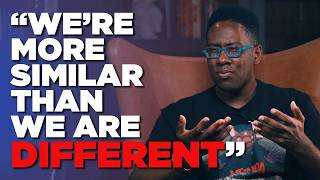
I get exactly what you mean. So I, I, I understand. So to me, one of my deepest fears is being misunderstood. And as a young person that wasn't always confident enough to use my words, like, frankly, the way that I describe it, like, I did not. I barely understand social norms now, but when I was younger, I didn understand social norms at all. I would observe people and how they behaved in an attempt to, like, mimic what it meant to be human so that I could get someone to understand me. So when I'm writing, I think about my audience and my readers. And that style, that aesthetic, the way information is communicated, is all me, like, yearning to be understood. So if you open Weirdo on the first page of the book, I'm in my room playing video games, but on my shelf, there's, like, a Pokemon reference and a Dragon Ball Z reference. Then you get to the next page, and there's a Super Smash Brothers reference. There's a Sailor Moon poster on the wall. There's a Naruto poster on the wall. To me, the reason that was there was because page one, I was like, there are more children's books about inanimate objects and animals than there are about black kids. There are going to be a lot of people who have not had to pick up a book with a black character and relate to that character. So off Rip I got to communicate to you, hey, we're more similar than we are different. You like this thing, I like this thing. You like this thing, I like this thing. You play this game, I play this game. It's all about how do I establish the connection so that you can hear this thing that I'm desperately trying to say.