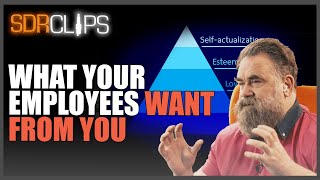
This is a short YouTube episode (Service Driving Revolution) where Chris Collins and Michelle discuss applying Maslow’s hierarchy to hiring and retention. They contrast employees focused on basic needs (e.g., sponsored immigrant technician seeking security) with those seeking purpose and fulfillment, and argue that articulating and embedding a clear “why” and giving autonomy increases motivation, loyalty, and service quality. The clip closes with a call-to-action to subscribe and submit questions.
Chapters
As an employer, it's important to understand where they are on Maslow's hierarchy of needs. So for example.
I was talking about this yesterday with my team and we were talking about in Canada, this client we had had sponsored a technician from the Philippines and, and moved them over, got them a visa and provided them with a job in Canada. And so when you think about an employee that lived in the Philippines and the basic needs of shelter and food and all that are a struggle and they come over to Canada and they now have security, they can provide shelter, food, and also move their family over eventually and citizenship and that they're, they're on the lower end of Maslow's hierarchy of needs and it's very simple and they're, they tend to be, you know, a more loyal employee because their basic needs are very simple. When you talk about some of these younger kids that still live at home, they still live with mom or dad, they don't really have bills and they're higher on Maslow's hierarchy of needs where they're looking for fulfillment, they're not looking for just basic food and shelter. And I think that's compounded with the, you know, the extension of unemployment benefits, the checks the government's been giving out. You know, those things to some degree affect that people aren't in a panic and just trying to pay their bills and trading their time and effort for money. They're looking for fulfillment. And so that's something you want to really understand in the interview and the pre hire dance that we do is where is this person on just the basic hierarchy of needs? Because sometimes for support positions I just want somebody who really just wants to pay for their rent and wants to eat more than they're looking to me for spiritual fulfillment in a sense. And I, I would be curious what you think, Michelle too as far as our culture where less and less people are going to church, less and less people have a spiritual.
Aspect of their life as far as organized religion and they're looking for their spirituality and that fulfillment in their job and in their day to day activities and not so much in an organized religion as they climb that hierarchy of needs. You know, just the basic trading time for money as a job in a.
Healthcare field which is, you know, she's a full time student going through the nursing program. So I recognize how stressful that can be being a full time student. But you know, again, it's like cry me a river, I did it. And also I wasn't living at home. So you're not going to get sympathy in this department? No, but, but I, but I had to recognize even as a parent that, you know, everybody is living their own reality. And so to me it might not seem like it's such a bad gig as she's experiencing full time employment and trying to make sure she makes certain grades so she could get into the nursing program. I mean, she was significantly stressed out, right? So she would come home every day and just say, I'm so stressed out. And so I think that just because we don't relate to someone and maybe our experience was harder or different, so it's harder for us to, you know, have compassion. I think that it's still important to recognize that even if it's not your reality, that's still their reality. I mean, that's the reality that they're living in. So when, when people are moving away from maybe not as many people going to church and people wanting to find more purpose in their work, I guarantee you that she would have stayed employed if there was more of a purpose driven mission and she recognized how she was impacting that organization. But too often than not, especially at entry level positions, we want people to push that work and we don't take the time to make sure people understand the bigger picture of why they're doing something. And so Simon Sinek is a fantastic author and speaker and he talks a lot about how people don't buy what you do, they buy why you do it. And so if you can't articulate that, and he uses a lot of examples in his book, he talks about how when the Walmart founder passed away and his son took it over, all of a sudden the why became very fuzzy and the Walmart organization as a whole was impacted by that. So people don't buy what you do, they buy why you do it. And so it's one thing to understand why for yourself, but you have to be able to articulate that to the consumer. And that can be very difficult to do because the part of the brain that is associated with emotion does not contribute to language. And so it's very difficult to tell people what is your why, what is your purpose, and then to be able to articulate that purpose to the employees that will help you to serve and fulfill that purpose. And, and then to take it a step further and make sure that the people that are choosing you over another tattoo shop or over another service dealer shop, when they're choosing you, they would, they will go out of their way to choose you over and over again if they understand your why? So it's really important that you understand as a business owner, what is my why? Like, why am I doing this? What's the point? Why did you get out of bed this morning? Those are questions you should be asking yourself as a business owner. And, and then how do you articulate that and get other people to rally around and get excited for why you're doing it? That purpose driven work is what keeps people motivated and what drives people to want to apply at your place of employment. More important than money, people want that sense of purpose. Like what I'm doing is not just a task, but it's impacting something bigger than myself. And so that is something that I think every business owner needs to take time and consideration when they're, when they're really finding, trying to figure out why is it that I'm doing what I'm doing.
Yeah, I think of an example of that that we've done before is having technicians in the shop actually meet the customers and putting pictures of customers out in the shop so the technicians understand that, hey, this is a mom with three kids trying to get work two jobs and get their kids to school and the soccer practice and all that. It isn't just a car. You're not just replacing tires, you're providing a single mom with transportation. When they need that reliability, they need consistency because it's a very important tool in the whole system of their life. And you know, attaching emotion to it increases the quality in the shop, but just the overall enthusiasm. Like you said, we understand that there's people connected to these vehicles, that they're not just water pumps and tires.
Exactly. And it's, it's so hard to care about someone you don't know. I mean, that's, that's natural. There's some people that just naturally gravitate towards caring about humans. But I'd say that is not, that is the exception and not the rule. So getting people to care about your, the people that you serve is, is huge. Because now they're not just this person or it's not just this car, it's this car that's doing X, Y and Z. And so I'll also say to that is that this is where a lot of people get so driven by rules and processes and procedures that they forget about just understanding the reasoning and so giving people the autonomy to make those kinds of decisions. The little things are the big things. And so if you close and your policy is that, you know, 15 minutes till doors are locked, we're starting to close up shop and someone comes in is in dire need. If you're following the policy that says close up shop 15 minutes before start closing down, but you're really recognizing, look, all this person needs is a quote and then they can come back tomorrow. We need to help people and give people the safety to think for themselves and say, hey, if I was in this situation, what would I want to happen? What would I want my service dealership to do for me? And so those are the types of employees that we want. We want employees that break the rules for the right reasons, and we give them that autonomy to make those kinds of decisions. Yeah.
Thanks so much for watching this clip of Service Driving Revolution. We're uploading new stuff every day, so make sure you subscribe and click the bell icon so you don't miss out. If you have a question you'd like us to answer on the show, call 8333 Ask SDR and we'll answer your question on the show. That's 8333 Ask SDR. For special deals on our books and training, head over to to offers.chriscollinsinc.com now that's offers.chriscollinsInc.com I'm Chris Collins, and I'll see you in the next video.