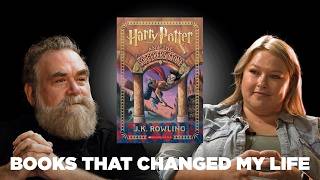
This YouTube interview (Chris Collins series) features Anastasia Narinskiy discussing books that changed her life, primarily the Harry Potter series (the series as a whole). The guest recounts her family origin (born in St. Petersburg, moved to Cleveland at age 4), immigrating to the U.S. as Jewish refugees in 1992, growing up first-generation in a Russian household, and later moving to Los Angeles (15 years in LA). She describes intense reading habits (aiming for 52 books/year; ~39 read so far), cites other influential titles (Valley of the Dolls; You Are a Badass), and briefly mentions a serious spinal injury seven years prior that affected her emotionally.
Questions this video answers
St. Petersburg
4 years old
1992
15 years
Two older brothers
Chapters
Your book that changed our life is Harry Potter. What effect is it having on an 11 or 12 year old?
Now, usually we would be making you a cocktail.
Listen, give me three months.
What do you think of the library?
This is. I want to live here. I want to live in this room. Definitely the Duchamp section then. Definitely the Duchamp section. Big fan.
We moved to this country, we're super poor. I'm such an outcast at my school. My brothers didn't want to play with me, so I'd go off and like, make up my own adventures in this tree house that I made in the backyard.
We love talking about books that have changed people's lives. Like, had such an impact that they are different after reading the book. Today we have a special guest, Anastasia Narinsky.
Okay, so then the big question is.
Yeah.
How did the Harry Potter books change your life?
Okay.
Thank you, Michael.
It looks just like a.
Cheers.
Cheers.
Wow. Just.
Just for the record, the. The water is because you're expecting.
Right, right, right, right, right. This is water.
I'm just kidding.
What do you think of the library?
This is. I want to live here. I want to live in this room. I love all the statues. Love this minotaur guy, Beth, she's.
She's an English artist.
Oh, I thought the Minotaur's name was Beth, and I got very nervous.
No, the. The theme there. Even before the library was built, we acquired that because this leadership experience that I do, we start off with a story about the Minotaur. And so it's. It was kind of a staple. We had to have something in her. Love that, her style. And he's reading a book. It's just so cool.
It's so cool.
How long have you been in LA?
15 years.
And where were you before that?
Cleveland.
Cleveland.
Yeah. I grew up in Cleveland.
That's a big change.
Big change.
Were your parents first generation?
I'm first generation, so. Well, and my parents, I guess so. We moved to Cleveland when I was 4.
So you were born in Russia?
Yeah, born in St. Petersburg.
St. Petersburg.
Yeah. And then we moved to Cleveland when I was four, as so many Russians do, apparently. And. Yeah, and then I came here 15 years ago.
So you were young enough not to really be affected because you were still learning and you're a kid having fun or were you affected about with just the cultural difference?
I mean, I guess I was sort of shielded from it, but I mean, my parents are.
You know, foreigners. So, like, I grew up in their house.
So while I was going to School. And I'm basically American at school. Home is so Russian, so food and movies and, like, tv. Like, I didn't watch cartoons when I was a kid. Cause I didn't. No. So I watched a lot of, like, Nick at Nite as a kid. So, like, Bewitched and I Love Lucy, which I don't think Anyone else who's 9 years old is watching when they get home from school. So I guess I was somewhat affected.
How did you. How did your parents come here? What was the catalyst for that?
So we came here as refugees because it was so rough. Like the Communists, Russia at the time. It was 1992 when we ended up coming over, and my parents were just terrified. They were 30 and had three kids who were young. And a lot of people, what they were doing was sending their kids off to other countries to go to school, like, boarding schools. And my parents didn't want to do that. They didn't want to grow up. Us to grow up without them. So they're like, we got to get out of here. So they started filing for refugee status in other countries. And we're Jewish. We're not necessarily very practicing, but, you know.
Like, it's in our family. So they filed as, like, Jewish refugees and America, the Jewish community in Cleveland was like, we'll sponsor you. You can come here. So we lived with a rabbi. They gave my parents jobs as I think they. My mom sewed, so she. She was a tailor. So they gave her some job as, like, at a tailor shop. And they gave my dad a job moving boxes in a warehouse at night. They put them through community college to learn English during the day, and they just, like, worked so hard.
Did you have siblings?
I have two older brothers.
Oh, so did they kind of protect you?
Yeah. Yeah.
That's great. That's kind of the perfect.
I certainly didn't notice anything. Any hardships, and I don't know if my brothers did either.
I heard that you're reading a book a week.
Yeah.
Overachiever.
Yeah, maybe. I really started reading, like, a lot a couple years ago. I just. I don't. What book did I read? I read some book, and I was just. I was. I would go through phases in my life where I.
I'll read something. I'm like, oh, my God, I love reading. Why am I not reading more? And then I just, like, read all the time. I have a very bingy personality, like, addictive personality. And then I just started reading a bunch. And then every year I would, you know, finish the year off. I'm like, oh, I read 20 books this year. That's great. I think it started with, oh, I'm going to read 12 books this year, one book a month. And then I surpassed it. I read like 14 and I was like, oh, 14, I could do more. So then the next year I'm like, I'll do 24 books this year. And I read more than 24 books. And so this year I was like, I'll do 52. And I think I'm at, I think I'm at 39, but I'm almost done with this one book. So I'll be at 40 soon and so I'll definitely hit it.
If you're trying to read 52 in a year, does it change how you select the books? Because you're not going to read Steve Jobs autobiography.
But I will because I mean the books I'm reading, the book I'm reading right now is like 1200 pages long.
Oh my goodness.
And I just finished another 1200 page one.
And you can do that in a week.
No, but I am always listening to a book and reading a book. So the ones I listen to, I mean, I'll listen to a book in two days, you know, so. And if it's really good, I'll listen to it in a day.
Your book that changed your life that we're here to talk about is Harry Potter. Now is it Harry Potter all of the series, or is there one particular one that was the catalyst?
You know what it is? It's the series in general. And it was such a hard pick to decide because I almost picked a different book entirely. I almost picked Valley of the Dolls by Suzanne Collins. It's like some book from the 60s.
That was made into a movie, right?
It was with Sharon Tate. Yeah, the movie doesn't do it justice. And look, the book is like, it's good, it's great. It's just someone gave it to me because they knew I wanted to move to LA to be an actor. And I just became obsessed with it. And I've read it so many times for that reason. It changed my life. And then actually while I was sitting out there, I was like, you know what book really I should have picked is you are a Badass by Jen Sincero, which is like a self help book.
Who is she?
She's just some. She like wrote this book about you are a badass. And there's a lot more to it, but it's like you should probably stop feeling sorry for yourself if like bad things have happened to you. There's a lot more to it than that.
So it's like, empowering.
Yeah, it is, because I have.
Just step into yourself and accept it for what it is kind of a thing, sort of.
I had this really crazy spinal injury.
Seven years ago and I just was like. I got so depressed afterwards for like a year. And I'm really not. I'm like a pretty happy person.
Generally resilient.
Yeah, Pretty resilient. Like optimistic.
Yeah. You give that energy.
Yeah. Like, for the most part, obviously you're not a victim. Yeah. And this, like, put me in a bad place. This, like, spinal injury. I had emergency spinal surgery. I had all this nerve damage and just like my life trajectory sort of changed. And then I had a friend email me after we hung out and was like, hey, you seem like you're in a bad place and here's some stuff.