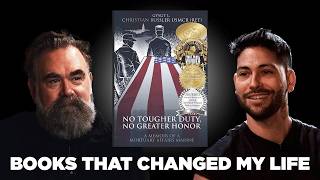
This is a conversational interview where Chris Collins and guest Anthony Caravella discuss the book No Tougher Duty, No Greater Honor and how reading transformed Caravella’s life. Caravella describes a difficult youth, reverence yet estrangement from his father, discovering reading around age 18 (finding two books on his nightstand), and how books became a sober-life anchor and lifelong habit. The interview also covers practical details—he evacuated during regional fires (took about 11 books), lives in the Woodland Hills/Calabasas area—and broader reflections on community, material possessions, and shared humanity.
Questions this video answers
About 18 years old.
A Nicholas Sparks novel (he recalls Dear John) and a Robert Greene book (referred to as "War").
About 11 books.
Woodland Hills (bordered by Calabasas/ Mulholland/Topanga).
Chapters
So the book we're talking about, no tougher duty, no greater honor. What did your parents do growing up?
My dad was a car salesman. My mom was a stay at home mom. My dad wasn't around very much.
What was your relationship with him like?
I revered my dad. He was a superhero. I used to dream of like retiring him one day.
Is he still around?
He's living.
Do you not have a relationship with him?
No. What happened?
We love talking about books that have changed people's lives.
Like, had such an impact that they are different after reading the book.
Welcome our special guest today, Anthony Caravella.
I was living a life that was going to end up either in the graveyard, hospital or jail. I had always had this feeling that I had more to give.
How did no tougher duty, no greater honor change your life?
How's it going, Anthony?
Pretty good, man. Thank you for having me.
What do you think of the library?
It's amazing. My wife, she, she, she always says I have too many books. And I've left books on the side of Sunset Boulevard when I was like getting evicted. And, you know, like, I just couldn't carry that many. So, you know, I love a good library. Really important part of my life or books. You know, I wasn't always a reader. I probably didn't read my first book until I was like 18 years old. You know, like in school they would always, like, make us go through like the curriculum, whether it was like Beowulf or, you know, any of those other ones, and couldn't appreciate it. You know, I didn't want to be in school so much that I never took the time to realize how much, you know, I loved storytelling. And then when I was on my own and I was alone, completely alone, you know, I'd moved away. I was 18 years old. And I remember picking up a book, and it's so funny because there was two books on my nightstand that somebody had left there. And one of them was a Nicholas Sparks novel. I think it was Dear John. And the other one was Robert Greene's. I think it was War. And I just remember, like, all right, what do I. I don't have a tv. I don't have the money for a tv. So I just started reading. And then it just like became this, like, thing where it was like I couldn't stop. Like, I had, like, discovered this thing that had been in my life, but I never really had done it. And since then it's like, you know, I'd like to say I got sober 10 years ago, but My addiction kind of morphed into this book, you know, like, habit of, like, I can't get enough of them. And I'm always reading, you know, several at the same time. I have them placed throughout my house so that, like, any room I walk into, there's just a book laying there that I'm in the middle of reading. And on my bookshelf, I'll keep five or so facing outward with the COVID outward so that I know that that's the one I'm reading right now. And as I'm done, I just keep switching them. And I could tell it drives my wife crazy. Cause I leave them everywhere. Like, under my bed. There's books in the bathroom, there's books. Every single surface, there's a book on it. And so when I see a library like this, I'm like, man, this is amazing.
So what is your style? Like, you know, if you like books, you eventually have some sort of overflow or they don't fit on your shelf anymore.
Yeah. I mean, I have boxes in my garage like, that. You know, the other day, I was cleaning out my garage, and I was like, oh, my God. I found all these books from our apartment 10 years ago that, like, just have never made it out of the box since we moved. Yeah. Luckily now, you know, we moved into a house where I have a lot of shelving. You know, I have these bookshelves that used to house my wife's shoe collection. And now it's just all books. So for me, it's getting to see them all out and stuff. It's amazing.
You know, that was one thing for me, because I had put so many books in storage and boxed them up as we moved. And also, I had a ton at home that were, you know, stacked and in rooms. And that sort of thing is. When we finally got the bookshelves in here and I got a lot of my books out, I felt different about the collection.
Yeah.
And remembered books I'd forgotten about that had meant a lot to me, but I'd completely forgotten.
Yeah. And, like, that was. That's the crazy thing about, like, I'm not a materialistic guy. You know, some people collect cars, watches. Oh, thank you very much. You know, they collect, like, things like that. And for me, like, you know, especially with the fires and everything that just happened when we got evacuated. It's funny, like, people always say, like, what would you take, like, if your house was on fire? And, you know, when you get that in real time, you realize how much stuff you're essentially a Prisoner to the stuff. Ends up owning you, and you're leaving, and you go, I just need us. I just need the people in here. When that happened, it, like, reinforced this thing that I already believed that, like, we're all renting what we. We think we own, whether it's our houses, our cars, you know, it all goes back to the same place at the end. You know, it's never ours forever. But with books, it's funny. It's, like, transient. It can like, almost, you know, leapfrog all these boundaries that, you know, we all live amongst. And for me, the library and, like, the things I've learned from books.
It doesn't seem nearly as ephemeral. You know, you can learn from it, and then you can have a conversation with somebody, and then you distill what you think you've gotten from that book and you talk about it with somebody else. And so it's like this book is this living, breathing thing. It's not just paper. It's how I feel about all art, that we get the chance to experience it through our own experience and our own life. And then the way it comes out of us and the way we share it with other people and the way we discuss it with other people, it makes it this thing that never has an end date, an expiration date. It just keeps changing and changing. And so that's why, you know, I love books, movies, music.
So when you're getting evacuated, did you take books?
Yeah, I took, like, 11 books and.
I did the same thing. Yeah.
And, like, it was so funny.
Like, birth certificate, like, all that stuff out of the safe. But, yeah, no, I loaded up the dogs, of course, and then the books.
So all the very, very, very important people are not replaceable. So, like, you know, your family obviously comes first, and you get all that together. But then you're like, I got five more minutes. And so I'm like, all right, I'm reading this book right now. I haven't read this book. And I just got this one and just shoving it in my car, and I'm like, you know, once you get to where you're going, you're like, unload everybody. Everybody's safe. Okay, now I could go back to my book, you know, and that was.
An interesting moment of time for me, is that moment of, oh, we're okay. What are we going to do? Like, when you're getting evacuated? Yeah, because it does, like you said, you think about what's really important, and you're like, okay, well, if it all burned, I guess Like, I don't know.
Yeah.
Like, you can't. There's. It's kind of out of your control, in a sense.
Yeah. There was something really freeing, you know, Again, like, we were fortunate. Like, you know, we. Our. Our neighborhood was fine. We didn't lose our house.
You're in Malibu, right?
We're in Woodland Hills, like the Calabasas, bordered by Mulholland, Topanga, buddy, that was.
The one thing when you. The one place when you would see it from the helicopters that they'd cleared the brush, like Calabasas, like.
Yeah, it's.
There was preparation there because it was. It would have had to jump right. Pretty far to get to the houses in a lot of those spots.
Yeah. And, like, you know, when the fires were happening, it was like, you know, they were popping up everywhere. And, you know, you. You're sitting there and it was. It was weird. You know, I. I grew up so close to where 911 happened, and, you know, it's the only thing I could really remember that felt in the same way, like, where you were, like, glued to the TV and the radio, and, like, all of a sudden everybody is, you know, texting each other, and it's like this sense of community comes back that we lose sight of a lot, you know, where we get stuck in our own world. You get stuck in your car and traffic every day, your career, you know, your ambition. But it's like a natural disaster or an event so great, like a 911 and things like that. You really do get to see that when all the chips are down, everybody's contacting everybody. How can I help? Are you okay? Where. And it's like, I want that without the disaster. I want that without the buildings falling, you know? You know, and it makes you appreciate it because we have so many differences today that are like.
They're so. It moves at such a fast pace, you know, before you know it, you're onto the next thing. And when stuff like that happens, it's this really serene chaos, if that makes sense, where everything's burning, literally. But yet the people closest to you and the people that really do care about you and the sense of community, your neighbors, everybody. Everybody's all working together. And that was. It was really interesting to see again.
You know, how would you create that without the disaster? Like, that's a fascinating way to think about it, because. Yeah, like, it is. Well, I guess in that sense, like, when you're thinking about life and death and, you know, being evacuated, your perspective changes, and you have way more in common with people when it's about the, you know, just the basic idea of living. Yeah, right.
Yeah.
The. All of the politics and all that kind of go away because. Well, I mean, I remember when I was a kid how. And I'm older than you, but there was a lot of tension between the US And Russia. Yeah. And then I remember I had friends that went to Russia, and they came back and they're like, oh, no, the people are super nice. They're. They. They want family. They just want opportunity. Like, they're not much different than us, but in the media, there's this whole thing that we got to hate each other, but those are the governments. Like, the people, you know, are very similar to us in a lot of ways. We have more in common than. Than different.
Yeah. And I say this, like, quite often. Like, everybody should travel across this country once or twice in their life and drive and spend time in different cities. Because when you drive across this country, you realize in every city, every state, it's not red, it's not blue, it's not Republican, it's not Democrat. It is people trying to do the best with what they have under the circumstance in which they live. They want to put a roof over their head. They want to raise their kids, they want their kids to go to good schools. They want to see, you know, their neighborhoods to be safe. That's all they want. And the media, and especially social media.