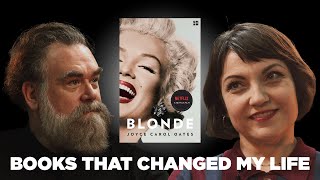
Jackie Jarrard found Joyce Carol Oates' Blonde in a used bookstore around 2006 while raising two young children. The fictionalized biography of Marilyn Monroe helped her see her own invisibility as a mother reflected back at her, and opened up what womanhood and identity could mean.
Questions this video answers
She said "I think, 2000."
She recalls reading it around 2006–2007.
In a used bookstore in her hometown.
About 3 and 1 years old.
Maybe about 25 years old.
Chapters
There's a story that my mom tells. I don't remember this because I was too young. I think I was 2 years old and she had me in a stroller in the grocery store. She said there was like this group of teenage, kind of ish boys. And they were like, your little girl is so pretty. She looks like Madonna, who at the time was a full grown, very sexual woman. And my mom's like, this is a two year old. But I feel like it's emblematic at a very young age being given some strange attention that there's no way that I could comprehend or ask for and even process. And then that just continued the older that I got.
And so how does that affect your view of men?
It's a complicated question.
This whole conversation is complicated.
Today we're talking about a book that changed somebody's life. Once they read this book, they were never the same.
We have a very special guest, Jackie Gerard. She is a licensed, licensed marriage and family therapist. She has her own podcast. She's many things, one of which is incredibly fun to talk to and smart. Somebody I could talk to all day. The book that she chose is Blonde by Joyce Carol Oates.
What is your. Your process? Like? Do you have a time of day you read? Like a certain ritual?
I guess I tend to read at night at this point, like before bed, which is good because it helps you get off your phone before bed, which, you know, the blue light is bad for us. So I try to go to bed, read a few pages. Some people get sleepy when they read, and it kind of puts them to sleep to read. So maybe reading in bed, they don't get very far, but for me, it doesn't. I can stay awake pretty long reading and sometimes.
So how long, like, how long will.
You go at this point? I don't know, maybe 30, 40 minutes of reading. And then I do get tired because I'm trying to go to bed. But I love reading in bed because it feels cozy and it feels personal.
What are a few of the books that you always kind of go back to in reread?
Oh, my gosh. Okay, so there's this one. Well, it's not fair to answer this way because it's called House of Leaves and it's sort of a really long, experimental kind of horror novel that's kind of a love story in disguise.
Choose your own adventure a little bit.
It's a little bit of that. There's two narrators, there's a whole frame story, and they're kind of being told simultaneously. Anyways, and it's really scary and complex. And I've tried to read that again several times. And I haven't been able to get through it because it's really hard and it's scary. But I did read it all the way through the first time. So that's one that I go back to a lot, even though I don't think I ever finished reading it for a second time. The Little Prince is another one that I read all the time, every once a year. The Great Gatsby, I probably read once a year. Yeah, those are definitely ones that I go back to.
Wow. And you've been doing that for a long time, rereading them for always.
Yeah. The Little Prince, I read since I was a kid. And I still go back and read it, like, almost every year.
So that's what I'm gonna have to read. I haven't read it, and it keeps coming up now.
It's very good. It's very good.
Kind of like the Alchemist for a while. Like, people just kept mentioning it and mentioning it. And then it hit me at the right time. So Blonde.
Blonde, yeah. Kind of.
Where were you in life when that book came into the picture?
It was actually kind of hard for me to remember the answer to this because the book came out in, I think, 2000, and I didn't get it right away. I'm a huge fan of Joyce Carol Oates, who is the author of this novel. She's an extremely prolific writer. She is, in my opinion, the greatest living American author today. So I didn't stumble across it until years after it came out. So I wanna say it was maybe 2006, 2007. I do remember buying it in a used bookstore in my hometown. And I was there with my two daughters. And they were pretty young at the time. I was a young mother at the time. Yeah. Two little kids, like 3 and 1 years old. Maybe I was, like, 25 or so. So I was young, you know? And I love her. I love. Joyce Carol Oates writes. And this book is a fictionalized biography of Marilyn Monroe.
Now, when you buy the book, are you more excited that she wrote it or that it's about Marilyn?
I think just anything that Joyce Carol Oates writes, I will buy. I will read voraciously. I can't say I've read everything she's ever written because she's written hundreds of novels and short stories. But I've read almost everything. Anything I could get my hands on. So it was really her that led me to Blonde. And it Just happened to be that book was what she wrote about for that book, you know, But I was very excited to read anything that she wrote.
So what is life like having a three year old and a one year old as a mom?
It's hard. It's hard. And I was young, I was pretty young at the time. And you're alone, but you're with these two little people all the time too. And even if I was married at the time, you know, and it doesn't matter, you're still alone. I was a stay at home mom with these kids and it's wonderful. I love my daughters, I loved raising them and being home with them. But you kind of start to feel like you're not a whole person anymore and you just become this mother. And I didn't want to just become a mother. I wanted to still be a whole person. And I think through literature and specifically Blonde, it touches on so many themes of what it means to be a woman and what you have to do to be a woman. And I didn't know that when I picked it up at the time that I picked it up. But as I read through it, I mean, it's already like emotional to me, just like connecting this stuff and remembering the themes of this book. It's really, really profound.
So when you feel alone like that, are you feeling alone because you're.
Serving others to a degree that you don't ever feel like you matter or that you're serving yourself because you got kids that are unpredictable and then you have a husband, like, explain that feeling to me, like what it is in looking.
Back, you sort of become invisible. You're there. These people, especially the children, are really relying on you and, and they need you desperately, like literally for survival. And you're doing for them and you want to do that, but hardly anyone is doing anything for you. And hopefully it would include a husband taking care of his wife in certain ways during that time. But it doesn't always, and it's not always his fault. And you know, whatever, maybe that's a whole other story, but you just start to feel like you are a function, that you're not a person anymore.
And it's routine, very routine. And you're right though, there is sort of this unpredictability or chaos that is also built into this really kind of boring, mundane routine that you end up in every day. So it's kind of this combination of every day is the same, but then all this different stuff happens every day and you don't know what's gonna happen or who's gonna have a mood or a tantrum, you know, and you're always trying to catch up and keep up with that and.