Books That Changed My Life: Jonah Tucker & War Is A Racket - General Smedley Butler
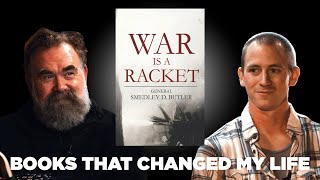
This is a conversational interview (host Chris Collins, guest Jonah Tucker) about books that changed lives. Jonah, a former Marine officer, discusses his background (grew up near St. Louis), military service (five years active duty beginning 2016; active-duty exit 2021; later reserve activations including long exercises and deployments), and how Smedley Butler’s War Is A Racket (written/published in the 1930s) influenced a moral reckoning about the military and the military‑industrial complex. Jonah explains his roles (combat instructor/evaluator at 29 Palms, logistics officer), critiques prime contractor dynamics and logistics fragility, and describes how Butler’s blunt, non‑partisan critique helped him reconcile loving Marines while opposing certain system incentives. The interview also covers Jonah’s post‑service life (co‑parenting his son Benny, tattoos, continued reading).
Questions this video answers
2016 (five years of active duty beginning in 2016).
2021.
He says he did not read it until 2021, though it was recommended to him in 2017.
Published / written in the 1930s (commonly cited as 1935).
Chapters
Chapter 1, War is a Racket. Where were you in life when this came into the scene?
I'm in kind of like a moral dilemma of how do I feel about the military? Because I care about being a Marine, I care about my guys. And then I remember this book, War is a Racket.
So you're kind of at a crossroad.
Of is the mission that I'm supporting worth risking my life and, like, the lives of people that I care about for?
We love talking about books that have changed people's lives.
Like, had such an impact that they are different after reading the book.
Welcome our special guest today, Jonah Tucker.
Do I need to be in this country? Am I here for the right reasons?
Big question. How does War is a racket change your life?
Oh, God.
Hey, Jonah. Jonah. Good to meet you. Nice to meet you. Yeah.
Oh, gosh, you're reading The Body Keeps the Score.
Yeah, I'm getting through it right now.
How far into it are you?
Slowly but surely maybe like 15, 20 pages. I just started. Ryan mentioned the podcast to me and I was like, start reading again. So I, I picked up the next book on my list.
That's a good one.
Yeah, it's. It's solid so far. You know, it's. It's just talking about his, like, methodology up to this point and kind of how the. How the author started studying PTSD with, like, whenever he worked in the VA or one of the VA hospitals. So still getting into it and kind of the. I haven't gotten to the lessons learned yet, but I'm understanding his methodology and it's. It's some pretty familiar stuff.
There's a couple times I had to walk away. Yeah, it gets pretty rough.
Yeah, I can imagine.
When did you get out of the military?
So I left back in September of last year. So I did five years of active duty starting in 2016, or I got out of active duty in 2021. And I was planning to just stay out, but then they offered me good orders from the reserves and I was like, okay, I could, I could go have fun with this job. And then they just kept doing that to me for the next three years. So I had just shy of three years of active duty time after I got out of the active duty world.
So is that like a contract or.
How does that work? Yeah, so I went to a naval academy. I went to a military academy for college, so I had a five year obligation out of that. And then after my obligation was up, I owed two years as an inactive reservist and they just send you emails of like, hey, this, this is open in the active duty world if you guys want to come over for a little while. And the job that I asked for when I was active duty came up. So I was like, yeah, I can't say no to that. Like, I wanted this job when I was active.
What was the job?
I was a coyote, a combat instructor or combat evaluator for the biggest exercise that the Marine Corps does out in 29 palms by Joshua Tree. I went and lived in an RV with two dogs out there for a year to evaluate this big, like 1500 Marines on each side. And they kind of do a force on force exercise where they, they fight each other with tanks and planes and jets and yeah, a very, very, very cool experience to roll around in dirt bikes.
And so what are you, what are you. What are you grading them on?
So we start by doing live fire ranges where we're evaluating, like, okay, this is, you know, these are how your shooter's set up. These are how your teams are moving. Are they moving with COVID Are they moving while another team is shooting to cover them to, like, keep the enemy's head down? Or are they just kind of like sprinting towards the objective without any fire? And then we're like, okay, cool. We tell those people that they're dead. And then we just kind of evaluate the leaders on how they handle the situations that we put them under. And then the force on force exercise, we step away from the instructor role and we strictly paint effects of like, okay, the other side's helicopter saw you, did two strafing runs. You have these many casualties. And then we force them to do the casualty evacuations. So we basically, if you grew up like, playing soldiers with your friends and you're arguing like, oh, no, I shot you. Oh no, I shot you. We're the ones that told them who shot who. And then at the end, we do the big after action report of like, hey, here's how your team did. We give a report to their usually an 06 colonel commander.
Have you noticed any patterns or characteristics of the stronger leaders in those scenarios?
Yes, I think the biggest thing was the guys that. It's terrible, but the guys that didn't give their guys too many breaks.
There is this kind of compassion that we have as leaders to be like, okay, we did this range. Take the next day off or go relax in your little hut for a couple hours. Those guys will usually make the same mistakes the next times that they go out versus the guys that are like, okay, hey, here's what we did. Here's what the coyote saw. Here's what I saw as your leader. Here's the things we need to work on. Let's go get them while they're fresh in our head. So the guys that recognized the problem and then immediately went after it did a lot better on the second and third run of the live fire ranges than the guys that were like, all right, let's take our breath and reset and try again tomorrow. Yeah. The aggressive leaders always, always succeeded.
Wow, that's fascinating because you'd almost think the opposite, right?
Yeah. You're out in. I don't know if you've ever been out to Joshua Tree, but you're either out there in the blazing heat. You know, there's the summer courses where it's 110 degrees. You're out in body armor, trying to stay hydrated. Yeah, you've got your camo back on, but, like, you're in 40 to 80 pounds of gear doing dead sprints and shooting, and you have the heat coming off the gun. Some dudes are shooting rockets. There's a lot of intensity going on. And then the teams that really did well were like, okay, that sucked. Everyone get some water. Get in a circle. We're going to talk about what we did, and then go right into drills to practice for the next run that they do the next day.
It's incredible.
Yeah, it's fun. It's a wild team. You know, the Marine Corps. There's the joke about the branches of, like, the Navy is a travel agency, the army is the military, and then the Marine Corps is a cult. The Marine Corps is. Is definitely a cult. Yeah. The crazy ones do really well in the Marine Corps.
That's funny. Yeah. They are culty.
Yeah.
I mean, they're all kind of culty.
To a degree, but, you know, the Marine Corps, like, we have our own. You know, we've built up our own almost language of very, like, weird grunts that we can communicate with pretty easily. And I don't really see that in the other branches. On my last deployment, it was a joint tour. I was out with the army of the Air Force. There was, like, 10 Navy guys on our team of 300, and then eight Marines, and then the rest was army and air Force, and the Marines were. We stood out. You know, it's. We worked better together, and there was definitely a pressure to, like, represent your branch well, especially with so few of us. Actually, one of your people, Christina, her cousin, was my coworker out there, and that's how I got linked into you guys. Yeah, he was. You know, it was great working shoulder to shoulder with another Marine in an environment like that. I really love the Marine Corps.
Yeah, it's a brotherhood, right?
Yeah, it's. I stick with Colt, you know. Okay, so I take it back. I don't love the Marine Corps. I love Marines. There is, like, a distinction there for me, and I try to remind myself of that one.
The book we're here to talk about is War is a Racket by Smedley Butler.
Yep.
Where did. Where did you grow up?
I grew up in St. Louis, Missouri, originally. Were you a Rams fan? No, not really. They followed me out to la, and I'm still not a fan. They. They were good whenever I was a kid. They sucked right around the time that I was leaving Missouri, and I kind of faded away from being a Rams fan. I was more of, like, a hockey fan anyways. I like the blues.
What's it like growing up there?
It's interesting, you know, I grew up outside of St. Louis in a little town called Crystal City. I enjoyed the backwoods. I enjoyed going into the city. It was kind of nice being on the edge of both. You know, you have the boot heel. Like, Southern Missouri was probably 20, 30 minutes from me, and then St. Louis was probably like 15, 20 minutes from me. So I could do a little bit of both. But, yeah, I think I leaned more towards the woods and being outside than, like, going into the city and enjoying, like, urban life.
Did you shoot guns early?
I did, yeah. I think the first time, yeah. I grew up hunting a little bit. The first time I shot a gun, I was probably like, 8 or 9. I was visiting family in Tennessee, and they're like, yep, it's time to go do it. So they took me out there, they walked me through all the safety stuff, and then we shot for the day. I hunt a lot more as an adult than I did as a kid. I think I only went on, like, two or three trips.
What would you hunt there as a kid?
Squirrel and rabbit was kind of the consistent one because it was easy. You could do it anytime. There wasn't a season for it.
Do you teach people how to shoot?
I take my friends out and I'll walk them through classes. I never really got. I evaluated motor transport companies whenever I was an instructor. So I was teaching their platoon commanders, their company commanders, kind of like the tactics of using motor transport as weapons, you know, using, like, gun trucks and everything. Never really had anywhere. No one never asked me to teach them to shoot. Unless it's like an LA friend that wants to learn, you know, Marines were usually as good or better shooters than I was.
What have you been doing since you got out?
Hanging out. I have a two year old son. Christine is actually watching him right now for me, which I really.
Oh, is he here?
Yeah, he's outside.
Oh, you'll have to introduce me.
Yeah, we'll go.
What's his name?
He's Benny.
Benny.
Benny Kaishwin. Tucker. Leo. Yeah, he's. He's fun little guy. Just turned two back in December. But yeah, I've just been hanging out with him honestly. I got out in September. I made a decent amount of money while I was deployed and I didn't really have any expenses, so I've just been living off of savings and kind of taking my time, you know, I left, I left California when he was 10 months old and I got back when he was 22 months old, so know I missed making up for time. Yeah, his mom went to a job in Atlanta right after I got back, so I had him for almost four months straight. Yeah, it's.
Is she back?
Yeah, she got back in early December.
And you guys aren't together?
No, we separated about four months after he was born. Just kind of didn't make the relationship work, you know.
But you get along?
Yeah, we're good co parents. We're very good at like keeping things focused on Benny. Couple arguments back and forth. But nothing like that gets in the way of raising our kid, which is important, all you can ask for, you know, in a situation like that.
So what are you going to do?
We'll see. I. I have two job offers right now. I'm waiting for a third. I'll probably stay in the logistics world because that's just like supply chain. That's what I know.
Have you always been smart like that?
I don't know about smart.
Well, logistics requires a certain understanding of depth and strategy and creativity.
Sometimes I think military logistics.
Because of.
The threat of your stuff getting blown up or people getting hurt and the mission getting redirected. We pump a lot of assets into logistics that kind of make the principles of logistics and can I maintain stock above what I need or do I have enough stock at this location to resupply this location if I need to? Because we've been in the Middle east for going on 30 years now. We've had these big stockpiles, they call them iron mountains usually of like I can dump a lot of stuff here and kind of push it out to my Little stations. I think that they really have lost a lot of the principles of like what logistics is in a contested environment because they can have these big iron mountains. And that was a big thing we focused on in the exercise. Like, okay, in a force on force exercise where you're competing against somebody the same size as you, you can't build these giant stockpiles because they can just bomb them. Which hasn't really been a threat in the last couple wars.
But if it was China, right?
Yes, up against China, you know, they'll see. We couldn't build a base like we have. Altacatum in Iraq. Is this giant right at its largest, I think it had 3,000 people on it. Can't do that in the desert against a big force that has aircraft and yeah, bombers. And you can do that against guys that have suicide vehicles and maybe like rockets and mortars and stuff, but you can't do that against people that can really do damage the way that an aircraft can do. So I think that they have to flex those, they have to relearn the principles of contested logistics. And I think the exercises that we do, it's called Integrated Training Exercise ITX or Modern Warfare Exercise mwx. I think that those two exercises are really forcing them to reconsider how we've been doing logistics because our experience, even our like most senior guys started in the same war that they're in now. You know, that's the guys that have been in 30 years were desert Storm guys.
What did you think of Russia's initial logistics going into Ukraine?
I think that they kind of had the same advantage that we did in Iraq and Afghanistan of being the bigger force, not really competing against an equal military. They could build those iron Mountains too, but they had years and years of years of corruption and they hadn't dumped trillions of dollars every year like we do into our military. So their stockpiles that they had stored up, you know, those tanks were, I think about this, because that was a big conversation we brought up is like, okay, this is the war against the people that we're talking about fighting one day. We need to study this. And I remember very vividly this picture of a tank yard that probably five or six hundred tanks with the tops taken off and moss was growing into them. They had plants growing out of the side and it almost looked like a post apocalyptic movie the way that these vehicles were just not maintained for 10, 15 years and had become like a garden. That doesn't really happen in the US Military because we don't leave Equipment sitting around like that very often. But yeah, I think that there were a lot of lessons learned from their logistics mistakes early on. I think that they had the advantage of dumping a lot of money into the problem as soon as the war started. And they've kind of thrown people and money and resources against a probably smarter force on the Ukrainian side. And now the Ukrainians are getting the technology and the equipment, the manpower from other countries. That's kind of whenever you saw the tide start turning. And now it's looking like it might shift back as people are getting less invested in the war because it's dragging on a lot longer than we want it to.
I think that a lot of people don't understand, like, how much the details matter in those sort of logistics. Like, I read Maddox's book on. It's actually not really a book, it's kind of like a pamphlet on the Gulf War and what his rules were and then what he learned or whatever. And like, literally they would court martial somebody if they had the vehicle running, because fuel, we had to take fuel from here to there. The cost of. Even though they have like oil like right there next to us, it's not refined, right?
Yeah.
So we had to take gas over and like, you know, soldiers want to run the air conditioning or whatever in the desert, but you don't have enough gas to do that. And so when I was watching the Russian thing, like, I think a lot of people don't appreciate how hard those logistics are just to get food and fuel and the right stuff to the right place in order to then fight. Like, it's a. It's a complicated logistical thing to pull off and keep consistent. Right. Because the lines can break in different.
Places and, and smart logisticians are very few and far between.
Myself included. Logistics was my 24th choice of 26 possible career fields that I could have gone into. There was nothing in me whenever I started that made me want to be a logistician.
Oh, really?
I got good at it, but I started as a ground intelligence guy. I went through the first school I was doing okay, but I wasn't really invested in it. And I was talking to my instructor and he's like, yeah, man, if this isn't the world for you, you need to go do something, something else. Because it was an infantry school to be a ground intelligence officer. So he's like, yeah, you know, infantry is not the world where you can kind of have your heart in it. He's like, we're going to push you to something else. So Then I switched over and became a logistician, but it was still so low on my list. And I think.
What was number one?
Intelligence. Yeah, I wanted to stay in that world. There's four, at least. There were. I don't know if there still are. There were four fields of intelligence. Human ground, air, and signals intelligence. And I had those four at the top of my list. And then artillery, infantry, kind of the combat arm stuff underneath that, and then all the support stuff at the bottom. I'm really glad I wound up a lot of station. I got a lot of really cool experiences and I did find something that I care a lot about, which is not something a lot of people get in the military.
How much does psychology and human behavior play into logistics? Like, do you have to. Do you have to account for that? Yes, because when I was reading Maddox's rules or whatever, like, there were some strict rules to overcome. Human nature, like, can't run the ac, you can't leave a vehicle running. Like, there were a lot of things that you don't think about.
You know, human. Human factors is kind of a big thing that we talk about. They. They give you this book of like, this is what a consumption rate is for a company for water for a month, right? And you have these like, layouts of. Usually have a smart card of like, okay, I have a company here, a company here, company here. This company's averaging this much water, this company's averaging this much water, so on and so forth. But you have these perfect charts written by these really smart logisticians. And then you take them to the desert and you're like, well, yeah, no, duh. They're drinking more water, they're showering longer, they're doing things to keep themselves cool. They're dumping water bottles on themselves. So, yeah, I probably need to account for another 20, 30% of water because of these human factors, because of these decisions that these guys are making. I think the court martialing for leaving the AC on, like that thing that. That concept has kind of died off because, yeah, it was early. Yeah. Now that we're not.
Our equipment got better. Everything got better. And we learned a lot, right?
We learned a lot. I don't know if I'd argue our equipment got better. No, it got. It got more specific for what we were doing. But it. The Humvee is like a pretty flexible vehicle, right? The. The Abrams tank is a pretty flexible vehicle. You can use both of those in a lot of environments. The mrap, the Bobcat, like, a lot of the vehicles we Designed specifically for the Middle east, would never make it in the Pacific. Probably wouldn't really do that well in Europe either, because they're so dependent on.
They're all terrain vehicles that can travel on crappy roads that you don't care about maintaining. But if you're driving it through, like a friendly country and you're crushing their highways and shortening the lifespan of all of their highways during a war, that's. It's not going to work out. And it's not a jungle friendly vehicle. You can't really do anything in the Pacific. It's not a fuel efficient vehicle. So you can't do the long stretches. Whenever you're talking about, like, planes of China or planes of Mongolia, it's very good for the Iraq war and not. Not good for a whole lot else. And you can actually see those out with LAPD if you. If you look, the big black armored vehicles, those are just resold Bobcats from the military.
Wow. I didn't know that. I've seen them. So what was the first book you read as a kid?
I don't know about the first book I read. The first book I remember was my dad reading me Old man in the Sea, which I think you guys talked about with another guest at some point.
Yeah, yeah, that's been coming up a lot.
Yeah, I have a tattoo from Old man and the Sea on my ribs. It's.
Oh, you got to let us get a picture of that.
Yeah, yeah, absolutely, we have.
It's funny how many people that have come on here have had tattoos of books.
Yeah, well, I was talking earlier. Yeah, I want to get a Dostoevsky tattoo. I took Russian in college. I used some Russian during my work. I've got my Hemingway tattoo. I want to get my Dostoevsky tattoo. I've got a Captain America comic book tattoo. So I'm kind of working my way through my literary experiences. But, yeah, my dad is a big Hemingway fan. So Old man in the Sea was kind of like my bedtime story growing up.
So what does that story mean?
I think my dad. It's not like he just, like, sat down and read the book. He kind of, like, did. My dad's from the south, so he kind of did his own interpretation of it. And I think it was more about perseverance and more about doing the hard thing. I think was the message. My dad wanted to pass Vice more. What Hemingway was getting out of, like, this is kind of this guy's big calling. This is something that he has to do to prove who he is. And more of like, a test of masculinity, because that's.
But isn't. In the end, isn't the fish, like, all. You know.
Yeah, it's destroyed. And it's. It, you know, that. I guess that's kind of the part where my dad's side of the story fell apart because, like, okay, the message he wanted to convey was like, if you persevere, you'll succeed. Right.
But then you have nothing.
Yeah. In the story, he persevered, and then he docked and he had to go to work the next day because he didn't get his big fish, you know, But. But he won, right? He. He. He showed that he could still do these things. He showed that he still the same man that he was whenever he started fishing, which I think is more of the message.
Do you believe in that? Like, that it's. Even if you.
If you lose, you still win.
I think there's value in it.
I don't think that you should live your entire life that way. I don't think, like, every. Not every hill is worth dying on.
If your fish is getting eaten up and you're surrounded by sharks.
If that's your livelihood, maybe you cut bait and you leave. Right. You drop the fish and you leave. Right. And sometimes you have to do that. Sometimes you have to persevere. Right. But, you know, growing up and hearing this story as a kid, the important thing was to instill, like, persevering through struggle. So that's more of what my dad focused on. I think as an adult, you have to have a little bit more nuance to the story and recognize that there are times where it's worth persevering, and there's times where it's not. But if you don't teach people to persevere early, they don't learn that, or they learn it in a more painful way than they need to.
Can you think of a time in your life where you persevered, and in hindsight, it probably wasn't?
Yeah. A couple.
Trying to think of a good example. I think.
The most recent one I can think of was this. We were shutting down a base in southern Syria, and I switched from. So I was originally the current operations logistics officer. So I was planning, or I was executing the plans that the future operations guy was. Was making. And then I switched extensive activities to do kind of more of this sneaky stuff.
And as the current operations guy, I got the mission to help shut down this base in southern Syria that had TOMF garrison, or at least The Special forces side of it, the conventional guys were going to stay there.
And I really, really, really, really died on the hill of, like, I'm the guy that's doing this. Even though I'm in the sense of activities job now, I should get to close out my project because another friend of mine showed up and he's like, okay, I'm the current operations guy now, but I'm like, okay, I started this. I want to finish it. Because that's just the mindset that I have. And I really, really burned a lot of bridges trying to force my way into, like, getting to close that mission out. And in the end, at the end of the day, like, I could have just let Gary do it, you know, He's a very competent logistician.
I don't think I ever.
I. I think I always trusted him to do it, but I think my ego got in the way a little bit of, like, I. I started this, I finish it, right?
In hindsight, I probably had other things that I could have been focusing on and doing my job, Vice, trying to do someone else's job. And it really burned my bridge with the lead logistician on the team, the colonel that I was working for, which did not make my job easier later.
It's a great example. Do you feel like when you start a book, you have to finish it?
No, that's a really bad. I'm the exact opposite with books. Video games, not movies, so much, but most media that I consume get 80 or 90% of the way through with it, and then I convince myself that I understand the message and I stop. With the exception of, like, fantasy books where I'm kind of, like, reading the story for the story. If I'm reading, you know, I'm really trying not to do it. Body keeps the score. I did it twice with this book before I finished it. I will convince myself I understand the full message, and I just feel like I'm reading, like, repeating lines and I'll stop reading the book. So I'm the exact opposite with books, unfortunately.
You like Alchemist?
Yeah. The Alchemist is where I started. My ex. My kid's mom got me the Alchemist for my birthday one year and then wound up getting me the whole Palo Coelo box set a little bit later.
How many of them have you read?
I think I've read almost all of them up to this point. I still need to read the Archer because I loaned that to a friend and he never returned it.
Don't do that, Matt Simcoe.
You're not A library?
Um, yeah, I'm not a library, but, you know, it was. There was just, like, a big rotation of the unit that I was working at. All the lieutenants kind of had like a. You have unit libraries that you steal from, and then you have like, oh, yeah, my buddy's reading this. Like, can I borrow that once you're done? Sure. And then you kind of, like, pass books to each other, and it's a good way to kind of get everybody on the same page, pun intended, of what we're reading at the time. Thank you for appreciating that, man. Somebody has to appreciate my dad jokes, man. My kids, too. He doesn't get them yet.
Those aren't dad jokes yet.
Yeah, I'm working on it. I'm learning the art. Okay.
Where were you in life when this came into the scene? How long ago?
So the first time it was. So I didn't read it until 2021, but it was mentioned to me in 2017.
By who?
By lieutenant colonel or at the time, Major Stu Scheller. I don't know if you've ever seen his name pop up in the news or anything, but he got, I think, like, two years ago, as the Afghanistan war was ending, he got in some pretty hot water and actually wound up in jail because he was commenting about senior leadership's way that they handled the Afghanistan war.
They put him in jail for it.
Yeah. Well, so he. He was a lieutenant colonel at the time. I think he was a battalion XO or battalion commander. He was in charge of a lot of people. And he went on Facebook and posted a video of him, like, just blasting all of these leaders. And it went super viral, at least in the military circles. And I think in kind of like the Fox News, CNN circles picked it up a little bit, but enough that it, like, put him on a lot of people's hit list. Now. I think he. I think he actually just got picked up by the Trump administration to be an advisor to the. To the DOD and help them with whatever they've got going on now.
So what, he told you about it?
Yeah, I was on duty one day, so I was just, like, sitting at a desk, staring at. You know, you have to sit at this desk for 24 hours straight, and you're like, the security or the representation of the battalion leadership whenever they're not there.
And I was sitting at a desk just staring at the wood in front of me, doing nothing with my life. And he walked by and he's like, what are you doing? I was like, Starting duty, sir. He's like, all right, what are you going to do on duty? I was like, I'm probably going to walk around and talk to people. He's like, go read a book. And I was like, okay, cool. What book do you want me to read? Like, go read War as a Racket. I'm like, okay. And I did not read War as a Racket. I continued to stare at the desk for the next six hours. Why? I was tired, I'm sure, you know, I was in the school where you're kind of learning the basics of infantry life. Even though, you know, none of us were infantry officers yet, none of us had been selected for our specialty. But everyone goes to this seven month school to kind of like get us all on the same page. So lawyers, pilots, supply guys, infantry guys, all get a basic exposure to infantry tactics. And I think we had just come out of the field, so we were out camping and like doing exercises against each other for a week. I was just tired. You know, I was 21 or 22 at the time and had just kind of gone. We, we call it going internal, just kind of like shutting off and going inside your head. And that's kind of what I had planned for that day. You know, it was kind of a mental break, I guess, from a pretty stressful week out in the field at the time.
Did you pretend, did you put it in front of you?
No, he went home because it was a Friday. So he went home and it was really just like the other lieutenants in the building. So, yeah, I just stared at the desk or like, my friends would walk by on their way out. We'd talk for 15, 20 minutes at a time, and that's pretty much how I spent the night. But then three years later, I'm in kind of like a moral dilemma of how do I feel about the military? This was 2020. Yeah, this is late 2020. So pretty far into the Trump presidency. Kind of going through like a moral dilemma of how I feel about what I had done on my first deployment through Kuwait and Iraq. Not moral dilemma of like, I hurt somebody and I feel bad about it, but just like, do I need to be in this country? Do I? Am I. Am I here for the right reasons? Is. Is the mission that I'm supporting worth risking my life and, like, the lives of people that I care about for?
And I didn't really have a good answer for that. Especially like, being like, okay, I don't really support a lot of the political decisions that are being made in general in the last 20 or so years.
And kind of having this political revolution in my own head of like, what do I actually believe? What do I actually care about? Because I care about being a Marine. I care about my guys. I don't think I'm wrong for wanting to be a Marine, but I think I'm. I don't think the Marine Corps is doing the right thing at the time. And then I remember this book, War is a Racket. Smedley Butler being like a two star. I think he was a two star general. One or two star general. Whenever he got out, went really high up in the system and then completely disappeared. I think there's one statue of him in Philadelphia where he's from, and then that's pretty much all you ever hear about him. But he's one of the most decorated soldiers in the Marine. He's got two Medals of Honor. He fought in Cuba, he fought in the Philippines, he fought in China, the Boxer Rebellion, he fought in World War. He was a. Believe he was a colonel or a general in World War I and then a lot of like the colonial wars down in South America. Yeah, I mean, he'd been everywhere. There was no reason for us to not talk about him, but no one really ever talked about him. It's like, okay, cool. It's worth. You know, I remembered at the time, Lt. Col. Schaller being like, okay, go read this book. All right. Finally got a copy of it and kind of got into it and I think it helped me.
So this was written in 1935, right?
Yeah.
Okay.
Yeah.
Or published in 1935.
Yeah, I think it was written just briefly before that, generally in like the 30s, the early 30s.
Chapter one, war is a Rocket.
He's. Yeah, he's. He's not an artistic man. I'll say that. He's. He's a very blunt writer. Yeah.
As a general, probably should be.
Right.
It's.
Yeah. I don't want him to be waxing philosophic whenever he's trying to write battle plans.
So you're kind of at a crossroad of trying to figure out how you feel and what your perspective is.
Yeah, I have that going on. I'm also. I'd gotten selected for career designation so I could continue, but it would mean signing another, I think a four year contract. I'd just gotten promoted to captain, like a couple weeks. Yeah. She was in San Diego visiting her parents when Covid hit. And she lived in New York at the time. So she's like, I'm just going to stay here. And then I think six months after we met, she was living with me in Oceanside doing auditions to be in stuff up in la. We'd been together six, seven months at that point. So I'm like, I don't really see us sticking together. If I take these orders because they were going to send me to east coast or Japan, there wasn't really a whole lot of chance of me staying in the West Coast. So I was like, the relationship matters to me. I don't know how I feel about this politically. I don't know how I feel about this personally. And I was kind of coming up on a decision point of like, I have to decide if I'm staying in or not. I think I had until November to decide. So I really didn't have much time and I kind of had to untie this moral knot that I was going through.
So you start reading it, how long does it take you to finish it?
First time I'm like reading it on my workbench in my little garage, out in the gym, because that's the only place I can get any quiet because I have a dog and three people living with me in a two bedroom apartment. So that was kind of like my, my quiet space that I would like read after workouts, probably a week or two to get through it because I'm reading other stuff at the time, I'm not wanting to read at the time. And I think I take two attempts and then finally finish the book in like one sitting.
And so what's the first thing that kind of like sticks with you?
The simplicity of it, you know, the way that he really reading the news, reading anything today, there always feels like there's a twist or there's a spin or that it's preaching to a certain audience. This book felt like it was preaching to an audience of people that care about the place that they live and care about the decisions that are being made. Not necessarily towards the left or the right, but just like here are the facts of what is happening and here are the ways that we can stop it. Just the bluntness and the lack of politicism in it is so different from what I read today. Everything I feel like today has a political spin. And it's very nice to read someone from the 30s that doesn't care about the left and the right. He just cares about his country.
And so did you kind of know what was in here or, or what did you learn?
Yeah, I mean, the title kind of gives it away. Right?
But did you kind of understand that as a premise already.
Roughly, I guess I came in expecting it to be more general, like, war is bad. This is a waste of troops, and less about like the development of the military industrial complex and kind of predicting a lot of. Of the things that did wind up happening.
But I don't, I don't think I came in expecting it to be like an aggressively anti war message from one of the, like, greatest warriors in American history.
I, I think it, I was expecting more of what you read today of like, we fight wars because they're worth it. This is like, hey, not every war is worth it.
Especially whenever the system starts benefiting from the war and from the, the death of guys.
So then how does that influence you?
I think it helped me untie the knot in my head of like, I want to be a Marine, but I don't want to work in the political climate that we're in today. I really loved being a Marine. I did. And I still, you know, I'm still very proud of what I did. I don't have the moral knot that I had before of like, I'm doing something unjust, I'm doing something wrong.
It helped me realize that I could do my job and care about my country and love my country and still have criticisms and still have things in the country that aren't worth fighting for, especially whenever it comes to the way that we spend money to fight these wars. Today is just out of control. It's insane.
Yeah. Helped me untie those moral knots that I had.
So the end of the day, you, you decide not to reenlist then, right?
I do. Yeah. I get promoted and they're kind of like, hey, what's your decision? Because we need to start figuring out where you're going to go. And I just let the clock kind of tick out. I never say yes or no, but I just kind of let it. I run out of time. And I, I want to say now I did that on purpose, but I could have at the time, I was probably still thinking about it a little bit and just never hit yes, so it became a no.
How do you feel about that in hindsight?
I mean, it's great that in 2021 I said I was going to get out, but then I did three years of active duty. Time after that, you know, I had six months left on that contract, and then I did a year in 29 palms, and then I did eight months in recruiting, and then I just got back from a year in Syria and Jordan. Mostly in Jordan. Yeah. It's great that I said I was getting out, but then I didn't get out and almost went twice or I almost went as long afterwards as I had before. So I don't know. I feel indifferent about it. I had good opportunities come up and I took them.
So explain to me how the military industrial complex works.
That's. Oh, God, that's a rough one for me because I don't. I try to avoid the nitty gritty details of it, but essentially there are industries that support the war. Right? There are companies that make food, there are companies that make weapons. There are companies that, there are contracting companies. Right. The biggest problem that I see within the system and the way that things work right now is the prime contractor concept of there are I think three or four prime contractors. General Dynamics is one, Boeing is one. I can't remember what the other two are. But there, there are four companies that basically don't get vetted.
Raytheon probably.
Raytheon. Yeah. And maybe Lockheed being the fourth. I think those are the, those are probably the four.
But there are four companies that don't get vetted whenever they.
Bid for a contract. Right. And they are eating up a lot, a lot, a lot of those Million, billion up to trillion dollar contracts. Yeah. They don't get vetted. Those are the companies that just can walk in and be like, yes, this is what we're offering. And as long as the bid is accepted, they get the contract without any background investigation into how they make the product, what their efficiency is, what their costs are, versus. I ran a small company for a little while after I got out and I got one of these contracts and I was vetted for four or five months as like a one man operation before I could sell anything to the government. So whenever the programs, whenever the contracting program started, there were 78 prime contractors. And it ranged from everything from like food, water, you know, there were just companies that were like, okay, because I think it was right after World War II because of the way wool works and the way that we need to supply troops. We need to have these companies that we don't have to spend six months vetting. And I think that the intention was very good there. And then today there's four prime contractors that pretty much just make weapon systems, rifles all the way up to like tanks, jets. They are the only ones that aren't getting vetted and they are eating up. I don't know the numbers, but I would venture to say above 60, 70% of the contracting money that we get.
And they also can Overrun. Right. So they don't have to hit their budget, right?
Not at all. Um, yeah, it's that being part of the system is horrendous to me as, as someone that has like had his life depend on that equipment before. You know, I've, I've ridden in MRAPs, I've ridden in the armored vehicles that they sell us. I've depended on the rifles, I've depended on the artillery.
Blows my mind that there's not a more competitive system for that.
So why does it stay the way that it is?
The people that are making the decisions of how it is are also the people that are making money off of how it is.
So Congress.
Yeah, I would say Congress is benefiting a lot from it.
How do, how do they benefit stocks?
I don't have numbers off the top of my head, but there's a really cool app called Autopilot that will match you up with rich people's stock portfolios. And this was my first exposure to how insane it is. It's like Robinhood or one of those penny saving apps that you can put money, you connect your account to it, it drops $50 in a month and then it invests it for you, but you're connecting it to, you know, Nancy Pelosi stock. You're connecting it to Joe Biden.
Nancy's done real well.
She's doing really well. Yeah, I had it connected to hers for a little while and you don't get it. You know, it's not like you get her same day trades, but she has to file a monthly report of like what her trades are to Congress and then they take that report and you can buy them. Yeah, you can, you can buy into it. And yeah, I was mind blown at the percentages that I was seeing getting the trades. A month later, I still. No, I don't use that app anymore. Actually. I took all my money out of it like two months ago. But yeah, it felt weird realizing how much money they were making off of it. Whenever I was making a decent amount of money off of it, they were making 2,300% return.







