Books That Changed My Life: Liz Flynt & The Autobiography of Eleanor Roosevelt
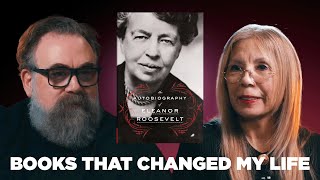
A recorded interview in the "Books That Changed My Life" series where Chris Collins interviews Liz Flynt (chairwoman of the Hustler brand). Liz recounts her upbringing and nursing career, meeting and marrying Larry Flynt, his personality and business acumen, and her sudden transition to company leadership after his death. She explains how a friend gave her The Autobiography of Eleanor Roosevelt about a year after Larry's death and how Roosevelt's example of leadership and service helped her gain confidence running a diversified entertainment and retail empire (casinos, live-stream poker, 100 retail stores, broadcasting).
Chapters
Our guest today is Liz Flint. She is the chairwoman of the iconic Hustler brand, overseeing publishing, broadcasting, retail, video, and gaming. Please welcome to the show Liz Flint.
When Larry passed away, 24 hours later, his attorney calls me and says, you are sole beneficiary of Larry Flint. Do you have any questions? And I said, I can't talk right now. And I started crying, and I had to get off the phone. I didn't want to hear anything. I just was a little lost in grieving. It was a very difficult time of my life. I can't imagine, you know, I lost my North Star.
When Larry passes away. How does this book come into the picture.
Books? They've saved us from the dark, set our souls on fire, and whispered truths we couldn't ignore. I'm Chris Collins, and this is Books that Changed my Life.
Larry saw leadership in me. He saw confidence, and he saw a lot of different qualities in me that I didn't see in myself.
So the big question, how did the autobiography of Eleanor Roosevelt change your life?
Foreign.
Welcome to the library.
Hi, Chris. Pleasure to be here and meet you. And I'm just in awe with your beautiful. The beautiful book collection that is displayed throughout this area.
We love books. What did you order to drink?
A water, Maybe a cup of coffee.
Coffee, perfect.
Oh, you're so sweet.
Coffee with cream, huh?
Cream and sugar?
Cream and sugar.
Just two packs of sugar. Yeah.
That's fun. Yeah. I love the smell of books. I just love. I love everything about them. It's so fun.
When my husband was young, in the Navy, he was fascinated by books. And in the 60s, he belonged to Book of the Month. I don't know if you've heard of it. Oh, yeah, Book of the Month. And you would get like a couple of books a month, you know, and read. And he told me the most interesting thing that he read, and he. He signed up for it and he took the course. It was called Evelyn Wood Reading. It's like speed reading or whatever. And he took it in the 60s. I said, so tell me what the method is, Larry. And he said, just reading down the middle, but if you forgot something, then you go back and read the paragraph or you didn't understand what you were reading about. But yeah. And I said, and what inspired. Thank you. And what inspired you to sign up for that? And he said that he wrote. He read that President John F. Kennedy took that class and that she had a visit to the White House. So isn't that interesting?
Yeah.
Where the inspiration comes from, you know, I've tried that.
And I don't like it.
I never tried it, so I wouldn't.
I like the. I like just taking my time.
Yeah. Because you lose, I think. Yeah, you lose.
I think I also, when I come back to a book, I have to kind of read a couple pages before where I stopped to kind of get back in. And I like that, too. I'm not in a big hurry.
Yeah. But it's interesting where the inspiration comes from.
Yeah. And JFK was. He was an avid reader. We have a couple of his books here.
And my husband met him. My husband was a young. He was in the Navy, a radar man. And he worked on. He was on the USS Enterprise. And John F. Kennedy, President Kennedy came on the ship. And my husband said. He came up to him and he said, young man, can you tell me what you're doing? And my husband said his superior stepped on his foot. Like, don't. Don't say anything that you shouldn't. You know? And then fast forward. My husband was interviewed for George magazine by John Jr. Oh, really? Yes. And then his sister Caroline, she wrote a book on privacy and she interviewed Larry for her book Privacy.
So it comes full circle.
Yes. Yes.
It's interesting.
Interesting that fascination, how books are. Are real important to my husband. And still in the publishing business, too.
Yeah, it's a part of it. Well, welcome to the library.
Thank you.
Our guest today is Liz Flint. She is the chairwoman of the iconic Hustler brand, overseeing publishing, broadcasting, retail, video and gaming. Please welcome to the show. Liz Fl. Excellent. It's great to have you here.
Thank you, Chris, for having me honored.
So where did you grow up?
I grew up in the San Gabriel Valley.
Here in Los Angeles.
Yes.
So you went into nursing. Were you always kind of that caretaker wanted to help people?
I think what inspired me to go into nursing is that When I was 15 years old, my father died of cancer. And I saw how, when he was in the hospital, how the nurses were very caring and just helping sick people. And I thought that was a noble job. And I thought, wow, these people really care about their patients. So I went into nursing.
Yeah. I think like two of the most important and giving occupations are nursing and school teachers.
Yeah.
Kind of the same. Like giving a piece of yourself for others.
Absolutely. Yeah. And I thought that was probably a good fit for me because I love being around people and I love.
That part of the nurturing, part of taking care of people. It's part of my personality and who I am.
So what did your parents do when.
So My mom never had to work. My father had a job, and my father worked for RCA back in the day. Well, my father died in 1977. So then my father passes away, and then my mom went to work. And I had an older sister and three younger brothers, and my older sister and I always felt like we were babysitters, housekeepers. We filled all the roles that you could cook, so caretakers, and so we all went to Catholic school. And so my sister and I went to all girl Catholic school, and then my younger brothers were in Catholic school as well. So. Yeah, things changed for. We kind of grew up right away.
Did your mom go do.
My mom was, I think, a teacher's aide.
Teacher's aid.
Yeah. So when she would get home from work, she's like, I'm not cooking, I'm not cleaning. So that's what my sister and I did.
Working pretty hard.
Yeah. So then. And my mom did remarry eventually, five years after, because my mom was only 39 when my dad passed away. She was still young.
And so when you. When you go into nursing, did you love it? Did you love the job? Did you like going to work?
I felt it was kind of hard in the beginning.
What was hard about it?
Between the theory, the theoretical part, and then science, and then.
Then the application.
Yes. And then going to the hospital, it was like you're app just applying yourself and acclimating yourself and putting it all together.
And the stakes are high.
Yeah. They're real people.
Yeah.
And people with real problem illnesses, life or death. Yeah. So I've only worked at two hospitals. That's Huntington Memorial in Pasadena and UCLA Medical Center.
And what kind of interest did you have besides as hobbies when you were younger? Yeah.
Oh, I like camping because we used to do that all the time. So I like the outdoors. Swimming, hiking. Yes.
You're active?
Oh, yeah. Bike riding. Oh, yeah. It was. It was fun. Growing up in LA as a kid.
Do you still camp?
I do.
You do, really?
Yeah. Yeah. I haven't been for two years only because I get so busy and things have changed a little bit for me. But one of the things that I enjoy and I do every once a year is I go on a yoga retreat because I do take yoga and Pilates. The two things that are important to me right now and have been for the last four years is because it. It's my time that I get to apply to just take myself out of that corporate environment, business, and have a little time for myself to breathe, to stretch, and to just be In a different mindset, be present. Yeah. So I go to a different country every year on a yoga retreat, and it's with women. And so you get to apply yourself and meet different people from all over the world, leadership. And you learn about other people, what they're doing in their lives. And I've always felt that is so important to me, to things I could bring back to work or do things a little different. Two years ago, I went to Capri, Italy. It was just beautiful. Last year I went to Bali, and I thought that the Balinese people are so beautiful, learning their culture and certain things that mattered to them. And before we would go to yoga, we had to learn how to do basket weaving and.
Apply flowers, go dress up in the traditional Balinese attire, go light your incense and say a prayer and make an offering. And what is important to you, your life, your family, your business, and anything that, you know, you do in life that comes full center. So. Yes.
Are you still Catholic?
I am, Yes, I am.
How does that play into the. The yoga and the spirituality and all that?
You look at your face and what gets you through difficult times in your life. Like, for me, losing my husband.
So that was very difficult.
How did you meet your husband?
So I had a friend, male nurse, that worked for Larry, and he asked me, hey, can you help me on a case one day a week? And I said, sure. But I didn't know who Larry Flint was. That was the naive part of. I didn't know Hustler magazine either. And when I told my mother, she goes, oh, I know that magazine. Only because my older stepbrother had a few in his car when he would come home from college. She saw her first Hustler in the early 80s.
And then. Yeah, so I met him, and. Very nice man. I never saw Hustler magazine in his home, though. Yeah. Very world.
What were you. So were you just helping with his health or what were you doing for him?
Yeah, he would have nurses. Yeah. And he lived by himself with a cook and assistance. Yeah.
And so then how does it evolve? How. How does.
Well, I worked for him for a year, and then he asked me out, and I said no.
Why'd you say no?
I said, no, because I wasn't interested. Yeah. And then he kept saying, well, why don't we go out to dinner? And I said, no. And then I finally said, well, if you want to go out to dinner, then come to my home, have dinner at my home, and meet my family. So my mother, my stepfather, my sister, my niece and a friend And I cooked.
That was your first date?
He came to my home.
Do you remember what you cooked?
Yes, I do.
What was it?
I cooked a prime rib, mashed potatoes, green beans, gravy, and three attempts to Yorkshire pudding. And the third time it worked, they came out.
That's hard to make. I tell everyone, don't think you can, you know. So the third time it worked.
So he. He comes over and what did your family think of him?
He came. So I lived in Alhambra because I. My sister and I owned the home that I was living in. And he comes over in Rolls Royce. And it was funny because I lived on a quiet street and there was people looking.
So he brought roses for my mother, my sister and myself and a bottle of wine. And he was the perfect gentleman. He is a very nice guests and he told jokes, had a good sense of humor and everyone liked him. And he didn't overstay his welcome.
Oh, he left after.
After dessert.
That's great. And so is there a second date?
Yes. Then we went to the Palm, Remember the Palm restaurant on Santa Monica?
Oh, yeah.
And it moved to Beverly Hills and close. Yeah. And he took me because he wanted to show me that he was on the wall.
Did that impress you?
I thought that was interesting. I met the Mater d at the time. His name was Gigi. And he said, he told me, he said, liz, he said, I knew Larry.
When Larry was walking. So my husband was coming to Los Angeles quite frequently because headquarters was in Columbus, Ohio. And then in the late 70s, Larry wanted to move the company to Los Angeles. And. But he was shot in March of 1978. So yeah, it was interesting. So the picture that was on the wall at the time was when he was 34, 35.
So how does he get you to fall for him?
Just dinners. Perfect gentleman flowers. But he was a very interesting man. He had an impeccable vocabulary and just very worldly and just a gentleman.
Very smart, right?
Yeah.
Very, very intellectual.
Oh, yeah, yeah, yeah.
Was there a moment that you, like, decided you were going to let this.
It went on for another year. And then. And then in 93, I. Because I went from full time at UCLA to part time to per diem to one day a week, one day a month. I'm sorry. And then my boss called me in her office one morning and said, liz, sit down. And I. And then I was trying to think, what does she want to tell me? And she said, liz, we're always having to adjust the schedule around you, so you're going to have to decide where your loyalty is. Is it going to be Larry Flint or ucla? And I teared up. Wow. I've never been forced to make a decision. My career or somebody else. That was very. That was overwhelming for me. So then I told her I needed to think about it.
I didn't want to make a decision right there. So who did you.
Who did you talk to about it?
So I talked to Larry. I called him up when I got home. And then I told him. I said my boss had a discussion with me and I said she wanted me to decide who are my loyalty. Was it going to be you or ucla? And he says, you don't need to work, Liz. I'll take care of you. So then I. I called in sick that day and then I went over to his house on let's Talk.
And I just told him, because by that time I was traveling with him. He said, you don't need to work, Liz. I'll take care of you. And I said, but I have a home, I have a car, I have this. He says, don't worry. He's just a really. Just a really neat guy. And. And I could see in his. The twinkle in his green eyes that, you know, there was love there. And he was man of his word, and he kept it.
What do you think about you made him fall for you?
I don't know. I think he liked brunettes. Maybe.
Maybe.
Because it's got to be more than that.
I think because he liked my style and I knew a lot of nursing and he thought I was probably something. Someone different.
What made you different?
Well, his daughter had told me one time, oh, he used to date her, her, her. And.
I don't know if they were just genuine or. I don't know.
Was it the fact that you were genuine?
I think so.
You liked.
Yeah. I wasn't born with the silver spoon, you know, and I always. As an, you know, I worked. I never relied on anybody for anything like. And I lost my dad early when I was a teenager. So. Yeah.
Did he sort of fill that role a little bit, like he was somebody to depend on?
No.
No.
Oh, no. Because as I got to know and understand how things were, I saw him at his company, how he. His style of, how he ran his company. He was a tough boss. He didn't get where he was by just being this, you know, guy, you know, publisher, poster magazine. He was a real innovator. He diversified his company through the years. I saw him when he thought that this. When he saw this Internet coming through. Oh, Free porn on the Internet. That's not going to be me left behind. So he diversified the company in the early 90s. Yeah.
What would you say that most people don't understand about Larry?
I always say that Larry was a real renaissance guy and very misunderstood. He was misunderstood. And I think the people that got to know him and really understood him, like Milos Forman, the director of the People versus Larry Flint. Oliver Stone. Yeah. These are very interesting people with different backgrounds and they saw something very different in Larry. He's very an intellect. I mean, I think one of the things that also impressed me about my husband is that he was invited to speak at Oxford, he was invited to speak at Cambridge. And they don't even have the First Amendment. We do.
Yeah. Funny, right? Or not funny. Really?
Well, I mean, Larry, this is pre Liz. So. And Larry went to the U.S. supreme Court and he had a case that changed the landscape for cartoonists, comedians, and his case was based on making parody and satire protected speech. So he felt so compelled and so passionate about the First Amendment and free speech. And that's how he wanted to be remembered. That if I can leave any legacy that helping expand the parameters of free speech, that's what he wanted to be remembered by.
Yeah, I think a lot of people don't appreciate that a lot of the comedic freedom came from that free speech.
Yeah. Making that anything they said they wouldn't be prosecuted or jailed. Yeah, I know Bill Maher appreciate that because he did a few shows with Bill and was a friend.
Did Larry, did Larry have friends, like close friends?
Oh, yeah, yeah, yeah. He had his close friends, third, older and.
One just passed away in December. And he was a producer for Bob Schieffer and Sam Donaldson. And then Larry's one of his dear friends worked for the Washington Post and his other friend's still alive, Kali Sher. But yeah, he had just a handful that were near and dear to his heart that were just very close. And a lawyer has been with him from the beginning since 75. Paul Cambria. Yeah. Ellen Isaac, man, is the lawyer that took him to the US Supreme Court.
So how did he propose to you?
Oh, he proposed to me at home.
And he had a 4 carat pear shaped diamond platinum and in his pocket. And he asked me, I think it was in 93. Yes. And he said, will you marry me? And I said.
Oh, wow.
You didn't expect it?
No, no, no, no. Yeah.
Did you not expect it because you didn't think he was the marrying type?
Well, he'd been married four Times before me.
Oh.
And I wasn't sure if I wanted to get married to him because I wasn't. His health. You know, he had health issues sometimes, so. Yeah. But eventually we got married in 1998.
Wait, did you say yes right then, or did you make him work for it?
Made him work for how long? 1998. But you know, what was interesting about Larry is that he was always a man of his word. He loved to travel. And when I met him, he didn't have a plane at the time, but when we go to Europe, we'd go to New York, JFK and get on the Concorde.
Yeah. And then in 94, he bought a G. G2. And then he had the G4 and the G550.
Those are nice.
Yeah. It was a very nice lifestyle. And. But you know what? He worked until he passed away.
Do you think that's what kept him going?
You know what he used to tell me? He goes, I love my company. He said, so I don't see it as work, Liz. He said, it's something that I have built from ground up, and I've been tested a few times, and I enjoy it.
Not too many people live that existence. Most people are feeling like they have to work, they have to do something.
And he used to tell me early on, he said, I have it to a point where we could survive a couple of depressions. Like if we went to an emotion. Yeah, you know, a depression. He used the word depression because a recession, you know, you go through it, you're. We're out a year or two. He was a good businessman, a role model, a mentor, and I learned a lot from him.
He had a plan early on for me, and I didn't see it that way. When he passed away.
24 hours later, his attorney, his State Alert attorney calls me and says, by law, Mrs. Flint, I have to call and make you aware of how things are going to be. And he says, you are the trustee and the sole beneficiary of Larry Flint.
Do you have any questions? And I said, I can't talk right now. And I started crying, and I had to get off the phone because that was only 24 hours.
Yeah, I didn't want to hear anything. I just was a little lost and grieving, and it was a very difficult time in my life.
Well, I can't imagine.
You know, I lost my North Star. I lost my husband. The company lost their boss. It was a very difficult time for the company.
And everybody was trying to figure out what's going to happen. Because they didn't know. And I didn't go back to the company for, like, two months. And I was called to come back. We need you, Mrs. Splint. Our hands are tied. We need you.
Yeah. And so then you kind of had to be kind of like when you're a kid, you had to now all of a sudden, step up, step up. And.
Kind of. It was about the company, not you, in a sense. Right.
I had to jump into a different role. And it was very difficult. It was very difficult. And Larry warned me. He had a conversation with me. He said, remember, no crying, Liz. You can't cry at the company. They're going to say, there she goes again, crying. She's weak. She can't do this.
Do you think that was good advice? Yeah.
He said, if you get into a difficult moment.
Step aside. Never make a decision on emotion. Go home, call your advisors.
So he really was kind of preparing you.
He did.
What other things in the business was he doing that you didn't realize until after.
I'd say, in the last maybe 10 years. I had to. My office was right next to his. He brought me closer because when we moved from 9171 Wilshire Boulevard, and he bought the iconic building on La Cienega in Wilshire, we were on. On the 10th floor, and he had this beautiful office, but I was on the opposite side of him.
He made it clear that I shouldn't be, you know, be privy to who's coming into his office. So. Yeah. And then the last 10 years, he moved me into the president's office. Yeah, right next to his office.
And so you had a very deep understanding of the business and how it functioned at that point?
Oh, yeah. I started in 94. He says, you're going to work? And I said, oh, okay. So I thought I was gonna go back to nursing. He says, no, you're coming to work for me. And I said, I don't know your business, and I don't want to. And he says, no, I'm going to teach you. So I started at the bottom in talent, the talent relations department. And then fast forward six years, he moved me up to associate publisher. Oh. Back in the day when we used to edit the magazine, we'd go down to the third floor and the photo room, and that's when they had the light tables. And we would edit with the loop. This is before digital. And we would be marking up, and he'd show me how to pick a center fold, how the layout. He goes, remember, Liz, you're Telling a story. So the clothes are on and then before you know it, they kind of slowly come off and then the photo spread.
So it's almost like a little seduction in a way. That was the story. Wow.
Yeah. There was always, always one girl, girl set in the magazine. One boy, girl, and then girl sets. Yeah. And then his photographers, we used to go on shoots and sometimes we'd go traveling. And so I always felt that I learned from the best. So Clive McLean, James Bayes, Maddie Clatt and Suze Randall. And I think James was Larry's favorite, and my favorite was Clyde. And I learned a lot. And they showed me the angles and how to take, you know, different angle shots. The nose was the most important thing.
And why is the nose the most important?
Well, not everybody has the perfect, cute, adorable nose. And sometimes you're pointy or at the angle, it looks kind of funny. And, yeah, I learned a lot.
So you have to cheat it somehow.
It's shooting the angle. Yeah.
The lighting.
Yes. Yeah.
Being taught you all of that.
Yeah.
So just if we can back up a little bit. So when you're younger and you're introduced to him and it's Hustler, like, it probably wasn't a magazine that you subscribed to.
I never saw Hustler until I met Larry.
And so what was your personal journey with just opening up to that and, you know, kind of.
Well, I. When I first looked at the magazine, he said, do you have a problem? And I said, no, it's just nudity. It didn't make a difference to me. I was a nurse. I saw nudity all the time.
Worse than that, probably.
Yeah.
So there was never any internal conflict for you?
No, I didn't.
What about the. The point of view of others like your mom or just friends?
Well, they. By then they got. They knew Larry and. And no one ever said anything. My friends are like, wow.
It was a respectable business because Larry was a true professional.
Yeah, he's an icon. Yeah.
Oh, yeah. But sometimes he used to say. He used to ask me questions. He goes, what is it like to be married to Larry Glenn? He would always joke with me. I said, you're just my husband and you're the father of. I would name my dogs.
He just laughed. So I treated him like a husband and not like this big, you know, figure. Life size figure. Because you knew, I just married him for being Larry. And not just guy who. Pornographer people. That's what you used to call him. And sometimes when I would read things I said, they called You a smut peddler? He goes, but with a smut pedler. Who cares?
He was cute. He was really sweet.
I kind of ran into him twice. And yeah, he was always very nice. I saw him at the Peninsula Hotel.
Oh, that's always breakfasts. Yeah, almost every day when we weren't traveling. Oh, yeah, he loved going there. You know what he said when he would go there for his breakfast before the office? He said, this is where I can just really kind of just get my thoughts together. What kind of a day? Or sometimes he had to meet people. Yeah.
And I've talked to people that worked for him and just unbelievable intellect. Smartest person they've ever met.
Oh, yeah.
They couldn't stop raving about him in that way.
He was a numbers guy sometimes. Well, because we own two casinos. And one time he asked the VP of gaming, he says, you're off a mill. And Tom would say, no, I'm not. He goes, yes, you are. And then he'd go back. He goes, I found that mail was an error.
Yeah, he just knew. So he had that thing.
Oh, yeah, he was just a numbers guy. He knew we would have. We have management meetings every once a week in the boardroom. And I still have them to this day. And people will come with their P and LS and everything. Larry would just come and they go over certain things. He says, you're wrong, they get all nervous. But he was always right. And that's what impressed me about him. Larry was a very interesting man. There was. He just never knew what he was thinking. That's the thing, the mystique behind. But he was a really smart guy, down to earth, fun loving, loved to travel, loved art, loved reading and fun. And this is a guy that love life more than anything else. And he had the best doctors in Beverly Hills.
What was his favorite piece of art?
Oh, that.
That you.
I have a piece of. It's from Switzerland. It's a very famous glass piece. And it's in a case when I had to leave my house for the fires because it was evacuated for overnight. Believe it or not, I took that piece and wrapped it in a beach towel and put it in a suitcase because I always remember he loved that piece and he paid so much for it in Switzerland at an auction. So I took it, but nothing ever happened.
What is the piece?
It's. It's just a very beautiful art piece. It's. It's a sculpture. Yes.
Made out of glass. Glass. And what is it of?
It's of a lady. It's forgot the name of it, believe it or not. But it's just a piece that he just loved. And he paid a lot of money. I think he paid for, like, half a million for it at the time. This was like 30 years ago.
Do you have any art that you guys own that you love?
Oh, I love. Well, lamps was his thing. So, yeah. Tiffany lamps, Handel, Pierpoint. I mean, just beautiful lamps. When we. When I moved the company from Beverly Hills to Century City. Because.
Two and a half years, almost three years ago. When I decided that I didn't want to stay there and not renew the lease because Larry had sold the building and took out a lease and was coming up. I knew it was coming up for renewal. And I said, I don't want to stay here. I want to move. I only looked at two area, two spaces. And the second space I saw was in the Century City towers North Tower, 42nd floor. And it was an empty shell. And I said, I want to move the company here. And I told my CEO, I said, I don't want to look at anymore. And this is it. He goes, okay. He goes, what's next? And I said, I'm going to call Nelson Alghazi. The architect that built Husser Casino, remodeled Lucky Lady. And when Larry bought the building on Wilshire in Los Angeles, he remodeled. And so for Larry. And I thought, I go to somebody who knows me, who knows the company, knows our taste. And I have a. It's all about the relationship. Larry always kept relationships. And I said, more better person is Nelson. So I called him and I said, can you meet me? And I arranged for them to let us come back and look at the floor again. He brought his design team and his team. And he walked around and looked around. He says, I can do this for you, Liz. I can make it happen. I said, but I want to tell a story. He said, okay. And the story was, when you walk in, I want to be able to tell a little bit how this company evolved. And so on the left side, you see in black and white, you see chips flying through the air in cards. And somebody's hand, like holding a card up.
And on the right side, you see the neckline of a beautiful woman.
And she's turned away. And it's telling a story that Larry started out with the magazine. Like Beautiful Women in the Clubs. Then the magazine, that's the story. And then in matte gold, you see these big letters, fng. And it stands for Flint Management Group. And then you see boardroom. And it's called the Kahuna. And that was Larry. He was the big Kahuna. Because in Vegas they had a suite named. They call it the Kahuna. And it was a suite for Larry in Vegas because he was a gambler too. In, in LA he played seven card stud. And in Vegas he played blackjack. And he was known as a whale.
I have a host that was my host that became kind of prominent. He's still, you know, big person there. Now he's a vice president. But I had him speak at an event because I was so impressed with how he followed up with people. He told the story of how he got Larry. So I think Larry, what's Snake, his name is Randy Carlson and he worked at the Hard Rock. Well, the story he told is that for 18 months, every month he would send Larry a fruit. One of those fruit arrangements.
Oh, yeah. Wait a minute. Is that Steve Search? No. No. Okay, maybe it could be. Okay.
So he said he, he would send it and then he would call and Larry would never take his call. And then he said on the 18th month, the person who answered the phone said, larry's just asking that you don't send them anymore. And he's like, no, I'm not going to stop sending them. And so Larry got on the phone and he ended up getting him out. He said he only came out twice or something, but he got, he was a whale and he got him. But he persistently sent him that over time or that was the story he told. I don't know.
Yeah, because the guy at the Hilton, the host at the Hilton, did the same thing to Larry. And this was in the late 90s.
And guys like Larry probably appreciate follow up and, you know, people that are really, you know, putting in the work.
So when Larry had somebody do something similar.
At the Hilton, the Las Vegas Hilton, when Baron Hilton owned the hotel and casino. So then at the time Larry was going to the Rio, this was in the early, like mid-90s, I should say 96, 97. And remember 48 hours before it changed into like this investigative stories, it was 48 hours. They would follow somebody for 48 hours. And Harold, the guy was named Harold, so he was really neat. And so they did a story on Larry and they followed him. So they followed us from the home to Clay Lacey, private aviation, get on our plane, go to Vegas land.
Go to the Rio on a Sea L plane, and they're filming this whole thing. And Larry's not doing too well. He's actually losing at the Rio. And then Larry takes a break, goes Upstairs. And he calls that guy that was calling him for a while at, from the Hilton, and his name's Steve. He says, hey, Steve, I'm Larry Flynn, I'm in Vegas. He goes, I want to come and play at your casino. I'll be over in an hour. All right, Mr. Flynn. Boom.
So 48 hours follows him to the Hilton, and then he's in a private room playing blackjack and he's doing well. And he said, liz, why don't you go shopping or go, go have some fun. Go, go look at the gift shops, whatever. He wanted to conc. He didn't need me because I would always sit to the, to the, to the left of him. So I said, okay. And I went to play a little bit. Then I went looking at all the shops. So I come back a couple hours later and he said, did you see anything you like? What did you do? And I told him, went to play a little bit. Then I went, I said, I went to this jewelry store and I saw these beautiful earrings, but nah. He goes, well, I want to hear about them. And I said, they were heart. They were diamond earrings, heart shaped, three carats each. But they were too expensive. Well, how much were they? I said, you don't want to know. They're almost like a hundred thousand dollars. They were like $90,000. And he goes, oh, okay. He said, you ready to go to dinner? And he was up. Was up.
So then we go to dinner, we go freshen up, and then we get to the restaurant and then we sit down and then Baron Hilton comes to the table. He said, hi, Mr. Flint, Baron Hilton. And Larry goes, oh, pleasure to meet you. And then he walks away.
And I get my napkin, put it on my lap. There's a little box right there. I'm like, what's that? He goes, I don't know. What is that? So I take the ribbon off and open the little black box. Oh my God, Larry. Oh my God. How did you do this? It was those earrings I saw.
Oh my God. And I was like, wait a minute. Oh my God. I was like, so excited. I was like, oh my God, I can't believe. And then I got up, gave him a hug and a kiss, and he goes, okay, let's eat dinner. I'm hungry. So then I was like, all I could think about is those earrings, you know, like, I need to put them on. But I didn't. So he told me this story. I said, how did you do it? Because you were. We were together and you couldn't possibly go get those earrings. He said, I told Steve that my wife saw a pair of earrings. If he wanted to keep me here, he had to do something for you. And I guess that's because he had to get permission. And the owner was. And I was thinking, oh, that's why you came to see Larry.
That's awesome.
So here's the thing. So at the end of the night, this is like almost midnight. And there he goes, I'm tired. I want to go back to the hotel and go to bed now because I'm tired. And he calls his host, Steve, and he says, rack up. I want to cash in.
It's a million dollars.
And 48 hours is still keeping my $40. So then we go back, and Larry tells Harold. He says, I'm tired. I don't want to do no interviews right now. I need to go. I'm just literally tired. He's working. Larry's working the whole night, you know, playing blackjack. So I couldn't sleep because I'm like, ah, these dying years. And Larry just won a million dollars. How do you sleep? Right? So they give Larry a check. And so in the afternoon, Harold comes to our suite and says, I want to do the interview, a small interview with Larry, because I think we have enough footage. And we're. We're done with this. So then he's interviewing Larry. He goes, I hear you had a good night. He goes, I sure did. He goes, how good? And Larry had the check in his pocket. And he goes, wow. And then he said, wow, this is a. This is. This is too good to be true. This is like a fun, fun trip. And then he goes, liz, come over here. And I was saying.
And he goes, come on over here, Liz. So I walk over there, very shy. He goes, show Harold your earrings.
He goes, Mrs. Flint, they're beautiful. Where'd you get them? I said, the Hilton.
Didn't that make it in the episode?
It did. So here's the kicker. So fast forward, it comes on TV, and Larry's host calls him. He goes, Mr. Flint, why did you do that to me? Now my other players are saying their wives want earrings. Their wives want their diamond earrings, too.
That's funny.
It's a good story, huh?
It's a great story.
Larry goes, it was just too a good story to tell.
Yeah, that's great. That's fun. When Larry passes away.
And you're kind of faced with that, how does this book come into the picture?
So the autobiography of Eleanor Roosevelt was given to me by a friend. Friend. She goes, you should read this. And I did. And I felt what a powerful connection.
Why did, why did she think you needed it?
Leadership. Because I was going into a role that I felt that I was not prepared for because that's how I felt because I was grieving. And I'm thinking, how am I going to do this? Trustee so beneficiary.
I was thinking, I can't. I, I, I'm glad somebody had confidence in me because at the time I didn't have the confidence in myself. Obviously, Larry saw leadership in me, he saw confidence and he saw a lot of different qualities in me that I didn't see in myself because I was grieving and it was a very difficult time for me.
And so she recommends the book how long after he passed away?
About a year.
About a year, yeah. And so you're in the company at this point, running it.
As I started to read as that FDR was in a wheelchair by polio in 1921. He got polio and then.
She was his eyes, ears and his.
Legs, his. She was the messenger. He depended on her. He relied on her. He had confidence in her. He had that trust in her even when she didn't have it. Because she says in the book, Eleanor says that she didn't see that in the beginning and that she was supposed to be this dutiful wife. Her mother in law was like doing everything for her, took care of the kids.
That felt very similar to your relationship with Larry.
Yeah. You were his legs in some ways. Yeah.
How does that change the closeness in a relationship when you're that dependent on each other?
You know what he depended on me was this and my knowledge of anything that would come or anything that he would incur in terms of like health issues. He depended on me. He always relied that Liz has got, Liz has it. She's going to have my back no matter what. And Larry's doctors always used to say that I made it easy for him. He never had to worry about his health because I took the burden off of him. And they always used to tell me that you make our job easy, Liz, because you know what you're dealing with. And I would report this, this, that. Okay.
You're aware that most relationships don't have that level of trust, right?
Oh, yeah.
So how does it change, you know, when we're talking about Eleanor and we're talking about you, that that level of trust and intimacy is different than there are most experience. Right.
There are times where he did get sick and he was in the ICU on a Ventilator got pneumonia, whatever. And I had to make a few decisions for him. And then when, after he got well and he said he did the right thing, he made the right decision. Yeah. And he got sick in 19 and real sick, and I had to make a decision for him. And.
It was interesting. He told his doctor when he was okay. He said, I'm glad Liz was there for me because she. She. She knew what to do, and she made a few decisions on behalf of me and business, and they were the right decisions for me. So. Yeah. And Larry's estate lawyer told me when he made that phone call, he goes, you know why you got everything, Liz? And I said, no, he never told me that. He says, because one time when we were meeting, he said, Larry told me, Mr. Carleto that he said, this never asked me, if something happens to me, will I be taken care of? She never asked about anything like that. And he says, and for that, she gets everything. And Rick told me the story. They were at the Peninsula.
Wow. How did you feel when he said that?
When Mr. Carl. Because Larry didn't tell me that.
Yeah.
Mr. Coletto, tell me that.
How did you feel?
I was crying. You always want to know that your husband would tell you those kind of things, you know, But I think Larry just didn't want to tell me that.
Yeah.
I never. I never had to worry about anything when Larry was alive because he ran the company, he was the boss. He financially took care of everything. He made those important decisions. He was very calculated man. Never had to worry.
Yeah. But isn't there also another side of that that I'm sure you understand is when you're successful, there are a lot of people that want to have relationships with you for the wrong reason.
Can be.
And so your authenticity, you know, was something that he probably didn't experience that much.
Right. He always felt that he was wanting something. Yeah. He always felt that certain family members just treated him like an ATM machine.
Yeah.
Yeah.
And so, I mean, that's kind of back to my point of that special relationship that was very intimate, and there was a lot of trust there. Right. Because you can't really trust a lot of people when you're.
No, you can't.
As successful as you are.
And. And I was always under the radar. He never saw me. He never heard of me. I'm not on Facebook. Yeah. Even when we walk the red carpet and go places, I would tell him, oh, you want the other side? You know, I would go, like, walk around. Yeah.
Yeah.
The only time I walked red Carpet is when we went to the Golden Globes and the Academy Awards, but obviously it's this movie, you know, but so.
How does, how does Eleanor change throughout this book?
She was a woman that came into a role and she was a force. She learned a lot about herself through that role as First Lady. She was the longest living. Well, she served as the longest role as a First lady, like almost 10 years. It was her force. She was very shy. She was.
Surrounded herself around smart women and always wanted to have women's, like for example, press conferences. She would always want to include them and eventually she would have one just for women. But she would always go to FDR's advisors to get their permission. It was different times back then. She always felt that she had to get the approval. But back then, in those days, the press, you know, newspaper reporters, they were like just looked at as always reporting the facts. And nowadays you say something, it's cancel culture.
I find the tone of the book to be like, from a different, a different era in the sense that she's not really open about her emotions. Everything is like very kind of matter of fact. And she's like, this happened and this is what it means.
And what I look at looked at her as like leadership. Leadership. That's what's important to me and women, because I have several friendships with women that are near and dear in my heart that were right there for me after Eric passed away. And we meet several times a year. We all do something different. One's a lawyer, one's a psychologist, one doesn't have to work, one is a journalist. And so we all do something different actually to our lawyers. So we all share different stories about us. And one, two, the three of us have lost husbands. Four of us have lost husbands. So there's that bond.
So tell me what leadership is.
To me, yeah, leadership is leading. It could be anything. It could be a company, it could be organization, it could be many things. But sometimes leading without and leading with force, you don't have to have a title and you could be underestimated and still lead a lead. I think that toughness and compassion can coexist. And Eleanor proved that, that you can.
Be both, that they're not. You don't have to sacrifice one for the other. Most people kind of think that it's a trade off. Right.
She proved that.
And so I was at a very delicate point in my life and pivoting to, and having to make critical decisions and make important ones because at the end of the day, I hold the purse Strings to that empire.
I have a management team that helps me run all the entities. So I have 2,300 people that work for me global. I mean, between Europe, we have a company in Amsterdam and London. And then I have a company, a broadcast company in Boulder, Colorado, two casinos. I have the 100 retail stores. And after Larry passed away, I grew the company because when he was very ill in the hospital and he knew he probably wasn't going to, you know, because he died of cancer at the end, he went in for back pain, and he says, where is this back pain coming from? I can't. I can't, you know, live with this. And they did an extensive workout work up on Larry, and they found that he was. He was stage four pancreatic cancer. And he had the same doctor as Alex Trebek.
And he felt so bad when Larry passed away. Wrote me the most beautiful letter.
Oh, he did? That's sweet. Doctor, how well, how would you describe your leadership style?
It's very open, but I'm a listener first. I want to hear what you have to say. Tell me how you're going to handle this decision. I want to hear everybody's input. And then based on that, I listen to my CEO and we have an understanding that we'll always talk everything out because where there's a financial impact or you bind me to something, I have to know how I'm spending this company's money or committing this company to millions and millions and millions of dollars. Yeah.
So let's say that I work for you and I run a division. Let's say I run the casinos. I'm just making one up.
VP of gaming.
The numbers are down and we're not making the money that we should. You know, you want, you want to change my perspective or whatever. How. How would you. How would you go about it?
First of all, I would have saw the trend. Months I would saw on the P and L, I would see a dip.
And then how long of a rope do I have before I have to. Before Liz is calling me.
Oh, you have less than a month.
Less than a month.
Yeah.
And how's that for.
So say I see the trend. See, I see the trend.
Yeah.
Oh, I'm going to call you up to corporate and let's have a talk. What seem. But I'm at the casinos. I once a week, both casinos. So I will always know what's going on. You know, but the thing is that.
If I see these sort of things are just a great example for other leaders out there to understand like your perspective and how you approach it.
Let's say I see a dip in the financials. So I'm going to call that person to corporate and then I'll bring my CEO in and then we're going to talk about what seems to be the change. Is it not having enough spreading enough games or say because we're third party bankers that we have at the casino? The thing is that there's, there's always something and you'll pick up on it right away. Or we don't have those big players anymore. But usually it won't be long before I pick up on that.
And what are you looking for from me? And what is it, what is it that I could do to make you believe in me? And what would I do that would make you not believe that I can fix the problem?
You've been doing a great job and your leadership has been phenomenal. So something is going on. Is everything okay at home or has anybody in your team left?
So you're looking for the variance of what has changed, what's the difference?
And then what do we have to do to get back those players?
There are many, many components to this.
A lot of moving parts.
Yeah. And maybe I need to replace him.
So how do you determine that? Like what is it that would happen that makes you realize that I'm the wrong person for the job?
I'll see a trend before all of that and then I'll start to talk to other the floor people and then, then I'll see the games, the drop, you know, what's that? What are those games? Dropping the money. So I'll see. There's many things that you can start to trace and figure out what's going on. So right now at Huster Casino, both casinos, we have a live streaming we're known all over the world for. It's called Hustler Casino Live. It's live streaming on YouTube. And that's something that Larry wanted. He signed off on everything before he passed away. He was working on it in the hospital, but he didn't get to live long enough to see it launch. And I finished for him.
What is it I watch if I.
Go on there, live streaming? The best poker players that have the resources and they're all known all over the world. And it's usually hold them or sometimes they play a little bit of a different game. Yeah. And it's funny, they have to have personalities. And it's interesting. Very. It's a very tough, tough to be in that game because you're Talking about millions of dollars. And they wire in, you know, because nobody wants to be coming in with a million dollars or $500,000, you know, so they usually wire. All wire in the money. Yeah. So we're known for that all over the world. It's called Hustler Casino Live. And then we have one at Lucky Lady. It's on a smaller scale, but it's. It's growing. Yeah. And people can be in their home. I'm like, oh my God, I know that guy. Saw him or, you know. Yeah, it's kind of fun. You know, we're. Our company has been known to be on the, you know, just trend setting, get starting new things, diversifying, being revel, revelant. And also, Larry was always doing things that before people never did.
Yeah. What are the nuances of the toy.
Business.
The retail business, and sell novelties. I was doing great.
No, but what are the nuances like that make it successful or if it was struggling, what would you be looking at?
Well, first of all, the average person is not going to come in and buy that 200 or 300 novelty toy, the vibrator, whatever you want to refer to it as. They're going to go for middle of the road and spend maybe 70 or $80. So you gotta look. And when you look at the sales and we look at what's trending and we're always bringing in new stuff, and we've had this one too long or this price, you know, we want to change it up a little.
But the biggest driver is the price.
Oh, yeah. Especially right now, it's all about the price. And the newest thing that I launched in the retail is we partnered with DoorDash. So Hustler Hollywood, our retail chain, is that you can go online to hustler hollywood.com and put it. Go into that store and make a purchase, and within an hour, you will have that little whatever you ordered at your door. You ring the doorbell, here you go.
How much does that increase the sales?
I don't talk numbers and sales, but we launched it in February.
Dramatic.
Huge. It's like I told my CEO, it's like having another retail store with no overhead.
Wow.
It's amazing. That's genius. Yes. So that is who we are. And we're the first. And Stanley, the guy that owns Door Jazz, Stanley, he plays at Hustler Casino live in the live streaming. And he told our general manager, he said, I want to meet Mrs. Flint. So he told me that last week and I said, well, I want to meet him too. Because we have an, an agreement. So we have 60 Hustler Hollywood stores. And then I had an acquisition, made an acquisition with Playboy Enterprises and we bought 40 of their retail stores. So now I have a total of 100 retail stores. And we're the largest in the business, in the adult business to have the largest retail chain. So that's our niche too. So we're diversified.
So door dash.
Doordash. Very convenient, very nice.
Okay, so back to Eleanor. Can I read you some, some excerpts here and then just get your thoughts on it? So this is more towards the beginning as a kid. But she says the habit of lying stayed with me for years. My mother did not understand that a child may lie from fear. I myself never understood it until I reached the age when I realized that there was nothing to fear.
Well, Eleanor once said that.
You cannot let anything intimidate you without your consent.
That's pretty good.
That's powerful. So building up the confidence. And she was young, she was pretty as a young girl, but she looked at herself and people said she was ugly duckling. Her dad died when she was a young girl, like me.
There's a lot of parallels.
Yeah, she went to go live with her grandmother, went to a boarding school. And so she had so many different transitions growing up.
Oh, this is a, this was a good one, I thought. And I'm, I don't know how to say this last name, but Millie Cente taught me also on these journeys that the way to make young people responsible is to throw real responsible on them. To throw real responsibility on them.
That was her. Because her life experience, her life experiences have really got her to think about her role and that's how she reacted. So her role as when she was going to marry fdr, she didn't know anything about having children or anything. You know, her mother in law cleaned the floors and did everything for her. And even like.
When she went into the White House as a first lady, they had these people taking care of them. She's like, wait a minute, this, the settings are poor conditions for them because she always looked at the people, the more common commoners, you know, and she always felt that she wanted to help people. And she did.
I mean, her mother in law would always try to make the decisions for her. When her son, like I think it was one of the younger sons, when he was in college, he, he was arrested for speeding.







