Books That Changed My Life: Nadine Crocker & Never Finished
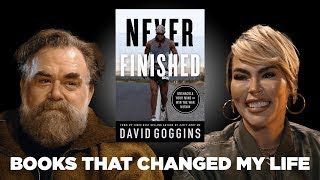
This is a YouTube interview (Books That Changed My Life) featuring Nadine Crocker discussing how David Goggins' book Never Finished influenced her—particularly in building discipline during low points. Nadine recounts growing up in Fresno, moving to Los Angeles at 16 to pursue acting, experiencing bullying, depression, self-harm, a suicide attempt at 23, and substance problems (mainly heavy drinking). She is nine years sober, made a first film Continue about her survival, donates proceeds to suicide prevention, and founded the nonprofit Continue On to support mental health advocacy.
Chapters
Covid happens creates this huge obstacle beyond what you're already facing. How does this book come into your life?
She loves anything with caffeine.
Yeah.
Cheers.
What do you think of the library?
I love it. I mean, this is just. The space feels so inspiring.
The reason I think my husband knew I would love this book and needed that book at the time is that I have had every reason to give up, and I have every reason not to believe in myself, but I've always had blind faith.
We love talking about books that have changed people's lives. Like, had such an impact that they are different after reading the book. Today, we have a special guest. Nadine Crocker. How did Never Finished by David Goggins change your life?
Love your bomber.
Oh, thank you. I just got it for my birthday from my bestie. Oh.
Happy birthday.
Thanks.
What do you think of the library?
I love it. I mean, this is just also. Just the space feels so inspiring. But not to mention, like, all these books. It makes me feel like I need to read more, if I'm honest.
Well, it's fun, though.
Yeah.
I love books.
And you, you've read a good amount of this.
Not anymore. Like, I think I've lost. I'm acquiring way quicker than I read. But I'll check them out. Yeah. I'll go to the table of contents and kind of find what I'm looking for in a sense. I also have a library at home, and those are more the ones that I've read.
The Creative act is one of my favorite books, and they were saying that that's one of yours. That painting out there is unbelievable. I was like, can you guys please make it a poster so I can have that in my office?
We might get in trouble for that with him. I don't know. But maybe we can make you one.
I won't show anyone, I promise.
This is a one. It's a one off. So it's original, but I think if we duplicated it, we might have to get his permission. I'm not sure, but it is a great book. He's great.
He's so inspiring.
Yeah, it's so funny. Like your book. David Goggins and Rick Rubin are kind of the.
I wouldn't say they're opposing forces, but they're different styles.
Yeah. I feel like.
Do you have multiple personalities in there for sure?
No, I definitely do. I'm a Scorpio. And, like. Yeah, I definitely. It depends on the day. I think that it's what you can steal from each person, you know, and for Me, with David Goggins in particular, it was discipline. I feel like that's something that sometimes in times of, like, low points, for me, I can kind of lose track of the power to, like, pick yourself back up and to put one foot in front of the other and realize I'm the only one who can change that, you know? So that's why, in particular, this book stood out to me in a really hard time. But, like, Rick Rubin reminds me that my voice is important just because it's my voice, like, no one else exists. That's like me when you start to, like, lose confidence in your creativity or, you know, so I have on my entire. When you walk into my office is just a vision board of essentially the people who inspire me, the things I'm trying to pull into my life. And one of them says the creativity of Rick Rubin, the discipline of David Goggins, the integrity of Robbie Brenner, the spirituality of Tony Robbins, and my friend Olivia Allen. So it's like these reminders of these things that really inspire me about these people.
That's powerful.
Yeah.
So do you know where the name for the book came from? The Creative Act. No, Duchamp.
Really?
So it's a famous lecture that Duchamp gave in Houston, Texas, of all places, about the creative act and how the artist ultimately is in control, but also that the audience has a vote. But if you put something in an art gallery, the audience is forced to see it as art. And so a lot of artists would say that Duchamp is the one that gave him the confidence to do, like, Andy Warhol. And a lot of.
Artists kind of from the, you know, 70s, 80s, would say that they became more authentic to what they wanted to do because of that lecture, the Creative Act.
Well, now I need to go listen to that, because that sounds so incredible.
That's kind of how I Shomp is a huge part of the library.
I know. I saw that. I said. I literally said to him, I was like, well, you know, how important someone's impact is on the world based on how many books are written about them. I mean, that was like, literally the biggest section. And I hadn't heard of him.
And he didn't produce a lot of art, but his influence on other people and artists and people will say that he was the most influential artist in the last hundred years. Consumers would say Picasso. Artists would say, Duchamp.
Wow, that's so cool.
Okay, so this is. We're trying this. Okay, so this is my. She loves anything with caffeine.
Yeah. Literally.
So it's espresso and tonic. And the espresso comes from Seattle. It's called Vivace. Cheers.
Oh, that's delicious.
Fun, right?
Yeah.
And a little.
Yeah, I was like. Because I'm really into sparkling waters. I'm like a ridiculously sparkling water connoisseur. And so I feel like anything that has, like, a little bubble or a little, like, I'm into delicious.
So where did you grow up?
I grew up in Fresno, California.
But it's kind of a rough area, isn't it?
Yeah, it is. It definitely was then, too. What's funny is my husband will give me a hard time now. He's like, don't you know where we're going? And when I lived here, it was like, go left at that field and then go right at the next field, like it was nothing. And now it's, like, this.
Gentrified.
Yeah. Like, it's almost like a small San Francisco or Sacramento. And, like, a lot of Bay Area people live there now. And so it's very interesting. But, yeah, I dropped out of high school and moved to Los Angeles when I was 16 on my own.
Really?
Yeah.
So did you have both parents?
I do, yeah.
Growing up, you had both parents that were together, and what did they do?
My dad builds and restores, like, muscle and classic cars. But he originally was a country singer. That's why I was actually born in Nashville, Tennessee. But when I was really young, my grandfather ended his life, and so my dad gave up on his dreams and he moved. And then my family moved back to Sacramento and then very quickly to Fresno, and then that's where I grew up.
So you're born to a country singer and raised by a mechanic doing muscle cards.
Yeah. Like a restorer. Yep, exactly. So one of the first things when I got my first couple films and when I was acting. Cause I started in acting before I went to directing. I bought a 68 Chevelle that he restored for me. And then when I found out I was pregnant, I was like, I need a savings account because I have a child on the way. So my new goal this year is for him to build me another Chevelle.
Oh, that's a good one. That's a good goal.
Yeah.
So what did mom do?
Mom sells office supplies for, like, a national company. Like, has done it for since I've been alive, which is crazy. Yeah, still does.
So if you had both parents at home, why do you end up leaving at 16?
Well, just because they're both there doesn't mean it's Perfect either, though. I will said that. But truly, because since I was very young, I was creative, and that was really what fueled me as a human being. I didn't always do great in school, but that was the one thing that felt like it was mine that really, truly made me happy. I didn't. I was pretty heavily bullied in Fresno. Like, I didn't have a ton of friends.
How would you describe Fresno then? Like, farmers and more.
The way I actually describe it is, like, extreme poverty next to extreme wealth. So, like, you have massive gang problems there, and there's both the Crips and, like, the Bulldogs. And then you have, like, very wealthy families, and all of them go to the same school. And so there was, like, a lot of, you know, like, I've been jumped by five girls. I've been in more fistfights than any girl you've probably ever met. Yeah, really, I can fight. Which is funny. It feels like a past life because, like, I really just try and be a lover now. But that feisty young woman is still in there. Yeah, for sure. You can't take the Fresno out of the gal. Yeah, Literally. That's what my, like, husband essentially calls me. It's like. It's not. You can kind of say what you want about me or do, but the second you mess with someone I love or one of my friends, that's when the little Hulk is like, I'll jump on your back. But, yeah, so I had gotten an agency and a manager. I did one of those, like, conventions for modeling. Yeah. And, like, because I had started modeling a little bit since, like, I was in third grade. And really acting was always what I really wanted to do. It was, like, my dream. And it started from watching my dad's country music videos. I was like. And only now. Well, I'll get to that. I would watch them and I would create these whole stories, and I would imagine myself, like, in love. And, you know, I wanted to be the video girl, essentially, like, the actor that was in the videos.
Was that a connection to your dad or what? What was that, do you think?
I think it was probably, if I look at the root of it, wanting to be a part of something he was doing or he did, you know, and wanting to be creative like him. But I also knew from a very young age I wanted to act. Like, I was always doing shows, like, you know, at Christmas, like, where you put on, like, a costume and then you perform. Like, that was me constantly, whenever anyone would watch, basically. So I always knew I wanted to create and Perform, and, um. And that would be part of my path.
But it's cool. You didn't fit in. Like, you got picked on. Did you have any close friends?
I did, and then I didn't. Like, I feel like I went through a lot of, like, falling outs or, like, there was a period of time in my high school in particular that, like, everyone was, like, gossiping about me, and there was all these rumors that I was, like, you know, so promiscuous and all of these things, which I was not yet. Like, I. Again, like, I don't even know why. I feel like I need to explain that sometimes when I'm telling people about that, I'm like. Like, I hadn't even slept with someone until I moved to Los Angeles. And, like, it was on my own. And, you know, it's like. So there was all these rumors, and people were very mean, and.
I only just really recently told someone this. But, like, it was before MySpace even became a thing. There was things called Xanga. And I don't know if it was girls or who it was, but they had created these whole pages, like, dissecting how ugly I was. And, like, that's how I learned how that my ears are different. I have, like, a deformed earlobe, and I didn't even know that. And I, like, went into my mom and I was, like, crying, and I was like, something's wrong with my ears. They were, like, making fun of my gap teeth and my ear.
And she was like, oh, yeah. Like, we noticed that when you were born, and we took you to a plastic surgeon. And the plastic surgeon said to us, like, you have one of the most beautiful babies I've ever seen. How could you want to put her under the knife for something so small? Like, why don't you wait until she's older and see if that bothers her? And so they didn't do it. And she tells me that, and I'm like, why didn't you tell me? I was, like, deformed. You know what I mean? It was like. And you look at it now, and.
You'Re like, the drama of being.
It was just so. Yeah, it was just really hormones and pressure. Yeah. Someone else noticed it. And, I mean, they literally took photos from my Xanga and, like, zoomed in on my ears and my teeth and my like. So, I mean, there was, like, full proof as to why I.
Who were they?
I don't know. I really, to this day.
Kids are so mean.
I know they are. You know, and. And only when you, like, have A kid. Then do you start to think of like the things that happen to you and you're like, I'll never let that happen to them. And you're like, but they're kids and kids will be kids. And like it did it really. And also if it was a much easier path for maybe I wouldn't have left at 16 and a, maybe my parents wouldn't have let me. So they saw how unhappy I was. I've suffered from depression most of my life and like self harming since I was in like junior high. So. And I was really depressed because of all the bullying and things. The thing is, is I also became friends at that time with a girl who was like.
Really self harming. So I feel like that's kind of where I discovered it and it almost validated it. Yeah, I feel like it did. And it wasn't something that necessari. Well, I wouldn't say it didn't stick with me, but it. I don't know if that was necessarily my own or if it was something that I did and kind of validated at the time.
But like, I mean a big part of my path and like my first film that I ever created continues about my survival from a suicide attempt. So I won't say that like the self harming was just, you know, a fad or whatever I did, I did struggle and then eventually it became a problem and I tried to end my life and change my whole life.
If you could explain it for people that don't understand how hard depression can be, how would you explain it?
The way I always try and explain it is like the worst part about depression is the isolation. And you feel like something A is wrong with you, B, at a certain point you feel like you're a burden. Like I thought I was doing my family a favor by trying to remove myself from the equation. You know, because you're not in your right mind, you don't really realize all the people that love you. You just see how A you're hurting them or how you feel so estranged from them. You know, it's like that saying you can be in a crowded room and feel completely alone. And at that time, whether you actually are alone or not, it's kind of like blinders, you know, like you're in your own prison, you know, of your own, that kind of blocks out the rest of the world. You're just kind of stuck in darkness. I would say truthfully, when you're in the depths of that. I also suffered from addiction, so I'm Nine years sober. So I think also substances don't help, especially drinking a depressant when you're depressed is not always helpful.
What were you doing? What substances?
Mainly drinking. Drinking was my problem, but I don't.
How much did you drink?
A massive amount. I mean, like, I'm Native American and Irish, so. So I can drink.
Genetically?
Yeah, exactly. Like, genetically. Like, I should have probably never drank, you know, like, never even picked it up. It was very clear from my family and my, you know, family tree and my lineage that I shouldn't drink. I mean, my grandfather, when I was in fourth grade, flipped his truck off the mountain up in Humboldt, driving that direction like, 27 times, was thrown from the truck, barely survived, kept alive on life support and then lived, and he's been sober ever since. And my other grandfather suffered from alcoholism and then eventually ended his life after two strokes, and my uncle drank himself to death. So, like, it's fucking evident, like, you shouldn't drink if you're a Crocker, essentially.
Yeah.
Or my mom's side, really.
So you have the feeling like you don't fit in. And the substance and drinking and that sort of thing. What. What else is in that. That perfect storm that creates the depression.
Do you think, in that time in particular, like, talking about, you know, like, when you ask me that, I think of my darkest time, right? Which is when I made that attempt when I was 23. And so another major factor then, I would say is you come here for this dream, right? And I don't want to blame anything on my dreams, like, or. But I feel that I was already in a low state. And sometimes you can't take that level of rejection constantly. And it is an industry that kind of constantly tells you something's wrong with you. You're not skinny enough now. You're not this enough, you're not that enough. I always got the, like, you're too pretty to be the best friend, not famous enough to be the lead. I would test for so much stuff. And so I'm working three jobs as a waitress to live here, you know, and it's just. It's a hard life. Don't know anyone. When I first moved here, I was 16, so I didn't have friends because I wasn't old.
So when you. When you moved here, who did you live with? Or how did. Like, so how did you have money for an apartment or whatever at 16?
My parents definitely helped me.
How much did they give you?
Like, they put the down payment on my deposit. Like, they didn't Give me, like, an amount. It was more like, okay, we'll go there, figure out jobs. So I got three jobs.
So they came down with you?
Well, they, like, moved me there. Like, they brought my stuff, and they helped me move into my studio apartment.
So you have a what, 300 square foot studio apartment?
Yeah, it's like a tiny little.
How much was the rent?
Oh, God, I can't even remember now, but I think it was like 1500 to start. What? Yeah, it was. Still. I mean, rent now is, like, astronomical. I mean, I still pay 4900.
So you're just crazy. So then you're waitressing, paying that yourself?
Yeah. And then, like, if I didn't.
Who hires somebody who's 16 to.
Well, my first job was dipping chocolate apples at Rocky Mountain Chocolate Factory.
But what is. What does that pay?
Like, minimum wage? Yeah, tips. Which is like a dollar if someone feels nice and wants to tip you for your chocolate.
You were barely surviving.
Yeah, for sure. Like, definitely had to call mom and dad more than one time, you know, like. Of like. I. But I. So I had that. I was hosting at a restaurant, and then I eventually got this, like, which. You're not allowed to serve alcohol until you're at least 18 years old, but I got a job waitressing at a hookah bar because they didn't serve alcohol.
Were there good tips?
Not great. No, not great. I mean, how much do people really throw down on a hookah? You know what I mean? Like, to tip you afterwards. But there were, like. They would get, like, a basket of fries and chicken strips with it or, like, you know, whatever it is, like, bar.
You know, it killed hookah bars. Covid.
Yeah, no shit. I know.
So we used to have a hookah set up in our old office. It's. It's kind of. Kind of gross after a while. Man, you were mature for 16. I always that quickly mature. Like, were you 12 going on 30?
Yeah, I've always been a really old soul. Like, I would say. I mean, my sister, too. Like, you know, they would take her to my dad's shows, like, and she'd be in bars from, like, three to five, just, like, holding court with the adults, you know, I think we weren't really. And I don't want to say that, like, it's not in a negative way. We weren't really treated as children, you know, like, we were kind of spoke to more like adults. So I feel like we kind of took that on or maybe we wanted to be older to get to hang out with them. Who knows? Who knows what's.
I think when you're a kid, you want to be an adult. Yeah.
You want to be. I mean, it's the same thing as like, as a teen, all I wanted was to be older. And then when you're older, you're like, God, I'd love to be a kid. You know, like that's again, one of.
The things, the fun about life.
Yeah. This is you always say, you know, it's like. And what you try and explain, you know, I remember my parents trying to explain that too. And you're like, yeah, yeah. And then now it's like as a grown ass adult with a child who's seven, you know, going on eight and you know, you're just.
When you're 16 here, who are you dating? Are you dating guys that are older?
I mean, I always dated guys that are older, for sure.
So they were.
But at 16, I don't know. I don't know if I dated. Oh, when I actually moved here, I still had a long term birth friend up there. Yes. But then he eventually moved here and then when he moved here, we broke up. Yeah, that's how it goes.
Such as life.
Yeah, exactly. So. And then I guess I started dating, which would have been more closer to like 18 or 19, I feel like is when I actually like started dating around here. But then, yes, I dated way older, which is. I wouldn't recommend why.
It was great for me because I was an old soul. But I do find that.
Listen, maybe this is just me in particular that I. That a lot of the people could tend to manipulate me because I'm younger and. Or treat you or talk down to you. You know, I feel like. And again, I didn't have great taste in men, I will admit that. So it could have just been the people I was attracting or attracted to.
But it's very like.
Mentally abusive at times, you know, I wouldn't say like.
Yeah, well, it's harder here, I think.
Yeah, it is.
There's more narcissism here than anyone.
Well, that's what I don't want. I hate to sound like negative, but they were definitely narcissistic and.
Oh, it's cobras.
Yeah. And the fact that I had talent or things like that, like, I think it was like, how do I squash that and make this person believe in themselves the smallest amount possible, you know? And that, yeah, started because that makes.
Them feel more powerful.
Exactly.
Like we used to. What I lived in Seattle and we'd come down here and showcase when I Was a kid, and I very early on, came up with this concept of you have to get the joke. Like, in L. A. It's like people are caught up in all the. The fake stuff that doesn't have a lot of substance, and if you get caught up in it, you'll get killed. Like, you're eating alive, essentially.
What?
So many people would move back to Seattle just broken, broke, depressed, the whole thing because of the rejection and all of that. So did you get a big part or anything? Was there any. When did the light open up?
I mean, I definitely had some parts that were really exciting. I was in Eli Roth's remake of his own film, Cabin fever. In the 2016 version, I got to be a villain on Supergirl, the CW show, and, you know, did a lot of other films that I wouldn't even necessarily name. Not to be mean, but it's just like, you know, those were two of the ones that I was really excited to do. You know, there was some fun, like Hallmark and some other silly ones along the way. Like, when I moved out here. I moved out here because, like, I saw Girl Interrupted, and I saw what Angelina Jolie did, and, like, I was like, that's what I want to do. Like, I want to move people. I want to make them uncomfortable. I want to, like, start conversations. Like, I have so much to give inside of me. And so I came here with not a single credit on my resume and performed the scene from Girl Interrupted when Brittany. When Angelina Jolie gets Brittany Murphy to end her life. Cause they said, prepare something like, you would want to act. And they were like, oh, okay. So, like, I knew from the start, I'm like, I want to do edgy and drama and, you know, and so I got reps pretty immediately. And so, yes, it's not to say I didn't work. There was so, so much rejection for things that I think I would have really loved to play. But again, if anything had changed, I wouldn't be who I am today. And my path wouldn't ended up leading me where I went, which is.
You know, suicidal depression. Survived that attempt.
What was the. What was the attempt?
Like, I.
Had pills or.
What did you do?
Massive amount of pills. And then I sliced my arms, but it was a bunch of pills. And this is the one. The thing I'll say that I really taught me is that it was, like, all the depressants, the, you know, pills, like that Xanax, like I said already, but I had. At the time, I had bad kidneys, so I was on Blood pressure medication, and I had an entire bottle of blood pressure medication, and I purposely didn't grab that bottle. And I think that was because I never did want to die.
Your unconscious mind didn't want it, but your conscious mind was just a mess.
Or maybe still just screaming like, someone help me. Like, honestly, like. Yeah. So I think subconsciously.
You know, I thought I wanted it, but was also really scared and not sure I did because I definitely didn't grab those pills. And if I did, I wouldn't be here. So, you know, I'm very grateful that I didn't.
What would you. What would you say to somebody who felt that way?
I mean, it's always going to be the same. You have absolutely no idea where your life is going or.
How your life can turn and how you can change and turn your life.
And you never will know that if you don't give it another day, you know, if you don't.
If somebody would have said that to you, would it. Would it have made a difference?
I think so, and here's why. Because, like I said, it's very isolating. So you feel as if. And no one talks about it. No one's out on a conversation, like, hanging out in Los Angeles being like, hey, let's talk about depression. Are you doing okay? Like, how are you? I'm suffering.
Of course not.
No, exactly. So it makes you feel as if you must be the only person who's feeling that, you know, the only person.
Which then makes you feel more alone and more.
And like, something's fucked up with you. Like, what's wrong with me? Why does everyone else seem fine? Why does everyone else seem together? And I literally can barely hold it together, you know, so it's just the.
The if. Just simply somebody just shows you that you matter.
Yeah.
And validates you.
Being seen is the greatest gift you can ever give anyone. And so people ask me all the time because, like, my first film, Continue, is all about that attempt. I donated a portion of the proceeds from that film to suicide prevention and mental health. I created my own nonprofit, Continue On. Like, my entire. One of my missions in life is, you know, to help with mental health. And so. Oh, they ask how I can handle so many people coming up to me after the screenings. And, like, it's heavy. They are telling me, me, too, that they've made attempts that they lost their daughter, their mother, their whoever to suicide. And really, most of the time, it's not that I'm saying anything at all. It's that I'm holding space for them that I'm present, that I'm listening, and that I'm there for them whether I know the right thing to say because I'm not a mental health professional. Like, I say that all the time. I don't always have the perfect words to say, but I'm here and I love you and I care. And truthfully, that is enough. Sometimes when someone really feels alone, just knowing that you're not running, that you're not going anywhere, and that you care and that you're there regardless of what they say, like, that's the truest gift you can ever give someone. You know that. Acceptance, I would say.
Yeah. The validation. Right?
Yeah.
So sad. It's also, like, one thing that I've experienced with this is I'll have friends that are depressed. They go. They get these prescriptions, and it messes them up even more. And then you can't talk to them because they're on all these pills and they. They. They're just further in the hole that they were in. But the pills are. Are creating this. This, like, I don't know, like, barrier to, like, really have human connection. Because they're numb. Yeah. So they're depressed and numb. And I don't understand why. They just start writing prescriptions for people. And. Yeah, I'm not a therapist either, but I see that it doesn't work. Yeah, it's just a continuity program. But they become less human and they isolate more.
Yeah, well, and that's. I, like, have an entire passage in my movie where I literally call attention to this. Like, if you listen to the commercials, right. And all of the side effects that come along with it. And the massive problem right now is over prescribing of medication and not.
No one paying attention to what those crossing side effects can do. You know, it's like they don't just prescribe you one, they just prescribe you three or four. Like, one of my main investors in my project lost their family member, and that's why they chose to invest and come onto my project, because they experienced depression for the first time, went to a doctor, they put them on four different medications. All of them started going and creating 10 times worse effects. And then they couldn't take off them. They said, you have to wean. And the person was like, no, I'm done, and just ended their life. And so, again, this is a problem. Now. That's not to say that all medication can't help people, because people with bipolar or schizophrenia or different things, like, there are medications and there are people that really need that. But it's much like being sober. It's the thinking, not the drinking. Right. So if you apply that to that, it's like you still have to do the work whether you're on a pill or not, whether you go the holistic path. I personally can't be on medication. I have adverse effects, and so I can't. So I have to do the work on my own. I have, and I say that now. My toolbox is so.







