Books That Changed My Life: Oz Rodriguez & Nuestra Parte De Noche by Mariana Enriquez
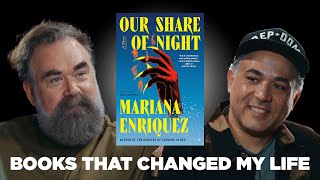
Oz Rodriguez, Emmy-winning writer and director, talks about how Mariana Enriquez's novel Nuestra Parte de Noche changed him. He found it in a Brooklyn bookstore and read the Spanish edition, discovering a story about a father and son caught between a cult and a demonic force that mirrors Argentina's dictatorship. The book reignited his love of reading and pushed him to keep writing.
Chapters
Let's welcome Oz Rodriguez. He's sitting down with us today to discuss a book that changed his life. Nuestra Parte de Noche por Mariana Enriques.
Latin America has sort of the shared history of struggles with dictatorship my parents both experienced in their childhood. Dictatorship, political violence. And I think it very much affects them to this day as far as, like, how they behave. There is something that's inherited from my parents that maybe has affected me.
What are those? Behavioral Cascades.
Books. They've saved us from the dark, set our souls on fire, and whispered truths we couldn't ignore. I'm Chris Collins and this is Books that Changed My Life.
It's both a sort of a book about a father and son, but also at the same time, it's ramifications of the dictatorship in the country of Argentina.
How did Nuestra Parte de Noche change your life?
Oh, thank you. Beautiful cup. Is it.
Is that just coffee?
Just coffee. Gracias. Thank you.
I have many questions for you. Tell me about your shoes.
This is a collaboration between Moncler and Rick Owens. I'm a big Rick Owens. Okay. Fan. Kind of my uniform. Okay. And so they take good care of me.
It's very cool. It's very nice. Got a lot of.
It's a long shoelace.
A lot of shoelaces.
Must take a while to tie it up.
There's slip ons.
Okay.
No. Let's welcome Oz Rodriguez. He's an Emmy award winning writer and director. He's worked on snl. He's written movies, sketches and TV shows. And he's just authored his first book, the Girl and the Robot. He's sitting down with us today to discuss a book that changed his life. Nuestra Parte de Noche por Mariana Enriquez.
Boom. Nailed it. Yeah.
Which is our sheriff night right here.
Yes, yes, yes, yes.
So fun. Where did you grow up?
I grew up in the Dominican Republic. I was born in Cuba, but I left when I was five months old. And do you remember? I do not. I remember when I went back when I was three. I remember a couple things. You went back when I was 3 years old and then I didn't go back again until I was 36 or something. So there was a huge span where I never went back to Cuba.
What is the story about how. How you ended up leaving or how your parents ended up leaving?
So my mom is Cuban and my dad's Dominican. He went from the doctor to Cuba to study medicine. The sort of medical school in. In Cuba is sort of renowned as far as Latin America, and he wanted to specialize in Cuba. He became a gastrointestinal surgeon, so he went there to university. And that's how he met your mom? That's how he met my mom. My mom is a anesthesiologist, so they met in med school. And they're both huge nerds as far as medicine. They love it. And so, yeah, they met in Cuba. My dad was there for a few years. They got married. I came. Came into the world, and Cuba is Cuba. So my dad and mom wanted me to grow up in the doctor. So my dad being Dominican, it was a little easier for us to go from Cuba to the Dominican Republic. So went there when I was five months old, grew up in the doctor, and that's sort of where I'm from. And all my memories are there. And my parents still live there, my friends still live there. So I consider myself Dominican. I dream in Dominican Spanish.
What is it like growing up there?
Oh, it's great. I mean, it's the only experience I have as far as growing up. But the beach is really close. It's super hot. My dad wanted my sister and I to learn English early on, so that's why it doesn't sound like I'm from the Dominican Republic.
Do they have both in school there?
Not in every school. We went to a school that taught English and Spanish, but Spanish is the main language in the Dominican Republic. It's a beautiful country, full of just, like, the greenest sort of jungles and the most beautiful beaches. And I will keep talking about the beach because I don't like to be in the city. I would just prefer to be in the beach if I can. When I go back, I visit my parents, I'm like, cool, cool. All right. When should we leave?
Now.
So, yeah, if I could be anywhere right now, it'd probably be a Dominican beach. Just sitting, reading a book or reading.
A book or umbrella. No umbrella.
Depends on how hot it is. If it's like, noon, I probably want to be under an umbrella because the sun will be blazing. But, yeah, I either like to either sit at the beach with a book or go for a walk with either music or an audiobook, say. I'm not a huge podcaster of neither music or audiobook.
Is it the smell and the feeling of sand in your toes and the whole thing that kind of get you?
Yeah, that. The smell, the people, the peace, probably the food, the.
Tell me about the food.
The food is delish.
I mean, what's your favorite thing there?
My favorite thing there Is this restaurant called Luis Restaurant? Very simple. Luis. That's it. He's like, my name is Luis. The place is going to be called Luis. So there we go. But it's. It's on the north. Have you met Luis? I've met Luis many times. Since I was, like, maybe 15, I've been going to this place, and it's on the beach, and it's this little shack, and there's tables, but it's seafood. But it's all caught that day. Like, they don't open until, like, noon. So they have to, you know, they have to get all the food that they have. Fish from the ocean that's right there. So if you were to ask for a lobster, let's say first, it's not going to be an insanely expensive lobster. You actually have to go into the freezer and say, I would like this lobster. Out of all the lobsters that they've picked out of the ocean that they. You have to go select the one that will be sacrificed for your belly. If you don't concentrate on that part, it's really cool because you're like, is.
That what you get? Is that your go to lobster?
Yes. I only eat it at this place. I don't eat lobster anywhere else.
Oh, really?
It's also warm, and it's not like on some cold, soggy bread. Sorry, I'm hating on lobster rolls. Lobster rolls right now. Yes. And it comes with a side of rice, beans. But there's also fried fish, which is incredible. Like, my wife is a pescatarian, and she said that that fried fish was the closest she's felt to eating fried chicken. Like, it brought her back to her when she ate fried chicken. It's just delicious. And they make the best beans. And I'm getting hungry. I wish I could be there right now. It's an amazing place. I might have to show you photos later.
Was your mom a good cook?
Yes, she is a good cook. I was fortunate enough that because my mom is Cuban, in my house, we ate Cuban and Dominican food, which is pretty similar, but we have certain nuances. Yeah. So that was really exciting. A lot of people in my family cook. Do I? Not really. They are very bad at sharing the secrets. Like, I maybe have a little more of an analytical mind when it comes to cooking. I've been told that baking might be better for me because I kind of need to know, like, kind of measure and this. That how long in the fire? When you ask my mom that question, she's like, yeah, you know, just Put a little S in there, whatever. And I'm like, well, it's not whatever. It's like, I need to know. So it's as good as your thing. And she's like, I think because she was gatekeeping this information, I never became the great chef that I could have been.
So that was your second calling.
That might have been my second colleague. So there you go.
What were your interests as a kid?
My interests as a kid were. Man, I wish I had a different answer, but the TV was my main interest.
Why do you wish you had a different answer?
Because I spent too much time watching tv. Tv?
What would you watch on tv?
Well, my mom is a big cinephile, which I think is where I got this affliction, let's say. So she can sit on a weekend and watch like three movies in a row. She could just sit on the couch and just blow through three movies. And they can all be three different level quality movies you'll still watch.
And fantasy. Different genres.
Different genres. Different levels of, like, you know, classics.
Did she have a favorite movie that she would come back to over and over again?
She has a couple favorite movies. She would never tell you. The Godfather is her favorite movie, Godfather 1 and 2. But she's seen it so many times that it has to be one of her favorite movies, you know. But she'll never be like the Godfather, but she's seen it a million times. And then there's a French movie called the Umbrellas of Chesburg, which is a musical, and that is also one of her favorite movies. And I resisted it for a little while because I'm not the biggest musical lover. Saw it and it's great. It's incredible.
Saw it like when you were older.
Saw it like five, maybe a little longer, close to 10 years ago, still older, and called her and said, you were right, it's great.
So if you watch TV a lot, did you not have a lot of friends that you played with?
I did have friends. I did have, like, a good amount of friends. I did leave the house, which was good. I did ride bikes and touch the grass. And all my friends became musicians somehow. So I was surrounded a lot by musicians. And I really like music. And I like the. Always interested in the life of a musician just because all my friends are musician. But there was also a divide because, like, they were like, nerd out about whatever. Pearl Jam's latest album. And I was like, yeah, but did you see Fight Club? Did you see the Matrix? Did you see these movies?
Yeah, yeah. So, yeah. And like, we in the Dominican Republic, we had access to not just, well, we have US television, but we had Spanish television, we had Brazilian television, Venezuela. So we. It was really cool to just be sort of exposed to all these different television shows, cultures, people, languages from all over the place. So it was, that was really nice to. You know, I didn't know that that was happening at the time. I was just watching whatever interested me. But looking back, I feel like it played a part in my interests because I think they're wide and far between. As far as, like, I love Pedro Molovar and his movies, but I also love Stephen King and I don't know what the connection is between those, but I think it was from just high art, right? Yeah. Just being exposed on. Yeah. Really well told stories and sort of stories with. With a personality, with a vision, with a pov.
And, you know, in the Dominican Republic is where I actually ended up watching snl, which doesn't make sense, but I watched snl. I'm dating myself here. Nirvana was on the show and I'm like, I like this Nirvana band and they're, you know, I didn't really have cable, so back then, you know, artists weren't as available as they are now. So I'm like, I'm going to watch this show called Saturday Night Live to see this band I'm really interested in. And as I'm watching the show, I'm like, what is the show? And I'm laughing. And I'm also like, learning about culture in the US and through Nirvana, I became a fan of snl. Oh, wow. Through Nirvana and Pearl Jam, it was like the one, two punch in 92.
Yeah. When I was one years old. Because I was born in 1991. No, I'm kidding.
So how, how old were you in 1990?
All right, I guess we're getting into these kind of questions. I was 12, 11 maybe.
So I would have been like 18, because I was the class of 90. Yeah. But I. So I grew up in Seattle.
Oh, amazing.
So I was in. I was in the music scene in Seattle.
Yeah.
And so just very familiar with Pearl Jam, Nirvana, the whole thing. Were your parents readers?
My parents are big readers. Big, big readers.
How old were you when you read your first book?
You know, I don't remember. I remember the first book that I chose for myself. Like, I was reading books school through, like my parents.
But there is this book that I remember picking up when I was like either 12 or 13 that was just so different from everything else. I was being exposed To. And that was Stephen King's it with Pennywise on the COVID from the Tim Curry version. And my parents were not a fan. Cause they were like, what are you reading? And then they found out about who Stephen King was, and they were like, this might be Satanic, and this crazy clown is scaring me. And it's also 1,000 pages long. They're very worried. And I actually read Misery first. That's kind of what got me into Stephen King. But I remember it sort of just being. You know, it was my second pick for this. But I feel like. I don't know. I assume that some people have mentioned Stephen King, and Stephen King has been talked about a lot. But that really impacted me in a profound way because it was. It was a story unlike what I'd read before, and it was so scary. And it also felt dangerous for me to read it at that time. I don't think it's like the first book I read, but it feels. Sometimes it feels like the first book I read because it was like, I want to read this, and it's my thing. And it just rocked me.
So it felt very personal. Because it was your choice and your thing.
Yeah, yeah. Cause I am.
How old do you think you were at that point?
Either 12 or 13.
12 or 13? Yeah, yeah. That's kind of the age, too, where you're looking for that independence a little bit.
Yeah, yeah, yeah, yeah, yeah, yeah. Because I remember reading things like Roald Dahl, for example, which I'm just revisiting again, a little younger in all these books in Spanish, too, that were sort of a sign in school. Or, like, my parents thought I should read them, but nothing was sort of clicking with me in a way where I'm like, oh, I have to finish this book as soon as possible. Or I'm, like, taking this book everywhere. And I remember that feeling with it because it's also, like, a book that weighs a lot. So, like, you feel it when it's with you.
It's a doorstop.
Yeah, yeah, yeah. And it also. It, like, paved the way for me to read doorstop books, which is what my wife calls them. Like, I love a thick book. It just sort of changed my mind as far as to. As far as, like, how to dive into a book of that length and sort of cherish the journey that you go on to.
What sort of books did your dad want you to read?
I think there was just a concern. I'm from the Dominican Republic, which is somewhat conservative, somewhat religious.
Catholic.
Catholic and.
Good guess.
Yes. Yeah. Excellent guess. Not that I grew up in an extremely Catholic household, but it was still. Yeah, the presence is undeniable. So.
Especially in the Latin culture.
Yeah. So there was just a fear of, like, do you have to be.
You know what's funny about the, the Salvador Dali Bibles is, you know that the guy who commissioned him to do that, the reason why he commissioned him is because he was convinced that Dolly would become a Catholic after doing it. Oh, wow.
It didn't work. Yeah, right.
Yeah, but that was his.
Yeah.
It wasn't about the art. It was. He thought he could convert him.
Yeah.
By hiring him.
Oh, look at that.
To illustrate the Bible.
Did not work.
Did not work. But funny.
I, I'm very curious. I, I, I just gifted my wife a book, Dali Book. I forget the name, but it's him. It's a book about wines, and it's him illustrating wines and talking about wine. And my, My wife has a wine shop, so she. It's one of the best gifts I've ever given her because it's his version of. It's like him. It's to get in his mind and see how he approaches wine, which has.
Got to be a little abstract because everything he did was abstract. What is her wine shop?
It's called Dia Natural Wine. It's in the Studio City. It's been open for like, two and a half years. And we sell natural wine, like the name says. So it's wine that has not had any pesticide or insecticide kind of thing in the farming and then in the bottling, in the processing, there's no extra chemicals added either.
Oh, that's great. Well, we'll have to check it out and support it. That's fun. We drink some wine.
I, yeah, if, if it wasn't in the morning, I would be drinking with you too.
So kind of take me to the point. In life, where are you at emotionally, mentally, when this book comes into your life?
Let's see, what were you doing for.
Work at the time?
So I'm a TV and film director. So I have been working in this business for, like, 15 years now. And I worked at SNL. I've been working in.
Episodic directing. Sorry. I've been doing directing episodic work. So I get to read a lot of scripts, or I have to read a lot of scripts. Sometimes I get to, but sometimes I have to.
So to be perfectly honest, reading sometimes felt like a chore because I am doing so much reading for work. So sometimes it felt hard to just sit and read A book. So I was doing more audiobooks. I was sort of consuming books through audiobooks. I love to walk. I love to go to bookstores just to wander and see what's out there. And I love a staff recommend. So I went to this bookstore in Brooklyn, and I just roaming around, and I see this cover. I saw the English version first and drawn to this. So this dismembered hand with these yellow fingernails. Great name. And so I'm already in visually. But then I do have this thing that when I go to a bookstore, and if I see someone whose last name ends in Z, that's usually a Latino person, so I always dig in a little bit more. So, yeah, I see the author, Mariana Enriquez. I'm like, well, this person's probably Latina. I see that she is Argentinian. And that was enough for me to then go to the counter and order the version in Spanish, in Espanol, because Spanish is my first language. And if I can read in Spanish, I'll try to read the original text in Spanish, if that's possible. So did that. I get the book also.
While this is happening, I am developing my voice as a writer. I have just done a movie called Vampires vs. The Bronx, which I was the writer director. And that is the official first thing that I've put out in the world as something that I sat down and hit the keys. And that movie came about because I wanted to tell a story about people that look like me, similar backgrounds, and people that have experienced things that I've experienced. And I felt like there was a lack of those kind of stories out in the world, in movies, in print, in anything. So I wrote this movie about these kids in the Bronx who are fighting vampires, who are basically secretly gentrifying the Bronx. And it has a lot of Dominican characters, a lot of Dominican culture, a lot of Dominican jokes. And that was really exciting for me. And it got bought by Netflix, and it's out in the world. So I got the. I got the itch to keep writing and keep telling stories. And this book.
Amongst many things, it inspired me to keep pushing myself to keep trying to write, because as anyone that writes knows, it's not easy, or at least not for me. It's. Sometimes, especially when you're faced with a blank page, it's. It's very daunting. And this was just inspiring and to this day has pushed me to sort of keep writing and telling stories.
Can I. Can I ask you a question?
Yes, please.
Did you read it by Stephen King in Spanish?
No, no.
So you read it in English that I read. When you were a kid?
Yeah. Wow.
So you. You could do both?
Yeah.
That's incredible.
Yeah. Yeah. Okay, so the Spanish version of it looks cool. I forget the translation, but I do like to get the book sometimes in Spanish just because the COVID is like. You see the.
Yeah, it's totally different.
And sometimes the name.
Yeah. Just feeds the culture.
Yeah.
So my question for you that I am just curious about is, when you're reading a book like this, are you reading it from the perspective of an author, or are you reading it from the perspective of a consumer, or is it both?
I'm reading it as a consumer because it's. The stories I've done.
And the work I've done before is mostly in comedy. And Vampires versus the Bronx is a horror comedy, but it's more akin to like, maybe a Goonies and Lost Boys. And this book I just wrote is probably similar to ET So I tend to read things that are different from what I. From the things I work on. So I work in comedy a lot. I rarely go home and watch comedy. For some reason, I like a thriller or a horror. This being a horror, this. Being a Latina writer and also dealing with the political violence of Argentina and the dictatorship and talking about that through horror felt really exciting for me because those are. I'm interested in stories about Latin America that deal with some of the, let's say, the past, violence and colonialism and dictatorship through genre. That is sort of a genre of itself that interests me. So this book was sort of hitting a lot of checklist things for me. So it started as just like, I'm. I want to read this as a consumer, not necessarily like to be inspired as a writer. But the way this book is put together ended up being very inspiring to me as far as, like, how it moves. I think it's divided into six parts, and the narrative jumps through time a lot. And the way Mariana Enriquez tells the story and it feels compelling and it doesn't feel like, well, now why are we 20 years before. It all sort of feeds into. The narrative was really exciting. And just like, in a sort of a general sense, like I said before, I was listening to a lot of books. I was not sort of sitting down and opening up a book and sitting on a comfortable chair like this one, and just like diving in. But this book kind of brought me back to that sort of that joy of just like, sitting, reading.
And it was kind of back to when you were a kid. It was like your choice Your book, your time.
Yeah. And I think it does connect a little bit to me being a kid. And it. Especially in that there's like. It's a multi generational story, but you meet these characters when they're kids and then you meet them a little bit older and you sort of see the. How past traumas have affected them as they become older. So there's like, there's these Stephen King connections that, that. That I thought were really, really interesting. And then like, once you're like, in it, I just. I was in it. I was sucked in. And I just wanted to. One of those feelings where you want to finish it, but you also don't want to finish it outside of it being a really fun read and a great book. It just also brought me back to reading sort of for pleasure.
So give me kind of the premise of the book.
Okay, so.
This is a book about a man named Juan and his son Gaspar. Juan is a medium for this cult that believes in this sort of demonic presence called the Darkness. And Juan is a medium that sort of conjures this evil God, evil demon for the benefit of this cult. And it turns out that his son Gaspar is exhibiting some of the same behaviors. It looks like he will also be obedient. So the book is about this father, Juan, trying to protect his kid from this cult, trying to keep him away. So this cult does not take his son. He is not a willing medium. He was kidnapped when he was a kid and became a medium for this cult. So basically, he does not want to give his son Gaspard the same life that he has lived. So a lot of it is sort of them running away from this cult. And that's sort of the pitch of it all. But I think what really gripped me was that.
The story really is about the Argentinian people dealing with dictatorship and the fallout of the dictatorship in the 70s and 80s.
So there's a political undertone.
There is. There is. So this dictatorship called La Junta Militar. It's basically this. There was a coup d' etat on this president, and.
This group of military leaders became the president or the government, if you will. And their sort of modus operandi was to eliminate anyone that was against them. So the country of Argentina experienced a ton of disappearances. There was a lot of torture, rampant murders, mass graves, and it's just like a real life horror show. And this is Mariana Enrique's sort of way to talk about those events without necessarily becoming a historical book. Like, the cult mirrors the dictatorship a lot because they do sort of the same things that the dictatorship did. They kidnap people, they torture people.
They just.
There's a lot of violence.
Yes, there's a lot of violence. And this is their cults, the way they conjure, their demonic presence. This demonic presence demands. It wants to eat, so it demands bodies and stuff. It's both a sort of a. Very much a book about a father and son and that relationship and what we inherit from our families and the baggage and trauma that we can inherit from our parents. But also at the same time, it's the ramifications of the dictatorship in this country over a course of like around 20 years.
Do you believe in mediums and mysticism?
I want to. I believe them more in the printed world or on screen, but I have not had any experience that has made me believe in such a thing. But I am maybe more agnostic. I just.
Maybe one day it will happen. But I don't necessarily subscribe to any kind of mysticism, if you will. But I do enjoy a story about it.
Yeah, that's interesting that you. You're kind of attracted to that. But it really is abstract, right? In a sense.
I think so, yeah. Because. Yeah, yeah. I just. I. Even as a young.







