Books That Changed My Life: Patti Penn & Conversations With God
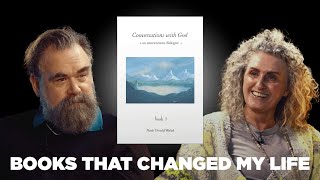
A conversational interview in which Patti Penn explains how the book Conversations with God influenced her life and practice. Through biographical anecdotes (growing up in Glasgow, early psychic experiences, learning martial arts, moving to London) and professional highlights (appearing in the documentary Heal), Penn describes her approach to energy work, timing/readiness for healing, authenticity versus truth, and how people change when they commit to growth. The dialogue mixes practical tips (mediative practices, projecting energy) with philosophical reflections on self-love and personal responsibility.
Chapters
We're here today to talk about the book Conversations with God.
Yeah.
Which feels amazing in the hand.
Oh, yeah.
What kind of tea?
Mint.
Cheers.
Cheers.
What do you think of the library?
Oh, my God. I think it's spectacular. Oh, wow.
This is wonderful.
I went home for the holidays and my mother had a tumor and my dad was just an early diagnosis of clinical depression. I said, this is what we're going to do. We're going to start getting the principles back that you brought me up with.
We love talking about books that had changed people's lives. Like, had such an impact that they are different. After reading the book, our special guest today is Patty Penn. The big question.
Yeah.
So how did Conversations with God? This book change your life?
I think it changed my life.
Are your highlights in there?
No.
You're not a highlighter?
Not highlighter.
Underliner?
No.
Oh, I make a mess.
No, I like to take notes, sit with. If it's a transmission, you know, kind of take a snooze for 10 minutes and then get back.
Yeah. You just kind of let it take its own tempo.
Especially in this book, you read a sentence or a paragraph and you need to process it. And sometimes the best way to do that is to close your eyes and kind of center yourself and kind of let the brain do its thing to reboot a thought or a sentence that is kind of coming up against something you've been taught, something that you. It's a fundamental belief.
What kind of tea?
Mint.
Mint?
Yeah.
Cheers.
Cheers. What kind of tea do you have?
This is a coffee and tonic.
Wow.
So espresso tonic.
Wow.
A little more caffeine?
I think probably I had my caffeine this morning.
Don't you think a lot of people read books to get it done versus to absorb it sometimes?
Oh, 100%. I think we were laughing in the corner about the self help section. And I said, we call that shelf help.
Yeah. No, I always say that's the least effective part of the library.
Well, I think it has become so. I think it used to be, I would say in the 90s, when to get really, a metaphysical book or a book that was talking about what's in the vernacular today, you had to go to kind of speciality bookstores. There was the Body Tree here in Los Angeles and in London, there were other bookstores that were holding Alchemy Magic books. They weren't in, you know, your high street retailer. Yes.
A little more fringe.
And then there was a lot of conversation in those bookshops. There was a lot of Meetings, events, and maybe the community that I think people are looking for around books.
What do you think of the library?
Oh, my God, I think it's spectacular.
If you were to analyze me just by the books that I have, what would you. What would be your analysis? Am I crazy?
No, I think you're very deep. I think you're curious. I think you want to know more about what you don't know. And I think that's. That's admirable because I think a lot of people like to know what they know and stick to what they know. And I think you're excavating through the mind of philosophy, art, movies, social, cultural. And it's interesting.
Yeah, I know very little. I want to know more, but I know very little.
That's the whole thing about being alive, right? We all have our own point of view.
So you made a documentary and you're writing?
I didn't make it. I was in it.
Oh, you were in it?
Yeah. It was a documentary that came out in 2017 called Heal, and it was supposed to last, I think, about a week in Santa Monica at the theater there, the movie theater. And it lasted six weeks, which is a long run for documentary. And we did a lot of Q&As. And a lot of people loved the conversation around disease, healing, emotions, things that people were really ready to talk about. So, yeah, I was in that. And.
It was.
An exposure to out of my bubble, you know, because I was in a bubble for, you know, at this point, 18, 18 years, just working with the people that I work with that, you know, heard about me, kind of called me in, got it, whatever way you want to put it. And then this kind of exposed this conversation bigger, and it was great.
Were there any big lessons or takeaways from that experience? For me, yeah, just what you came away with?
Yeah, like, I was in a bubble. I thought people knew this stuff. I thought people had correlated that. You know, when I get nervous, my hands get sweaty, my heart starts to palpitate. You know, I have a physical reaction to something. So if I am holding onto grudges and resentments, that is also having a physical reaction in my body for 10, 20 years.
And.
So that kind of bursts my bubble into outside of the people that already knew this or were coming to this realization. I think the experience.
I met a death dou in Santa Fe, and.
She said it was interesting to look at my work because she felt that everything she was doing at the end of people's lives, I was kind of getting them while they were still, you know, in their 20s, 30s, 40s, 50s, 60s, that they could shift things. That was really interesting to me because it was the death of something in yourself at 27, 35, whatever. Now I'm working with teens that think, you know, why haven't I got to this work sooner? And you're like, okay, you're only 16, but I hear that from a 46, 56, 66 year old. I think it just comes at the right time.
But it's natural probably to feel that way. Right?
Yeah. Because they only know their 15, 16 years. Right. That's. Oh my God, I've wasted so much time not knowing this stuff.
Is it a trauma that you're getting rid of?
No, not all the time. Sometimes it is.
The awareness of patterns. Why do I have this pattern?
What is it disguising? What is the fear underneath it? Where are my edges? Why do I keep saying that I'm going to do something and I'm not doing it? So it's like kind of self analysis that they have started to audit, started to do a dive on themselves. On some level they've noticed.
Like a soft noticing. They've observed, they've realized, oh, I'm here again. Sometimes it's the disease. Sometimes it's creatives, especially here in Los Angeles, been here for a long time, and creatives who are coming up against walls or trap doors that they have that they get to admit to. That's the big step, admitting. And how do I not hate myself for going down the dead end.
And double back and start again and regroup. People find different inroads to what I do and to themselves, and I just show up. Once they find that inroad, once they find that aha moment or as Bill W. Likes to call it, the psychic phenomenon.
You know, and something happens, something occurs, someone shows up. Or in the Joseph Campbell. I kind of show up in people's lives.
That timing is always interesting.
Yeah, yeah. And I work with that energetically. You know, I don't want to force people to be at a certain place that they're not ready for because they'll just sabotage it. Yeah, yeah.
In my world, the pre qualifier for that is that they invest.
Free advice is often sabotaged.
Oh, completely. Completely.
It's a weird thing.
Yeah. Because there's a. There's a value system that we're already in agreement with.
Yeah. If you, if you're willing to invest in it, then you are already on. You're. It's the placebo effect in the sense that you're committing to it working in a way.
I think so.
And I think enough to get to open the door. Yeah, you still got to do the work, but it's enough that the doors open. Instead of people that say they want to get better, they want to improve, but everything else is telling you they don't.
Well, a lot of people will say that they are. You know, they've been working on themselves for 20 years. And you're like, why are you doing the same thing then for 20 years and not seeing results?
That's probably a hard one to answer.
Yeah. So the people that I have worked with that have answered that, have said, oh, yeah, I kind of knew about you five years ago, but I avoided you because I knew you were going to make me go there and look at it, and I don't want to look at it, but now I'm ready to look at it because now it's everywhere.
So it's a delay. But then again, is that a timing thing again, that they wouldn't have been ready five years previously? But they're. They're kind of. They're a cuckoo at that point. They're ready. It's, I think when people think they're ready and sometimes they try.
That can also, you know, because they don't have the energetic circuitry for the success, the money, the recognition. And that sometimes brings up a lot of old. Old programs and old stories that sabotages it. Oh, yeah. I call it the Killjoy.
Oh, it's great. So we're here today to talk about the book Conversations with God.
Yeah.
Which.
Feels amazing in the hand.
It does.
Like, I like the way this book is designed.
Yeah, it has a nice old kind of papyrus feel almost.
Yeah.
Yeah.
That's a great description.
Yeah.
And it's. It's heavy. Yeah, it's got some weight to it. So where did you grow up?
Glasgow, Scotland.
Was that where you were until your early adulthood or.
Yeah, I was there until my twenties and then I moved to London for, you know, nearly a decade, and that's where the book came into my life. You know, I'd been brought up in a city that religiously was split.
Very sectarian. In the 70s and 80s, they did a really good job at getting that out of the football clubs. And my grandmother, you know, my family were considered mixed as Catholics and Protestants. And when my grandfather died, they didn't really kind of want to know because she had married outside of the faith, so she started going to the spiritualists. And that's when a lot of healers started coming into our life and a lot of clairvoyance and a lot of mediums and a lot of people.
How old are you at this point?
Oh, I'm three. And this seems normal.
And talking about energy, talking about connecting to the light, connecting to a higher force is normalized. I'm also going to a convent school and warned not to talk about it when I go to the convent school.
Did that get you in trouble?
Oh, of course, because I wanted to talk about it.
Yeah. You just my initial impression of you, you're probably not one that can be censored.
No.
Easy, right?
If it's something that I believe in, I can't be. Sorry. Censored. But I can hold my tongue.
Did you have any early experiences as a kid?
Yeah, many.
What was one that was profound, probably.
When I started kind of connecting to what I considered my guide and that I would listen to, that I would hear.
You know, guiding me through life, you know.
Hearing probably about five or six.
And what sort of things were you needing guidance?
Well, someone tried to pick me up in a car once. I was standing next to the lollipop man, and I. And it was a woman. I had been told, don't take sweeties from strangers. Don't take rides. And this woman stopped and she said, I know your mom. She said, and you go to this school. And I was like, well, she sees the badge, but maybe women don't have sweeties. And I went to get in the car, and all of a sudden this energy that was thick like treacle happened. When I had my foot in the car, something told me, get out of the car.
And I looked at her and I said, yeah, you don't have any sweets. And, yeah, and I've got a badge on. So slammed the car door and I went back to the lollipop man.
And she just drove off.
She just drove off.
Wow.
So there's things like that that are, you know, in the library of accumulated things that keep you from being kidnapped or anything happening to you or, you know, like the normal stuff as a teen or a kid where, you know what's going to be in the exam. You can get it the night before. So you start reading that chapter and look, it's in the exam. And then I started doing martial arts by the age of 12.
What made you want to do martial arts?
Because of where I grew up. You know, my mother wanted me to be able to fight. Being at the school that I was at and where I grew up, it was two different worlds. And I Was getting chased a lot and beaten up. So she was like, you know, you need to learn to fight, but you need to learn to fight like Bruce Leel.
It was the 70s and enter the Dragon was big and she just loved all those movies and we used to watch them together. So I went when I was 12 and it was some serious stuff.
So then, did you get in more or less fights after you learned martial arts?
No one came near me after that.
Yeah, that was my experience with martial arts is I didn't get any fights.
So I knew that the energy of me knowing how.
Yeah, you're projecting a certain thing.
And then after I became a black belt at 14, I knew that there was a. There was an energetic emission, that I knew something and no one, no one came to fight me.
So that specific energy, does that energy have a color? Does it have a density to it? What, how would you describe that? That specific energy?
You know, like if you get up really early in the morning, like at 5 o' clock in the morning and you are wide awake and you're sprightly and you're full of beans, it's that energy. It's like you're not asleep, you're not kind of semi awake. Like they look at you and they think, nah, I'm not gonna bother with that one.
Yeah.
Cause you seem in your body and on your toes.
Does that have a color?
No, I don't really kind of see colors. I see it as like a lightness and a light and a luminosity. I know a lot of people that see colors. I think we all see energy differently. I work with musicians and filmmakers, so people see things.
Musicians will see orbs, they'll see light, they'll feel the lightness, they'll. They'll feel the nuance of the notes and what's calling them or when there's a block.
People, I think in film can sense there's a sense of something's not working here. I don't know what it is, but I'm just gonna wait and sit with it or move on to another scene and then come back and then it drops in the idea. So everybody, I think, has their own mechanics of it. And I think when you can cultivate that, you become really successful.
Can I ask you a question about energy?
Yeah.
Okay, so let's say I go to a place.
Yeah.
And it's, it's a gathering and I understand my energy when I walk in the room and how I can affect the room or not affect the room.
Yeah.
I can be Invisible or people can feel me. What is the energy that people will say, wow, I felt you before you were here. Like I knew something was going to happen, I knew you were coming or whatever it is. How can energy.
Get there before you?
Why put my energy here before I came here?
How did you do that?
I sent it just by thinking about it, the thought of it, the thought of speaking to you, being in your space, you know, being in the openness, in the willingness to open up, the enjoyment of it.
Of what you do. Just the thinking of it projects your energy forward. Like you thinking about going to the party, you thinking about who you might meet. What's the opportunities of meeting possibly new friends of the next 20 years and the next 10 years? So I think you having. It's like non locality in physics, right? You can.
Your energy is already going there. Yeah. Energy of. Not your physical being, but the energy. If there's no time and space. Right. It's already happening. The. The event that you're going to is already in motion.
So like the. At the time that I scheduled or committed to going to the event, my energy is already going there. Is that.
Yeah, your energy is already, you know, connecting to the other people that are also coming to the event. And then maybe there's going to be someone that doesn't want to go to that event.
They just can't be bothered. They're tired that you have to meet them. So they're like, oh God, I'm gonna go. I don't want to go. I'm gonna go for five minutes. And then all of a sudden they come and they meet you and they're like, oh, this is why I came. This is why I dragged myself off the couch. So your energy can also magnetize people coming and it can also repel people that don't want to be there too, because they don't want to be in that level. Maybe a conversation or whatever. The gathering is because we all bring our own note, right. Our own musical note that adds into the harmonies.
How do you get your energy to be the note that is the most collaborative and welcoming for others? And my experience is doing tm. Transcendental meditation has created that where I noticed a big change in people feeling comfortable because I'm kind of a big intimidating guy. That changed that energy. Yeah, for me, whatever that is a vibration or.
Well, I think you also. Well, you said that you're. You perceive that people find you big and intimidating.
Well, you can tell.
Yeah. And I think when you. You compensate for being big and that Energy is in the mix and it makes it worse. Whereas when you start to do.
Yeah.
Or another meditation or you start to get into yoga or whatever it is that you start to find the inroads to being and dropping into starting to. How can I be more of this so more authentic? I don't really like the word authentic as a process because I think authenticity is a byproduct. I don't think you can. Oh, I'm going to be authentic today. I think I can just be myself. And if people perceive me as being authentic, then it's a byproduct of me just being myself.
Oh, okay. I've never heard it explained that way, but I like, because then.
Then it's. It's. It's less work. I feel being authentic really work, really hard work. There's a lot of.
Well, I could see how it would be. I don't perceive it myself, but, you.
Know, I think if you just. I just need to be me, me and allow people to not jive with me like me and also let them think that I'm big and intimidating and scary and all that. Like, people would say that to me when they would see heel, you know, and the work that I do, and they'd be like, oh, how do you do that? How do you go into that space? And I'm like, what of like, the truth?
This is a space I really like, but I can understand why people find it imposing and scary and terrifying. But I also really enjoy it.
Would. Would you use the word truth the same as authentic as a byproduct, or is truth more.
No, truth is when you're honest with yourself. Like a truth of, you know what? I thought I was this. But I just don't really like myself. I'm spiteful. I'm resentful at this person because, you know, that kind of level of truth where you're seeing it and you're just trying to kind of feel into where the disappointments are so that you can clear them rather than dragging around this bag.
Filled with stuff that's unnecessary, that's holding you back from what you're really here to do and be.
That's so interesting and makes so much sense. I have this conversation with people sometimes about loving yourself.
Yeah.
And I'm always like, I don't know that you need to love yourself. You just need to like yourself. And just like, I always feel like it's just be. If you. If you're trying to love yourself, you're not being truthful.
Well, yeah. Trying to Love yourself is the worst.
You should be and like yourself, it's too high of a bar. Like sometimes you're, you're, you need to be honest that what you're doing isn't working.
But isn't that love, being honest with yourself?
It is to me, but I don't think it is in the way people say it. The way people are saying it is they want belonging. They're like, I need to love myself, I need to belong.
Yeah.
So there's different versions of love in the way people describe it. I would agree that it is.
Yeah.
Usually people that say that are searching for something and you're not going to find that thing by trying harder. No, you find that thing by acceptance and liking. You just kind of start by liking yourself and being honest that there's things that I do that are creating this.
And but to me that is self love, you know, that's the byproduct of being like, you know what, I'm creating this, I'm doing this, I'm putting my head in the sand and I think the admittance of that just like someone walking into AE today and admitting that they've got a problem. To me that's self love.
Yeah. Okay, so you moved to London.
Yeah.
What is going on in your life at the time when the book comes into view?
Well, I think I turned 30.
And which was that, an easy birthday or a hard birthday?
I think it was a birthday like all Saturn returns 30, 60 and 90. That made me look at everything around me and say.
Why am I with this person? Why am I, you know, doing this job? Like there was a lot of excavating of society and what is it that I'm here to do? You know, 30 years went really fast and do I want to be on this path in.
Working? I was working in fashion at the time, but I also had my own practices of, you know, energetically knowing how to navigate my own career. And then it was like 99. So there was a lot of, I was coming out of a relationship, so it was a lot of going to the clubs and dancing because I'd been in a relationship for eight, nine years. So I had missed that whole early 20s going to the clubs and dancing. So I started.
Because you were with somebody.
Yeah, so I'm doing this, I'm at like 20, 29, 30. And.
There'S a person that I know who had his own TV show, very, very successful and it was the beginning of reality television, you know, like houses and stuff. And he eventually gets put in a conservative ship and he is drinking and taking a lot of drugs and I hadn't seen him in a long time and he was also gay. I think it was about early 2000. I was in Soho and I ran into him, which I didn't expect because I knew he was in a conservative ship. And he said, you have time to go for a drink? I says, I heard that you're not allowed to drink. And he says, okay. I says, let's go for dinner. I says, and what is it you want to tell me? He said, let's go to dinner. He says, I want to read you a book. And I was like, oh, this is interesting. So we go to dinner and he pulls out this book and he starts to read the book to me and he orders Merlot. And I notice he's so engrossed in this book that he doesn't touch the drink.







