Books That Changed My Life: Robert Palleschi & The Accidental President
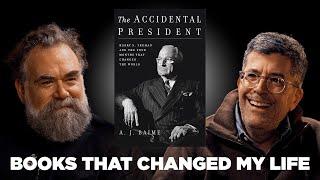
Robert Palleschi credits 'The Accidental President' with helping him navigate tough boardroom moments around 2018. A friend sent it as a wake-up call, and Palleschi found parallels between Truman's outsider rise and his own path from Johnson & Wales. He draws leadership lessons from hotel management: take care of your people, coach continuously, be transparent.
Questions this video answers
Around 2018, when it first came out.
Jeff Kurzweil.
Johnson & Wales.
Chapters
So the book that we're here to talk about today, the Accidental President Harry H. Truman and the Four Months that Changed the World.
Yeah.
What'd you order to drink?
Coffee.
Coffee.
Oh, coffee never fails.
Cheers.
Awesome. Cheers.
What do you think of the library?
Oh, my God, this is insane. I mean, it's incredible.
How did you come about it?
Friends sent it to me. You know, I find myself in these, you know, boardrooms with, you know, you know, hundreds of bankers trying to work through situations, and I'm like, I don't speak that language. He, of course, chewed me out. And then Christmas, I got this book.
So what was he chewing you out for?
Specifically thinking that because I didn't have that pedigree that I couldn't achieve or couldn't accomplish.
We love talking about books that have changed people's lives. Lives have had such an impact that they are different after reading the book. And our special guest today is Robert Pelesi. So how did the Accidental President Harry S. Truman change your life?
I would say that it.
Just books. You know, you. You end up buying a bunch, and you got stacks on the floor, and then you put them on a shelf and then you buy more.
And that's outrageous.
Just kind of gross.
I mean, it's incredible.
So how many books do you have at home, do you think?
Oh, geez, I don't even know. I don't. I. I don't count them. They're kind of like all scattered. We move a lot, so they're kind of scattered between, you know, boxes and, you know, places all around the house and all that. It wasn't early on. I mean, I didn't start, like, really paying attention to books until I got older. And, you know, I did all the cursory stuff that you had to do through school, but, you know, didn't really pay much attention. And then as, you know, the older I got, the more interested I got. And then, you know, you find, you know, you find something that just grabs your attention and just carry it on from there.
So what are the categories?
I like a lot of biographies.
I like.
I like history, like biographies.
You know, that. That kind of stuff just, you know, anything that I can not necessarily learn from, but more, you know, inspired by. I love the underdog. You know, you gotta. You gotta. You know, you gotta, like, you know, that's why I like this book about Harry S. Truman. And the S stands for absolutely nothing. You know, but you've gotta. You gotta admire a guy like that. So ordinary. So Humb just, you know, pulled himself up by his own bootstraps. And so you wouldn't think. And so it's like, you know, how can't you be inspired by that? So why do you. Why do you move along hotel business?
You know, I used to manage hotels early on and then moved up to the corporate office. But when you're managing hotels and it's, you know, you're always. At least for me, I took the roles and the jobs that kind of nobody else wanted because, you know, it was. They were hard, and you could, you know, get attention. You could, you know, you could really kind of chart your own way because everybody had kind of low expectations. So you just worked hard and you could turn a situation around, and then once you turned that around, then you get moved to the next place. So it was kind of a hassle, but more of a hassle on the family than me. It was always easier for me.
Like, where. Where are the jobs that people don't want in hotels?
When you start out, it's, you know, no one wants the jobs that are like housekeeping, and nobody wants to do housekeeping or stewarding, which in the old days was like, the washing the dishes, the pots, the pans and all that sort of stuff. Nobody wanted those jobs. And actually, those are, like, some of the most rewarding, and they're actually the most fun because you're dealing with, like, real people with real problems. And, you know, you've got, you know, you get pretty creative, especially starting out young in management. You get, you know, when you find out that half of your, you know, your department just, you know, got arrested the night before and you're racing downtown to try to bail them out, that you get pretty creative with that stuff. But then, you know, throughout the hotel business, there's a lot of. It's a tough job, you know, 24 hours a day, seven days a week. You never close. And so a lot of people try to get away from managing hotels and move up to the corporate office. And so for me, I just stuck with it.
What'd you order to drink?
Coffee.
Coffee. Oh, cheers.
Coffee never fails, you know.
This is a coffee tonic.
Oh, nice.
Cheers.
Awesome. Cheers. A coffee tonic.
What is it? So what is this? Yeah, coffee tonic.
Is it?
Espresso.
From Seattle.
Nice. Nice.
We take our coffee pretty serious here.
Oh, man, that's really good.
That's really. That's delicious.
So what is the secret to hospitality and running profitable hotels?
Take care of your people 100%. Just take care of. Take care of your team. Listen to your team. Everyone has A story to tell and just listen and try to be as supportive as possible. Try to, you know, coach them, you know, counsel them. I've never been a big fan of all that, you know, the documentation or the, you know, the annual reviews. It's like, wait. I'm going to wait 365 days to tell you how you're doing. Coach, counsel along the way, but take care of your team. If you take care of them, if you're loyal to them, they'll take care of you. And be realistic and transparent. A lot of people don't tell the truth. Tell the truth. Tell them what's going on. If it's tough, if things are bad, enlist their help and they'll rally around and they'll, you know, they'll make things happen. So I mean, I think it's not more complicated than that. And you know, I think some people get a little bit over their skis and they think they know all the answers when they don't. So at least just be kind.
What's the best hotel that you've ever stayed at?
Oh, the best hotel I've ever stayed at. Oh, that's a tough question. I stayed at like amazing hotels when I was, I advanced my way and I finally made my way to the corporate office at Hilton and I had the honor of being in charge of all full service brands globally. So I got to stay in amazing properties all around the world. The properties that stand out to me are the ones that again tell a story. We had a Hilton at Trafalgar, right at Trafalgar Square in London and this beautiful view of Admiral Nelson's column and the art museum and all that. And what a lot of people failed to recognize was it used to be the headquarters for the White Star lines. So on the second floor it was an amazing meeting room, all ornate and historic. Great wood and amazing. This just amazing meeting room that looked at Admiral Nelson's column and that was the office where the chairman of the White Star Line learned that his Titanic was sinking. And it's like those types of properties that tell a story, it's like, how can there's something romantic in that. So whether it's that or the Waldorf in Rome overlooking the basilica, you know, in the Vatican, you know, it's just, you know, those, those types of properties, I think those are the ones that.
Stand out the most, almost museum pieces in a way.
Yeah, that's a good way to put it. Yeah, that's really a good way to put it.
Yeah, that's Great. How many books do you read a year?
I don't know. Probably. I don't think I've ever counted. A couple dozen, you know. Yeah, yeah, it's. I usually have a couple, like, cooking at the same time, which is kind of dumb.
Why is it dumb?
I don't know, I just. I just think, you know, between you know, managing a business and, you know, navigating all the email and then, you know, to have, you know, two books going, it seems a little. I, like, I should focus on one and finish it. You know, I'm reading Patriot right now about Navalny, his memoir. And. And at the same time, I've got war going from, you know, Bernstein. So it's, you know, it's kind of like flipping back and forth. Although I'm kind of like a little bit torn on war right now. I'm like, over war, but I still feel like I gotta read it.
So you feel obligated to finish a book when you start?
Yeah.
Never.
Yeah, I feel obligated to it. No, you don't.
It works for me.
Yeah. Yeah. I don't know why it feels like.
There'S like, I own em. They work for me.
It feels like there's a law there. I know. Sometimes I'll be honest. Sometimes, like, I'll put it down and I'll come back to it, like a month later, two months later, three months later, I'll come back to it and be like, you know, but, yeah, I feel like I've got to read it.
I don't think I've ever come back to a book.
No.
Like, if I'm. If it doesn't connect, I just don't connect.
Have you read. Have you, like, read the same book, like, a few times?
Oh, yeah, Tons.
All right. Yeah. Okay.
I've read books. Right after I finish it, I just started again. Really, man. Same thing with the experiences or movies or something. If, like, if I think it's really good, I'll. There's things that I've seen 50 times.
That's amazing.
Just trying to understand the layers, like, you start to get, you know. And also in writing books, there's layers to books. Like, there's a book called Body for Life that I've probably read 50 times because of the cadence and just the storytelling and the, the design of the book is to sell protein powder. It's just, it's an interesting business model, like, and it's written by an incredible author, but it's written like copy, like, sales copy. And it, you know, it gets you Emotionally, and then it. Towards the, like halfway through. Then it tells you the how to. So it's all emotional up front. And then it flips to. Okay, now here's how you lift weights. Here's how you eat. And that part, in and of itself would just be easy, but it wouldn't stick if they didn't tell you the stories up front to emotionally attach.
Right, right.
So, I mean, it's an incredible work of art in a sense that, you know, the. I think the most valuable part of his company was the protein powder that he sold on the back end. But the book was a contest for, you know, working out and gave away his Ferrari to the person who used his stuff and got the best results. And it's. It's all before and after pictures inside.
Yeah, it's fascinating. I don't know how I. I can't imagine writing. Writing a book. I just can't imagine. I don't know, because I don't know where to start. I don't know where you would. I don't know where. And I just don't know. It's just.
Well, yeah, you would know if you were going to write a book because you'd have something you want to say.
Right.
You don't just write a book. I don't think you have. You want to say something or you want to research something and share it with the world that you're interested in or something.
But it has to be bigger than you or you'd probably never get it done.
Yeah.
Because you give a piece of your soul.
And then you put it out there and you got to listen to people's opinions about it.
Yeah, that's always amazing.
That's the vulnerability of the whole coming at it.
And they come at it from a different perspective. Right. They come at a commercial perspective or this perspective or that. And it could have nothing to do with what the author intended and didn't necessarily care to be a commercial success or, you know, hit the New York Times bestseller list. I guess that's always a goal, but may not have started out like that.
Well, I mean, even that is relative, right? Because, like, I have a. I have a friend who's. I think he's got six New York Times bestsellers. And I was at his house once, and I had a book that was number one on Amazon in five different categories for a while. And he. He was talking down to me, and the whole time I'm like, dude, the New York Times is a curated list. You're selling or you're not.
You're selling or not.
And so to me it's just funny how there's a prestige with, with something, but really at the end of the day, it's, it's, you know, manufactured for, for a certain, you know, mystique. But it isn't really the real measurement of book sales. I have no aspirations to be a New York Times best selling author, but I, I know that I sell more books than most of them.
Congratulations.
I'm more about the connection.
That's awesome. That's great.
I'm writing the book for the individual, not for the, for the masses.
Yeah.
And I'm trying to attract a certain kind of person.
Are you working on something now?
I am.
Anything you can share.
So in my last book, which is called I Am Leader, there's two books. One is the I am, and then the second one is leader. And the thing that I've learned in fixing businesses is that people talk about leadership with these dog whistles, but most of what they're talking about is management. It's not leadership. And everybody feels good buying a leadership book. But leaders eat last and all that cheesy stuff really isn't leadership. Like real leadership is like hard. And you know, you have people's lives in your hands. Like it's not a joke and it's not, you know, it's not a motivational feel good thing, you know, in a sense. So when I started to write a book on leadership, it became very clear to me that you had to deal with the individual way before you could talk about being a leader.
Right.
Like you had to fix the person because there, you know, you can't be a really flawed individual and be a leader.
Yeah.
It's, it's not, it's not how it works. So in that the one thing that I've learned, because that book's been out, you know, seven, eight months now, none of the conversations in the app that comes with the book or that I have with people are about leadership. It nobody gets through the im. They get stuck there.
Yeah.
And so the next book is kind of a different version of that where it's called you. And so it's about the individual.
That's good.
And so I'm taking a different approach to that subject.
Are they stuck there because they're just focused on like the management component of it or they stuck there because they just want somebody to hit the easy button and give you this, give you the answer, do this?
No, they're stuck there because it's about them and organizing yourself before you can be a leader and organizing yourself doesn't happen through a dog whistle or in a motivational quote.
Yeah.
You got to put in the work and you got to think about it.
Yeah.
And so there's. They're thinking about it and they're working on it.
Yeah.
But they real, you know, most people realize that there's a lot of work to do there before the leadership component comes in.
Yeah.
Does that make sense?
No, it totally does. 100%. People don't want, you know, a lot of people don't want to put in.
The work and they don't want to take responsibility.
No. No responsibility. Or they just assume that because, oh, I've been doing this for five years now. I get this title and I do that for five years. I get that title. And then they go to the new role and they try to make their new role exactly like their old role, bringing all the frustrations, all the pain, all the anxiety with them, and then they expect a different result.
Yeah. And they become entitled by.
Right.
You know, by time, but not results. Where leadership is about outcomes and results. It's not entitlement.
Yeah.
You don't, you don't need a title to be a leader. In fact, most of the great leaders, like Martin Luther King. Except had no title.
No.
It was irrelevant. And also, nobody knighted them or gave them permission. Right.
They took it. Right.
And that's the other part too, is, you know, not waiting for permission.
No, there's. Yeah. And there's. And it's rare. There's very few people that, that are, you know, that hit that category. I think there's some that are, you know, I think there's leaders that are outside of business, too. I mean, you see all kinds of different people stand up and take the lead in an emergency situation or, you know, a, you know, a health of a family member, and they take that, they take that. That lead and they take. And they own that responsibility. But then when it comes to business, it falls apart. They just, they just can't do that. They lack the confidence over there. When you're, you know, you're making more important decisions about a family member's, you know, you know, in a hospital than you are, you know, working in an office. It's kind of crazy.
So the book that we're here to talk about today.
Yeah.
The Accidental President Harry H. Truman and the Four Months that Changed the World. So how long ago did you read this?
I read it back like in 18, I think, when it, when it first came out.
20.
18. 2018.
How did you, how did you come about it?
Friend sent it to me and said.
Who's his friend?
Guy's name is Jeff Kurzweil.
What does Jeff do?
Jeff is an attorney. He's a partner at a.
What's his win loss record?
He's, I don't, he's not that kind of like attorney. He's kind of like, he's like the, at least in the hotel space, he's like the consigliere of hotel CEOs. He's really well connected in. His offices are in D.C. and he's just like the coolest guy around. He tells it like it is. He, you know, he'll, he'll. He holds court at a dive diner in McLean, Virginia. He goes to the cigar bar next door and he's there with senators, congressmen, you know, governors, you know, Saudi royalty, and he holds court. And he, you know, kind of is a fixer or makes you think of things differently.
And. But so he just, he sent me the. I don't know. I was in.
Why did he send it to you?
He. I don't know. I was like, in it. I was like, I don't know, maybe I was in this, like, defeatist mode. We had, we knew that we had, we had been going through a number of different.
A number of different issues at a company I was running, and I kept like banging my head up against the wall. And in the hotel industry.
Cornell is like the top dog, right? You want to go to Cornell and everybody that comes out of Cornell produces the C suite execs. It's widely known, widely recognized. I didn't do that. I went to a different school, Johnson and Wales, and kind of had to pull myself up by my own bootstraps, right? Had to do all the hard work. And so then you find yourself, there's a couple of times in some complicated situations, I find myself in these boardrooms down on Wall street with hundreds of bankers and lawyers and trying to work through situations. And I'm like, I don't speak that language. You know, I can, you know, you want to, you want to talk about washing dishes and making beds and you want to talk about, you know, running a profitable hotel, I'm your guy. But when it comes to some of this stuff. And he, of course, chewed me out, gave me a lecture for, you know, a long time. And then Christmas I got this book.
Well, so what was he chewing you out for specifically?
Just for, like, for self deprecating. Yeah, I think self deprecating for, for like this Defeatist attitude or not thinking that because I didn't have that pedigree, that background that I couldn't achieve or couldn't accomplish.
Do you think this self deprecating is a protection mechanism?
Yeah, and sometimes it is. Yeah, sometimes it is. But I think I also, I use it because nine times out of 10 I'm not the smartest guy in the room and I know that. But I can make you laugh, you.
Know, it's, you know what's funny. In high school, yeah. I was voted so there was this girl, she was our, our class president. I went to a big high school. There's like 2200 students.
Yeah.
And 2200 students in. It was only 10, 11, 12. So they kept ninth grade at the junior high.
It was so big. Right.
And nobody there will ever vote to build another high school. So like it is what it is. Stop having kids basically is, is the, the message.
That's the message, yeah.
So our class president. I was kind of an odd kid because I played some sports, but I had long hair and I was a musician. And yeah, I didn't really fit in, in a category but people liked me. But I, I wouldn't say I was popular, but everybody knew who I was. She, she came to me and she goes, hey, you were voted funniest in the yearbook. And I was like, what? Huh? Like I'm not funny. That's, that's pain. That's me like trying to survive this.
It's just like you tell the truth and in, in that sarcasm and in, in pointing out the obvious, people like will, will either get shocked and some, some people find it funny, but it's just.
Yeah, but it was, it was shocking to me that people perceived like I'm not a stand up comedian, right. Like I'm just like, I'm making fun of authority is what I'm doing. You know, like it was interesting. So do you feel like that in a way like that it's a protection mechanism?
No, I mean, I think I used to. Now it's just you get to the point where it's like you kind of just don't care anymore, right. It's like you just like, ah, what's it matter? It's like in the scheme of things, what's the worst thing that can happen here? So now I'll just say whatever's on my mind. But for a period of time there, yeah, I think it was the, you know, that, that you know, self, you know, facing humor was probably a defense mechanism. Yeah.
What do you think he saw or witness that made him.
Oh, he knew I could work through situations. He knew I could get through it. And historically, I've always. I've always been able to navigate it. And I think he just, you know, it was probably a, you know, it was a tiring time. It was a difficult time. There was a lot of, you know, people coming at us from a bunch of different angles. And it was just. I think I just got in my own way. And I think he was sending me a message by like, look, here's another guy that didn't expect any of this and was handed this crazy situation and, you know, but was hardworking, was, you know, had. Had no enemies.
You know, and was willing to do whatever to dig himself out of this hole. And, you know, he followed an amazing leader in Roosevelt. Right. And so I think he, you know, he sent me that book as a message. It kind of was a wake up call.
So you get it and is there a note or.
Read this.
That was the note.
Read this, Read this.
And so then how long does it take you to read it?
I think I blew through it in maybe a couple weeks. Yeah, I blew through it faster than usual because he just, you know, I'm.
Who it was in the situation.
Yeah, exactly. And it was just.
You're open to learning the lesson.
I was open to it. But it was also more along the lines of, the only thing I really recognized about Truman was the fact that he followed fdr, Right. And the fact that he, you know, he made the decision to, you know, drop the atomic bomb and all that, and that was kind of the end of it. But I didn't realize all the complexity that, you know, that he had to deal with and how crazy it was and this in, you know, his first four months in office, everything that he had to do. I mean, there was a. There was a survey that was taken in 45, 1945, and it said it was talking about, basically across the globe, who had the biggest impact on the world. FDR was number one, Jesus number two, and Abraham Lincoln was three.
Wow.
He beat Jesus. FDR beat Jesus. And this guy's got to follow the.







