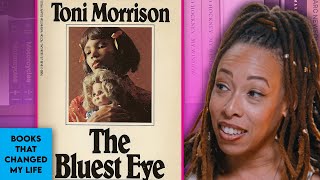
CC Rice discusses Toni Morrison's The Bluest Eye, which follows 11-year-old Pecola Breedlove through 1940s Ohio as she internalizes colorism and desires blue eyes as a symbol of whiteness. The novel traces how her parents' trauma and the Black community's assimilation pressures shape her self-hatred and isolation.
This time on books that changed my life. So kind of explain to the audience the premise of the book.
Yeah. So the Bluest Eye. It takes place over the course of one year, go through all four seasons. And it is centered around an 11 year old dark skinned black girl named Pecola Breedlove. And Pecola is an outcast. She is essentially shunned by most people because she's not pretty and she's not smart in other people's eyes. And she is seen as unworthy of love, both from her perspective and from the perspective of others around her. There's nothing charming about her in the way that she is portrayed. However, she has an enormous imagination and.
A desire to be seen and a desire to be loved that is so potent and so strong. And ultimately, the book is about Lorain, Ohio, in the 40s. This town that is, you know, mostly black, but there are definitely white people around and within the neighborhood. And it is a story of, you know, early assimilation, what it was like for black people who both, some of them who, you know, had always been in the north, but also once the great migration happened, there was this influx of southerners who were now in the northern states. And that really shaped a time in America that this dark skinned black girl is looking at white baby dolls with blue eyes and coveting them and wanting to have blue eyes and praying for blue eyes and ask for blue eyes. And she goes through a lot. And you find out about generational trauma. The book is so brilliant because it spans the past and the history of Pecola's parents, the trauma that her dad has been through, how he's been objectified, the trauma of her mother. Her mother has a club foot and so she shuffles when she walks. And so she is seen as an outcast in many ways from the other beautiful women.
And the story ends up that Pecola is raped, ultimately by her father. And for him, it's this act of affection where he's trying to show a girl that has not experienced love, love. This is his sort of point of view. And she experiences it as trauma. And she gets pregnant. And everyone in the town, I shouldn't say everyone, but people in the town get it. They know this is her father's baby. But the way in which it's spoken about in the book is so beautiful and that her two best friends want the baby to survive and they want it to live. Even though the adults, for a reason that they can't understand, are telling them, no, we don't think the baby's gonna make it and they don't get why. They don't understand that, you know, incest is not the most viable. And so they plant marigolds. And they say, okay, these marigolds are gonna brighten up the scenery. They're gonna make you happy. They're gonna be this symbol so that the baby will survive and know that it's loved and that it's in an environment of love. And the marigolds don't make it, and they don't flower and they don't bloom. And Pecola loses the baby and she becomes an outcast. And she's always been an outcast, but now she, as a woman who grows up, she lives on the outskirts of town in a place where she can see people and they can see her, and she just sort of haunts. And it's both a tragic story and an incredibly beautiful story that is so far ahead of its time. It is a masterpiece of epic proportions. It is pastiche. It's all of these styles, and there's avant garde elements to the way the language is written, just in the plasticity of the page. Their dynamics and the use of dialogue is so brilliant that you can hear the whole world that in its specific in place. And to me, it's just such an achievement, especially as Toni Morrison's first novel. You read it and it feels like it dropped out of the sky, you know?