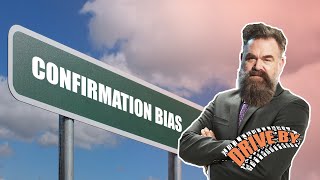
Chris Collins (Service Drive Revolution) presents a short "Elephant in the Room" segment about confirmation bias. He explains confirmation bias as a natural habit-conserving mental shortcut that causes assumptions and missed opportunities. Using automotive-shop examples (inspecting cars, phone/customer experience, hours per RO) and hiring analogies (attraction to people like us, left-handedness example), he argues businesses often overestimate how consistently processes are performed. His practical remedy: focus on measurable results, start with outcomes and work backwards, inspect processes regularly, verify references/results for hires, and attack specific biases iteratively. The clip ends with a promo for the next episode and show CTAs.
Chapters
Foreign.
Welcome to your Friday drive by. We're going to give you a little something to think about, a little food for thought, a little tickler going into the weekend and hopefully coming out of the weekend. It'll inspire some new strategies and some execution. So I want to start a series called the Elephant in the Room. And this is obvious unspoken truths that either because we're embarrassed about it, or we're just used to the scenario we're in, or they're just triggers and it's too painful to really talk about. We don't really think about these things or we don't talk about them. And kind of the definition is things that everyone knows about but are ignored. And the first one is confirmation bias. Now we're all guilty of confirmation bias. Think about it. Probably the reason why we're guilty of confirmation bias is because the way our brain works is we gravitate towards habits and kind of scripts that we, that we fall into. And the reason why we do that is to conserve energy. Because let's face it, like if you learn to ride a bike, right, think about how stressful it was the first time. You're worried about falling, you're trying to balance, you're learning something new. So you're using all of your capacity mentally and physically, and it's kind of draining. Now imagine if every time you went to ride a bike, you had to use that same amount of energy and everything that you did was like that. It was like learning it again for the first time. You wouldn't be able to do very much and you wouldn't be able to function at a high level. In fact, I've read some, some studies that the smartest, most successful people are the ones that go into a meditative state and are the ones that create habits the quickest because then they can use their energy on other things. So it's something that we're all guilty of. It's a natural thing. It's programmed in to how we function as humans. But there's a downside to it because what happens is we assume things and we prejudge. And a lot of times we're missing the gold or the secret or the thing that we really need because we have a confirmation buy. So think about this in your business, like a lot of times I'll ask somebody like, hey, how often are you inspecting the cars that come in your shop? And the manager or the owner will say, oh, every time.
Well, my best clients that I've ever had still maybe are 97%, but they're not every time. And so we're assuming because one time or a couple times we did it right, that that's how it always is. But the truth of the matter is you're probably closer to 50%. Same thing with customer experience. I'll say, hey, how do we answer the phones? Oh, we answer the phones great. We're great at it. Nobody's great at anything. Everything is constant practice, constantly reminding your employees what they need to do, constantly inspecting. But because that's a lot of work and it takes a lot of energy, we go to our habit and our meditative state and we assume that those things are getting done right. And then also the other side of this is we're attracted to people or things that are like us. For example, you know, there's the idea that left handed people are more creative. Well, I'm left handed. And so if you tell me you're left handed, I'm kind of like, oh, well, they're more creative, they're more like me. Because we, we naturally want to attract or we naturally are endeared instantly to people that are like us. Right? And so I want you to think about that. I want you to think about what are the things that you have a confirmation bias about in your business that you're overlooking because you're assuming that those things are getting done, like the customer experience, like inspecting, checking history, all of those things. What things are we overlooking because of our confirmation bias? Make a list of them and then over the next couple weeks try to attack a couple of them at a time. But let's not assume that anything is happening. Let's not have a confirmation bias. And also, just because people aren't like us, let's not assume that they're not great people or assets to our company. Let's actually go through the work and really learn about them. Really, you know, thinking about employees coming in, really check their references and check their results. And then the last thing I'll leave you with is the easiest way to get over a confirmation bias is to focus on the results. So in that same scenario, I told you up front, where I'll ask somebody, oh, so, so how are we doing with inspecting cars? And the manager or the owner says, oh, we inspect almost every car. We're really, really good at it. Well, I can look at their hours per ro and tell that they're not good at it. I didn't even need to ask the question.
A lot of times I ask a question, I already know the answer. Your results are terrible. You're at 0.9 hours per ro. How could you ever say that? You inspect every car coming through.
And so the secret here is focus on the result and work backwards. Don't focus on how lazy our mind is and how easy it is to make assumptions and have a confirmation bias. Focus on the result and the outcome of what we're doing and work backwards because the results tell you how we're doing and then you can find out where we're missing it between the starting and the ending point of any system or thought process for that. For that matter. So start with the result in mind and work backwards because the confirmation bias is going to leave you high and dry most of the time. So that's the elephant in the room. I hope you have a good weekend. And do me a favor. Check out this clip from the upcoming episode of Service Drive Revolution.
Next week on Service Drive Revolution, the top five four letter words advisors use every day.
Is this the G rated one or is this the one that they're gonna have to do the beeps for?
Is there anybody that you would be willing to catch? Coronavirus.
To meet 5,000 to 20,000 people look nothing like the pictures online. I'm not staying in a house with a guy.
You would never want to tell a customer to shut the front door.
You got to run the jokes by Christian before the show.
I'm not the joke.
Guys. Are you guys keenly aware of the fact that rock and roll is dead? You listen to Slipknot, it's one thing. It's like mad at your parents.
I want to know if the voice.
Of God thinks rock is dead. Yes. He pretended like he didn't know what we were talking about. Guys, I love the show, but why do you hate parts so much?
Stop with the part. Smashing. Oh, wow. Oh, no.
Thanks for watching this episode of Service Drive Revolutions Drive by. I hope it gives you something to think about over the weekend and inspire fires some new ideas and hopefully some new results. If you have any questions for the big show, go ahead and post them below in the comments. We'll be looking out for them and we'll answer them on the show. Make sure you subscribe and hit the bell icon so you're notified when we post new episodes. I'm Chris Collins and you can find me on Facebook and Instagram at Chris Bulldog Collins and I'll see you again on the next episode.