Disney Imagineer Joe Rohde on "Pagoo" || Books That Changed My Life
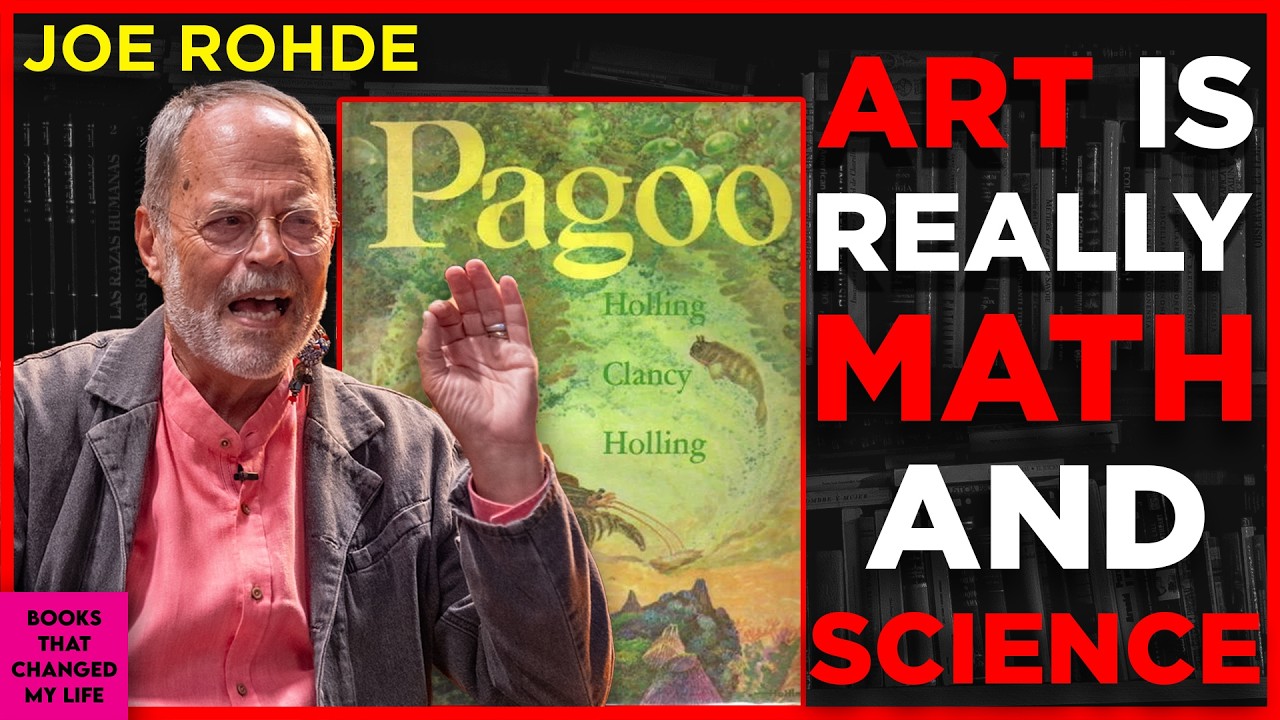
In this interview, Disney Imagineer Joe Rohde discusses how the children's book Pagoo shaped his worldview and career. He argues that creativity is rooted in structural principles, likening it to mathematical or physical systems, and critiques the cultural myth that creativity is an innate gift limited to a few. Rohde introduces concepts such as cognitive disambiguation—the brain's ability to resolve ambiguous stimuli—and notes both genetic and trainable components of creative thinking. He explores how group collaboration functions like a collective brain, emphasizing the need to suppress hierarchical cues and foster a shared, gravitational idea that guides teamwork. Rohde contrasts efficiency (Euclidean, measurable) with effectiveness (creative, experiential) and explains how Disney’s Animal Kingdom was built through flat information networks, open collaboration, and a focus on thematic unity rather than linear narrative. He delves into the role of agency in art, questioning where the creator’s intent resides, especially in AI‑generated works. The conversation also covers Rohde’s early reading of Pagoo at age six, its vivid scientific illustrations, and how the book fused art and science, influencing his later design philosophy. He recounts personal anecdotes about teaching drawing, the narrative nature of human perception, and the importance of allowing audiences to experience environments that reduce cognitive load. Throughout, Rohde stresses that everyone can be creative if they choose to participate, that creativity thrives within supportive social systems, and that the measure of creative work is the experience it generates for its audience. Additionally, Rohde reflects on decision‑making using a shell metaphor, the importance of reading for youth development, the need for trustworthy multi‑source validation, and the conceptual underpinnings of his own book Floating Mountains, which uses the illusion of floating Himalayas as a metaphor for collaborative creativity and outlines its origin story and structural design.
Chapters
Things that work work for the same reason as anything else that works. Creativity works because of structures. Creative people struggle in organized systems is actually a mathematical struggle. Just like growing a plant in a pot, you pop it out of that pot someday and all the roots are shaped just like that pot. Diamond stars and golden suns and red, green, blue, and purple jewels that kicked and wiggled and danced in a restless ballet of the sea. Humans are a narrative creature, so now we're telling ourselves what happened, and that is already Wow. So it's not obligatory that you unbecome who you are to participate in creativity, but it is obligatory that you choose to participate.
The big question, how did Hagoo change your life?
This book—
I'm Chris Collins, and you're watching Books That Changed My Life. Get comfortable, grab a notepad and pen, and get ready to learn something, because this week We're joined by legendary Disney Imagineer, theme park designer, conservationist, world traveler, and creativity expert Joe Rohde. And he's here to talk about the book that changed his life, Pagode by Holling C. Holling. Where do people get it wrong when it comes to creativity in that?
Several things I think happen. We culturally have a peculiar penumbra around creativity, the arts, singing, writing, creating visual art, these creative things, that they are special gifts and that only certain people have them. And that if you have it, you have it. And so, and this, manifests itself really early, really early in your life, where you're either a very good artist, right? Or a very good singer, or have a natural talent for acting, or you don't. And the way our thinking is structured, we tend to just excise these people, or they self-excise themselves very early.
In the sense that you're anointed with it or you're not, when really The best ones put in the work.
That's right.
Were students.
That's right.
Read books, had mentors, studied, paid attention. It's a lot of things, right?
That's right. There's definitely— we all know from research there are little genetic advantages or pathologies associated with creative behavior. You know, though, that is true.
What are those?
There's something called cognitive disambiguation. Cognitive disambiguation is the thing that makes your brain go, that's a chair.
Like that.
That's a chair. It prevents you from saying, that's a chair, but a chair has 4 legs and a dog has 4 legs. And you could have a robot chair dog. It could be like a medical assistant, faithful dog-like robot chair that followed you around. And if you were feeling like uneasy and a little off balance, your faithful dog chair would come up and be there for you and you could sit down, and that way you could remain mobile and you wouldn't have a walker. You would just have this faithful dog chair because 4 legs, 4 like a dog. That doesn't happen because of cognitive disambiguation.
So is that, in a sense, a judgment? Like, when people judge, if you say even creativity could be a judgment, he's creative. Now I'm done with you. It's final. The creative part is the part where you're not judging, you're seeing All of the possibilities of something versus it being singular.
Right. So there's a trainable aspect to that, and then there's the involuntary genetic aspect to that, right? Because having a slower process of cognitive disambiguation does indeed— that's a thing in your brain. You're a little tiny bit slower before all those data streams consolidate. into the thing, right? Because for example, color and motion enter our nervous system at different speeds. They're processed at different speeds, they're processed in different parts of our brain. So it's a long time before you get to the point of that's a red ball coming at me, right?
And everybody experiences that different.
That's right. One of the other books I would have recommended is The Creating Brain. By psychiatrist Nancy Andreasen. And she studies pathologies in creative people, but also brain behavior. I participated in a study that she was doing of just brain behavior. And she was able to track or demonstrate that high perform— first of all, high-performing scientists and high-performing creative people have identical brain behavior in this particular condition. And it has to do with what the brain— there's a whole placebo experiment she runs where you think the experiment's about this, but it's really about this other thing, right? And what they discover is when asked to do nothing whatsoever, be silent and do nothing, creative people's brains do not behave the way the baseline population's brains behave. High-performing creative people's brains behave Like that old pong game, right? They just—that's how they rest, going ta ting pa pong pa ping pa pong. That's why you have that thing where you like start up suddenly in the shower and go, "Oh, I know the answer," right? It's because of this thing. Well, that is delivered in higher proportion in these populations, but that doesn't mean you didn't grow up somewhere where your dad told you, "I don't care." you're going to get an MBA and you're going to go work for a big law firm, or you're going to go, or I don't care. In our country, nobody plays musical instruments, so you're not going to be a musician. So you have to have the nurture, the— back to Csikszentmihalyi's book, Creativity. You have to have a system that expects there to be creativity in order for there to be some creativity happening. You alone are a portion of that. But humans live in social systems. Humans don't live alone. They live in social systems. So the creativity manifests itself within, against, and on behalf of that system.
So are there people that aren't creative?
I don't think so. I don't think so.
There's people that believe they aren't.
There are people that believe they aren't. There are people who identify as not being, and there are people who have not invested, as you know, as a creative person, invested in the Time to train those aspects of creativity, unlike the typical behavior of a person regarding, say, sports.
Right.
Not all of us are going to go compete in the Olympics. We're not going to go play basketball in Madison Square Garden, but most of us will throw a ball. You are not going to take the ball and go, oh, no, oh, no, I couldn't. I couldn't. I can't. I just can't. Who would do that? But we do this with paintbrushes, pencils, typewriters, musical instruments. Many people, oh no, oh no, no, no, I can't possibly. And that is a cultural phenomenon. That's a cultural— you're telling yourself you can't do that. Spent a lot of time on the island of Bali where they don't have that. Right? They don't have a thing of like, oh, I can't paint, I can't dance, I can't draw, I can't sculpt. So everyone does.
Well, and kindergartners don't.
Yeah.
They'll finger paint, whatever.
It's somewhere in there where you start to form a sense of self.
Your personality starts to come along.
It starts to matter to you what other people say. And if you don't have that innate skill, then they're going to say your drawing of a horse is not as good as Mary's drawing of a horse, right? Or your song isn't as pretty as Bob's song. And then people start to self-edit because they don't—
Instead of saying your version of a horse is just different than this version, it's one has to be better than the other.
But also it has to do with how much— there's so many factors in this. Where are you as a creative person in the arc of group identification? See, for example, some people who become very creative are not in control of their group identification. The group has already decided you are not like us and you are not coming to our treehouse, so we don't really care about what you do. So now you are untethered. You're over here and you're perfectly free to spend 6 hours a day drawing or singing to yourself or acting in front of a mirror or writing stories that nobody will see because nobody wants you in the treehouse. So that ends up being a blessing for creative people because otherwise that time would be spent in the treehouse with people talking about who knows what socially acceptable things to talk about that are robbing you of the developmental time That you would now spend honing some skill that would make you be creative. It's all these factors that fold together that make creative people creative. And then when you put them together in a group, on a team, you have to face the fact that the origin stories, the genetics, the origin story, the self-identification of these individual creative people is not the least bit identical.
Right.
So how they collaborate, how it comes that they can be together in a room and work together almost has to do with forming another personality in which all these individuals become more like neurons. They become more like functions of a brain. And the brain that you've created is now yet another creative person, one that can only exist from the fusion of these people.
In a sense, what you're describing is the leverage of collaboration.
Yes.
It becomes bigger than the individual.
Yes. And this is a tough thing for people sometimes. To truly collaborate, you have to not have a person in the center. There's no person in the middle. There has to be a gravitational pull, an attraction to a value set, an idea, a thematic notion, something that is pulling these people like gravity, like planetary gravity around this thing. They circulate around this idea so that they can negotiate and collaborate without the presumption that there's a dominant—
Idea.
Person, right? There's a dominant idea, but not a dominant person.
Can you give me a real-life example that you've experienced with that?
Yeah. When I started working on Disney's Animal Kingdom, which is the centerpiece of my career with Disney, this big park had never been done. It was actually very controversial. It was not meant to be built. It wasn't on a business plan to ever be built. The only reason A young, rather inexperienced designer like myself would be allowed to take on a development project like this is because it wasn't real. So I put together a little group of my peers, peers who I had worked with before, and we formed a very small team, about 5 people initially, to think about this idea. But none of us possessed any title. Or really pedigree that would entitle us to be in charge of the other people. We really were peers. And so we had to concoct a way of working together on an idea that we would then own communally as the Animal Kingdom team. And it did come to pass. I mean, this did get built, but that— cultural habit of a rather flat, open information network then pervaded the project itself as it grew to hundreds of people. It stayed a rather oddly flat project reinforcing this idea that you can really do this. You can have very open information flow. I do think you kind of need to deliberately suppress perceptions of hierarchy. If you want to get information flow—
How do you do that?
If you are the supposed leader, eventually as this project went on, because I started out as the spokesperson, I became the representative, I became the leader. This is kind of the arc of my career. I started out as the kid who talked a lot. I became the guy in the room who, because I talked a lot, I'm doing a lot of the Negotiating, I ended up being the representative. I end up being the leader, kind of like that.
You end up inheriting a lot of the responsibility.
I end up as the guy with the name that is chiefly attached to the product. So personally, then, you have to kind of beg people really to speak freely, to critique what you have to say. You have to demonstrate through action that critique is well received. You know, you have to demonstrate demonstrably change things that people critique so they can see that, oh yeah, I said I thought this was a weak idea and we are changing it. And you've got to have to do that because there's such a strong human involuntary urge to be part of a group and to cater to the slightest indication of authority. Right. It's like a built-in primate thing. We all do it. We do it involuntarily. There's studies of it. The guy in the white suit telling you to shock, all of that.
You're referencing, is it the Milgram?
The Milgram experiment. Yeah. You have to fight this. Right. You're fighting this. So the other thing I would typically do is I would give myself subordinate jobs and tasks within the structure of my project. So I would be taking direction from people who are taking direction from me.
Which then encourages them to give you honest feedback.
That's right. And it also, you can model the behavior you expect to see. They can model the leadership behavior they expect to see. You can see the leadership behavior they expect to see from their leadership of you. All this stuff is happening.
Yeah, it's so insightful that not only is that intentional the way you're doing it, but it's math.
It is. This is a fact.
It's just math, right?
I believe that things that work work for the same reason as anything else that works. Why does that light work? Why is this building being held up? It is essentially all physics. Math, chemistry, structure. That's why things work. Creativity works because of structures, and those structures may not be the ones— Personally, I think creativity functions like algorithms in a fractal equation, and I think businesses tend to function like Euclidean structures, points, lines, connections, measurable, quantifiable units. And so the thing that happens where creative people struggle in organized systems is actually a mathematical struggle between algorithmic-based growth patterns that are based on some kind of initiating impulse, like a fractal would be, and structures that are based on known knowns and known relationships between those knowns. And yet if you're creating, none of that is true yet. It will become true when something has been created, but as it's being created, it has no form yet, it has no body yet, it just has an urge. And it's sort of manifesting itself through its relationship back to this urge as it grows and it mutates and it becomes itself. And then you're kind of observing it. And as you observe it, you are theorizing what kind of fixed structure will become necessary to make this thing take on a body that is physical, right? But it's not that one because that one already exists and this thing does not yet exist. And if we just make it grow inside that, it's just like growing a plant in a pot. You pop it out of that pot someday, and all the roots are shaped just like that pot, right? So you just created a root pot, not a new root system. So you've got to consciously bypass these restrictions the same way a person has to consciously bypass the impulses that make them want to stop looking. I used to teach drawing, and people would say, oh, I can't draw. And they almost always talk about it in terms of physical coordination. I'm not coordinated, I can't draw. She'd go, go up to the blackboard. That was a teacher. And just sign your name, your signature about 6 inches across. Just sign your signature. Now sign your signature 2 feet across. Now sign your signature across that whole blackboard. Now write the numbers 1 through 10 on the blackboard. Write 'em 2 feet across. Write 'em across the backboard. Now come back here. And look at all the shapes, all the compound curves, oblique curves, circular curves, straight lines, right angles, oblique angles you just did thoughtlessly without thinking about it, effortlessly with no anxiety and no concern. There are no other actions your hands need to be able to take to draw anything you will ever draw. You just did all of them. That's not the problem. The problem is a mental problem of presumption of closing.
Mm-hmm.
You're closing before you have actually attended to the thing that is in front of you. And if you attend to the thing in front of you, it will actually disappear into form language and color language and shape language and contrast patterns. And that's what you need to let yourself respond to in order to draw. But your mind keeps going, it's a dog. So you start drawing the platonic idealized dog form. That's in your brain, not the thing that's in front of you, which in fact kind of looks like a pillow right now, like that. So this training, this encapsulation of ways of negotiating between fixed and fluid thinking, this is just something that I've done for years. And it partly comes from this belief that if things work, they work for a reason. And that reason ultimately is some kind of science. So art is ultimately some kind of science.
And so it starts with how you see yourself. If you see yourself as not creative, then that will become the truth. And then in that moment of judgment, you're closing everything off, and that becomes how you see the world in a way.
Right? You see the world. You may very well be a person, who does not see themselves as creative and therefore sees other people as very creative. And you might have very sophisticated appraisals of their creativity, all true. And you're just identifying within yourself. This does not mean, by the way, that, oh, if I change the way I think, I will become the best painter in the world. But it does mean you probably will be better than you are right now. If you change this, right? But more to the point, if you join a creative collaborative structure, it doesn't matter that you personally are not creative because your function within that structure, let's say as an estimator or a manager or an administrator, is necessary to the function of this overall structure, and it is creative. So you are now creative because you are inside a creating structure, and it is necessary for you to be an obsessively orderly person who's keeping track of every penny. But that is now folded inside this other brain, which is this collaborative brain. So you've become like the superego of a collaborative brain. So it's not even necessary that you convert yourself Only that you are willing to join a body of people who are devoted to a creative output, a creative expression.
Becoming a collaborator.
Yes. Yes.
Or allowing yourself to—
And then you fall inside this creative structure and you are therefore creative. Something will be created and you will be among the people involved in its creation. So it's not obligatory that you unbecome who you are to participate in creativity, but it is obligatory that you choose to participate. That is obligatory.
What are some of the secrets to leading a group of creatives? I mean, you kind of talked about one, the hierarchy, but what else in the sense of— because creatives can They can go in places that don't serve the overall mission.
You need a clear sense of the difference between efficiency and effectiveness. Business strategies are often obsessed with efficiency, and efficiency, like Euclidean mathematics, has to be measured against some fixed object somewhere to understand the gradation, right? Creative stuff isn't that way. So for example, if I had 2 people working on an opera and it's going to take those 2 people 2 years to complete this opera, it's not going to be helped by adding 6 more people to the group. That's not going to make it happen before Christmas. The opera is not going to get written more quickly because I added a bunch of people. It doesn't work that way.
In fact, it could take longer.
It could take longer.
Or it could get lost altogether.
Or speeding up the time with which I mix paint and apply it to a surface is not necessarily going to get me a better painting. And yet polishing my silverware is not going to make my spoon any bigger, not going to make my fork any sharper. It just makes my silverware more beautiful. So you have to instill this attitude that effectiveness is more valuable than mathematical efficiency. Efficiency is to be used on measurable things that can be measured against some other standard of application clearly, right? This brick could be made more efficiently if we eliminated this one process in its construction because we know it's a brick and we know how long it takes to make the brick and all the tools necessary. And I can perceive this redundancy. But in a creative product, we don't yet know it's a brick. We don't know almost anything about it yet. But we know that we are headed towards, let's just say, something that needs to be solid and reliable. That we know, right? Maybe it turns into a brick. Who knows? We don't know that yet. And if we tell ourselves too many things that we think we know, we'll just make something we made before, right? You'll pull the creative thing back again to something in order to make it be efficient. You will make it be something that has already been done.
And less effective to whatever the goal is.
That's right. Right. Because the effectiveness of creativity is so odd, it's so hard to measure. It's so dependent on how it connects to users and connects to audiences and connects to other minds.
So is it measured in the experience?
I think it is measured in the experience.
Of the person, the consumer.
And again, that goes back around to that creativity book, that a thing becomes creative. Mihaly Csikszentmihalyi's theory is kind of radical in that he's saying You can be creative all you want, but it becomes creative when it changes the domain in which it exists and other people recognize that change as valuable, impactful, and take it up and begin to absorb it. Right?
Yeah.
Until then, it's maybe personally creative, but it's not capital C creative. It's not like, I mean, you go back in time to think of the Impressionists, and the Impressionists create a way of thinking about a painting that admits of the flat surface of the canvas upon which the painting is on, as opposed to a naturalistic window through which I look. And they paint in this way that nobody paints, where they admit that the things I see are just scattered. They don't say photons, but scattered particles of light. That's the only reason I see things. So that's what I'm going to paint, the scattered particles of light. And while they're doing this, it goes from a public that's like, this stuff is crap. We hate it and we hate you.
Right.
To, this is interesting and there seems to be something here, and I wonder what would happen if I tried a thing like that. But I want to be more precise about this, so I become a pointillist. Right. That's like, so now we've got another thing over here. And then meanwhile, somebody else is like, you know, that flatness idea, very interesting. So I become like Cézanne. And then from Cézanne, we end up with Braque and Cubists, and pretty soon we're with Malevich and complete abstraction. And that all starts out as something that people are like, I don't like that. I don't see that. And then they see, and then they absorb, and then they utilize, and then they create. That's creativity. So Mihaly Csikszentmihalyi's thesis would say it becomes creativity when that happens.
So when it inspires more creativity?
Yes.
Okay. And so—
When it creates, then it has— then it is—
Yeah. It's so simple, isn't it?
Yeah. It has become creative. You see what I mean? Yeah.
It inspires creativity.
Yeah.
So Duchamp talks a lot about the spectator has a vote. And so in the creativity, it only is tested against the spectator's experience.
Yeah. I have to be careful because you have to have a spectator who is willing to engage. Back to the other issue of, can you see? Can you let yourself see?
Well, Duchamp says when he did the readymades, he's like, they're forced to see it as art because the spectator's in an art gallery.
That's right.
So the environment is controlling their perception.
That's right.
Yeah, that's right.
You have to—
you got in your car and drove to an art gallery.
So it must be art.
It must be art. And it's a shovel he bought at the hardware store.
Yeah. When we were building Disney's Animal Kingdom, which is vast, because it's like a combination theme park, wild animal park, and we're creating this huge African savanna, very realistic, that these animals will roam in out of nothing, out of like a fireworks testing field and a cow pasture. So we're importing soil, blah, blah. And easily a year before we open, Probably more than a year before we've opened, but there's no animals, but there are beautiful grasses growing over this undulating savanna, just grasses. And we're driving these executives around in this Jeep to look at the project. And all these executives are, oh, that's beautiful. Look at that. Look at the heads on the grasses over there. And look at this color, that russet color. I'm thinking none of these people would say that driving through a real savanna. If they were driving through a real savanna that was not a work of art, they would not say any of these things. But because they're driving through one that has been created, suddenly that framing that we made this, this has been made, causes them to look. And what they see—
Yeah.
is the same thing they could see in nature, but they don't frame it that way. This has been framed so that now everyone's talking about that yellow and, oh, the delicate little shafts of this. Really interesting to me. And it's that same principle of I'm here in a place that I know to be theatrical, I know to be artificial in a sense. It is a created thing. I know that it's been created and this is part of that. Therefore, it is worthy of a kind of vision that regards detail, and the detail there is to look at is grass. Fascinating.
Yeah, there's a little suspension of belief there that allows them to add their imagination to it, right?
And to see, which is creativity on creativity. Actually looking because they know that it has been made. They know there's intention. This is that thing about, what's the word I want to use? Agency. At the very, very, very, very earliest roots of art, I think there is something just about recognizing agency.
That the creator put the work in?
Yes. On the other side of this thing.
Yeah.
Like, if I'm walking through the forest and there's 2 rocks, 2 rocks, I don't care. If I'm walking through the forest and there's 5 rocks in a straight line, somebody did that.
Yeah.
And what does it mean that they did that? And that's either a good thing or a bad thing. But now I understand there is agency. It's one of the problems I think with AI-related art is this, where's the agency? On the other side of this image or on the other side of this product, where's the agent, the agency? Because I think a lot of the vibration of art has to do with this perception that on the other side of this thing that I'm looking at, a painting, a novel, a piece of music, is agency. And my communication is actually with that person through this work.
So just when we're talking about agency, I have a question for you. There's a magic to agency in the highest art, right? So John Lennon writes a song, For some reason, we think that song's about us or we relate to that song. Somebody writes a novel, we see ourselves in that novel. Somebody puts 5 rocks in the forest and we come up on it. We think we're being seen. We think we're a part of that now.
Someone's saying something.
Yeah. And somehow it makes us feel seen. We relate to the song. Yes. It makes us feel seen. We see ourselves in a character, we feel seen, we feel validated in a way.
Right. Because I think part of art, art is a kind of ordering system that takes— essentially, you're taking the artist's— I'm back to this view of brains and what brains do and all that stuff. Brain is a very, very hungry organ. It chews up Fuel really fast. And the world in which we live, generally chaotic, full of noise, lots of contradiction, very hard to parse. Where am I? Where am I supposed to look? Where's the important point? Where, where, where? So an artist, a designer, a writer, a musician spends huge amounts of fuel putting these phenomena Into order. Right? So that order now exists. But when you encounter this ordered phenomena, when you encounter this thing that has been put in order, your brain doesn't have a neuron for recognizing that art exists. So it approaches the object, or no matter what it is, expecting to spend the same amount of fuel that it would spend in the world. But it doesn't have to because that fuel has been spent. by the artist. I believe this is why people have that feeling they claim to have in theme parks, for example. Right? I just have this feeling when I walk inside Disneyland. That feeling, I think, is that your brain is relieved of a lot of processing because our brains did it. And so now it is easy when you scan an environment to go, I look here, I look here, I look there, I look there. That thing means this, that thing means this. These 2 things both mean that, which is what that is. And in the real world, you're grinding, grinding, grinding through phenomena to get to that point. And the modern world, because of the way capitalism and commercialism works, is a particularly competitive visual environment where— The objects are, they're not even random. They are compulsively competitive. So it's even harder for you to process a decent sense-making, meaningful pathway through any urban environment you walk through because it's all competing for the same level of intention separately.
Right.
And so in these built environments that were the substance of most of my career, What you're trying to do is the opposite of that. You're trying to create a fluid, sense-making, intuitive progress through space that has cumulative meaning, a rational relationship between the emotions you're feeling and the cognitive information that's coming in, and a sense of autonomy because the processing is so easy that you can move through space with relative autonomy and ease. Right. And so all of that, if you want to do that well, all the way back around to you read a lot of books to understand how does that really work?
Yeah. And so the Disneyland example, just like the art gallery example, is when I go to Disneyland, I expect to release the stuff I have at work and at home, and it's the happiest place on earth. I'm going to have an experience. So you already have a context that people have let go that then you can leverage. Just like if you come to an art gallery, I can leverage the fact you expect everything to be art.
Right.
You wouldn't expect that a shovel isn't art, even though I just bought it at the hardware store.
Although it does mean that you should attend to a shovel in the hardware store. I mean, the lesson of it is to go to the hardware store and look at that shovel and appreciate that shovel just as you appreciated this shovel.
Yeah. I mean, that's part of the underlying message.
That's part of the underlying message. Yeah. And then with—
Because we just dismiss it.
We do the thing.
The judgment.
It's a shovel. I'm done. Yeah. I'm done. I've shut it off. I can't imagine it. I can't imagine it as a personality of some kind that is shovel-like, or who knows what I might imagine. And then again, my career with Disney's Animal Kingdom was odd because it's not entirely a fantasy. The animals are real. The politics of those animals are real.
Mm-hmm.
The lives of those animals are real. The time in which they live is real. The history in which they live is real. The countries in which they live are real. So now you're creating something that is more like a quasi-documentary. You have obligations to the bar set by the unflinching realism of these animals. You're creating a frame for a real animal that is real, and yet everything around it is being created by the same people that would create something that was, say, a Disneyland. But you can't use the same aesthetics. You can't use the same narrative framing devices. You can't use the same arcs because all the arcs in a classic Disney park or even an animated film, they're resolved, right? They have a beginning, a middle, and an end. I know the characters. I know the plot. I know how the story ends. That's why I love it. None of that is true in this other venue. I don't know the end of the story. I don't know the end of the story of elephants. It might be bad. I don't know. So you have this other kind of narrative framing that you have to do. And this is why I ended up with the career that I ended up with and why this career intersected so much with science, math, research, and why I chose the book I chose, because it too fuses visual aesthetics, research and a narrative arc. But as much as it's this sort of lavishly illustrated kind of epic coming-of-age story, it's also crammed with real information that must be real. It has to be trustworthy, real information. And this stuff that I did, all in the same category. So there are many, Many, many images you could take, photograph at Disney's Animal Kingdom, which is utterly indistinguishable from the real world, which is completely indistinguishable from the real world. And yet it is not copied from the real world. So it's not as if we just went and replicated things. You had to get people to read. I want you to read about, for example, Swahili architectural style, history, And theory until you can make a building that seems like it did not come from a designer, but came from a history. It came from circumstances. And that too is a little different than a classic fantasy environment in which part of the premise is this world has been created by designers. Storytellers made this place, and therefore it is— Idealized, beautified, simplified in a way, made pure, made eternal, and sweetened, because that's what signifies this is a story being told to you by storytellers. We are signifying this is like a documentary that's happening right now today to you in the world. So you're signifying something different through the design. But to do that, in my case, you have to develop an entire theory of design because it doesn't exist. Right back to this issue of what's being created here. The first thing that's being created is a theory of design that would ever give rise to a place where the actions and existence of a living creature would be harmonious with the environment instead of a strangely disjunctive element. And that's what I spent the center of my career doing. And it attached to other similar incomparable projects that were either tied to natural history, back to the book at hand, or culture. But all of it involved research, negotiation, And, um, a blend of narrative and some science of some kind.
Later on in this episode, you'll hear about Joe Rohde's book Floating Mountains. I think that everybody should read this, so we are giving away 50 signed copies by Joe himself. All you have to do is like, comment, and subscribe, and hit the link in the description, follow the instructions there, and we'll get your copy out Now back to the conversation. There's something that I've noticed in creativity and creatives where there's kind of two sides of this. One side is creatives feel like they're the most effective when they get out of their own way. And they talk about this thing called the ego. Now, when I ask, what is ego? Nobody, it's like love. Nobody has a definition. It's this boogeyman, but they don't really understand what ego is, but the ego needs to get out of the way. So they're talking about that in a sense. On the flip side of that, the art that resonates the most often is the art that's the most authentic, which requires the creator or the group of creators to be vulnerable. Comedians or storytellers, Usually their stories resonate more with people when they're vulnerable and they're telling something they're ashamed of. And they're letting people into this part of us that we usually have a mask and we're hiding in a sense. And so it's more authentic, but it's the thing that most people won't say or most people won't go there. Is there a science to getting out of your own way And being creative in a way that's authentic, that then people resonate with them more. Does my question make sense?
Because again, I worked for many years in the Disney Company. It's a corporation, and the product is aimed at very broad audiences. And yet I do believe, and I would tell my own designers, you can't get to this place without the experience of actual emotions. You can't do this by being clever. You can't do this based on data. You can't do this based on observing the behavior of the market. You are going to have to feel things and think things and imbue them into this work in order for it to— It's extremely hard to put your finger on, but in order for it to resonate. And I have had experiences, I talk about one of them in my book, where in the tiniest micro interpretation of a previously approved upon color in the execution of an environment 4 times the size of the studio we're sitting in, somehow this person was able to evoke the precisely opposite emotion of my intended emotion in developing the project, like the opposite. And I'm talking about in a micro interpretation of an approved color because of that person's state of mind. And so state of mind is state of art. And so you still need to manage people. They need to feel things. They need to feel— Empowered. They need to feel, they need to at least empathize with the intended emotions that the project is meant to convey. Now, mind you, these are not gallery works of art. It's not what I do. What we do is create these vast, very complex interactive environments in which people move. They move rather freely, so you don't have the benefit of Linearity. This is another whole thing, by the way. So you don't have the benefit of linearity of plot, really. You have thematic unity, but not plot linearity. So you have to really focus on thematic unity because it's your primary tool. More like a poem than like a linear narrative. Right. The poem circles and circles.
So more like a poem than a 3-act play?
Yes. More like a poem than a 3-act play. More like a piece of music than a novel. So you return and you re-express and you return and re-express these ideas. But the progress of a person through the space, you may never know. You only know that the only ideas that can be found in here are ideas that are consistent with our thematic idea. But it has influence on directorial theory because in film, I have the benefit— we're surrounded right now by lenses. Right? Those lenses create a vertex. When I am gone and I walk out of here, somebody who is your editor will sit down and they will decide only and exactly what the viewers of this event see. And whatever else happened here, if I dropped my glass of water or I burp or who knows what happens, that may never, ever occur. It is utterly controlled. Through the vertex of the lens, both the lens of the camera and the lens of the projector. And this confers to the director a kind of authority that relieves the director of having to say out loud what their motive is, because they're going to express their motive through the manipulation of the image through the vertex of the camera and the projector. So you could have a director who isn't very verbal, doesn't say much. They just make sure that the image transfers. We don't have that in my business. There is no vertex. And so the director cannot control in the same way. The director has to distribute directorial authority to not only different groups of people, but different groups of people at different valences of behavior and perception so that the thematic idea is re-expressed, re-expressed again, again, again, again, and again in different disciplines by different people with different attitudes, but all consistent with the core thematic idea so that this oddly diverse group of users, audiences, can move through this space as they please from where they come from with whatever foreknowledge they carry in their brains and somewhere find a communicable idea that connects to them, but may not be at all the idea that is connecting to you standing right next to them. Which is different from me sitting next to you in a theater watching a film, you see, where the music and the closeup and all that structure is attempting to reproduce the directorial intent, the single directorial intent. I mean, I'm immobilized in a chair, so my body's not engaged. So I know where you're looking. You're looking at the screen. Blah, blah, blah, blah, blah, blah. We don't have that. And again, this then trains you into a way of thinking about directing that is very dispersed because it's the only way to get to a moment when all kinds of different people, different ages, different cultural backgrounds, different preferences will have emotional reactions that are relevant to what you've done. But not necessarily singular because you've dispersed this directorial authority to this group of people who are all circulating like planets around this central idea. And that is kind of what I tried to do with all my projects over the years that I worked and since I retired, continue to do with the smaller but still projects.
Yeah, that's a big undertaking.
I'm sure you would agree humans are a narrative creature. Literally, the processing time that it takes for our brains, as I said earlier, to just make any sense out of what's around us means that we're actually telling ourselves what's happening. It already happened microseconds ago. Whatever happened already happened. So now we're telling ourselves what happened, and that is already narrative. Right. Wow. Hold on a second.
You see what I mean? I've never thought of that. I mean, there's a delay. Yes, because it happens and then we process what happens in our context that has a high value in the processing of that. So if your thing is that you, when you were a little kid, were abused by the color blue, And when I was a kid, the color blue was my best friend. You experience blue in a completely different way than I do.
Right. So if I want you and me to work together on a project in which blue is a functional component of the storytelling, I need to make sure that we commonly share a third idea that is neither of ours. That only belongs to the artificial brain created, which is this group of people in which blue means this. Now, what's going to happen is that that central blue is going to become inflected by your kind of A minor kind of tonal take on it and my prime take on it. But it will still have a central blue that belongs only—
So adding the third blue into the situation makes you expand your horizons and makes me expand mine. And then there's a possibility that it's bigger than my—
Yes. Neither of us know what that blue is now going to turn into.
Right.
This is why I love this so much, is because it is, and why I think it is so oddly related to physical exploration, which I also do. In the world, in the Himalayas, in places, Mongolia. It's the same thing. You know why you're doing something. You know what your urge is. You know what the prime mover is. You don't know what the result is. You don't know what's around the corner, but you have to hold onto something that allows you to adapt and inflect with what does come. And that is that central idea. So as we both would collaborate on the Blue Project, I am going to be surprised because it's not as simple as what you do or what I do because we're working on that.
Right.
I will be surprised by what starts to happen with that. And then I will be compelled to adapt and to adjust and to think, well, maybe my completely Pollyanna-ish vision of this blue tone is thin, and I should attend to this darker ultramarine Prussian blue tone thing. It's very oceanic, interesting. Now I'm changing my blue. All this stuff happens, and this is a simple metaphor, but this is what's happening.
Right.
Right? And so—
No, it's very powerful.
It really is interesting. This is why I liked doing it. I liked the Discovery of it.
And are you always paying attention to your context?
Yeah. I think self—
That delay in what happens versus how you perceive it?
Why do I see that? Why do I say that? Why did I do that? The stuff I do now, I'm retired from my career as an executive creative director. I work a lot with people in the Explorers Club on art-science expeditionary stuff where I'm creating these Communal, large communal paintings that are, where in which I am effectively, it's as if I was a ChatGPT bot and people are telling me what they think, what they feel, what they want to see. And I'm translating that into these images, which leads, this is why I love it so much, is I end up creating paintings. that I simply would never be able to create, not even stylistically. They are utterly distinct. And so I learn by doing this. I'm not a young person. So the fact that I can learn a way of expressing myself by utterly submitting myself to the expression of others, really interesting.
Right.
And one of them was a 30-foot-long, 6-foot-high canvas, all Inuit. I worked in northern Baffin Island with Inuit narwhal hunters creating this densely woven web of these images of what does the world of nature mean to them, the relationship between tradition and modernity and The structure of a year and all these things are not adjacent to each other. They're literally like a whole series of transparencies laid over each other to create this big thing that now is circulating through museums and communities in Canada with Inuit people. But for me, it was the— The discovery process. You start on something, you have no, absolutely no idea what it's going to be. None whatsoever. And not all that much time to see it through, right? So it's very dynamic, it's very engaging, it's a vital kind of act of discovery, which I really enjoy. It is in a sense, just as satisfying as building giant theme parks. It certainly doesn't take as much time or as many people, but you still get that sense of like, we're doing something that hasn't been done. Nobody knows what's gonna happen. Nobody knows what this'll be when it's done, but we're all working on it and it's turning into something and it's satisfying. The thing that we see is rewarding as it emerges. So I've done a I've done a few of these now, and this is one of the things I want to try to continue to do until, of course, you reach a point where you're really not going to Mongolia again. You need to find people who are doing work where there's a sidewalk. But I hope that's like a decade out. That's fun.
Let's get to the book.
Oh, sure. I have my copy too, my original hardback copy in my little bag here. So yeah, Pagu.
And so it's interesting that you understand creativity and that this book was something that you read very young. How old were you?
I started on this book when I was probably 6. This book took me from rudimentary reading to being able to read this book.
Now, it is a kid's book, but it's dense.
It's pretty dense. Yeah.
What age do you think an average kid would read this? 9?
Nowadays, I'd say 8 or 9.
Yeah.
Yeah.
And you were 6.
I was a precocious reader. I first learned to read upside down like some of these kids do because I'm being read to. And they had to say, oh, that's not good. So I had to flip it. And that was, I don't even know how young. And my mother would drop me off at the municipal library of Honolulu basically as a daycare center while she took my brother to this clinic that was across the street for these long sessions at this clinic. So I'm just alone in this giant old 19th century library, this grand old library. And it's not like I would have this book and I would have, like, Dr. Seuss, but I had this book. And it's interesting. This is about books that change your life, right? That's why we're talking about this. This is the book That opened— it did several things. It made me able to read any book. Within a year, I could read James Bond if I wanted to. Ian Fleming. Now, you read this book, there's plenty of words in here, lots of paragraphs, lots of adjectives.
Yeah, it's not necessarily formatted like a kid's book.
No. It's like a little— and it's full of Okay, so for me, how this worked. First, it was the imagery. The imagery is really powerful in this book. It's beautiful, beautiful images. So before you can read, you're like, this looks like Hilma af Klint. Yeah. I mean, it's really cool.
The text is inside of it and it's actually pretty detailed too.
Yeah. So step 1 are these stunning, stunning Images, which as a little kid, you're like, what is this? And I grew up in Hawaii, so I'm in tide pools all the time. But these are not Hawaiian tide pools. These are California tide pools. So I'm still looking at them going, what the hell is this? What is that? What is this? I don't know what this is. So the first thing I can read besides, you know, you're trying to read this, you just can't do it yet. But I can read all this stuff, the marginalia. I can make my way through. I can sound that out and read that. Right? So now I'm getting from the visual to the marginalia, which is almost all science. This is all just science.
And so this is a children's book. You expect a certain thing. There's enough of that there. But for the most part, it's not that at all.
No, it's like a science adventure. But plus—
It's formatted in a totally different way.
It's full of combat and death. And, you know, he goes from being like a zygote to a sire of a whole new clan of creatures. All this stuff happens. And he's abandoned by his mentor at a key point in the plot. It's like, this is like an insanely dramatic story for a little kid to read. And then to go stick your head back in a tide pool again. Right? Because you're taking this back to a tide pool going, this is where this stuff is happening. All this is happening in this tide pool. So for me, why is this an influential thing in my life? The theme of science and art, right? Art is a thing that comes along with science. So you're 6, 7, 8 years old, By the time you're 8, it's too late now. So whatever else somebody else thinks art is, that is too late for me. Art and science are fused. At the same time as this is happening, my parents are friends with an artist who lived in Honolulu at the time, Jean Charlot, who was part of the Mexican mural movement and again, an artist anthropologist. So we go to his house, it's full of art, And artifacts and anthropology. So by the time— it's the only famous artist I know is a guy who was the illustrator of the excavations at Chichen Itza, and his art is full of artifacts from Papua New Guinea and replicas of Mayan art and books about anthropology. And he speaks Hawaiian and works with Hawaiian indigenous people on— and that's art, right? So then that's a When you think of navigating an ocean of life, this is like 7 or 8 degrees very early in the journey. So you're definitely not going to Japan. You're going to end up in Indonesia somewhere already. And then there's the 3-part combination of profoundly effective visual, lots of reputable data, And a strong narrative you can follow. And that's just what I did for my whole career is that. So this is not the copy that I had when I was 6 or 7 because we couldn't afford any books. That book came from the library. This one though, I have had probably since I was 14. So it's weirdly important to me.
Oh yeah.
Strangely important book.
There's a lot in that.
It's only a little thicker than a coaster, But it's really an important book in my emergence somehow.
So if nobody's read the book, it's about a crab.
Yeah. It's a coming-of-age story of a hermit crab named Pagu, which is just a humanization of Pagurus, which is the Latin name of hermit crabs. So Pagu is just short for Pagurus, which is the Latin name of hermit crab, which you learn When you're 6. And then it is this series of challenges and growth in awareness as he— because he starts out like a little plankton thing in the ocean and it talks about this vast oceanic milieu. And even there, there's danger. The other plankton are getting eaten by tiny other plankton creatures. And then he lands in this tide pool And he has to find a shell, but he's really, really tiny. Everything's trying to eat him. And finally he gets his first little shell, doesn't work very well. And then he ends up in a shell that's a part of a shell of another hermit crab that's like his landlord. And so there's all these life lessons from being— so when I saw Howl's Moving Castle, right, my first thought seeing it, oh, that's like Pagu. Because Pagu's like in this little tower of this Barnacle on top of this hermit crab. Then he's mature. Now he has to fight like a gladiator over and over again to steal shells from other hermit crabs. And finally he finds this treasure trove of shells. Why is this treasure trove there? Oh, because there's like an octopus that's going to eat him. And on and on and on like this until finally he finds a mate and he has new babies. And that's kind of the end of the story.
But it's He's not at the top of the food chain.
No, he's never at the— he's just a hermit crab.
There's a vulnerability.
Yes. And I love that he's just a hermit crab and they keep coming back around to, look, he's just a hermit crab. And the author kind of takes pains to let you know, look, Pagu does not speak English. He has these feelings and these urges, but he's a hermit crab. I don't know. It just had a thing, and it's the beauty of the illustrations, very seductive. The illustrations, by the way, are by his wife, Lucille Holling.
Really?
Yeah. And I did not know when I was a child, but both of them were scientific illustrators. Science writing is heavily researched, so it's just oddly consistent with the other elements of my life and career as it unfolded. Considering that I'm barely in grade school when I start this journey. So it's weird, and maybe it's a little arrested development. If you think about it, it's like, okay, is there not another book in your life? But I found that when I think of the other kinds of books that I would talk about in this context, they aren't life-changing books. They're more like— Affirming books, you know, uh, and there's some fascinating books you could talk about.
That's a great distinction.
Yeah, but this—
They're affirming.
This is a life-changing book.
Okay, let's, let's kind of go through some of it.
Okay.
Um, so on the first tab—
Oh yeah, I see that. Oh, and by the way, when I was a child and I read this book, I read it in my mind in a voice that I think was John Huston. That's very specific. Very weird. Yeah. Now that I know what John Huston sounded like, I think that was the voice in my head. It wasn't me reading to me. It was this man voice reading this story to me. So you're looking at the highlighted thing?
Well, so there.
Yeah. So it's like, I'm going to do the, well, so there were other sparkly things in the sea after all. Ornamental little Pagoo was being surrounded by a cloud of fairy ornaments. There were diamond stars and golden suns and red, green, blue, and purple jewels that kicked and wiggled and danced in a restless ballet of the sea.
Can't you just see that?
Yes, it's kind of fantastic. And it goes on in this vein. You know, what do we have here? It's like, like, like, yeah, you know, he had no claws at all, not even legs, nothing but feelers and fuzzy things sticking out. And yet he was only a promise of becoming a hermit crab, as a caterpillar is a promise of becoming a butterfly. But old Pal was right there. Sure, you're just a mite afloat on the sea, but buck up! You are a promise. Your billions of ancestors have handed down your toughness. You can't be knocked out too easily. She's like, that doesn't sound like John Huston, but that's kind of this man voice, this American man voice that is speaking this story to me as a kid.
Yeah.
Isn't that not weird? I think that's weird too.
And I, I love— yeah, I just love how that he's playing with the vulnerability.
Yeah. And then, I mean, I marked a bunch of them myself because I'm like, they're just these kind of like fabulous— tons of tiny animals were caught up in the surging spray and hurled higher than a house, splattered with foam against the rocky cliffs Thousands of them stuck and glowed there dimly. Dry air soon put out their little fires, and they flaked away and vanished on the whirling wind. Millions of others were rolled forward, tossed and slapped across the sandy beach. When the water drained from them, they flopped across great boulders of sand grains, flickered faintly, and slid off. They died in the canyons between the boulders. Like, Jesus, you know, this is, you know, that's a lot. Right. And I just thought it was epic. Kind of epic. So anyway, was it all a dream? Pagu didn't know where to start. He began trying on one shell after another in a frenzy of joy. But at last, old Pal got an idea into Pagu. Look, boy, he cried. After all, you can wear only one shell. So find that one. Love it. And this, this old Pal is the instinct. It's, it's, it's Collins' way of characterizing the instinctive Urge of an animal, right? But he turns it into this voice, this kind of character.
So back to that one, though. I think it's interesting that people feel paralyzed by choices.
Yeah.
Like, he can pick any shell, but that's a lot of pressure.
Yeah. And you can only use one. Yeah. Pick one. This is the thing. This is something— it's interesting. I would say this a lot, and I do think there is something to this. You can agonize about making the right decision. But if you're creative, the real truth is you're going to make the decision right. So make the decision, then make it right. And this has to do, again, with the emergent quality of creative things. You just take the canvas, put a line on it. Now that that line is on the canvas, what does that make you want to do? Right? Instead of, what do I do? What do I do? What do I do? What do I do? What do I do? You can forever, right? Once you do something, now you have to do something based on what you've done. And it's very similar with exploratory stuff. It's like, look, we have to pick a trail, left trail, right trail. You can't do both. So pick one and let's find out what we're going to do next. Kind of like that. I think it is— there is a chance you will make a wrong choice, or not a wrong choice, you will make a choice that introduces trouble. You will make a choice that introduces challenge. That's possible. And so then you're going to have to make another choice of what, what, what you do then.
Versus it being final.
Yes.
Kind of like in, uh, in comedy when you're, you're doing the growlings or whatever, and it's like You say something and then I got to go, and I got to build on it. It's not final.
That's right.
And the worst thing I could do is say something that makes it final because then it's over.
Yeah. And people who study design development, creative design development, will tell you that the way design emerges is you start it, see what it looks like it might be, And then you begin to develop a plan based on what it looks like it might be, and then start to execute, and then see what it is and make another plan based on what it might be. So you don't make a plan and do it. You are constantly planning as you see what it becomes to get it to become something.
Yeah.
Right? And all of that knowledge, whatever that is, it relieves you of the Paralysis of like, oh, but what about this? What about this? You just pick one, pick one and make that work. Right? So the shell metaphor, because it's interesting, he has to keep— he's growing, so he keeps putting on these new shells, right? New shell, new shell, new shell, which is another growth metaphor and a personality metaphor and an identity metaphor as he reshells himself and he tries a shell too big for himself. And all this stuff happens in this book that I think is really resonant. Even if you didn't know it was resonant when you're like 7 and a half, right? You're still reading it. Why in the world would I pick this book up again as a 14, 15-year-old and keep it for the rest of my life unless it's having some pretty profound impact? At that other stage.
Yeah. And also books like this that are so well done transcend age.
Yeah. This one in particular—
You'll experience it different as you get older. Reading it now will be different than when you were a kid.
That's right. I think that's right. This is another thematic thing, the circularity, the cyclical circularity of visually reintroducing this idea that we see at the beginning, this sort of Hilma af Klint-looking art thing. We come all the way back around. We come back around to these vulnerable little creatures.
It sort of ends how it starts.
Ends how it starts. Really interesting. And then down here are little pictures to make it clear. It's pretty clear that he— it's implicit that he's not staying with this hermit crab mate that he's mated with, right? It's not stated, but it's implicit because they're very careful about the science of this. So it's like, you know, I'll watch over your mate, Old Instinct was saying. She'll lay her eggs and hang their clusters along her body. She'll rock gently inside her shell, switching Bubbly seawater around to clean and air those eggs. Oh, she'll make a wise mother, never fear. After many days, her children and yours will hatch out. And then— And it goes back around to the opening statement. A glossy pagu from an egg small as a pencil dot drifted on the ocean. He heard the silent voice of old pal saying, you're hungry. And sure enough, he was. Once more, a new pagurus— pagu for short— had found his place in the endless rocking rhythms of the sea, which is kind of great. Anyway, so that was the book, and I just think it inflected so many— even my book, Floating Mountains, is full of marginalia, have my own little commentary things. It's kind of this science and narrative thing.
Yeah.
I guess I only have one note, but that's my note. So it's just interesting to think that you really do need to— this is the thing. On the one hand, I think you need to be very mindful that young people are very serious and are picking up very serious implications of the things around them. And at the same time, the last thing you want to do is hover over them Force-feeding them, it's just the black— that's the not thing to do, you know. But you do need to be aware they're really smart and they're really aware and they're really thinking. And mostly what they lack is language to explain what they're thinking, not the thoughts, right? The thoughts are there. It's the language to articulate them that may not be there. So you can mistakenly trivialize. what children are thinking or thinking about or receiving from things. And yet at the same time, you can be really insufferable with the, here, read Pagu. I mean, I found this on a library shelf all by myself and along with everything else I pulled. I would all through, really all through High school, I just would go to the library. Until I could drive, I took the bus to school, and the bus stop was right in front of the library, and I would churn through these books. And so, I mean, like this every week, just churn through books all the way through. And so by the time I was in high school, Yeah. You read just piles of stuff, both informational, not all grand literature, but piles and piles of stuff. And you have to be careful because it's a long time ago. And so some of what you're absorbing is outmoded and you got to kind of go back and go, maybe I should read another book on whatever, the history of Native Americans or But I still have books. I still buy books. My boys, my family, they can literally randomly buy me a book. Like, close your eyes, run your finger along the shelf, pull that book, and I will at least try to read it. I mean, especially if I'm like, hmm, I don't know anything about fungus, or I don't know anything about Maria Theresa, the Empress of the I don't know. I should try to read this. A lot of nonfiction. The fiction that I like is usually richly built worlds. Álvaro Enríquez, That You Dreamed of Empires. Have you read this book?
Mm-hmm.
Fabulous. It's a droll telling of the last few days of the Aztec Empire as these bewildered Spanish and Aztecs are wandering around Montezuma's palace trying to figure each other out, but richly imagined. So I mean, again, I'm a placemaker, I make places. And so setting, ambiance, tone, when I'm dealing with fiction, those are important to me. And then obviously Information, books about things. This is a book about something and trustworthy. So I know that when I'm reading this book, I can trust what I'm getting from this book so I can build with it.
That's one thing that I love about what you say about seeing it as a science and reading and putting in the work, because then it's based in something, right?
Yeah. Because you're going to build other things on top of it. Right? And so you want to make sure—
So it's a foundation.
It's trustworthy.
Yeah.
And usually to do that, you have to read multiple things. That's what proves it's like so-and-so said it and they said it and they said it. They did it, they did it, they did it. Okay, now I feel like there's some there there to this thing. So this is a gateway book to a lot of other books about the ocean, about sea life, about natural history, about animals, about the world of nature. Aldo Leopold, all kind of feathers out from one little source, but it becomes all kinds of stuff.
So let me ask the big question. What did Pagu by Halling, Clancy, Halling, how did it change your life?
This book sets the course of my life as an artist, who is absorbed with science research and the natural world. That is what this book does for what now is almost, well, 65 years.
It's incredible. Well, we appreciate you doing this and letting us pick your brain. Okay, tell us about Floating Mountain.
Yeah, I have the hardback too. Look at this.
Love it. We love the art.
So Floating Mountains, this title, which my wife actually came up with, is a metaphor for several things. It's a metaphor for the art of magic, to make people believe something impossible, to float a mountain. It is a reference to a specific project that many of the Disney readers will recognize in which we created a technological marvel, which was these massive suspended mountains that are indeed floating in the air, seemingly suspended on these tenuous little vines. It's also a reference to the Himalayas, where I spent a lot of my time. And this illusion you see in the Himalayas— have you ever been to that part of the world?
No.
It's a phenomenon where the mountains, the massive High reaches of the Himalayas do not appear connected to the Earth at all because the atmosphere between you and the bottom of the mountain is much thicker than the atmosphere between you and the top of the mountain. So not only does the top of the mountain appear more clear and more detailed and more present than the mountains in front of it, it appears to be floating over them. Not beyond them because of that clarity. And yet this seemingly unreachable, evanescent place is reachable. You can go there. So all these ideas are inside. This is a book about creative collaboration and it follows— it's like a memoir in that it uses anecdotes and parables from my life experience, both as a designer and in exploration, expeditionary. experience to go bit by bit talking about how do you— what is creativity? What is creativity in a group of people? How do you manage all of this so that it turns into one thing? And what does it possibly mean in the end? And it's very episodic, so it's not a chronological linearity. The linearity comes from the structure of the idea. The stories are all over the place, and partly because creativity is kind of free association. And it has, you know, oh, the Inuit painting is in there actually in the illustrations. So it's a book for people who want to create together.
What made you want to write it? How long ago did you decide to write it?
I had written another book that I didn't know was about the same thing, and I took it to National Geographic because it was very much concerned with one particular expedition and its relationship to creative development. And they were like, we like this book, but this is not a first book. We want you to write a book that is more fully about your life, your career, your thing. So this was almost like an assignment.
You've got to tell them the origin story first.
Yeah. So tell me who you are through this book, and then these other books can follow. It's like, oh, okay. And they wanted it to sort of be— I have an Instagram account, and my Instagram account is characterized by these little essays that are sometimes meditative essays that start out with, here's a frog, But let's talk about what it means that this is a frog or a 36-chapter history of narrative placemaking from Rome to the present day, whatever I want to do. That is too disjointed. I was like, I need structure to this. So I want to trace from the premise of the genetics of individual creativity through its impact when it becomes integrated into a group, Through the challenges and opportunities of what it means for that group to try to work together and be together, to the questions of what it means to do this at all. Why is it being done? For whom and for what purpose? And then to close kind of on meaningful collaboration and this principle of kind of disappearing, disappearing into the group so that you experience this exhilaration you were referring to of being part of something bigger than yourself, but it in a sense isn't even yourself. Right. So that's kind of what's in the book.
Well, I mean, I'll say I come from a business world, and one of the things that always surprises me is The people that are most successful at business are problem solvers and are creative. But most people in business see themselves as managers, very linear, and they don't embrace creativity. And so I would advise anybody in any situation that creativity and understanding it is the secret to Progress. And if you want to make the world a better place, you're only going to do that through creativity. And your example of it, your enthusiasm for it, and your studying it and understanding it and trying to explain it back to us is very inspirational. I'm very grateful for that. I can't wait to read this and hope someday we can have more conversations because I could pick your brain.
Oh, great.
Forever. Today's been really, really fun talking to you. I know The boys share the same enthusiasm for it. So thank you very much for doing this.
Thank you. I really appreciate it.
And Floating Mountains: The Art of Imagining the Impossible. Pick it up. We are so excited to announce the Books That Changed My Life website. We made a way for you to show your book pride and that you love books. Hats, tees, hoodies, Check it out, link in the description. Everybody needs a self-help hat.







