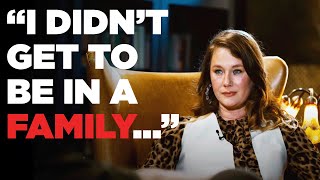
This content was created by Chris Collins. This content was uploaded by Chris Collins. This is a YouTube video titled "E.A. Hanks: Growing Up Fast" featuring a conversation between E.A. Hanks and another speaker discussing the impact of growing up in a challenging environment, the development of coping mechanisms, and the process of deprogramming these survival strategies in adulthood.
Chapters
My concept of adults and authority was that they were the ones to be that I needed to take care of.
Yeah. So you grew up quick.
Yeah.
You were an old soul. Early kind of.
Yeah, an old soul. And also, like, I think anybody who grows up with the shadow of violence kind of present every day is very good at reading people, moods, tones, vibes.
You become very an empath in a way.
Yeah. It means that you're objective, not subjective. You are always watching. You don't get to be in a family. You watch how other families work. I don't get to be in relationship with my mom. I'm just watching her because I'm trying to find out if it's going to be a rough night. And it means that I'm hyperverbal and I can talk my way out of a tense conversation. It means I'm funny because I need to lighten the tension. It means that I pick up social cues that are nonverbal. It just means that I'm, like, wildly attentive to other people's anger.
When I was in high school, I was voted funniest. And when they told me, I was shocked because I was like, no. I realized very quickly, no, that's my survival.
Yeah.
I'm not. I'm not a comedian.
Right.
Like, I'm not a standup. I'm just trying to navigate this chaos.
Yeah.
I had no aspirations of being funny, but other people perceived me.
No, what you aspire to was survival.
Yeah.
Well, I think a huge part. You know, I mentioned earlier this kind of cataclysmic artistic block that I had. It was because there was a whole part of myself that was walled off because I didn't have the time or space to go to that place. Everything had to be about keeping my mom safe and unangry. And you mentioned a ladder earlier. I had no ladder for myself there. I had all of these feelings that there was never any safe space to navigate them because I was constantly navigating someone else. And all of the coping mechanisms that I had built that allowed me to survive how I grew up eventually started working against me. Right. Being on the outside of relationships helps when you're navigating an alcoholic, mentally ill mother, but it does not help you date for the first time. It doesn't let you be present in intimacy, in any. In platonic or romantic dynamics. It doesn't let you connect with people. So by the time I had survived long enough to be in my mid to late 20s, I'm sitting there going, well, everyone thinks I'm funny and nice, but I don't think feel close to anybody. And realizing that all of these kind of, like, bespoke systems that we build to help ourselves survive our childhood end up actively working against us as full grown adults. And so it's like, you know, it's a very scary process to go, well, all of these things I needed to survive, and now I'm going to put them back on the shelf. And you have to constantly tell yourself, you know, I don't need this anymore. I don't need to make a joke every time I'm uncomfortable. I don't need to lead the conversation because someone's going to get hit if there's silence. It's really about deprogramming yourself to a degree. And I think the most radical thing you can do in that deprogramming is to make vulnerable.