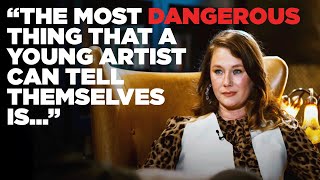
E.A. Hanks reads a fiction and nonfiction book each week to fuel her writing, working from 9 a.m. to 2 p.m. at her desk. After a 12-year creative block following early success, she rebuilt her practice through morning pages, artist's dates, and deliberately writing badly.
Questions this video answers
Roughly one fiction and one nonfiction book per week.
Around 9:00 until about 2:00 (9:00–14:00).
About 12 to 13 years.
Chapters
How many books do you read, like a month?
Oof.
Or does it come and go?
I will tell you that roughly. I read a fiction book and a nonfiction book a week. So sometimes it's more than that, sometimes it's less than that. So I can tell you about two books a week.
And what is your process? Like, are you reading in a chair, in bed, everywhere? How do you, how do you do.
This is my favorite question I've been asked.
So in the morning I read while I caffeinate and I read fiction. And that's because that's my most open kind of accepted state. I'm soft in the morning. My critical thinking skills aren't quite awake yet. And I want to sort of fill my tank, as it were, for the art making, with creativity and abstraction. Yeah, creativity and abstraction. And also like give up the reins. Like let someone else be in charge for a little bit. It doesn't have to be in a genre in which I'm writing. It doesn't have to be like, if I like right now I'm working on children's novels, but I'm not reading a children's novel right now for fiction, I'm reading adult fiction, fiction for adults. And then I do the bulk of my work. So I'm at the desk creatively on a good day from around 9 till 2, thereabouts. And after that I usually will take a bath to kind of wash off the juju. And I read nonfiction in the bath for a really long time and that's kind of how I wash off the days.
Like, will you cycle the water?
I will.
Because if you're there a while, it gets cold.
Yes, yes.
How hot? Do you. Do you like it or do you like the change?
I like that. That's how I tell it's time for me to get out. Maybe I'll refresh the heat once. If I reheat the bath twice. I know bubbles really enjoy every time.
Salt?
No. Unless I'm genuinely sore from working out or something like that. Usually at night, if we're not watching Drive to Survive or my newest obsession, Chinese soap operas, which are. I really can't recommend enough, then maybe I'll pick up the New Yorker or something like that. My job is to fill my brain with as much quality, you know, stuff as possible.
That's a great insight for writers and artists to understand that you're actively working on feeding the muscle in a couple different ways. One with the, with the abstraction and then the other with more reality based substance. Yeah, you know, I think A lot of people kind of get lost in that, that they don't understand that it's. You're practicing what you're going to do.
In a sense, a lot of my process is informed by the fact that I was unable to write for about 12 or 13 years. I had a significant creative block. I sold three novel series in my early 20s. At the time I worked at the Huffington Post and I was basically on a four hour news cycle. I was 20 something years old. I had the beginnings of a stomach ulcer. It was just physically and intellectually brutalizing experience to be churning out copy at that level. And I had no process for creative work whatsoever. And suddenly I get given everything I've ever wanted. You know, I've known I would be a writer since I was 8 years old. And here it is, I've been given this opportunity and I choke so hard. And so fundamentally it completely, it broke my personality down to crumbs in the way that it completely altered my sense of self. I had no idea who I was if I wasn't writing. And I thought, well, I'm a huge failure because I've set up my whole life to do this and now I can't do it. And I have no other marketable skills and there's no such thing as a 30 year old with promise. So I'm done. I'm, you know, I'm benched. I didn't even get to play in the game. I'm like one of those guys who is going to storm the beach on D day and he doesn't even make it off the U boat, literally dead on arrival. And a huge part of how I built myself back up to being able to finish something, let alone publish something, was the artist's way was my introduction into self help. And a big part of the artist's way sort of artistic recovery is morning pages, which is a practice where you free write three handwritten pages every morning. And something called an artist's date, which is that you take yourself to take in someone else's work at least once a week, whether that's you go to a gallery or you go to a movie, or you buy stickers and decoupage an old picture frame. You do something creative, but it has to be on the regular and it has to be solitary. The idea that taking in other people's work does not corrode your talent, it buoys it, it inspires you, it gives you the fuel to do your job. And the biggest takeaway I had was the only way out of this is to read more, read things that I don't think I'm gonna like, and to write bad. Write bad for as long as it takes to build the muscle again. The biggest thing I can say to anyone who's trying to write and can't or who's trying to get out of a rut is you have to inspire yourself. It's integral. I don't know what your artistic process is. I don't know if you, you know, if you regularly go to see other people's work. I think the most dangerous thing that a young artist can tell themselves is that art is a solitary practice. You can't make it on your own. You can't be inspired by yourself, and you can't physically achieve art.
Of any sort. I don't think on your own. And even if you're the community that you find with other art makers is just by reading other people that counts.