ERIC BENÉT on DUNE: Music, Religion, and the Environment
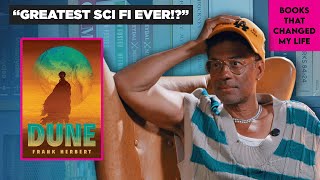
Interview between host Chris Collins and singer Eric Benét about how Frank Herbert’s Dune shaped Eric’s sense of purpose and creativity. Eric recounts his Milwaukee upbringing (youngest of five; father a detective from Mobile, Alabama born in the 1930s), early musical/religious experiences in gospel church, and how Dune (assigned in high school) made him identify with Paul Atreides and themes of ecological fragility, religion as social control, and dangers of technology/AI. Conversation also touches on music and performance, brief experience with psilocybin mushrooms, critiques of Herbert’s portrayals of women and homosexuality, views on capitalism and resource hoarding (spice as natural-resources metaphor), current reading (Two Thieves) and a YA fantasy Eric is finishing, and calls to support live music.
Questions this video answers
Milwaukee, Wisconsin.
Dune by Frank Herbert.
His father was born in Mobile, Alabama in the 1930s and became a detective in Milwaukee.
Two Thieves.
Inner Visions (Stevie Wonder); Sgt. Pepper (The Beatles); The Nightfly (Donald Fagen); Roberta Flack & Donny Hathaway duet album; A Night at the Opera (Queen).
Chapters
This time on books that changed my life. Nobody's done this book. Everybody loves the book.
Nobody's done it. That blows my mind. Well, there are many things about Dune that just took my heart and my perception of self and just shook me.
My first concert, five years old, in a Baptist church in Bremerton, Washington. Andre Crouch.
What?
I watched him take a room, pick them up, throw him against the wall, grab him again.
You could have been the atheist of most atheists.
There was nobody escaping feeling.
When I was nine years old, I realized if I use my voice a certain way, my voice is affecting these people's emotions. Look at, look at this. This already turned into a damn therapy session.
What is he saying about artificial intelligence? Do we gotta be careful?
Every industry is at risk.
The programmers that created the AI are getting laid off by the AI.
We're doomed ecologically. Dune itself has sound so much to do with the potential of a dead planet and the warnings of being ecologically ignorant. It's fragile, incredibly fragile.
Vice also is like something that gives you mental perception of new dimensions in a way, yeah. Have you ever tried anything like LSD or something that made you see other dimensions?
I felt like there was this underlying creativity of a young kid feeling like they're destined for something greater.
I gotta save the universe.
I gotta go save the whole damn universe.
So, big question. How did Dune by Frank Herbert change your life?
Dune made me feel.
Welcome to the Syndicate X library where we love books, especially books that have changed lives. We're joined by a very special guest today. He is a Grammy nominated RB singer, president of JBR Creative Group and and Dyed in the Wool Reader. He's here to talk about the book that changed his life, Dune by Frank Herbert.
We are so excited to announce the books that Change My Life website. We made a way for you to show your book pride and that you love books. Hats, tees, hoodies. Check it out. Link in the description. Everybody needs a self help hat.
Please welcome to the show Eric Benet. Nobody's done this book. Everybody loves the book.
Nobody's Blows my Mind. Nobody. Nobody picked Dune.
That's.
Hello.
Hello.
Cheers. Thank you.
Thank you. What did he order?
Just a nice cup of water.
Vodka.
What did you get?
Coffee.
Coffee. I should have got the coffee. Can I have a coffee? All right.
Do you want a black coffee or do you want what this is?
I'd like it black.
This is espresso. So it's an Americano.
I'm blown away, man. Oh, you're gonna give me that?
Yeah.
Look at that man, I love you for that.
So tell me a little bit about where you grew up.
I grew up in Milwaukee, Wisconsin.
And I had a great childhood. My dad was a detective. Mom stayed at home. I'm the youngest of five siblings. We were all very musical. Every time I think about my father, I think of a blessed. How blessed his life was and how tragic it was because my father had a deep passion for the arts and for education.
And being a black man. Born in the 1930s in Mobile, Alabama.
Probably the Times and maybe a little bit of the programming of imposed limitation of the Times, in addition to actual limitations of.
Racial segregation. He wasn't really able to pursue a lot of his real interests as easily as I think he would have been able to do had he been another ethnicity. So he became a. A policeman for the city of Milwaukee, and he hated every moment of it. And because of his distaste for what he had to do just to put food on the table for us, he was. He kind of turned into a very inward man who didn't speak much and was kind of present, but not really present. And it was. You know, I mean, I'm. I'm grateful for the. For the dad that I had, but it was kind of like not an emotional present father, emotionally present father. Look at. Look at this. This already turned into a damn therapy session. You didn't even ask me all that shit.
What. What would he have been. What would have been the ideal career for him?
He probably would have been a physician of some type, but he was also.
Fascinated by authors and classical music. My father named me after Stephen Vincent Binet.
Had a massive classical music collection. And he was the type of dad that was always. He wouldn't. He would either watch cop shows or cultural educational programming. Yeah. So it was one or the other, like Book Em Dano or Tonight on Masterpiece Theater, you know. So it was one or the other. Yeah.
So is that where you got your kind of interest in the arts.
Was from here?
Probably. Probably indirectly, yeah.
What was Mom's interest?
Mom's interest was whooping our tails when we got out of line and gospel music and making sure that our Sunday shoes were shined and we looked good.
She was busy.
Yeah. And being a great mom, being an incredible mom, and that rock, that hug that heals you and makes you feel protected and, you know, she was. She was just. I had a great. I had a great childhood. I had a great childhood.
My first concert, five years old, in a Baptist church in Bremerton, Washington. Andre Crouch. What really like Maybe that church held 500 people. There were 700 people.
Man. If Andre watched him take a room, I'm. No one did throw him against the wall, grab him again, bring him to his heart. Yeah. And that.
And you probably.
He's five years old.
What kind of impact did that have on you at 5? First of all, you remember that at 5 and how impactful it was. But what did that do to you?
There's something about the soul of gospel music and what he like, I don't know, it's hard to even explain. It's hard to put into words like how that sort of revival in a church in that setting elevates people and changes, like just changes their self esteem in a way.
So when I was 9 years old and I had a vocal solo, I felt that power. Well, you know, I think primarily I felt the power from God, but I think that power moving through me. I realized if I use my voice a certain way, the way you described Andre Crouch, it was like my voice is affecting these people's emotions. I would see tears, I would see crying, I would see getting up, I would see. And I think that was a realization of the incredible power of art when it's authentic and, and I think somewhere back then in church, it made me realize like.
I want to wield this power and I want to.
Improve on it.
Yeah, it's a dimension from somewhere else that just also is like very unifying. Like everybody feels it. Like you. Like in that church with Andre Crouch, there was nobody escaping that feeling.
You could have been the atheist of most atheists in that church and you would have walked in there and if you would have felt that spirit in the, in my church, and I'm sure in that church too, overcome with emotion of feelings that you didn't know where they came from. And so, yeah, man, it's, it's, it's, it's a beautiful, beautiful power.
Yeah. Why does God like gospel specifically too? Just. There's something about it.
Yeah, I think that there are, which I. This is only my personal theory and I, I have no scientific backing or peer reviewed whatever, but I think there are certain combinations of melodies and chords that have a metaphysical power that we've yet to tap into and understand. I believe they have a power that can evoke rage, can evoke empathy, can evoke love, can evoke fear, depending on that particular audible alchemy of sound. And I think gospel music, some tantric, some other types of music and sound, it goes, it's like laser targeted to the most empathetic and emotional part of your heart. How it works, I don't know, but I know when I tap into it, when I'm writing a song. Yeah. Because I'm always on the verge of tears. I can feel the goosebumps if I'm writing something and I'm getting the goosebumps and I can't contain myself, and I have to step up or have to step outside or I have to. Whoa, what was that? You know, then I know that I just tapped into something.
I have no idea if I'm onto anything with this theory, but it might be in Jordan Peterson's Maps of Meaning, but he's talking about how.
Before there was a higher power or a God, tribal leaders had to fight each other. And basically the higher power was developed so people didn't have to conquer each other. Like, we would all serve a higher power that was bigger than us. And in gospel music, it's aimed at something that's selfless and outside of us. We're singing to something that's bigger than us and selfless. It's not about us. And, you know, just like whenever you give to others or you're serving others, there's something that happens to you that almost. You get more out of it than they do, in a sense. And I think that that's a. That has something to do with it.
I think you tapped into something, man.
It's the selflessness.
The selflessness. Because I think as human beings, we are naturally tribal people. Right. We started off as hunter gatherers who traveled from region to region based upon the climate conditions of a band of 20 to 40 people that stayed this unit. And there was this.
Egalitarian.
Perspective of the clan that helped them to survive. So I think that feeling of giving, selfless, giving to the tribe just elicits feelings of, I'm doing the right thing. I'm doing something good. I'm doing something to continue.
Humankind by giving. And I think it comes from that.
Yeah. And there's something very vulnerable about standing up there with a microphone and.
You'Re all alone. Like, it's very vulnerable.
Yeah. And it's. The first couple times, it's very frightening.
Oh, yeah. Like, there's all those, you know, jokes, like Seinfeld talks about how much people hate, you know, public speaking or being in front of people. And that the guy doing the eulogies wishes he was in the casket because people raided up there, they would rather die than speak in front of others. And. Yeah, it's very vulnerable.
Yeah, man.
You're letting Something go in a sense.
Right you are indeed.
So were you reading books early on?
I mean, I think I read maybe a little more than the average kid. But I think by the time I got to middle school I was only reading what was assigned to me. My mind was on other things. I think the way I fell in love with this book was.
It was high school.
And I'm imagining for a lot of artistic weirdo personalities like I felt like I had when I was in high school. I had that feeling of I never really fit in anywhere. Teenage years are those years where children and young adults naturally just assimilate into certain groups that they feel like they belonged to. And I always felt like I didn't belong to any of them. And I would read books. I found myself always drawn to science fiction and fantasy like a lot of kids, Irobot Asimov and Lord of the Rings.
But I felt like.
When I came, when this book was assigned reading in high school, there was something very, very specific about. Well, there are many things about Dune that just took my heart and my perception of self by the lapels and just shook me. At the time I wasn't really understanding why, why is this moving me so much? And I, I think I just related so much to this.
To Paul because I felt like there was this underlying.
And probably a lot, probably a lot of this is just, you know, the creativity of feeling like a young kid feeling like they're destined for something greater. I think that that feeling was, was prominent in me and I think I tie that back to my father a lot because my father was this. He was a very deep and well rounded man who was withdrawn and quiet. But to know him, you knew like yo dad, there's a whole lot of layers to you that you're not sharing with everybody. And so I think part of witnessing my, my dad stifle his gifts made me feel like I'm a. I feel like I'm destined for something greater and I am determined not to let it stifle me. And for whatever reason, I just really identified with, with, with Paul Atreides on, on first that point I think what.
What about Paul and, and the story aligns with that.
I think the book starts with Paul really not knowing that there is a, a hu. Importance to his existence. Him. Yeah, I'm the son of a duke. I get it. But why is everything so profoundly serious right now? And then he comes into the realization that his existence is going to matter to the survival of the universe.
Now why did a 15, 16 year old Eric Benet feel like, ooh, I can relate to that.
Other than the fact that I felt like there was something in me that would positively affect a lot of people. I just need to tap into it.
Did Milwaukee feel small?
Yeah, Milwaukee felt. Oh, man, Milwaukee. I love y'. All. I love Milwaukee. But Milwaukee felt small to me. A lot of the conversations in Milwaukee felt small to me.
A lot of the thoughts, the thought.
Process thoughts felt small. Some of the aspirations of some of the people around me felt small. And I just felt like, I love y', all, I really do, but I gotta. I gotta get out of here.
I gotta save the universe.
I gotta go, like, save the whole damn universe. And, yeah, so like 15, 16 year old Eric felt like there's something in me that maybe can't save the universe, but I need to go add to it.
What do you think the book is saying about climate change?
Yeah, that's the thing about Frank Herbert and Dune, where it's like, I felt like he. Ecologically.
Dune itself has so much to do. To do with the potential of a dead planet. Right. And the warnings of not of being ecologically ignorant and how delicate the ecosystem is within a planet. Because in Arrakis, you had this planet where on the surface and to most of the other great houses in the universe, it's like it's a dead planet. Only good thing about it is the spice.
But can you explain what spice is? If something doesn't matter?
Oh, so the spice melange is an incredibly rare substance in the universe. Well, if you really want to go back. So there was a huge jihad, if you will, hundreds and hundreds of years, maybe even thousands of years before Paul Atreides and his family, where, you know, James Cameron and all of our other directors who are making movies and stories about thinking machines like the Terminator coming back to take over humanity. Well, Frank Herbert may have been one of the first ones to have that, you know, that trope of AI and thinking machines taking over humanity. So basically, after hundreds of years of struggle, humans were victorious over these thinking machines. And they decided that we gotta outlaw computers, we gotta outlaw machines that think for us, because that's some dangerous shit. So ultimately, I think what happened is because humans stopped relying on thinking machines, human beings started to evolve, our consciousness started to evolve. And then they discovered this substance on this dead planet called Arrakis, called Spice. The spice melange. And they found that if you use the spice melange, you can do all kinds of things. You can accelerate the way that your brain works so that you can become a computer. You can extend your life. You can even travel through space and time. So it's an incredibly rare substance. And to the ecological point on the surface of the planet, it appears to be dead. But underneath the surface, there are all kinds of subtleties that are happening within all the animal groups that are there, and all the subterranean caverns of water and other things like that that all contribute to the production of this incredibly rare thing called spice. And I don't even remember what your original question was, but just like, what.
Are you saying about the environment?
Yeah, the environment. Yeah. So I think ultimately it's fragile. Yeah. Frank Herbert's comment about the environment is, it's incredibly fragile. But if you embrace that fragility and honor it, then something incredibly powerful can come of it.
So you touched on it, but what is he saying about artificial intelligence? Do we got to be careful?
Very. Wrote this book when I was, what, a couple years old? And every industry is at threat, is at risk now of just being gone, really. And that's just the tip of the iceberg of what we need to worry about.
But, I mean, it's crazy that we live in a time that the programmers that created the AI are getting laid off by the AI, like they've created something that makes them obsolete.
How about that?
Nuts.
I mean, look at the music industry. It's like everybody's a songwriter now with a couple prompts. We're doomed. We're doomed, man. We gotta tap back into authenticity and the realness. I mean, I wish there was a balance where we could be certain that technology will be and always will be a tool for our greatness, not the demise of us. Seems like we're heading in that direction, but Lyrian jihad, you know?
So what do you think spice represents?
Probably represents the power of natural resources and not taking them for granted and knowing that on earth, I think we have every resource that we need to survive and to feed every person on this planet. But spice is almost a warning to capitalism and greed and how certain powers that be may want to hoard all of those resources and profit from something that should be free and that gives life to everyone.
What's the thing that should be free?
Clean water, grain, land. Nobody owns the earth. Food, freedom, people. Certain powers that be try to control and hoard these things and give these things to people who they feel are deserving and hold on to as much or destroy them or hold on to as much of it as they possibly can so that they retain the power.
If you had a blank Piece of paper. How would you restructure our country? Would you leave capitalism in place?
No.
What would you do?
I would probably create a system. Depending on your contribution and your effort, you should be rewarded. But I think it would probably be a system where we care for those who, whether it be from mental health, physical health, or just emotional disability.
Can'T seem to get it together. I think I would probably have something that was a little bit more.
Inclusive of people who are struggling. I don't know what that system looks like. I just think that the.
The extreme nature of haves and have nots and what we have now, or this version of capitalism is profane. I mean, it's like 1% of the population. I don't know the statistic, but it's what you probably know better than me. 1 or 2% of the population hoards all the wealth of the world, and that ain't right. Somewhere in between extreme gluttony and yes, a reward system based on your gifts, your attributions, your art, your. Your scientific breakthroughs, you should be rewarded. But somewhere between that and what we exist, there's got to be something that makes more sense where, where, where babies aren't starving.
And the spice also is like something that, that has like a. I don't know, it's kind of like a drug in a sense, where it gives you perception of. Of new dimensions in a way.
Yeah.
Have you ever tried anything like LSD or something that made you see other dimensions? Mushrooms.
That's so funny that you ask me that question.
Because just a couple days ago I tried mushrooms for the first time.
How much did you do?
Not much. So I've never been. I stopped drinking alcohol couple years ago.
I've never been a big weed smoker. Do a gummy once in a while and I felt like a creative explosion with cannabis when I've done it. But I've never tried real hallucinogenics and I'm not going to do LSD or anything like that, but you can't live in LA without somebody at least once a week saying, dude, man, you got to try shrooms, man. So last week was my week and it was, you know, maybe a little bit more than micro dosing. I did nothing groundbreaking, but some good feelings.
Did you feel more creative?
No, I feel more creative with my little edibles. Yeah, Yeah, I feel creative. It's mind blowing, the creativity.
You know, you can stack them, right?
Do what?
You can stack them.
What do you mean?
Do the edible, then the mushrooms.
Oh, I'm Scared to do that. Man, I'm such a lightweight. Because if I do too much, once I cross a threshold of edibles, and it's usually a very low dosage, then I turn into a paranoid maniac. But before I turn into a paranoid maniac, if I take the right amount, then I hear symphonies and chord changes and musical explosions in my mind, and it's pretty wild.
But the mushrooms didn't really take you.
No, the mushrooms just made me feel warm, fuzzy and peaceful and. Oh, wow, that sun. Thank God for the sun. Oh, my skin feels amazing. I love it. I love this sand. Oh, look how it falls.
You know, we're all connected.
Yeah, all that. I felt that. And that was. That was a cool little. Cool.
Have you noticed in. In LA that the new pastor is the shaman? Like, people are like, I had to introduce you to my shaman. Has anybody done that for you?
I've heard those conversations.
Yeah, that's the new pastor.
The past, the shaman. All right, Somebody hooked me up with a shaman. Probably got some good shrooms.
What is Dune saying about religion?
That is the other thing about this story that at that particular time in my life, resonated so powerful, powerfully with me, because when I was probably before 15, when I was, like, 13, I started questioning the exclusivity of the religion that I was brought up in. Not so much the exclusivity, but. But, you know, we're taught, as with most religions, like, okay, this stuff we're telling you right now, this is the truth. Those other religions, they're not the truth. So believe in this truth if you want to get to that place. And so I think that when I was 13, 14, is when I started to question the validity of that line of thinking. And then discovering Dune and realizing how religion was used.
To lay the foundation for a control that was going to come later in time. The other thing about the book is there are so many layers and so many subsets of. Of cultures and groups and religions and beliefs, and it's so incredibly layered, which was attractive to me at 16 years old. But anyway, the Bene Gesserits, way back when that whole thinking machine, jihad happened and the humans won. Thousands of years before this, or maybe hundreds, I'm not sure, a.
Sect of. Almost like nuns, a sisterhood. And they were called the Bene Gesserit. So the Bene Gesserits decided that they were going to start this program to try to breed the perfect being, knowing that it would take hundreds and hundreds of years, but they started this program of selective breeding. With this person and that person hoping to eventually come to this. This person that would be a savior of an inevitable destruction of the world. What they did was they started to plant seeds of prophecy throughout the universe of one day this will come. And they created this religion. And it was just fascinating to me how people from hundreds or thousands of years ago could tell a story so that people hundreds of years later would follow certain stories to keep them docile. And that was very fascinating to me.
When I was a kid, I had these two neighbors that I would play with all the time. Caesar and Abel were their name. And I remember my mom said, you know, you gotta pray for them because you're gonna to hell. And I was like, no, they're not, they're Catholic. Like, they believe in Jesus. And she's like, no, it's the wrong Jesus. And I was like, that doesn't make any sense.
How old were you? I'm.
I'm guessing 10.
Yeah, and that's, that's.
But I was very upset because I didn't want them. I didn't want my friends to go to hell forever.
I know.
And you couldn't pray hard enough.
And when you're 10, if your parents say something, then it's true.
But it didn't make any sense to me.
But it, but it made no sense, man.
Like, and I would ask them and be like, you believe in Jesus, right? Like, have you given your heart to Jesus? And be like, yeah, but it's just a different monetary system is all it was. They went through the priest. We had an offering trait. Like, it was just different.
But then to your story, how sad is it if one of your friend across the street, he believed in Krishna and be like, oh, that's what I mean. Yeah, I can't mess with you then, bro. You at least go across the world.
And they're pretty sure that their thing is the thing.
They're not pretty sure they're willing to. Like a lot of people here willing to die for the fact that my thing is the right thing. No, your thing is a lie.
It takes a lot of confidence to look somebody in the eye and say your thing's wrong. And I know my thing's right.
Right.
And I have, like, I've never met my thing.
The whole thing. When you are 15 years old and you're asking yourself those kinds of questions.
Well, that's where my, that's where my mistrust of authority started was on in religion, buddy. And then just also how the adults would tell you to do one Thing, and then they did something else right in your face. They were all having affairs and doing stuff, but you had to wait till you were married and like, it just. None of it. None of it. If you were okay at math, it didn't work right. It just didn't make any sense.
Yeah, the hip hop, do as I.
Say, not as I do.
All that.
I'm like, no, I don't like that.
All that. I remember being like. I remember having these coals. These coals. Waking up from these dreams when I was like, maybe five or six years old. And I would have this recurring dream of me being in a burning lake of fire, you know, because you taught that, yo, if you don't do this, that and the other, then, you know, when you die, you know you're going to burn forever. And that's. That's some serious trauma for a kid.
Yeah, yeah.
Well, I had that and then I had the Ronald Reagan Cold War. Get under your desk. The nuclear war. The nuclear bombs are coming. Like, pretty.
But that was real. That was a real. I mean, it didn't. Obviously it didn't go down.
How real was it, though, really?
Well, it wasn't real enough to actually happen, but we got in a.
In a competition where a lot of companies got rich making stuff.
But, yeah, that's most likely the purpose of all that.
I mean, I'm all for America having a great military, but it is propaganda to you.
I'm all for us having a good military. I'm probably more for people having access to health care and people being able to marry who they want and people being able to.
Worship how they want or not.
I'm not so sure of anything. And I think that my thing should be the only way.
Yeah. If anything, that we just talked about from our childhood, like, people should walk away from this conversation and be like, well, maybe my thing isn't the one thing.
I'm much more curious why your thing is what it is than me trying to make you believe my thing.
Right, right.
More curious about that. What other.
Lessons in the book stick out?
You know, there were some things in Dune that aren't the greatest.
In. In retrospect, like. Like years later, I would.
I mean, not to take anything away from the greatness and how profoundly influential that this book is on science fiction or literature in general. But Frank Herbert has some pretty interesting views about women and homosexuality that I think that were very indicative of the time. And I feel like the villain in this book, Dune, is the big boss of the Harkonnen Planet Vladimir Harkonnen. He was the evil guy in this book and he was homosexual. And clearly a very.
It felt like Frank Herbert was connecting homosexuality to, like.
An insidious pathological.
Disease of.
He was using negative association as a tool.
Yeah, yeah. And I feel like there was a lot of that is probably from the. You know, Frank Herbert is a product of. What was he born in 1920? So he's a product of the time. We evolve as human beings and we understand that. You know, there are many people probably in the 1950s and 60s who would refer to people of my color as derogatory terms, may feel bad about the way they look down upon people. Hopefully they feel bad about it now. But this isn't so derogatory. But he had some really interesting takeaways on women, too. The sequels of Dune, like, by the time he got to, like, the fourth book and the fifth book, you had the Bene Gesserits, but then you also had the honored madres who were this. They were like the Bene Gesserits, but they controlled men through.
Sex. And they just had heartless intentions and used their sexuality to devour the universe. And of course, it's all fiction and he's making this up as some deeper meaning, but there's an authority to it. Yeah, there is. You know, usually the main character, the protagonist or whoever the star is, you get to go inside their head and you get to see what they're thinking. Frank Herbert had a way of whoever steps into the scene, you get to see in their brain, you get to hear their thoughts, you get to see their true motivation in a conversation or their true motivation of what they're doing. He almost. Almost to the point where he gives the reader too much information. Like, it's almost like he kind of gives the plot away sometimes. And I thought that was really interesting how there was not only so much information in the world, in the world building of Dune, but there was also so much information in each character. I thought that was fascinating. And I think a lot of people call it the greatest science fiction book ever written. And I think there's more arguments to support that than there are to, you know, refute it. So.
So big question. How did Dune by Frank Herbert change your life?
Dune made me feel whether it was the wistful creative mind of a 16 year old, or maybe it was something woven in the words of this book. It made me feel as though I had a deeper purpose as I went through this metamorphosis from young man, 16 year old Paul, atreides to whatever I'm supposed to be. It made me feel as though there is much that I don't understand yet. But I know that there's greatness in me and I need to just utilize the gifts that I know are real within me. I think, I think it, it, it kind of underscored all that for me when I was 16.
What are you reading right now?
I'm reading this book called Two Thieves.
Would you recommend it?
I would. It's really good. It's a great Two, two, two, two. Two Thieves. Yeah. Who's the author? Somebody say it? No.
We got a thinking machine.
Yeah. Oh, no. I'm also writing something really fantasy. Yeah. For the first time. Yeah. So it's like a young adult fantasy. It's probably the age. Target age would be like 12, 13. Yeah.
So how far along are you with that?
I pretty much. I'm pretty much finished with the book. I just need to fine tune some chapters and you know what they say.
When you're 80% done, you're. You're only 50%.
I'm finding that because I've. I've literally finished writing the book and the story four months ago. And every time I go back and revise, you know, it's like pulling a thread in the sweater. It's like every time I go back and I revise one chapter, it's like, damn, now I gotta go back here. And so it's like, hopefully that process will be over in the next few months, but I'm excited about it.
That's fun. That's great.
What about you? What are you reading right now?
It's. It's a book on healing and how people perceive. I don't know, it's just a study on healing and people's perception of it. How it's kind of a magic trick most of the time in psychology, like how important it is that they believe in the doctor. And then if the doctor has authority and then if there's social proof, like all of these things make the placebo effect.
The placebo. Yeah, sure.
And that's kind of how it is, no matter what. I'm fascinated with human behavior and that sort of stuff.
And tapping into the potential there. Yeah.
And just understanding how important it is to say things with authority. If you want to help others, you have to create a Persona that they believe in in order to help them.
Right.
Like if you have Dr. In front of your name, it has a different effect than if you're just, you know. You watched a YouTube video.
Yeah, man. 100%. So all.
All of that kind of plays into it.
You know what I would love? Like. Like when. When I do finish this book, I would love to give you a copy and I would love for you to tell me what you think. Yeah.
Be fun. Top five albums of all time.
Wow. You hit me with some hard ones, bro.
I'm gonna say Inner Visions by Stevie Wonder, Sgt. Pepper, the Beatles, Donald Fagan, the Night Fly, the Roberta Flack and Donny Hathaway duet album. And I'm gonna say A Night at the Opera.
I love that list. That's great.
Yeah.
Top five books.
Probably at the top would be the Power of Now and then Dune and then.
Upgrade. The magician's nephew.
C.S. lewis.
C.S. lewis, man. The Magician's Nephew. I love that book. I love the portal, the going through different dimensions.
Time.
Yes.
And then Huckleberry Finn.
Wow. Incredible list. It was fun. Anything else you want to talk about?
Music. If you love an artist, please support that artist. Please go to their shows because we don't make any money from streams anymore and we don't sell records anymore. So if there's a particular artist that you love, whether it's country or rap or.
Bluegrass or zither music or whatever it is, when they are in your town.
Go see them, keep art alive, read books and try to.
Help each other in these perilous times.
Good stuff. We are so excited to announce the books that change my life website. We made a way for you to show your book pride and the you love books. Hats, tees, hoodies. Check it out. Link in the description. Everybody needs a self help hat.







