Former CIA Officer Andrew Bustamante on new book "Outsmart Everyone" || Books That Changed My Life
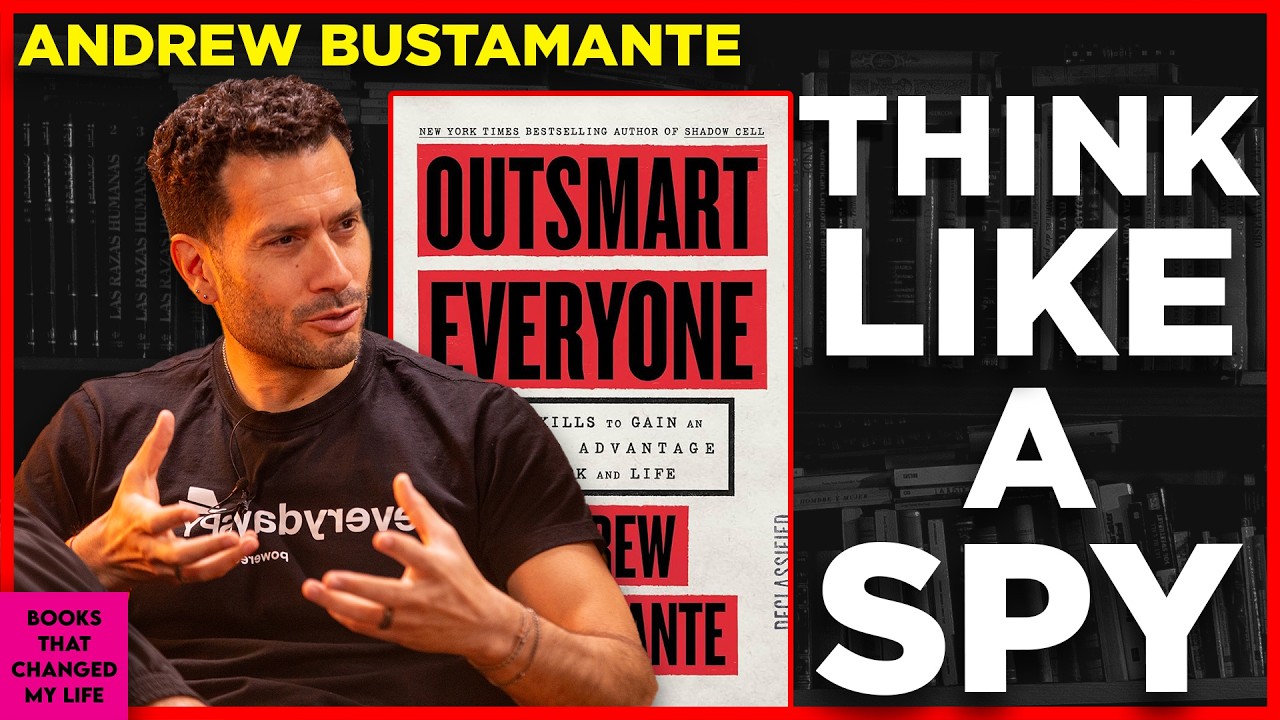
In this YouTube interview, former CIA officer and author Andrew Bustamante discusses his new book Outsmart Everyone, which translates CIA tradecraft into everyday influence techniques. The conversation covers the book’s core premise—using spy skills such as attention control, information hygiene, and the "two questions and a confirmation" method—to improve persuasion, storytelling, and personal power. Bustamante shares vivid anecdotes from his intelligence career that illustrate how these tactics work in high‑stakes environments and how they can be adapted for business, relationships, and self‑development. He also reveals his personal reading philosophy, recommending a curated list of fiction and non‑fiction titles (e.g., Hyperion, Frankenstein, Moby‑Dick, Think and Grow Rich, Zero to One, Ender’s Game) that have shaped his thinking on narrative, human psychology, and wealth creation. The host, SPEAKER B, enthusiastically endorses the book, promising to distribute copies to clients and positioning it as a long‑term reference for influence mastery. Throughout, the tone remains conversational, supportive, and promotional, with both participants expressing gratitude and excitement about the book’s impact.
Chapters
Cognitively, human beings actually want to be outsmarted. If you actually end up head-to-head with a psychopath, there's a really good chance you'll never know. Man, I was such a dumbass when I was younger.
I still might be.
There's no way you can read Frankenstein and feel bad about your fucking life. 50% of society is never going to be a good employee. Learning is one of those things that keeps us growing and keeps us thriving. And if you're not growing, then you're dying.
In 60 seconds or less, kind of just tell me, how do you outsmart You outsmart everyone by making— This week we're joined by former CIA officer, friend of the show, Andrew Bustamante. Now Andrew has been on before to talk about the book that changed his life, Ender's Game, but this time we're taking a deep dive into Andrew's latest book, Outsmart Everyone. This is the book I always hoped Andrew would write, and we go deep into how you can understand others, read people. It's CIA stuff. It's really cool. incredible. If you stay tuned, at some point in here I tell you how you can get a copy of this from us for free. Get a pen and paper, you're going to want to take some notes. This is Andrew Bustamante and Outsmart Everyone. Yeah, usually it's the big tour, the whole thing. Yeah, but you, uh, you've already had the tour. This is the—
this is kind of the way I'm doing the tour this time. One of the things that's nice is, uh, is once you have success with one book, then the publisher kind of lays off and lets you do whatever you want to do for the second time around. So hitting my favorite people at my own pace and going from there.
You brought me this, A Swim in a Pond in the Rain.
Swim in the Pond in the Rain. This is my most recent physical book experience, right? The touch, the feel. The smell. I mean, even just the edges of the pages here are not even. So this became a very intimate experience for me, and it's not often that I feel like I have a very intimate book experience. But let me just read something from this. So this is essentially the, uh, the dedication is a quote from a short story by a Russian author named Anton Chekhov. From 1880s, I'm guessing. Um, and it's a passage from a story called Gooseberries that's actually covered in the book. And just let me just read the passage. And keep in mind, this is an English translation of an ancient Russian short story. And the whole book dissects Russian short stories translated into English to find the writing craft, which suggests that the craft of writing transcends—
Mm-hmm.
Language itself, right? And this was just stirring to me. Ivan Ivanich came out of the cabin, plunged into the water with a splash, and swam in the rain, thrusting his arms out wide. He raised waves which white lilies swayed. He swam out to the middle of the river and dived, and a minute later came up in another spot and swam on and kept diving. Trying to touch the bottom. By God, he kept repeating delightedly.
By God!
He swam to the mill, spoke to the peasants there, and turned back, and in the middle of the river lay floating, exposing his face to the rain. Birkin and Alioan were already dressed and ready to leave, but he kept on swimming and diving. By God, he kept explaining. Lord, have mercy on me. You've had enough! Birkin shouted to him. That's the passage, right? A Swim in a Pond in the Rain. When I think of even just that passage and the title of that book, it's sensory overload. I mean, could you imagine being in a pond in the rain? Not like a pool, but a natural pond. So it's a little bit slimy and greasy, right? Because it's got algae in it. And then it's outdoors. It's in Russia, so it's not warm. It's going to be a cold pond. And then there's a cold rain falling, and it's you and 2 other men. There's a mill nearby. There's peasants nearby. You find out in the story itself that they just got done bathing, their first bath in like 3 weeks or something like that. So they're nude as well. And all of a sudden it's like cold air, cold water. Is it light or dark? Probably dark because it's a thunderstorm. Is it, is it 10 a.m. thunderstorm or 5 p.m. thunderstorm or 1 p.m. thunderstorm? And all of a sudden the book takes you someplace that isn't where you're sitting. And that's not— that's just a story. That's a short story written by a Russian guy almost 200 years ago. Could you imagine having that kind of impact that you're still touching lives 200 years after you wrote it?
Oh yeah. When you're reading that too, I was thinking like, that's why the book is always better than the movie, because it takes you somewhere where in the movie you kind of like are left with whatever's on the screen, where here you can fill in the colors. Yeah, you, you always fill it in better than what it would be on the screen.
And, and this book too taught me More about why readers read. That's something I've never thought about. I've thought about why writers write, and I've thought about the relationship that writers have with other writers and the relationship that readers have with the authors that they like. I've had those thoughts before, but I never had the thought of the relationship that the writer has with the reader.
Hmm.
Do you see what I'm saying? And I'm probably not enunciating it right, but— or articulating it correctly. When a writer writes, they have to be thinking about the reader at some level. They have to be thinking about the reader. I've written nonfiction, and when I write nonfiction, my relationship with the reader that I'm only now reflecting on, my relationship was very practical. How do I get my information across in a way that's understandable to the reader? And if I'm expecting the reader to be 8th grade educated, or if I'm expecting the reader to be 12th grade educated, or even, you know, advanced degrees in college, I can change the word choice. I can change the complexity of the sentences. I can change the complexity of the concept. But that's, for me, that's essentially as far as my thought ever went for the relationship between writer and reader. But this is all fiction. And a fiction author writing a completely fictionalized story has to have a different relationship with their reader than what a nonfiction writer is writing for, because they're oftentimes writing for 2 different purposes, right? This person's writing to create an environment, create a story, create—
An escape. Yeah.
Maybe even create an allegorical message. So the craft is so completely different.
Like Shakespeare, in a sense. Like, yeah.
And but imagine— I mean, I keep, I keep using the word imagine because I haven't done this yet. Other people have made a career out of this. But imagine trying to create a completely fictionalized universe, character, backstory, motivations completely fictionalized and then deliver that to the reader. And that's what people have been doing time immemorial. But this is the first thing I've ever read that taught me how that writer has to think about their reader in order to be relevant 200 years after the short story itself is written. And I think what's so exciting to me about this book Is the physical intimacy of it all, yes. But also the fact that every page was humbling, Chris. Every single page just reminded me how dense and shallow and stupid I am, because I just kept learning. And even when I would, like, pat myself on the back, like, oh, I think I understand that concept, then it would be the start of the next— Russian short story. And I would slog through that short story and be like, I don't know what the hell I just read. This—
there's—
I mean, at their— at face value, some of these stories are nothing more than a man walking up a hill in a small town to a bar where something is happening. Like, that's the story. And I, I get from beginning to end and I'm like, I don't get it. And then I start what he calls his afterwords, where he's explaining the story to you. And then it all makes sense. And it's just one of those things that reminds you how even if you don't want to be humble, the world will humble you.
What's, what's your biggest shift in perspective after reading it?
I think there are 2. My biggest, without a doubt, my biggest is the connection between what George Saunders calls radical preference. Radical preference. And how it relates to the craft of any kind of artistic endeavor. I've always struggled with understanding and appreciating art because art has so many forms. You stand in front of a painting, you listen to a song, you read a book. I mean, you look at architecture. Art has so many different forms, and I've never been able to really appreciate why somebody spends so much time On all the details.
It's craftsmanship.
Craftsmanship.
They're proud of it.
And that is the thing that I was never able to understand about art, was the craftsmanship. And this book helped me connect that craftsmanship is radical preference. If you care radically about what you care about, you will not quit your craft until it reflects what you care about. So when I see those paintings that are like, to me, they might look like splatter on a board. To the craftsman, everything is intentional and they put real effort into that intention, whether that means that they whited out a little fleck of paint that they didn't like, or they just scrapped the entire thing and then started all over again. It's just, that's not how I've ever been wired. And being somebody wired for pragmatism and practicality, There's nothing less practical and pragmatic than craftsmanship. It's radical preference. And that's the number one thing that I took away. I think the second thing that I took away was a brand new appreciation for fiction. Fiction lets you have a relationship with people that neither of you ever imagined, right? This book has a fantastic example. I'm going to slaughter it. George, wherever you are. I am slaughtering your fine words, but he talks in here about how until the reader reads the line of fiction, that world never existed. And then when the reader reads that line of fiction, not only does that world begin to exist, but the reader doesn't question the world that they're in. So when I write a line of fiction that says, the red car pulled into the street in the middle of a traffic jam, if you're listening or if you're reading that line, a whole world comes to mind. You see a red car, you see lots of other cars on the road, you see a road that it's pulling into, but you don't see how many lanes the road has. Like, I didn't tell you how many lanes the road has, but in your image, you have a certain number of lanes. I didn't tell you if it was a city like Houston or a city like LA or a city like New York, but you created most likely a city.
Yeah, so I had 3 lanes and it was like a rainy Seattle.
Where for me—
Downtown.
For me, I was— when I was saying it, I'm picturing a red car pulling into LA on a sunny afternoon on 5 or 6 lanes of road that don't even line up perfectly because there's like a bike lane on one side and there's a double yellow line on the other side and, and there's wide open streets and condensed buildings. So we all all picture something different. We all picture a world that didn't exist until we read that, and we don't doubt for a second that that world actually exists.
So does that make you want to put more fiction into your writing?
It makes me appreciate the people who dedicate their life to fiction a lot more. And I would be lying if it— if I didn't admit that it also makes me want to test my own skill at fiction.
Also, just the Russian side of this always fascinates me, which is another conversation, is how much communism has kept a lot of incredible writing and art from getting out to the rest of the world.
And, and even before that too, right? The, uh, the authors that are in this book were largely persecuted in the 1890s with the change in In government, in Russian government. So these famous people like Chekhov and Tolstoy became targets of a cultural revolution that happened in the 1890s.
Okay, so back to the making of a book as art for somebody to consume. Now think about I Am Leader. Price point. Are you going to spend $250 on something you're not going to open?
It's true.
No. Just the way that it's formatted, the way it's an experience. I would rather sell 5 of those a day than sell a million of something else that nobody reads. And so it's all designed around kind of forcing people to read it.
But your book—
And a publisher would never do it in a million years.
No, no. Your book is— my relationship with you, Chris, honestly, is where my whole turn towards arts and craftsmanship really started. And that was what, 4 years ago? I think it was 4 years ago, man, that I sat in your little library in your house in LA. We had a conversation shortly after we had first met on a— for a whole different podcast, for your, uh, for your automotive podcast. And you were just pointing at books on the shelf and pulling these books off the shelf, and they all had notes and tags and highlights. And I realized that I was meeting somebody who is different than the vast majority of people I've ever met in my life. Truly someone who loves books, truly someone who reads books, truly someone who learns from what they read and applies what they read. And because of that, like, you have a— you have this fascinating sense of confidence when implementing something you've read. You don't doubt it. You are the reader who reads something and believes it to be true, especially if you've read it in multiple different formats from multiple different authors and you've seen multiple different sides of it, right? And I wanted a piece of that. Like, I wanted a piece of what you naturally had. And then as I spent more time with you and as I spent more time with your community and I spent more time with, you know, your loved ones and your, and your pups, it's, it was very clear that it bled into everything. Right? That there is a craftsmanship that you appreciate that bleeds into all these different elements of your life, and you shape your life to try to find more time to create more of that radical preference. And your book, I Am Leader, is a— if it is anything, it is a complete representation of your radical preference.
Mm-hmm.
From the fonts on different pages to the picture choice to the The 3 different types of formats that you created for covers and packaging.
Yeah, it's very vulnerable too.
And you were saying that it is an opus of you. And how do you put that out for people to judge, for people to even just, I will buy it or I won't buy it? That's a judgment, right?
Yeah.
It's tough.
For sure.
It's vulnerable. It's artistic. Learning is one of those things that keeps us growing and keeps us thriving. And if you're not growing, then you're dying. If you're not increasing, then you're decreasing.
I have taken your courses. I have spent time with you. I've hired you to just talk to me. Me and my buddy Mike just hired you to come hang out and just let us bounce things off of you. And I've learned a tremendous amount from you about human behavior. I think the 2 things that originally fascinated me about you was this interview you did with Lex. He asked you this question about what you have learned in your travels And your answer was that all people at the end of the day want validation and meaning and belonging. It doesn't matter how powerful they are or how much they show that they don't, they actually do. And that hit me like a ton of bricks. And then your charisma, the way that you're always on, you're always attentive, and just seeing you work A room and your ability to make everybody in the room feel like they are important and how you genuinely are interested in people. Yeah. And just how you're always on. Watching you work a room was just unbelievable to me. And I asked you tons of questions about it. I wanted to understand what you were thinking. And at the end of the day, the The biggest takeaway is just you're always on. You're not taking the easy way out, which makes people feel really important and is the basis, I think, of charisma, because you're very charismatic in that way. And so it's so exciting to me that you've kind of now written the book. This book needed to exist. I think you always knew you were going to write this book.
Yeah, it was about convincing a publisher to let me write that book.
Yeah.
That's really what the problem was.
And so Outsmart Everyone: Spy Skills to Gain an Unfair Advantage in Work and in Life. It's an incredible book. You're going to sell a ton of these.
Thanks, man.
And I think this will be a book that a lot of people will put down as their favorite book or a book that influenced them in a big way. And so just in 60 seconds or less, kind of just tell me, how do you outsmart everyone?
You outsmart everyone by making their brain skip steps so that they reach a conclusion that they actually already like and already want. And you've taken specific actions to get them to that outcome. Because if you can get people to a conclusion that they already like and that conclusion benefits your outcomes, it's a win-win scenario. It's what we call at CIA a net positive sum gain, because you've won and they've won. But the magic is that you outsmarted them to get them there. And this is beyond 60 seconds, but the, one of the most powerful lessons I learned at CIA was that cognitively, Human beings actually want to be outsmarted. We want someone else to do the calculations. We want someone else to do the heavy lifting. We want something else to do the work, and we just reap the outcome. What is artificial intelligence if it is not that? What is outsourcing if it's not that? What is, you know, a computer if it's not that? An algorithm if it's not that? Our brains naturally want to conserve resources. And the fastest way to conserve a resource is by letting something else do the work. So human beings want to be outsmarted. What we don't want is to discover that we've been outsmarted. We want to feel like, oh no, I picked the right horse, I backed the right guy, I bought the right software, I, you know, hired the right consultants. I made the right decision by putting the work. On that person's shoulders, and if you can make someone feel like they got the outcome they wanted without having to do any mental labor, then you've outsmarted them.
Yeah, I love that. My my favorite quote from the book is on page 186. You write, "I had a phenomenal instructor at CIA who used to say." We repel each other with our strengths and connect with each other through our vulnerabilities.
I love that your favorite quote wasn't even my voice. It was the voice of somebody that taught me something. I love that because now that instructor lives on. That was a really powerful lesson to me. I remember being younger, man. I was such a dumbass when I was younger.
We all were. I still might be.
But I used to spend so much time talking and trying to convince people that I was right and trying to be something that I wasn't. Trying to be good looking, trying to be trendy, trying to be fashionable, trying to be charming, trying to be a ladies' man. I spent so much time trying to be tough, trying to be athletic, trying to be competitive. Just the list goes on and on of all the shit that I tried to be. that I wasn't naturally. And I never once connected that all that effort I was putting into trying to show my strength, strengths that I didn't even have, strengths that I was just trying to artificially generate, all I was doing was pushing people away. CIA taught me these— the lesson of the 3 lives: the private life, the public life, the secret life. I teach them in this book. We're all putting so much energy and resources into this public persona, this public life that isn't really us, but is what we feel like we have to be. And when your public life collides with my public life, it's just us pretending to have strengths that we don't have. How are we ever going to connect over that? It's like 2 turtles trying to cuddle. Their shells keep their bodies from touching. We have to get rid of the shell if we're ever going to actually have that connection. And like, sometimes we all feel intentionally separated from other human beings. And the only way to shed that shell is to connect on our weaknesses, connect on our vulnerabilities. Hey, I don't have a lot of friends either. I feel like my wife doesn't listen to me either. I feel like my kids don't— like, my kids question how much I work. My kids wish I was home more also. Like, those are the things that make people get next to you that make you— that remind you that you're a human and not a shell.
I love the turtle analogy. 2 shells.
I've had the privilege now in my past life of connecting to— connecting to intelligence targets. And connecting to an intelligence target is a hard thing to do because they're either surrounded by layers of security or there's somebody nefarious, and nefarious people don't trust anybody. And the skills that I teach in this book were the same skills that CIA taught me to cut through the security and cut through the layers of protection to get close to that person, to get into that person's— not their public life, not their turtle shell, but to get into their private life, to get skin to skin. And then since leaving CIA, I've had the same opportunity to do it with other wealthy clients, wealthy business owners, wealthy Middle Eastern sheikhs. And what's been so powerful to me is that the pain that successful, powerful people feel is so common among them. They feel lonely, they feel isolated, they feel the overwhelming weight of responsibility. And no one to share the burden with them. And that's so very different than what sits on people's minds at the working class level, at the middle class level, at the poverty level, where they're worried about paying a bill, or they're worried about a car payment, or they're worried about keeping the lights on, or they're worried about the next meal, or they're worried about whether or not their kid is going to get a good grade this semester. Connection is so different because the more powerful people become, the more wealth they accrue, the less of a peer network they have, and the more valuable you appear if you can get past that public life with them.
You dedicate this to your wife. I do.
I do. I've dedicated— my wife and I both wrote our first book, and we dedicated it to our children. When I wrote this book, I think the easiest thing to write was the dedication because my wife—
My best friend, my closest confidant, you are more special than you'll ever know, and I am the lucky fool that gets to grow old with you. Yeah, that's pretty romantic.
That's my radical preference put into that book for sure.
Who is your target? audience for this book? Who did you write it for?
So when I set out to write this book, what I really wanted to do was I really wanted to address the person who is struggling with some kind of barrier that they can sense, but they can't name. Whether it's an entrepreneur trying to break through a, a ceiling at $2 million a year, whether it's a, a career employee trying to become an entrepreneur, whether it's a parent trying to understand their 13-year-old, whether it's a, an 18-year-old thinking about whether or not they wanna build a new career in the arts or a career in corporate America or a career in the military. I wanted them to have the skills that they needed so that they could dedicate their resources to getting the outcome that they want instead of dedicating their resources to the struggle of the system. So in my mind, I was always picturing somebody who was 35 trying to make a massive change in their life because they know that they want more for the last 40 years than what they got for the first 30 years. But as I actually wrote the lessons out, I was realizing that some lessons are going to have a larger impact on a 25-year-old than they will on a 35-year-old, and some will have a huge impact on a 40-year-old more than a 20-year-old. So my target audience is always myself from 10 years ago. That's always who kind of comes to mind is a less wrinkly, less gray version of me. But In reality, I think the, the book isn't about a demographic as much as it's about a psychographic. It's about trying to help people who feel like there's a barrier, an unseen barrier that they know they can get through 'cause they've seen other people get through it. They just don't know how to do it.
And so in the book, you're sharing a lot of things about human behavior that aren't common insights and, you know, things that we just don't talk about or don't understand. And most people aren't curious about, they just kind of live their life. And one question the team here kind of, had that I thought was interesting is just, if everybody read this book, would the tools in here still work? I mean, that's an interesting thing, is if everybody knew the secrets, would they still work?
I think the answer is yes. And I think the answer is yes because of my experience at CIA. At CIA, at all the intelligence services around the world, we're all taught the same fundamental tools of tradecraft. Tradecraft tools are what's being taught inside the book. How do you use someone's thinking processes to shortcut their conclusion so they reach the conclusion that you want them to reach? That's what it means to outsmart somebody. So all spies learn this, but there are still spies that recruit other spies, right? There are still traitors and turncoats. There are still American CIA operatives who end up working for the Russians, and there's still Russians who work for the CIA. So how is it that Spies can recruit other spies if they all have the same skills. It's because the skills still work, but they work for a different reason. They work because 2 painters appreciate the talent of the other painter, and they realize when there's something to learn, or they realize how to pull the motivational levers of another person because they lived those motivational levers themselves. So my answer to the team's question would be yes. If everybody read the book and everybody applied the skills, they would still work. They might even work faster and better because now the person who sees the effort you're putting into it knows exactly what the fuck you're doing. And they're like, I appreciate that.
Like, I always appreciate when somebody's really good at sales. Yes.
And you want to buy from them.
Yeah. And you want to experience it. You want to let them do their thing.
Yes.
Because it's fun.
How deep does the rabbit hole go? Where is the place where you start to show effort in this talent that you have? I want to see it.
Okay, so kind of a question setup in a sense. So if you're undercover somewhere in a hostile territory and you get caught and you're in jail in a foreign country, what are the 3 books that you wish you had with you? Oof.
Gosh, that's a, that's a powerful question. That's not where I thought that question was going either, which is a really cool turn. So I think that what I would have is Mary Shelley's Frankenstein, because when you read that book, it's just excellent prose. It's long, it's thought-provoking. It's visceral and it's, it's going to keep you distracted from the pain and isolation of being arrested. I think I would also take Treasure Island because Treasure Island is this, is this fun read, but it's also, um, it's also kind of childish and, and just a fun romp. And I would, I think I would take the Bible. Because I have found spiritual comfort in the Bible before, and I find that the Bible is one of those books that when you reread it, there's always something else that you pick up from it. It's long, it's dense, it's going to get me through potentially years of captivity. Yeah, I think those are the 3 books that I would take. None of them are going to show that I'm a spy. All of them are going to keep me mentally engaged. They're going to keep me from feeling too bad about myself. There's no way you can read Frankenstein and feel bad about your fucking life when you read Frankenstein.
So in Outsmart Everyone, you write about the fact that we're all taking in too much information. Like, we need to be more intentional about the stuff that we're letting into our brains. Kind of tell me how you set up your day. And what are you reading? What are you watching? What are you listening to to protect yourself in that way?
I think part of the interesting piece to this answer is that I don't let much in. So when I wake up, I don't look at my phone. I get up and I take that first few minutes of the day when I don't have any stimulation. And I try to just sit in that lack of stimulation. It's a skill that I teach in the book called getting quiet. CIA taught me that the human brain works in only one of two modes. It's either absorbing or it's indexing, meaning it's absorbing new information. And the only way your brain gets new information is through your 5 senses. So if you're tasting something, hearing something, feeling something, seeing something, then you're, then you're absorbing. You're not actually indexing, saving, downloading. You're not connecting ideas. You're collecting information. So I try to use the first 3 to 5 minutes of my day to just let my brain connect, index on the information that I collected through my night's sleep. Sometimes I have inspired thoughts, new creative ideas during this just 5-minute break that I call getting quiet in the morning. After I get quiet, then I actually get up and brush my teeth, do the morning things, because now there's hot water on my skin, cold water on my face, the taste of toothpaste in my mouth. And now my brain is going into absorbing mode. It's getting out of indexing mode. And I kind of ride that wave into the productivity of the day. I, my day involves waking up kids. It involves making breakfast for kids. It involves walking a dog. Those are all chores that I have to do. So I try to do them in a way that benefits my long-term goals for the day. For example, I'll walk the dog before I wake up the kids, and I'll do that because the dog doesn't talk to me. The dog is just very happy to get out of his kennel and go outside and piss in the grass. But I get fresh air and I get natural sunlight going into my retinas, which helps trigger the release of cortisol. Cortisol, that's kind of like a hormone that Gives you more energy first thing in the morning. So I get to start my day off right when I do things in the correct order. That's another principle I teach in the book called the Domino Principle. You put things in a certain order so that they build momentum productively throughout the day. So it's not until after I've walked the dog, after I've washed my face, after I've, you know, taken my time to myself. That's how I structure my morning. My day looks very much like my morning. I don't watch the news. I look for the news. I have algorithms that I've trained to help me find stories that I like or stories that are relevant to what I'm trying to achieve. When I find something that's interesting, then I'll actually look for things that, uh, I'll look for stories that dispel, contradict, or prove that the story that I'm interested in is wrong.
So my takeaway from what you, you just explained is that you're very intentional. And you are setting yourself up for success. And it all, like, you're designing the thing that you want. You're not on automatic pilot. You're not a passenger. You're the driver. There's where most people are the passenger.
Correct. There's an outcome that I'm trying to achieve, and, and outcomes are the, are the heart and soul of Outsmart Everyone. It's a book about how to use these skills to get outcomes that benefit you.
Hey, really quick, if you want a copy of Andrew Bustamante's book, Outsmart Everyone. All you have to do is like this video, comment, and then go to the link in the description and sign up. We'll get your info and we'll get them out to you. If this video is still up, it means we still have copies to give away. It's on us. We just want everybody to be able to experience what we did with this incredible book.
Most of us aren't trained to think about an outcome that benefits us. We're trained to think about an outcome that benefits someone else. So what happens is we start to pursue outcomes that were given to us. 50% of society is never going to be a good employee. They're too creative, they're too innovative, they're too— they buck under, under too much control. So I try to live my life pursuing the outcomes that I want, and I only got there because The military set me on outcomes that they wanted, and the CIA set me on outcomes that they wanted. And when I left CIA and started working in corporate America, they set me on outcomes that they wanted. And I, and I learned that if you can help other people achieve the outcomes they want, then the same skills can be applied to yourself. And that's what started me on my own entrepreneurial journey. The human brain, cognitively, chemically, biologically, Hasn't evolved very much in the last 1,000 years. So what that means is that the wiring in our brain is still a wiring that's intending to try to keep us alive. Our survival instinct still dictates the majority of our cognitive functions. So when the human brain— when a human being meets another human being, the first question that the brain asks is, is this new person A threat or not a threat? A simple binary question. It's the first thing that happens every time you meet a new person. A very similar question happens every time you run across new information. Is this new information threatening to my well-being, threatening to my life, or not threatening to my life? And the reason the brain asks that question is because if something is threatening, it will require resources, and the brain's trying to conserve resources. If something is not threatening, no resources needed. Every time you open your feed, the news, the mainstream media and non-traditional media have been wired to present you with threatening information, threatening to your, uh, financial well-being, threatening to your health, threatening to your family, threatening to your national security. And then your, your brain sees it and commits resources. You've got to get— you've got to recognize that when something triggers your brain as a threat, It's just an emotional response. And if you can just label it— something else we teach in Outsmart Everyone is you have to name it to tame it. You have to name it to control it. You have to name it to make it subservient to your outcomes.
Yeah, that's really good. I love that. Okay, so we're going to go through some parts of the book.
Do it.
Spies learn quickly that fruit is the ultimate superfood.
Yes, this is one of those simple things that I use every day that I actually feel embarrassed sometimes to tell people. So fruit is a natural source of glucose. It's also a natural source of fiber. When you mix glucose and fiber together inside the digestive system, you literally have long-lasting energy where people, many people, me included, will drink a cup of coffee when we feel like we need energy. That's— that coffee comes with a chemical called caffeine. Caffeine gives you an energy, a simulation of an energy boost, but it doesn't last for a long time. Turns into jitters or it turns into a crash. So, and coffee is actually a very hard thing to acquire when you're out in the foreign field in the middle of a mission, but you can find natural occurring fruits everywhere. So CIA actually teaches us that when you need an energy boost, when you need to plan long-term sustainable energy, look to fruit first. Look to fruit before you look to energy drinks or power bars or, or caffeine or tea, because it will serve you more consistently and sustain you for longer.
Are there some that are better than others?
Yes. So, what you're looking for is a glucose source that has a high fiber content, and even better if it also contains antioxidants. So, things like strawberries, blueberries, Apples, pears, those are all fiber-rich, antioxidant-rich sources of natural sugars. But when you look at something like watermelon or grapes or dates, those are different. They have a higher glucose level that is more likely to spike you and less fiber content to sustain.
Yeah. Okay. You don't want to surrender control of the information flow, of course, but at the same time, if you are only asking questions, even good open-ended one, the other person is eventually going to start to feel like they're being interrogated and will probably shut down the conversation. To avoid this technique, CA officers use all the time in 2 questions and a confirmation. That's one thing that I learned from you that works so— it's just so easy. It's like magic. And people perceive you to be a great conversationalist, even though you're not really talking that much. The other thing that I learned from you in reference to questions is questions put you in control.
Yeah.
There's probably nothing that gives you control of the situation you're in More than being the one that's asking the questions.
What you're talking about is a major contribution that I poured into this book, was the power of asking questions. Because asking questions creates a foundation where 2 things happen simultaneously. One, you direct every step of the conversation because you set the tone, you set the pace, you set the vocabulary.
You're driving. You can drive them where you want.
Yes, because you're asking the question. But then also what questions do is it creates the perception in the other person that they're interesting to you because you're the one asking the question. They're the one telling you about them, their opinions, their perspective, their experience, their point of view. In the human experience, the thing that we get to do the least is express ourselves. The thing that we have to do the most Is acknowledge and validate other people. Our bosses talk at us. The TV talks at us. Our wives and husbands talk at us. Our children talk at us. With all that onslaught of people talking at you, you never get to express yourself, and you feel like you're subjected to everybody else's opinions, and you have to swallow your own and suck up your own, and nobody cares about your thoughts, and nobody cares about your ideas. Like, that's how it feels. So when you create a series of questions, all you're doing is inviting that person who has felt for months, hours, years like they can't talk about their ideas. You're giving them an open forum to express themselves. And when they do, they get a dopamine hit because they feel like their opinion matters. And then the third step in that question-question validation or question-question confirmation Now you're confirming that what they said is important to you. It is something you committed to memory, and you're confirming that it's valid. You just amplified their sense of chemical momentum to keep talking.
Yeah. And so they become very open, right? And then the more you do this, the more you realize you can kind of put them where you want them. And so one thing I think I've noticed you do, but I'm curious, Is when you're asking questions, and we shouldn't lose sight of the 2 questions and then validating their opinion in some sort of personal experience, or you were interested in that, but stopping and validating it, is that you taught me to think of people in 3 masks. So you have the mask that the world sees.
Yeah.
You have the mask that only your close friends, family see, and then you have the mask that nobody sees. In asking questions, one thing I think I've observed, but you tell me if I'm reading this right, is you will go to something personal eventually. You will fractionate, so they'll be easy, and then you get deeper. But you will do something vulnerable about either sex or some sort of mistake, something that's kind of a novelty that gets closer to that mask that nobody sees. And are you doing that in that dance of questions?
Yes. What you're looking for is, just like you're calling them masks, I oftentimes refer to them as lives. Public life, private life, secret life. The mask that everyone sees, the masks that only close, personal family friends see, and then the mask that nobody gets to see. Understanding that there's 3 lives, understanding that there's 3 masks is helpful, but it's not useful. Because what's useful is knowing how you move from one mask to the other. How do you get from a person's public mask to their secret mask? How do you cut through everything? Question, question, confirmation is how you do it, because you start by asking questions about their public persona. And then because the questions you're asking are open-ended questions, meaning they're questions that get more information in return versus closed-ended questions, which don't give you more information. Open-ended questions means that the person gets to volunteer information to you. And then when you confirm and validate that you've received the information and that you find it interesting and valid, what happens is they naturally Start to create more open answers that gravitate from their public persona to their private persona.
And the key is you got to validate that mask.
Yes.
And then it almost comes off the board.
Correct.
And now we're friends.
Now we're friends. Now I'm in your private life. Well, once you're in someone's private life, the threshold, the distance, you might say, the distance between private and secret is much, much further. than the distance between public and private. We all think that we've done something great when somebody invites us into their private life, when they share their favorite music or they bring us over to their house or they introduce us to their kids. We're like, oh, look at this great achievement. No, that's not that great an achievement. The distance— the shell might be very, very hard, but it's not very thick. So you get into their private life. Now, the way that you get from their private life to their secret life, From their place that they're a little embarrassed about how their feet might smell bad or their breath might smell bad, from that to the place where they feel shame and humiliation, that is a much greater distance. Maybe not as hard of a shell, but a very thick shell that you have to cut through. So once you get to that private life, now the way that you make that distance happen quickly is you start to demonstrate more vulnerable, open questions. that might even apply to you, but that you believe apply to them.
So that quote from your instructor that it's not our strengths, it's our vulnerabilities, that's how you make that jump, right?
Correct.
So I've seen you kind of do that in a sense. Can you give me an example of how you would make that jump and being vulnerable?
Absolutely. So a question to get from someone's public life to their private life might be something like, Have you always wanted to have children? They can answer that any number of ways. Yeah, I always wanted to have kids. Or I always imagined I'd have 7, but I only had 2. Or no, I never thought I'd have kids, but now I have kids. The same kind of topic, parenting. A way that you get from private life to secret life might be something like, one of the things I struggle with is finding a way to frame homosexuality and sexuality for my teenage son. Do you ever struggle with something like that?
Very vulnerable.
Very vulnerable.
And not something you talk about with most people.
Right. And they can very well shut that down and be like, I don't even touch that subject with my kid.
Right?
No, that's, that's not something we talk about at our house. They can shut it down if they need to. Or they might go down that door in ways that you never expected.
But the magic in it, in it, in that is not whether they shut it down or not. It's that you've been vulnerable. And now They feel that they can open up more to you with something else.
Correct.
So it might be a completely different subject that they all of a sudden end up sharing with you that you don't expect. But your vulnerability, even if they say, oh, I don't talk about that with my kids, the work has been done.
The work has been done. And what's beautiful is it doesn't even have to be a true thing that I struggle with. I could have created an artificial vulnerability. Maybe it's perfectly easy for me to talk about homosexuality or straight, straight sex with my son. Maybe it's easy for me, but that's not what I wanted to communicate to them in the question. So in the question, I told them one of the things I struggle with is navigating human sexuality with my son. Maybe I don't, but from their point of view, I do. So why did I set it up that way? I set it up that way because I believe that they probably do struggle with that. So now is their chance to confirm that they struggle with it with their answer, confirm that they struggle with it with their denial of an answer, or maybe even go deeper into that topic.
So one thing you taught me with that subject is in the CIA, you would already have research on the person and you would know, for example, that they're having an affair. So then you would say, oh man, I'm so afraid. I think my wife caught me having an affair. And so you already have inside information to know kind of where to meet them, right?
Yeah. You can frame your questions when you know about them in advance. You can frame your questions. But we also have this tool that we call assessment versus assumption. Also something we cover— I cover in the book. You can assess, meaning you can gain objective data points from a target without assuming that you're right. Right? So I look at you and I can, I can assess certain things based on the style of shoe that you wear and the way that you choose to dress and the way that your hair always has just a little bit of a disheveled look to it, but your beard never does. Right? These are all data points that I can use to point at some kind of assessment. Right? This person is creative. This person is enigmatic. This person is detail-oriented. But not compelled by social norms to look a certain way or act a certain way. I can make those assessments. That doesn't mean that they're right. But then I can use my question-question-confirmation strategy to determine whether or not my assessments are more accurate or if they need to change. So I can start asking questions about social norms. I can ask questions about style. I can talk about shoes without talking about your shoes. To see what you say about shoes, to see what you say about shirts, to see what you say about hairstyles and facial grooming. I can cover all of that in an open-ended question and confirm your responses, and that's going to help me tighten up my assessment of what's really happening.
So one thing that attracts me to your training, and I think a lot of people, is that we've been taken advantage of. And I know there's a lot of females out there that consume your content because they've dated a guy that was a psychopath, or people that have just been in relationships, and really they just want to understand how to avoid being hurt. How can you tell that somebody is going to take advantage of you and that sort of thing? And so you're talking about it here a little bit, but the best way to spot a liar Right, is to give them an opportunity to lie, then scrutinize their response.
You're looking for effort. Lies are unnatural. Even to a skilled liar, lies are still unnatural, which boils back to this idea of how the brain consumes resources. The human brain wants to conserve resources. If it was up to your brain, your brain would tell the truth. Because it's the easy thing to do. It doesn't require a lot of creativity or memory recall or anything else. It just tells the truth. It tells what's— that's the fastest way to Rome. But when someone is lying, their brain has to go into overdrive to reference previous lies, remember details that never actually happened, try to recall what was shared with you and what wasn't shared with you in the past, make an assessment of whether or not the lie they're about to tell will contradict something else that you might come in contact with in the near future. Just imagine how much energy that takes. So when you're trying to spot a liar, especially spot a liar in the moment, what you're looking for is the effort that goes into their communication. And that's both verbal and nonverbal effort because lying creates energy, it creates output, it forces the brain to go into overdrive. So you will find them physically moving, you will find them increasing their volume, you will find them increasing the pace of their language. Even if they're skilled, the longer you keep them in the lie, the more energy and effort it takes.
And the more they will react, right?
They will react.
Yeah.
People who are trained— and I differentiate between skilled liars and trained liars because skilled liars learn how to lie through practice. Trained liars learn how to lie through systems. So a trained liar will learn like I did, that lying is something you want to avoid. So when you have to lie, you lie quickly, you lie in a short, succinct way, you lie where it's 95% the truth. You only fabricate 5% of something. You don't fabricate 95% of something. It's too difficult to maintain that lie long term. So a trained liar is much harder to work against. But there's so few trained liars out there. What you're dealing with most of the time are skilled liars, and skilled liars haven't gone through the training to respect how difficult it is to lie. If anything, they feel very confident at it. They feel overconfident at it, so they'll just keep pouring effort and energy into it.
How do you spot a psychopath?
Psychopaths are a whole different breed. So before I answer the question, I want to make sure people understand, of 100% of society, it's estimated empirically that less than 2% are actual, by pathology, psychopaths. So, so the reason I'm starting with these metrics is because it's, it's, it's to help frame the answer. If you actually end up head to head with a psychopath, there's a really good chance you'll never know. You'll never see it. And it's partially because they don't even know it. Psychopaths are blind to the fact that they're different in many, many ways. It's an actual pathology of the mind. It's an illness of the mind. They have no concept of consequences. They have no concept of empathy. They have no concept that their actions impact another person at all. What I think most people attribute as a fear of psychopathy is actually a fear of narcissism or sociopathy. Narcissists make up about 3% of the population. Sociopaths make up closer to 15% of the population. So your chances of coming in contact with a narcissist or a sociopath are 700% more than your chances of coming in contact with a psychopath. And the reason that they get blended together is they are all pathologies. They're all mental issues, mental states. But a sociopath can fake empathy and can hold empathy back if they are trying to create an outcome that they want. And a sociopath doesn't believe that they fall under the rules of society and human condition. Like, they feel like they are justified to be outside of the rules. So because of that, they are oftentimes far more manipulative than a psychopath, because a psychopath is just going through the actions that they believe are natural. A sociopath knows— they know, if I say these words, she'll get in bed with me.
It's intentional.
If I do this thing with this gift, she'll have a harder time leaving the relationship because she'll feel like I'm getting better. She'll feel like I'm improving. And I only need to show— make her feel like I'm improving for the next maybe 15 days or so before I can go back and meet my other That's a sociopath. These rules don't apply to me, so I just have to play the game to get what I want. That's what we come in contact with far more often.
So kind of the last card I have here about your book is there's 4 parts in here about books. So you talk a lot about books in here. And so the first one is your experience with Moby Dick. So you said, at one point, my stepdad decided that I should read the classics, but instead of starting with Charlotte's or Annie of Green Gables. The first book he pressed into my hand was Moby Dick, a 700-page whale of a novel, almost as big as the monster that ate Captain Ahab's leg. But here's the part that killed me, is you say, my inner bookworm died that day.
Yeah. I felt for the majority of my life today, I'm 46 years old. I have felt for the majority of my life Like I'm a bad reader, like I'm not a reader, like I don't like books. That's how I've judged myself until maybe 39. 39 or 40 is when I realized that I didn't— I never hated books. I was never bad at reading. And, you know, I think one of the things that helped is that my son started to become very active at reading and my daughter started to learn how to read. at about that age, 39 or 40. So I realized that through them, I was so excited for them reading, and then I was excited to read with them, read to them, read about how to raise them. And I was like, I, I never— I was never bad at this. Why did I think I was bad at this? And I had to reflect back and say, oh, it was because my dad made me feel like because I didn't read that and I couldn't read that and I wouldn't read that. That there was something wrong with me. And my conclusion was, there's nothing wrong with me. There must be something wrong with books.
Yeah, that surprised me because I've perceived you as somebody who's an avid reader. And it's so interesting how those sort of experiences as a kid affect us forever.
And what kills me is how many opportunities I lost in those 39 years, like how many books I could have read. If the energy that I put into chasing ass and trying to impress people when I was in college, I could have been like some of my closest friends. When they got a weekend off, they sat around in their, in their gym clothes or their underwear in our dorm room reading a book.
Yeah.
And I, I could never bring myself to do that because I would tell myself, that's not me. I'm not a reader.
This one blew me away. At CIA, one piece of required reading is Napoleon Hill's 1937 self-help classic, Think and Grow Rich. That might sound odd, although we do a lot of thinking in spy world. No government worker is in it because they expect to grow rich. But that book is assigned to new recruits because Hill describes the process of getting obsessed with a goal, visualizing it, and spending every waking hour pursuing it. That level of focus that intelligence work demands.
Yeah. You know what's beautiful about Napoleon Hill's book is that when you read Think and Grow Rich, he tells you in the preface that the book is not about anything. That in reading the book, you will find what this book is about for you. It's a fascinating read. And then when you, for me, when I read the book, that lesson of obsession became very clear to me. And then when I, when I recapped it and reviewed it with my CIA class, that was the main takeaway that was consistent among all of us because. We were already kind of pre-chosen, pre-qualified by CIA. They already knew that we were of the type of psychology that when we read that book, what we would take away from it is a validation of our obsession. And what's fascinating is that in the book itself, it talks about people who are obsessed with money, people who are obsessed with, with improvement, people who are obsessed with sex. And it talks about each of these different forms of obsession. Yeah. Are really just a manifestation of energy, how you choose to apply the energy that you have. And all CIA did was take it and say, hey, you've all come here, you've already known what it's like to apply your energy to these things. For me, I applied an inordinate, inordinate amount of energy in pursuit of sex and in pursuit of, of power and status. That's where all of my effort went when I was in college and in the military. And then they were like, what would happen if we just Took all that energy and transmutated it into an obsession to beat the bad guy, to keep American dominance, what we call American primacy at CIA. And it was just a light switch for me. I was like, oh my gosh, if I had, if I had all my other needs met and all I had to do was take care of one thing, man, I could make America powerful. And that's what all of us realized.
You're talking about inside the CIA here. You say losing a single case officer is a tragedy. Losing a librarian would not just be a tragedy; it would risk crippling the organization. Without their vital work, us spies would be left with little more than the content of our heads. Our missions would go nowhere.
Nobody even thinks about the librarians at CIA. But when you work at CIA, you can't stop thinking about the librarians at CIA. And like legitimate library. Library sciences graduates from the few schools in the world that actually do library sciences. And they are just the— they're the nicest, coolest, geekiest, friendliest people. And there's only a handful of them. And they work at CIA's library and they will get you—
I would love to interview one.
It's amazing. It's amazing. I, I don't think that they're covert. So arguably we should be able to write their library and ask.
If we can ever set that up.
We'll try to.
I'll fly anywhere for that. That would be incredible. Here you're talking about connecting with people. You say in everyday life, the way you show your value doesn't have to be earth-shattering. You could start with a book recommendation. CIA officers walk around with lists of book recommendations ready to go for exactly this reason. Everyone loves a good book.
Especially the right book people. When you— and book people don't advertise themselves. You never know who's a reader and who's not a reader. You can never assume based on what they wear or how they carry themselves or the way they talk. You never know. And you for sure can't tell whether or not they're an audiobook person or a physical book person, a classics person, a pop culture person. You never, you never know. So what you always want to do is have a book recommendation list, 5 or 7, that you can apply what book you recommend to the right person at the time. If they're a wealth-based person, here's a money book. If they're a history person, here's a history book. Because you never know if they're actually a reader, but you can identify what their interest is, and then you can ask them about the book, and that conversation will very quickly turn into whether or not they're a reader.
So give me some examples of books you would recommend.
So I brought one. This is one that I recommend to you personally because I know you well enough to know that you would appreciate the craftsmanship, And kind of the niche, the niche of this book. But I also talked about Hyperion today. That was a sci-fi book that I would recommend, The Fall of Hyperion, the sequel to that book, because I will warn everybody in advance, if you read Hyperion, it ends on a cliffhanger that requires you to read the second book. But I'm telling you right now that the second book is worth it. Save the Cat is another book that I would recommend to anybody who's curious about creating a narrative, creating a story. Especially a fictionalized story. And that's another book that I've read recently. The Magnetic Marketing is another book I talked about today, a Dan Kennedy classic, along with his copywriting book that continues to— it's in my book bag and it continues to escape my brain right now. I often recommend Frankenstein, Mary Shelley's Frankenstein, because it's just this fantastic work of written English prose, but also Exploring the human psyche. Moby Dick is a go-to for me. Think and Grow Rich is a go-to for me. Zero to One by Peter Thiel is a go-to for me. Thou Shalt Prosper is another wealth book that we've talked about that I would recommend to anybody. Ender's Game, my favorite fiction book of all time, is a recommendation I make to people. So that's just my shortlist.
That's great. Well, I'll tell you, my shortlist is going to be Outsmart Everyone by this guy Andrew Bustamante. I'm gonna buy hundreds of copies of this. I'm going to send it to clients. I'm going to give it away to everybody for a long time. It will be a book that we have stacks of in here. And when people come, I will give them it. You did an incredible job. And this is a gift to us to understand how we work and to intentionally be able to create the thing that you want to create, to take your power back in a way.
Thank you.
It's very empowering.
Thank you so much, man. That means more to me than you know.
Well, you put a lot of work into this. I mean, I think this will be a reference book for a long time. It will be for us. So thank you for letting us preview an early copy of it too. That feels very special to read it before anybody else, but we'll be giving it away. You don't need our help. You're going to be very successful. But thank you for doing this. It was great.
My pleasure. Thanks, friends.
We are so excited to announce the Books That Changed My Life website. We made a way for you to show your book pride and that you love books. Hats, tees, hoodies. Check it out. Link in the description. Everybody needs a self-help hat.







