Hilarie Burton on "Dandelion Wine" || Books That Changed My Life
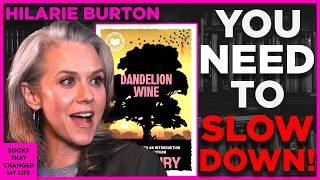
In this candid interview, actress‑author Hilarie Burton reflects on how Ray Bradbury’s Dandelion Wine shaped her sense of home and appreciation for everyday wonder. She recounts childhood yearning for a nurturing, grandparent‑like figure, the influence of a gifted‑and‑talented program, and the comfort she found in Bradbury’s image. Burton discusses her eclectic spiritual outlook—calling herself a “buffet Christian,” embracing reincarnation, stardust metaphors, and a playful openness to mythic beings. She shares a late‑life first experience with cannabis, the emotional impact of that revelation, and how language and labeling shape trauma versus lessons. Using a story about Mr. Jonas, she illustrates empathy for sensitive people. Burton explores the metaphor of “relish” and the pantry as an altar of discovery, linking it to making dandelion wine with her children. She explains how Dandelion Wine gave her a portable sense of home and inspired her to write and tell stories that honor the mundane. Currently, she produces a Sundance documentary series spotlighting small‑town America, exposing judicial corruption, and turning true‑crime narratives into activism, alongside a scripted AMC series, The New Gothic. She cites a specific case of racial injustice in North Carolina (the Christian Griggs shooting) as a catalyst for her advocacy. Burton also talks about the books she shares with her children—Perks of Being a Wallflower, Of Mice and Men, and Clive Barker’s The Thief of Always—and her practice of gifting signed copies of Dandelion Wine to people in need. Finally, she describes her personal fandom of Bradbury, including memorabilia, fan letters, and the emotional significance of a signed bottle from Bradbury Vineyards.
Chapters
You won't be here tomorrow. He's crying. She asked him why. He says, you won't be here tomorrow. And she said, tomorrow morning I'll get up at 7 and wash behind my ears. I'll run to church with Charlie Woodman. I'll picnic at Electric Park. Oh, and she just lists all the things that he's going to do. I remember I dated a boy like the first week of college and we went to Central Park and he was like, everything's so beautiful. And I thought he was so irritating. And then I read this book and I was like, it is really a beautiful guy.
So the big question, uh-oh, how did Dandelion Wine by Ray Bradbury change your life?
Dandelion Wine by Ray Bradbury changed my life.
Welcome to Books That Changed My Life, New York City Edition. We're taking a page out of Homer and going on an odyssey all the way to New York City. We're in the beautiful House of the Redeemer Library right here in the heart of Manhattan, and we're joined by actress, author, and mother Hillary Burton, and she's here to talk about the book that changed her life, Dandelion Wine by Ray Bradbury. So we're here to talk about Dandelion Wine by Ray Bradbury.
That's him.
Quite a book.
Oh my God, it's the best book.
The style, I think, is what sticks out the most.
Yeah, well, I think it makes it really, really easy on the reader. You know, Bradbury had been accumulating short stories for decades that would, you know, run in all the, like, magazines, you know. He had a lot of Playboy articles, which was shocking to me, you know, in my youth. I was like, he wrote for Playboy? But back when they actually had great articles, that was like, you know, a place where members of the literary elite would place their stories. And so Bradbury had written these very wholesome but kind of, um, these stories that had a moral fiber to them. And with Dandelion Wine, he found a place to really put them all together and weave them through the lens of two young boys, two brothers growing up in this very small town. One of the boys was based on him, the lead narrator, Douglas Spaulding. And then he's got this real cheeky little brother who I think was maybe Bradbury's inner voice.
Yeah, we were kind of talking about it in the sense of the fictionality of it or the abstraction of it sometimes allows you to write a better book even though it's based on—
Oh yeah.
—real life experience.
Yeah, I think Bradbury was always writing about his own experience, even when he was writing sci-fi. And I think that's why He just resonated so deeply with me, and I know with young people all across our country, because he— whether he's talking about men landing on Mars, you know, and feeling homesick, how different is that from the experience of all of these young enlisted men who are landing on the beaches in France? You know, I think he was able to use the veneer of sci-fi to speak to really core elements of what it means to be human. Human. And with this book, it felt like perhaps the world was finally safe enough to not have to use sci-fi. Like, you could just tell the story in really human, personal terms.
Yeah, he has a way of describing just moments.
Yeah, and appreciating moments. I, I think I'd been such an ambitious young person, and I was so, so eager to get out of the place that I grew up in that reading something like this about appreciating the mundane and the really small, tiny moments, it just— no one had ever taught me to do that before. No one had ever pointed it out to me before. And so I felt kind of foolish. I remember I dated a boy like the first week of college, and we went to Central Park, and he was like, "Everything's so beautiful." And I thought he was so irritating. And then I read this book, and I was like, it is really beautiful, guys.
That's funny. Yeah, it kind of like forces you to, to slow down. So tell me about where you grew up. So yeah, I mean, I grew up in Northern Virginia. Mom and Dad did what?
Uh, my mom did a variety of odd jobs. She started off working in the grocery store, at-home childcare, drove the school bus, back at the grocery store, kindergarten, real estate, like a whole array of things. And my dad worked in He was in the military and he did computer stuff. I mean, it was all very vague to me, uh, because I think my experience was more centered on like, oh, we do Little League baseball, and the domestic part always outweighed the professional part. And so for us growing up in Sterling Park, Virginia, it was a town of 9,000 at the time, and we had our parade, Sterling Fest, every year where we'd march and with the Little League and football teams. And it was incredibly quaint and cute, but there was always a kind of a seedy underbelly to it. There'd been a murder at our local gas station when I was very young, but it, it kind of colored every walk home. You know, like you're walking home or you're going to your friend's house, and all of a sudden, this town that hadn't seen a murder in decades has one. And so, there was always something a little bit dangerous about our very quaint town. And then, when I was in high school, I think like AOL built a headquarters there, like a huge hub. And all of a sudden, this town that had been very, very small became all overpasses and underpasses and just like a web of 6-lane highways, and it's— completely gone. It's unrecognizable now. And so I mourn the town that I grew up in 'cause it doesn't really exist anymore.
What does that feel like?
It's, you're unmoored in a way and you look for it everywhere. I think it's why, I mean, I know it's why my husband and I ended up moving to the Hudson Valley because we found a similar town, of 9,000 people that has Memorial Day parades with the little soccer players every spring. And it really mirrored what I grew up with in Virginia and what he grew up with in Washington because his town was swallowed up by Boeing. And so both of us were kind of these kids without a hometown and we wanted our kids to have, have that, you know, to have the connectivity of walking into a store and knowing the owner and, if you're being naughty out in town, someone's gonna call mom because everybody knows everybody. We wanted that proximity and that feeling, but we had to treasure hunt for it.
We had to go looking for it. Yeah. So what kind of kid were you?
Oh, very square. Very square. I was like a kid that I wasn't— You just wanted to do the right thing? Well, I was very sheltered. I wasn't allowed to listen to modern music. If I was gonna watch a modern movie, So Christian? Oh yes. Oh yes. Church? Yeah. Evangelical Lutheran. And then eventually joins the Methodist Church.
So Lutheran's a little more buttoned up, right?
Oh, I don't think chicks were allowed to talk in the church that I grew up in, which is— that's weird, right?
Well, half the people can't talk is weird.
God, I mean, I just remember being so pissed because you get older and the boys were all allowed to be ushers. And things and light candles and play the trumpet and like do all these cool things. And the girls just had to sit there and it was so frustrating.
So in middle school— So you conformed? You were the good kid?
You didn't get in trouble? No, never. I formed Clean Teens in high school. Like, we were the very square kids that didn't drink or smoke or have sex or do anything. But we still went to the parties. We didn't judge anybody.
We were cool.
We just were square. And I like— And you embraced it.
Oh, yeah.
I thought, you know, the first play I ever did was The Sound of Music. And so there was a time where I was like, well, do I have to become Catholic to be a nun? Like, what do I have to do? The religious life was very deeply ingrained in me, and I think it still probably is. I think I have a broader worldview at this point. That's what moving to New York City does to you. But I loved faith and the community of church, and that was something that I really— I dug a lot. I'm an Episcopal now and like pretty pagan, so it's a very different scene. Yeah.
So what kind of music did you listen to then? Oh, Motown. Oh, you were allowed to listen to that?
I was allowed to listen to anything like pre-1970, which is kind of screwed up because the innuendo of Motown, sexy. And I'm like 10 singing some sexy songs and having a great time. I think that also was a big factor in broadening my worldview, whether my parents knew it or not, is like hearing Sam Cooke songs and understanding that there was a fight to be had out there. I took it all, I internalized it a lot. I really, was looking for the answers to questions that were being brought up from music. And so I would listen to that. I would listen to a lot of, you know, music in the '60s was very controversial. You listen to some of those lyrics and there's protest songs in there and there's love songs where women are kind of demanding equal attention. You know? And I think maybe it was just an easy fix to say, well, we don't want you listening to anything modern. But no one really thought the plan through because those old songs were just as invigorating as I think anything that was out at the time in the '80s and '90s.
So that wasn't my experience. I wasn't allowed to listen to anything except for Christian music. Oh, really? And so— Yeah, I can see where that gap would have allowed a little more culture. It was— it allowed culture in.
We definitely grew up. But do you remember, like, Telly the Talking Bible? I had those records.
I think I'm a little older than you. I think it was—
it was like early '80s, and it was a talking Bible. It was like literally a mascot costume that would come to your church, and they had pressed vinyl records, and that's what I would fall asleep listening to every night. I loved it. Such a good kid. Yeah, it was really square. Very square. But I, I also loved kind of this environment of the '50s and '60s. We didn't have a lot of money. And so any movie that we would watch had to be borrowed from the public library. And so it wasn't like the Blockbuster or Arrows. We had Arrows too. The only movies they had were like Westerns, black and white movies. I spent a lot of time with Wuthering Heights. And Jane Eyre and Tammy and the Bachelor was like another one that was on repeat. And so I just loved, I loved this era. And I tease my husband 'cause he's older than I am. I'm like, well, you were born in the '60s. And I think that was my destiny because I just was so drawn to what was happening in that era.
And so what, what sort of books were you reading when you were a kid? Well, so let's see. So Bible stuff, right?
Definitely Bible stuff.
Did you go to the Christian bookstore? No, no, no.
A public library. We lived walking distance to the public library, and there was a section of books that were completely out of print, but they had whole series. And I liked reading series because it was a longer-term relationship. If I'm going to fall in love with a character, let's spend some time together. And so the two that stood out from like elementary school were the Katie John books, which was about a girl who moved from the city with her parents to this rural community where they'd been left a bed and breakfast, or like a huge old mansion, by a dead relative. And Katie John's always getting into trouble, you know? And I liked that butch little Katie John. I thought she was real cool. I wanted to be her. And now I've got the whole book series for my daughter, who also was like, I don't wear dresses. I'm tough. And then the other one, there were these Betsy and Tacy books about just a pack of little girls that were friends running around the neighborhood. And that held such allure for me because I didn't have that. Like, we weren't allowed to go to people's houses and people weren't necessarily allowed to come over to our house. It was a very secluded childhood with my brothers and myself, my parents. And so these stories about, like, neighborhood kids running around and going to each other's houses and just getting into trouble, that was really attractive. It's probably also what I found so attractive about this, like, that sense of, "It takes a village." You know, I really wanted that.
So when you would go to school and kids would talk about other music or other movies, did you ever— you never felt like you were missing something?
Of course I did. Of course. But I was friends with the teachers. Like, I was the kid that was like—
So you were an old soul.
I was always old. I was doing— I started doing theater in third grade, and it was the play at the local high school. So my friends were in high school, right? I got a letter jacket as an 8-year-old, which was sick. And then I started doing professional theater in like fifth and sixth grade. So my friends doing like A Tale of Two Cities. Were a woman— Oh, what was her name? Rusty was her name. Rusty was incredible. She taught me to crochet. She played Vengeance in A Tale of Two Cities, which is basically the lady that just cackles the whole time. And then there was a banker named Peggy who played Cross, who's Little Lucy's nanny. And that woman was my best friend and would just— We'd talk on the phone about the Beatles. Like, she was so cool. So I could talk to my friends about this, the things that I liked. I just had a different— school was lonely. I had a different set of friends. But like, you know, my first concert was the Four Tops and Temptations, and that was the coolest thing ever.
You were probably the youngest person there. 100%.
Like standing up, shouting every word.
I loved it. That's so fun. Can you crochet? I can't.
My daughter just wanted crochet stuff for Christmas, and so I went nuts. We're just gonna be crafting our brains out.
Has crocheting advanced in time, or is it the same?
It's the same old thing. It's just a hook and some yarn. Yeah, I mean, you can crochet pretty much anything. Dental floss.
What is your daughter gonna make?
Um, okay, so the big— where do you start? My daughter's really into dragons and stuffies, and right now she's doing a lot of hot glue with felt and making legit real-looking creatures, like sculptures. She's incredibly gifted at this. I don't know if it's going to parlay into her future. She watches a lot of Jim Henson, like, puppet-making stuff, and she's taking a puppet-making course after school on Mondays. Like, she loves creature-making. So neat. Be that girl, you know? Yeah, she loves special effects. Like, she's just— she's got an eye for design in that way. So if she wants to crochet some monsters, I'm in.
Yeah, see, I thought you were going to say like socks or something. No, God, no, no.
She's into mystical stuff, man. She's a— she's a strange bird. And what's so nice is that she's so confident in it that rather than getting made fun of, the other kids just kind of get in the boat with her and they're like, I guess we're into dragons now. So that's fun. Oh, that's really fun.
Okay, so you're— you grow up in this small town. W— did you kind of aspire to get out of the small town?
Yeah, yeah. I knew— I had gotten an agent in New York when I was in 7th grade. Uh, so I was coming up to New York with my dad to audition for things like Star Wars and sitcoms and soap operas and things like that. And what I realized is that while these were very cool experiences, I wasn't getting any of these jobs because they could hire an emancipated 16-year-old or an 18-year-old to play these, like, younger parts. I don't know. There was something in me that was like, you need to just go to high school. You need to go to high school and, like, really, really do it to the best of your ability so that you can tap into it later. And that must have been from some, like, theater training thing that I'd done. But that's what I did. And I high schooled harder than anyone's ever high schooled. Ever. But then I applied to every single school in New York City and just went to the one that gave me the most money. Worked out great.
And so then you escaped to the big city?
I did, I did. I contacted that agent that I had when I was younger. I was like, guess who's back?
And it was awesome. And so when does the— when does this come into your life?
So this comes into my life at like— I'd been in New York for a year And I— you're 18, 19? 19. I loved it. I had already gotten this job at MTV. Literally everything I set out to do happened within the first month of coming to New York. And sometimes when you get what you wished for but you didn't think about all the other steps around it or after it, it can be incredibly overwhelming. And I was, I was very young. I had been splitting my time between the dorms at Lincoln Center, but also my boyfriend's apartment down at the South Street Seaport, which was very close to the World Trade Center. And so post-September 11th, that was, I think I probably still carry some PTSD from that because I was just so young and that it really rattled me in a way.
Where were you when it happened?
So it was the first night I'd spent in my dorm in probably 6 months. I, I just thought, I'm going to do laundry at the dorm because it'll be easier, and brought all my laundry up to the dorm. And my roommates were even shocked. They're like, what are you doing here? Um, and then I woke up to a phone call like, you need to turn the news on immediately. And so kind of that reckoning of, oh, the, the safety and the magic of New York City has been shaken for me. And also my home is just being developed so rapidly that every time I go back to Virginia, I don't recognize where I am anymore. Like, I'm getting lost in my own hometown. I felt unmoored, and I was, you know, walking through the Village trying so hard to be independent and cool and even just be able to present that. And there's a bookstore that was— the name of it is very confrontational and I loved it. I think I texted it to you guys. It's on my phone. Can I look it up? Am I allowed to look it up? This is what it was. Okay, so this bookstore was called the Unoppressive Non-Imperialist Bargain Books on Carmine Street. Okay, so you're like this little girl coming from a super Christian background in New York City. And you walk past this store and it is just everything your parents warned you about, right? Like, don't go in there, don't go in that store, they'll turn you into a communist. And, and they had a card table out front and there was this beautiful book with a dandelion on the front. And it just, I don't know, caught my feminine attention. It was a very like gentle looking cover. I see the title Dandelion Wine and I see like a big gold award sticker on there. And as I stopped and got closer, I saw that it was written by Ray Bradbury. And I had been a huge Ray Bradbury fan, like huge. And I had never heard of this book. And that was shocking to me. It's like finding out one of your favorite artists has an album that just completely escaped your attention. And I definitely stood there for, like a while before thinking, I'm gonna go inside and buy this. 'Cause remember back then we didn't have just like cards and things like you had to pull out the cash from your wallet. It was a much more tactile transaction. I don't really have a lot of money anyway. And so I think it was probably like a $7 book. And it, it just completely captured my attention.
And so for the audience, just kind of explain what, what the book is about.
Yes. So the book is about one summer in the lives of these two brothers, Douglas and Tom Spalding. And it's a collection of short stories that are woven together through these boys witnessing what's going on with the multi-generations of their town. There's stories about the grandparent group, stories about the parent group, and stories about the children. And I was so drawn to the fact that those multigenerational relationships existed so easily. You know, I think a lot of the fiction I'd been exposed to really focused on one or the other. And because I'd grown up in community theater with older friends, I loved the idea that everything was so interwoven in this town. And this summer is really focusing on the 12-year-old, Douglas realizing for the first time his mortality, you know, realizing that he's alive in a world where nothing is, nothing's forever and nothing is guaranteed. And once you realize that, it makes you understand that everything is special. So it's a book about recognizing the special in your little boring corner of the world.
And so at that time, you, I mean, I don't know, how do you explain the emotions from 9/11? Oh, um, unsettling.
Yeah, I think the— especially if you were in New York in the before times, the fear was always— it was a one-on-one thing. You might get mugged, you might get, you know, one person wanting something bad to happen to you. And after 9/11, I think we didn't trust the narrative. We didn't trust anybody. I was surrounded downtown by machine guns and dogs, and it was— it felt fiction. It felt fiction. And so I think I retreated into fiction looking for a reality that I could tap into.
So you have 9/11, then you have the fact that when you go home, your, your town is changing and it's gentrified.
All the restaurants closed. Our community center, you couldn't get to anymore because they had to tear it down to build an overpass. Like, it was—
and then you're just, what, 19? You're just trying to figure out life.
Yeah, like, I'm 19. I think I got— I bought like a, like a garden box, like a window box and some dirt and tried to just like grow flowers on our roof. That's so fun. Like, I really was trying so hard to tap into anything that felt normal.
That's interesting. Yeah, yeah.
I mean, I definitely went to the Ace Hardware and was just like, I'll take a bag of dirt, and then hoofed it down to the seaport, you know, trying to make the best of it.
There's a funny thing about books that, that's, you know, I don't know, magical, but Sometimes when you're in a situation, somebody will give you a book. They'll be like, hey, I think you need this. But the more interesting one to me is you're walking and you are called to it.
Oh, like God rays were hitting this book on a card table outside.
That's more interesting to me because there's, you know, I don't know, you believe in fate or whatever it is, but comes into your life at a, at a time where it's relevant.
Yes. And it became a litmus test for the people that I was allowing into my life. Like, the boyfriend I was dating at the time wouldn't read the book. He's gone, clearly. Right. However, I had just been signed up for a scene study class in the Village, and I was really excited about doing that. I've been doing this MTV VJ thing, but I'd been an actor my entire life. And the very first day of scene class, our teacher, June Stein, was like a very prominent character actress here in the city. And she said, "Hillary, you're the new girl. You're being paired with James here." And this kid with like the happiest smile in the world turns around, and it is my very, very longtime friend, James Ponsoldt, who is the guy that runs Shrinking. And he did— He's like a very successful, writer, director, producer now. And he tells very, like, heart-tugging stories. And so, when I first met him, I knew he was this kid from Georgia, also a Southern kid in the city. And after doing scene study for a little bit, I was like, "I have this book, and I really like it a lot. And I know you're in school, but if you've got some time, will you read it?" And he read it right away. And we used to just go to the Renaissance Diner in Hell's Kitchen, and I had— at work at MTV, I'd use the copy machine and I'd copied every single page, like doubled up so we could just make notes on it. And we were like, one day we're going to make the Dandelion Wine movie. It's going to be so epic and so awesome. And I mean, I still have those binders. We were so serious about it. Wow. Yeah, we were really— we were so green and so excited. But it really— it was my litmus test. For are you my kind of person? And that's held up. And I'm a gray-haired lady now, so it stands true. I love that so much.
Okay, so I think it's page 14. Just kind of explains what dandelion wine is.
Let's see. You've got—
can I switch you?
Yeah, switch me. So I've got— this is my fancy version. Page 14. There she is. Do you want me to read it to you? Is it story time? The grass whispered under his body. He put his arm down, feeling the sheath of fuzz on it, and far away below his toes creaking in his shoes, the wind sighed over his shelled ears. The world slipped bright over the glassy round of his eyeballs like images sparked in a crystal sphere. Flowers were sun and fiery spots of sky strewn through the woodland. Birds flickered like skipped stones across the vast inverted pond of heaven. His breath raked over his teeth, going into ice, coming out fire. Insects shocked the air with electric clearness. 10,000 individual hairs grew a millionth of an itch on his head. He heard the twin heartbeats beating in each ear, the third heart beating in his throat, the two hearts throbbing in his wrists, the real heart pounding his chest. The million pores on his body opened. "I'm really alive," he thought. "I never knew it before, or if I did, I don't remember." I read that to my son and cried.
Yeah, I don't even know how you—
imagine being a grown-ass man and taking the time to sit down and articulate that.
Well, yeah, imagine being able to articulate it like that. I just love—
I love that at the height of his, his power and career, he wanted to focus on this, this reminder. The first chapter of this book is really kind of, um, it's a test, it's a gauntlet to see if you can get through it because it is very much in your head, right? It is a 12-year-old boy going through this series of realizations as his father takes him and his little brother out into the wood picking berries. And it's not the easiest read, right? Because you're following along almost in, like, beat poetry fashion what this kid is thinking. And it becomes much more narrative and, like, "This happened, then this happened, then this happened," as you get past that. But I like that there's— there's a bridge you have to cross to get into this world. That's what it feels like. And so, before you can truly appreciate and understand all of these stories that are going to come next, You need to go through that same process that Douglas Spalding is going through and realize that you're alive. And what, you know, those million pores and million hairs are feeling, it's important to tap into that so you can truly digest everything that comes after.
Yeah, and then in a sense, it changes how you experience the book. 100%. Yeah. Yeah. That's incredible. You're, you're great at reading, by the way. You ever done an—
well, and I dropped out of college, so I'll just stick to my 12th grade reading level.
Let's go to 45. And this is the— so this is when we, when we all kind of start to begin to understand.
So there's a threat that's running through this book about someone called the Lonely One. And it's a grifter that has been moving through the communities and killing people, specifically young women. And perhaps in the headspace I was in when I first read this book, you know, and feeling threatened now all the time, 24 hours a day, this sense of, this sense of the children understanding that the grownups were just as scared as they were was really hitting home. And even now as a mother, I think the timelessness of this book is that as a mother, I've got an 8-year-old who still thinks that her father and I are bulletproof, but I also have a 16-year-old who knows that we're just, total screw-ups and that we're trying our best, but we're also scared of things. And so this moment of, of a 12-year-old boy discovering that about his parents is sweet and it's sad. I think very few of us remember the exact moment that it happened for us, that the spell was broken. Um, I do. What was it? I do. I had a neighbor who had been dealing with some really difficult issues when I was in middle school, and he was always so lovely to me. He was a young father, young wife, they just had a baby, and he was so, so, so kind to me. And the last time I'd seen him was my summer birthday party because he went out and got ice for my coolers so my friends could have sodas. And then he disappeared, and he and his wife split up. And it was very kind of— you could tell the adults were always talking about it, but we weren't included in the conversations. And there was this, like, "Don't ever answer the door for anyone, even if it's someone you know." And I knew that to mean, him. And it became so serious. And then he ended up committing suicide. And that was the moment that I just started to doubt every adult around me because I think the situation had been incredibly misread. And so, yeah, when you, you know, I was 14. So a little bit older than Douglas, but again, I was really sheltered. I couldn't listen to modern music. So he's probably more advanced than I am in this book.
That is a moment that I think we all go through though.
We all go through it, and either you clock it or you don't. You know, I think you've gotta have the luxury of free time to think about it, and not everybody has that luxury. But maybe as an actor, I've been forced to tap into some of those things, or as a writer, tap into some of those things and understand my why. Why do I feel this way? Why do I think this way? In a way that, you know, not everybody has the freedom to sit down and just think. I don't ever want to take that for granted. Was there then no strength in growing up? No solace in being an adult? No sanctuary in life? No fleshy citadel strong enough to withstand the scrabbling assault of midnight Doubts flushed him. Ice cream lived again in his throat, stomach, spine, and limbs. He was instantly cold as a wind out of December, gone. He realized that all men were like this, that each person was to himself one alone, one oneness, a unit in a society, but always afraid. That's actually incredibly reassuring to be told that everyone's afraid, because then it makes you not a freak.
That's a really positive spin on it.
That's the Methodist spin on it. Yeah, I like that.
I like that you can go there.
That isn't where my head was. Yeah, I think validating fear, fear's not a bad thing. Fear is one of those evolutionary things that protects us and keeps us safe. And if you can understand that you're not alone in the fear and that you're not damaged in some way and that everyone's experiencing it, then it's like, oh, well, okay, then I can look at that person and see how well they're doing and know that they're afraid. So then I know that I can do well even though I'm afraid. Yeah, I like that.
Okay, let's go to, uh, 68. I'd love to. Let's see.
Tries to build a happiness machine. Oh, Leo. Oh, Leo. The Offmans. I like the Offmans. Um, this is an interesting story to have up front. Because it is about a man who is like a tinkerer, and he decides to invent a happiness machine. And it's the closest you get to sci-fi in this book. Um, I think you see a lot of Bradbury's kind of like Martian Chronicles writing in this story where You have a man who is fixated on technology without thinking about the repercussions of it. And so every bit of free time he has is not necessarily spent with his children or his wife, who could be true happiness machines for him. It's spent building this thing that's gonna just fix it all. and he lets his wife use it. I don't know how much I wanna ruin for everybody. Ruin it. Ruin it. He lets his wife use it and her reaction, he's so pumped for her reaction and she bursts into tears and she had gotten in the machine and Paris flashed before her and every beautiful thing that she had ever desired or experienced all flashes before her, and it is a parade of indulgence and magnificence, and she is sobbing, and he can't understand why. And I mean, I think that as a woman speaks to some gender differences, you know, I think that, I think that sometimes when women aren't understood or their rage isn't understood. There's a perspective issue. And for this woman who has been single parenting all the nights where he's been out tinkering and missed her husband, missed her partner, and she finally sits down in this thing and yeah, it's gorgeous and it's very ephemeral. It will not last forever. And look, it's over. It's over even now, and it was never real to begin with. And here I am, flesh and blood. I, I struggled with this chapter in particular when I was younger, and now I find that it's the chapter that I probably can relate to the most, you know, where appreciating what's real is so important. Um, but yeah, it's— what is—
explain the gender differences you see it in that.
Well, I think particularly when this was written, this came out in 1957, and the technology race, you know, we've got to keep up with Russia, men have to go out and be conquerors of every industry, and you've got to invent more, learn more, do more, build more, more, more, more, more, more. And the feminine perspective, I can't speak to what it was in 1957, but I can speak to what it is in 2026. And I can say that the appreciation of this moment, this minute today is so important, maybe because of 9/11, maybe because we know how quickly things can change. We're watching that happen on a global scale where people's— right now, this moment is being changed on a global scale every single minute of every single day. And it's exhausting that if someone wanted to distract me with a big beautiful machine, I would be incredibly hurt. And so the hurt that this woman carries is something that I feel is a very female experience. I hope that makes sense.
Yeah, just so, would you be more hurt by the machine or by the fact that your husband was obsessed with the machine?
Well, the machine's a mistress. Yeah. And I think the hope is that, okay, I'm gonna trust you and I'm gonna let you go do this thing because it's your passion and I love you. And then when you sit down with the mistress and realize It's beautiful, but it's all smoke and mirrors. It's not real. That's a hard— all the time's already been lost. That's hard. And what's lovely about this chapter is that her husband comes to the realization like, oh my God, what have I done? And the little kids in the neighborhood who have been watching him build this, you know, forever, are like, "This is gonna be awesome. Oh God, he did it. It finally works. How cool." And as they approach him, what he says to the kids is so important. He says, "The first thing you learn in life is you're a fool. The last thing you learn in life is you're the same fool. In one hour, I've done a lot of thinking. I thought Leo Hoffman is blind. You wanna see the real happiness machine? The one they patented a couple thousand years ago? It still runs." Not good all the time, no, but it runs and it's been here all along. And then, you know, he's inside and he's with his family. And I mean, if that's not what we've all been dealing with in the last year, I don't know what is, you know, in a world of distraction and chaos. The happiness machine is something that we— the real one is the thing that we have to hang on to.
And that thing is being present with the people that you care about.
Present, intentional, purposely joyful. How do you personally balance that? Yeah, I mean, I do a show, a documentary show about really hard subject matter. And the question I always get asked is, you know, what is your balance? How do you, how do you deal with darkness on a regular basis? And the answer is that for every moment of effort I put into poking the bear and fighting the fight and beating the drum and all of those things, I have to counterbalance that with just as much intentional effort building joy. So like, I'm getting my kids a cat today, like, and the kids are so excited about a cat. And do I have time for another animal? No, definitely not. But we're doing it. And these kids are so pumped. And I have to do playdates even though, you know, the world is falling apart and we just moved and I'm in the middle of renovations. My son asked if the drama department could come over for a cast dinner last Friday. All 40 of them. And I was like, yes, I would love that. I don't have a kitchen, but I want all 40 of those kids in my house. And so you have to be dogged about finding the joy and the connection and that real life experience. So at the end of the day, you're balanced. You've put in your hours doing the hard stuff, and you've put in your hours doing the joyful stuff. That's great.
'82 and '83, Okay, Trapped in the Present. Oh, ah, this story.
Mrs. Bentley, man. Okay, so I'm a hoarder. You are? Yeah, I'm not even embarrassed about it, you guys. I'm a hoarder. I save— wait, why aren't you embarrassed about it? Because I'll tell you what, my stuff comes in handy all the time.
Give me an example.
All the time. I mean, when COVID hit, I had everything. I'm like, you need some bits of string? Got 'em. You need seeds? I've had them for 10 years. You know, like, I have such nostalgia for things because my home doesn't exist anymore. So my home exists in the trunks and big, huge bins in my attic. So you have a barn? I have attics, I have barns. I got a lot of stuff.
Okay. When you said hoarder, it sounds like it's organized.
It's— it depends.
It's not like those TV shows where you come over and you can't open the front door. Give me time.
Give me time. I feel like that settles in when your kids leave the home. Like right now I've got to get everybody to school in the morning. And so the paths must be clear. But the second they leave, I'm just building stacks.
I feel like it's not the kids leaving that makes those people do that. I feel like they were that way.
I'm gonna get 30 more cats and it's gonna be awesome.
Oh my God, I went, uh, just a funny side story. So there's this, this guy that, uh, yeah, he's just, he's a little off, but he, he goes around and buys books at like estate sales and he'll get like really collectible stuff. Yeah. And so he wanted to sell me some books and I went over to his place and he was in this apartment Literally nowhere to sit. Books. Just— You could stand and read. I know, but there's this thing that happens when you're standing there and you realize what's going on. Yeah. And it, it, uh, it's very sad.
Well, I, I read Fahrenheit 451 in 8th grade, and I knew that my destiny was to be the woman at the beginning of the book who will not leave her house full of books and decides to just burn up in them. There was something about that that felt so like, oh my God, familiar. I remember kids making fun of her in class and me looking around like, wait a second, you guys wouldn't? That's— huh, how about that? Um, I I like my things, and I like my hoarding, and I like this chapter because this woman goes through this process of being like, well, I have all these things, and I've done this. She's like, I have all of these things that I've kept, and now I see this pack of children who I think might appreciate them. So I'm going to go through the emotional labor of parting with my treasures and I'm gonna give these kids some, some stuff from my history. And I've done it with my kids. Like, I've given my son my old iPod. It was the greatest thing I ever did because he can't figure out how to change the music on it, so he just has to listen to what I was listening to in like 2004. And that was— I was cool. And I'm much cooler than him now.
What were you listening to in 2004?
You know what he's so into is Gogo Bordello. He had never heard that band. And, you know, it's a Ukrainian punk band. And he was like, "What is this?" And he really got into the White Stripes off of the iPod. That was a kind of a fun era for going to see bands in bars. That was the vibe. And so reading this chapter, imagine if I'd bestowed this glorious iPod onto my son and expected a reaction of him being like, You are so cool. And instead, what happens in this chapter is the children look at her and they're like, "You stole this from a little girl." She's like, "No, I didn't. I didn't." They're like, "No, this never belonged to you. You were never like— you were never this little. Ew, gross. You're a thief. We're taking that from you." And the kids take the treasures, but they insist that she stole them. And she's so hurt. And she's so angry, and she wants her stuff back, you know? And by the end, I think she really looks in the mirror and perhaps comes to terms with the fact that she wasn't a 7-year-old girl. The version of herself in that moment was always an elderly woman, you know? And— And that's a weird thing to sit and wax on, you know?
Yeah, but weren't you kind of always an old soul in that way?
I was, but I was definitely 8 years old at a certain point. I'm going through a lot of muscle memory now with my 8-year-old daughter where I'm watching her do things and I'm like, whoa, yeah, I remember that. Cool. You know, I have conscious, like, real thick memory of that. But I can't— I can't give her something of mine and have her believe that I was an 8-year-old girl. To her, I've always been a gray-haired lady, you know? And I'm sure she's like, "Okay, adorable that you were young once," you know? But it's not real. It's just a story that I'm trying to convince her of. And so, um, what her husband says to her, she's so, so mad. No matter how hard you try to be what you once were, you can only be what you are here and now. Time hypnotizes. When you're 9, you think you've always been 9 years old and will always be. When you're 30, it seems you've always been balanced there on that bright rim of middle life. And then when you turn 70, you are always and forever 70. You're in the present. You're trapped in a young now or an old now, but there is no other now to be seen. And so I buy that. I think it's an accurate way of appreciating where you're at rather than wishing for—
It's just another way of him putting us in the moment.
Yeah. Yeah. How many different ways can someone encourage us to just, like, focus on now? You know, don't, don't get fixated on what's going to be. Don't get fixated on what was. Fixate on right now and you'll find pleasure and joy in it. So good.
Okay, 94.
Oh, well, this hits differently now. I mean, maybe it hits the same as it did when I was 19.
How did it hit when you were 19?
Well, all my classmates were going off to war, you know, post-September 11th. Oh yeah, people are signing up.
Yeah.
And I grew up outside of Virginia where all our parents already worked for the government or the military, and so it was incredibly natural for everyone to be involved in some capacity. And so I did lose a classmate in Iraq, and it was earth-shattering. And being a theater nerd, Les Mis was the kind of the cultural touchstone that I would go back to. Empty chairs at empty tables. Was a song that really resonated. But I remember growing up in an environment outside of D.C. where everyone's affiliated with the government and the United States and America in some capacity. You're bred to be super, super, super patriotic and to view questioning as treason. And I think the opposite is true now as an adult. I think questioning is incredibly important and a protective measure so that we're not sending children off to fight in senseless wars. And so, the boys of this town have really kind of idolized Colonel Freeley, who is this old man that lives in a mansion and has started letting them come inside his house and tell them stories during the summer break. And they're just fixated on these wild tales he's telling them. And one would think that with all these wild stories and his life of experience, you know, I wanna say, I wanna say because this book takes place in 1928, he was around for the Civil War. Yeah, he's a Civil War vet. Yeah. And these kids are just like, this is a creature from a totally different time. And the kids ask him, They say, well, you remember winning, don't you? A battle won somewhere? No, said the old man deep under. I don't remember anyone winning anywhere, anytime. War's never a winning thing, Charlie. You just lose all the time. And the one who loses last asks for terms. All I remember is a lot of losing. And sadness and nothing good but the end of it.
The one who loses last asks for terms. So good. You just lose all the time.
I know. But how radical writing this in a post-World War II America. Yeah. Where the winning of it was a part of our national dialogue and a part of our identity. Yeah. And for someone to say in no uncertain terms, there is no winning. It's not bold, it's not heroic. It's sad. It's sad all the time. I just think that's a bold thing for him to have said then.
And it reminds me of JFK because, you know, JFK, the only president I think that ever got a Purple Heart. Because he served, and he said that if you've ever served, you would never take the country to war. Exactly. Because war is terrible.
If you've held your friends while they've died, if you've come home with fewer than you left with, I think you're just a very different kind of leader. There's a gravity to it. It's not a video game. And so I think there's a reckoning that's happening right now where people are waking up to that, you know. Iraq was bad, and now they're asking my generation, with our friends and classmates and, you know, our family members who went to Iraq, to send our kids. I think it's still a bold move to say there's no winning There's no winning in this, but it's an important thing to say out loud.
Yeah. And yeah, just the way he described— like, how— I don't know. The writing is just incredible.
How do you write a book that just hits every decade? Yeah. You know? It doesn't matter where you are in time, whether you're reading this during the Vietnam War or you're reading it when I got it right after September 11th, or you're reading it right now as we invade other countries. The message is the same. I'm just astonished someone can think in terms that global and that true sense.
Yeah, yeah. Okay, 156. They say the more you know, the more you realize you don't know.
Okay, but this is just my favorite chapter in the whole book. Um, and this actually inspired my life. So there is a young newspaper reporter in town, William Forrester, and he's like talking to the boys and he's like that cool guy, kind of in his 20s, new to town, and he's a sweetie. And he sees a picture printed in the newspaper for a party that's being held in honor of this woman in town, Helen Loomis. And she is smokin' hot. And he's like, "Oh my God, I have to meet this girl." And so he goes to this party fully expecting to meet a woman his age. And instead, she is a very elderly woman. And she's just kind of been so well-liked by the town that they only ever use the super beautiful picture of her at 27 years old. And everybody's in on the joke. It's only the new kid that doesn't know the joke. So he's looking around for her and everyone's like, good luck, bud. Go get her. And so to this day, I have the same driver's license photo that I took when I was 25 years old. And I'm going to be 80 years old. If I can keep swinging this with the DMV and just keep that picture forever, Done. Because anytime I get carded, they're like, well, your birthday's accurate. Uh, your face is different. So Helen Loomis was absolutely an inspiration to me. And she is this fabulous woman that never married. She just lived this incredible life. She traveled the world. She is an adventurer. She reminds me of E. Jean Carroll. And kind of that bold, brave spirit that's just like out for a good story, you know? I worked with E. Jean when I was about 19 years old. We were correspondents with Mo Rocca for the Today Show. And I met this just dazzling woman that had done so much. And I was like, oh my God, you're like Helen Loomis. You're so cool. And so William Forrester, the young guy, seeks her out, and he starts just going to her house for tea and is asking her questions about her life. And eventually they fall in love in an incredibly beautiful platonic way. And so he comes over for tea and just closes his eyes, and she tells him about their trip to Egypt, and she tells him about going to Paris and staying up all night, and she tells him about all of these incredible adventures that she had experienced alone, but that now she was getting to relive with another person. And she— he— this dude is ready to just like be her pet. And she's like, no, you have to go fall in love with somebody young, but just promise me that you'll die young so we can meet up at the same time next time, because this is off. And I just— I'd had so many friendships and relationships with people much, much older than me that that made sense. Like, oh, we knew each other before and we'll know each other again. It's just timing's weird right now. But I really, I really loved this relationship because she's gentle with him. She says, well, she started pouring the tea to start things off. What do you think you know of the world? And he says, "I don't know anything," which is a very likable thing for a man to say to a woman. All men should say, "I don't know anything," because it gives her— Noted. Yeah, say it. She says, "The beginning of wisdom, as they say, when you're 17, you know everything. When you're 27, if you still know everything, then you're still 17." So take note, boys. Just, yeah, Helen Loomis, listen to her, she knows.
Did you, did you ever like contemplate the idea of being single?
Um, yeah. Okay, so I bought a haunted house when I lived in North Carolina, and, and I lived with someone in my house who was lovely and very kind to me, but I didn't have like an, a deeply like intellectual or emotional connection with. It was just fun, you know, we were, we were young. And then we broke up and I got to live alone and I became so enamored with my routines and with my freedom and my ability to do whatever I wanted with the house and decorating and my time. And I could stay up till 4 in the morning and, I had a— I was really into making tea and just kind of writing, and I was writing a novel, and I was so in love with it that I started keeping a journal that I intended to turn into a book one day called Spinster Chic. And it was addressing the fact that there are obviously female spinsters. It was an ugly word that I wanted to reclaim, but that there were also spinsters in couples, but who just preferred their own company. And then there are male spinsters. You know, a spinster doesn't necessarily have to be a single woman living alone. You could have a colony of spinsters. But there were just certain characteristics of that title that I was really drawn to. And so then when I went to write my book Grimoire Girl, that talks a lot about ritual and ceremony and being okay with yourself. And I was writing about my time living in that haunted house. Huge sections of the book are pulled from Spinster Chic. So it manifested and I found the perfect marriage for myself because my husband's an actor. And so he'll go away like Hades for half the year and then he'll come back for half the year. And so I get that duality of having the love of my life with me and then being forlorn and missing him in my spinster state. It's a good deal.
Perfect. Yeah, it's perfect. 202. 202. It's a moment with great grandma. Yeah.
Yeah, this is— I didn't have a relationship with grandparents I'd known my great-grandmothers a little bit. They lived in Iowa, so I only saw them like 4 times in my whole life, but they were impactful. You know, I was just like, who are these women? They seemed, they seemed assertive and solid in a way that I was attracted to. And so by the time I was 19 and reading this, I didn't have any relationship with any kind of grandparent. And I'd always kind of viewed myself as older. And so the grandmother character in this book is someone who I really identified with. She was the best cook in the family, never used a recipe. She was just one of those hands-on ladies that just made everything better. And I wanted that. I wanted to be that. But the great-grandmother character in this, is on her deathbed, and Douglas, who has just realized he's alive, is called to her bedside. And— And she's trying to explain things to him because he says, "You won't be here tomorrow." He's crying. She asks him why. He says, "You won't be here tomorrow." And she said, tomorrow morning I'll get up at 7 and wash behind my ears. I'll run to church with Charlie Woodman. I'll picnic at Electric Park. Oh, and she just lists all the things that he's going to do. Oh, I'm so sad you have to read it.
I can't even read it. Okay. Important thing is not the me that's lying here, but the me that's sitting on the edge of the bed looking back at me, and the me that's downstairs cooking supper, or out in the garage under the car, or in the library reading. All the new parts, they count. I'm not really dying today. No person ever died that had a family. I'll be around a long time. A thousand years from now, a whole township of my offspring will be biting sour apples in gumwood shade.
I earned the tissue box. Thank you, sir.
God, are you— are you thinking about yourself or are you thinking about your kids?
I think I was jealous of this. I think I wish someone loved me like that. And to know that it existed in the world felt very aspirational. And so it gave me a thing to want to build, right? Like, I couldn't wait to be the grandmother and the great-grandmother because there was never anyone that to talk to me that way. And in a world where everything had been shattered when I was 19, I really wanted reassurance. So here comes Ray Bradbury in his turtleneck with his cat, you know? And I, you know, it's like, the thing is, it was like, I would look at this picture too, because it's the exact same picture that was on my copy. And I had had an autographed picture of Ray Bradbury, this exact one, hanging in my bedroom my whole life. I'd got it. Were you a gifted and talented kid? Were you one of those? No. Okay, so I got sent away to that program and they called it Futura. I think we were probably all on the spectrum in some capacity. And they're like, yeah, yeah, send those crazy kids away once a week. Give the teachers a break. And so in Futura, in 4th and 5th grade, that's where I was introduced to Bradbury. And so this face felt very safe. And to me, that felt very safe. And safety is like the nicest thing you can give anyone. Yeah. Thanks for reading it so I didn't have to. It's beautiful.
Do you think about being a grandma?
Well, my daughter is Helen Loomis. She's fabulous. She's never getting married. She's never having children. She's already called you. And it just feels like I've healed a lot of generational trauma with that. She's like, I'm good. But I think it doesn't matter. Whether they're biological grandchildren or just young people that I take on the same way those like old theater broads kind of took me under their wing. I think I've always appreciated that tender age, particularly I was doing a lot of PTSO, the Parent Teacher Student Organization stuff at my son's school, and nobody wanted to do the middle school. And like for years nobody represented the middle school or the middle school kids. No one did any events for them. And I was like, I'll do it. And I just found that age where they're smart enough to have ideas of their own, but also so tender in that they need the validation and they need clarity and honesty from the adults who are cheering for them. I just really like that age. And so I love that a grandmother would have this conversation with her 12-year-old grandson because it sets him up for the whole rest of his life. He can handle any loss that comes after this because she's made it okay. So yeah, sure, I'll, I'll take care of anybody's kid. I love kids. I love kids.
Yeah. There's also kind of the side of that is like the belief in the afterlife and how it helps you get through loss if you believe that there's something more.
Yeah. I mean, and whether that's reincarnation or it's a heaven idea or anything like that, even reincarnation. You know, I have a friend, I have a friend from high school, Dan. He's like, Hillary, I'm Jewish. I have one set of rules. These are the rules that we follow. This is what I believe. He's like, you buffet Christians. Calls us buffet. And I was like, oh God, you're right. And he's like, y'all just take a little of this, a little of that.
Oh, you call it the menu.
I'm drinking wine, but no. I am a buffet Christian just to the core. Yeah, I do. I do. Why? You know, I like the idea that we're all made of stardust and that energy cannot be created or destroyed, only transformed. I think that there's a great deal of transformation. And what I explain to my kids when we're talking about church, my kids don't go to church. What was very confusing for me was learning a whole narrative and then getting older and being told, psych, it wasn't actually 7 days, it was 7 eras. You know, like everything got backtracked that I was like, I'm just gonna wait and let them—
well, it was translated wrong.
Yeah, yeah, yeah, cool. Does anybody— can you read Armenian? Um, yeah, it was really— I have to be very intentional about how I introduce like religion and faith to my kids.
And so have you ever seen the Louis C.K. thing where he talks about you gotta teach kids to be Christians because the Christians won. And he's like, what's the date today?
Oh, right. I know, the calendar. Yeah. Boo-hiss. Boo-hiss. So funny. Yeah, it's funny. I, um, yeah, I, I didn't want to expose my kids to too much, but I explained to them that God, in whatever form you believe in God, is more than humans, right? Which also means that God has a bigger imagination than humans and a bigger sense of humor than humans. And so our family believes in everything. Bigfoot, fairies, chupacabra, aliens, reincarnation, all the things. You know, I believe in every possibility. So reincarnation is definitely part of our buffet.
Have you ever done mushrooms or hallucinogenics?
No, I was, I was very square. I didn't smoke weed until my friend's 40th birthday. Like, I was 40. And she was like, for my birthday, I'm gonna need you to stop being such a teetotaler and like chill.
So you were hungry and paranoid? No, you know what it was?
I laughed hysterically and then I started crying because I felt so bad. Because all these years I thought that when people were giggling, they were just kind of faking it and just like, I'm getting attention. And no, it's real. What a discovery at 40.
That's so funny. Okay, so 244. Yes. Now that you made me cry—
hold on, pull together, pull it together.
So this is about a child's form of nostalgia. Yeah. You want me to read it? Well, let's see.
Mr. Jonas the traveling salesman. You know, I read these names and these are just like friends I've had for over 20 years. Like, Mr.— I feel like at a certain point the fact and fiction blend, and I feel like Mr. Jonas was a guy that came to my town and like that I knew. Um, and oh, I just appreciate it. So Douglas says Douglas is sick, and he's got this fever that is, you know, just kind of threatening his safety. Okay, so Douglas has this fever, and he's actually sleeping outside because it's, it's finally cool, and, you know, it's cooling down at night, and sleeping outside is more comfortable than sleeping in the house. And Mr. Jonas, who has the ice wagon, you know, he's the guy with the horse and the cart coming through town. He's coming through in the night. And this is something I use in my everyday life. He says, Douglas, you just lie quiet. You don't have to say anything or open your eyes. You don't even have to pretend to listen. But inside there, I know you hear me. And it's old Jonas. Chris, your friend, your friend. And then he says, "Some people turn sad awfully young," he said. "No special reason, it seems, but they seem almost to be born that way. They bruise easier, tire faster, cry quicker, remember longer, and as I say, get sadder younger than anyone else in the world." I know. For I'm one of them. And I love meeting people where they are, right? This man isn't saying, get better, kid. You know, he's not saying toughen up. Yeah. You know, like, you'll be okay. He's meeting this kid where he is and he's like, you probably feel a lot. You know, Douglas gets sick right after his grandma dies. You know, there's a connection there. And so I just love, I love saying, you don't have to open your eyes. You don't. Anytime I have to send someone a message about something bad has happened, somebody's died or, you know, anything. The most important thing is to say at the beginning, do not respond to this. It is not meant for response. It is just meant for you to hear. And I wonder if I got it from this. It's just been a constant part of my adult life, so maybe. But yeah, the sensitive people can see each other.
Yeah, it's, it's also kind of being self-aware too, right? Like, isn't being in the moment being self-aware?
Yeah, it can be crippling unless you spin it on the positive, right?
And so, yeah, that's interesting. I, I kind of figured out something the other day that was like, people describe things in their lives as traumatic experiences. And I was trying to think, oh, what are my traumatic experiences? And then I was like, well, I don't really see them as traumatic experiences. I see them as lessons. And it really is kind of what you said, is it's the context you give it. Yeah. Like, it's a lesson and you're growing and you're getting better, or everything stopped right there. Are you a witch? No, why would I be a witch?
Well, because I, I give my kids shit all the time because I'm like, your words matter. What sets us apart—
can you be a male witch?
Yes, you could be a male spinster, you can be a male witch. Jackie, join us. Can you be a male witch? Yes, of course you can. Um, yeah, I, you know, understanding the weight of words, the reason you say spells out loud, the reason, you know, even The Secret, you know, is supposed to be just say the thing out loud, just say it, say it, say it. Um, your words matter. And so if it is trauma, call it what it is, label it. But if it is not trauma, if it is a lesson, if it is a pivot point in your life, you know, using your words to describe it in a way that matches what your goals for that are. You know, do I want to move out of this trauma? Do I want to change from this situation? Anytime my kids use certain words, you know, I get— I'm a nut about that. I'm like, never speak words that you don't want to be real. You know, because they'll, they'll happen, and then it'll be your fault. So don't do it.
So 249.
Oh, I love it. Relish. Do you ever think about the word relish and the condiment? Did you ever— like, I don't think I'd ever I never thought of the word relish in terms of, like, the verb.
Yeah, the condiment has— it's more common. Yeah.
Yeah, I guess I just never put two and two together. And so Douglas is on— he's on the upswing now, and he's thinking about how he can possibly thank Mr. Jonas. For stopping by and giving him the pep talk and just connecting with him in that really vulnerable moment. And he's in the pantry and he's looking around. And it says, "The word on the jar was 'relish,' and he was glad that he'd decided to live. 'Relish.' What a special name for the minced pickle sweetly crushed in its white-capped jar." The man who had named it, what a man he must have been. Roaring, stamping around, he must have tromped the joys of the world and jammed them in this jar and writ in a big hand shouting, "Relish!" For its very sound meant rolling in sweet fields with roistering chestnut mares, mouths bearded with grass, plunging your head fathoms deep in trough water so the sea poured cavernously through your head. Cavernously through your head. Relish. Relish. I like the idea of the pantry being a place of, um, discovery because my kids and I have made dandelion wine. Like, I sought out the recipe. It was a thing that we made. I wrote about it in my first book. And we've also made relish. And I think the pantry can be a bit of an altar space. And so I like, I like a 12-year-old kid finding that in here.
Okay, so the big question: uh-oh, how did Dandelion Wine by Ray Bradbury change your life?
Dandelion Wine by Ray Bradbury changed my life in that it gave me a home that was portable. That I could take with me everywhere. And it gave me characters to aspire to, and it gave me an appreciation for all the mundane little things that I knew I hadn't appreciated in my own hometown, that as I sought out new hometowns, I would be sure to appreciate. And so that message of awareness and appreciation is now a thing that, I write books about and I tell stories about. And so it's been life-altering.
Well, thank you for picking this book.
Thanks for making me cry. I'm sorry.
So good. Yay, thank you. So what are you working on right now?
Right now, I do a documentary series with Sundance. And so we go to small towns like this. And I'd written a number of books about how much I love small towns. But I also knew that there were levels of corruption in the judicial system in these places. So I wanted to address the toxic stuff so that you could appreciate the good and beautiful parts of living in small towns. So we travel around America and we go to towns that are usually like less than 10,000 people, and we shine a light on stories that need the public's attention, and then we steer them towards advocacy. Because people like true crime stories, but telling a story about the worst day of someone's life just for entertainment felt parasitic. And so, if it can be turned into activism instead, where your viewership and your interest and your involvement actually corrects the justice system, I think that is something that really excites me to work on. And then we've got a scripted show that we're doing with AMC that taps into the criminal underworld. It's called The New Gothic. And I think what I've learned doing the documentary series has really been helpful in how we tell stories about what is criminal, how is criminality defined in the United States, and what are the levels of power in small towns. And of course, it's told from a female perspective, So what's, what's been a story that has had the most impact on you? I mean, it's, it's, it's so hard to narrow it down to one because we got you to narrow it down to one. I know, I know. And what's difficult is that I think if Radbury— I think if Ray Bradbury were still alive, I wouldn't be able to narrow it down to one. Because he's passed, I can, and I don't have to worry about him being like, "Really?" You know, with all of these families that we interact with, I really connect with the mothers that have either— either have a wrongfully incarcerated child or a child who's been murdered and not received any justice. And so, yeah, I mean, we had a case in North Carolina where I lived for a long time. In the area that I used to hang out in all the time, right outside of Raleigh, where a young Black service member had been married to the white pastor's daughter. And after he was deployed, he came home and was suffering from PTSD and they split up and they had a daughter and he got back into college and was turning his life, you know, into what he thought it was gonna be when he was younger. He was one of those kids that was like top of the class, you know, and, And he's going to one of the schools right there in North Carolina and studying really important stuff. And he's the golden kid. But to that pastor, he's just a young Black man. And so when he came to pick his daughter up for visitation that was supposed to have happened the day before, and they didn't give him his daughter the day before, the dad shot him in broad daylight on the front porch. And was never arrested, never held accountable. To this day, there has never been any criminal charge filed against that man. He shot this boy in the back multiple times. And the anguish of his parents is something that I still— I've never been back to that area again. I am hurt by what happened there and hurt by what the leaders of that community allowed. To happen and still allow. They could arrest him tomorrow if they wanted to. He was found responsible in a civil court, um, but the betrayal of serving your country— both of his parents were members of the military— so for all these generations, the betrayal of serving your country and then dying here at home in what was clearly like a very racist situation. Um, that really— I'm still very upset about it. Yeah, that's crazy. Well, if anybody— but like I say, our show tries to turn people towards activism. And so the Christian Griggs case is still something where if people want to look up Christian Griggs in North Carolina, it's not too late for justice. You know, that's the positive spin, that's the optimism that you learn from, from pieces of literature like this, take the positive spin. It is not too late for justice to happen. And so the more people pay attention to it and pressure the district attorney, the sheriff, into opening an investigation, state legislature— state legislators, you know, you can, you can really make a huge impact.
That's crazy. Yeah. What other books were on your list?
Oh, What other books are on my list? Mm. This is definitely the book that I give out the most.
How many do you think you've given out over the years?
Well, so I was saying this one, its spine isn't cracked because this was an edition that came out. They did a printing of this and I always find them. Yeah. What is this? This was made in 2000. So they did these like special editions. This one's signed by Bradbury, and you can find them on like the fancy used bookstores. Yes, Easton Press is the publisher. And I have bought probably, I don't know, 30 of these and given them out. So anytime I don't have the words when someone's loved one dies, and I think words are cheap, I think actions are probably more appropriate. But the action of giving someone these words is a small token of, of probably how I feel about them. And I've given it to a number of people who are in the trenches. And again, the folks that read it are my people. Um, so yeah, I've given it out quite a lot. Other favorite books? Oh man. You know, I've, I've been making my son read books that are not part of the curriculum. So I had him read Perks of Being a Wallflower because that was a very important book to me when I was a senior in high school. And it's become a very important book to him. And Of Mice and Men was a very important book to me in 6th grade. So I had him read it in 6th grade. And you get to live vicariously through your kids in that way of like, this is what I want for you. There was a book, book that I'm getting ready to read to my daughter that was the very first book that ever made me cry. Obviously I'm a crier, and it was Clive Barker's The Thief of Always. And no one knows this book. It was a kid's book that came out in like the late '80s, early '90s about a little boy who hates his parents, hates his life, and this little creature comes through his window and it's like, do you want to go to the holiday house? And the kid's like, "Yeah, as a matter of fact, I do." And he goes to this dope mansion in the middle of nowhere where every minute of the day is a different holiday. And so it's— you wake up in the morning and it's New Year's Eve and it's a big celebration. And then you go through the day and in the afternoon it's Fourth of July and there's fireworks and fun and watermelon and popsicles. And then by dinnertime it's Halloween and everybody goes out trick-or-treating. And then you end the day with Christmas. Yes! Who could want more? Right? And it's exhilarating. And he makes friends with a couple other children there. And then the realization that every day there is a year back in the real world, and he has given up his life to live in this kind of fantasy. When I tell you that I was choke, snot, sobbing, laying— I was in this position, just crying so hard. And so I tried to read it to my son when he was 8, and he was like, no more. I can't do it. This is too much. It's too hard. It's too hard. So my daughter's 8 now, and she's a little tougher than he is. It's time. Yeah, I think we're going for it. But that book, you could read it as a grownup. That book will get you. I'll have to find it. It's good. Clive Parker writing kids' books. But I know. I know. I need it.
What is that? Oh, so this is my husband.
I have a first edition. I've got probably 7 different copies of Dandelion Wine, just, you know, in different places all over the house. But this is a label from the 1998 Dandelion Wine from Bradbury Vineyards, bottled on the estate in Greentown, Illinois. Uh, rare and select vintage. And so this might have just been like a promotional item, but Ray Bradbury signed it twice. Um, and it's to someone named Daniel, and my husband got it for me. I was very surprised, and I just cried because it meant that he listened and he knew, or at least he looked at our bookshelves. And, and knew, um, that Bradbury was someone who was very special to me. Like, you know when you adopt celebrities to be your parents or your grandparents or whatever? You never were like, I might be adopted and that's my real parent?
No, no. Oh, I wish. Who adopted you?
Who would you pick if you had to pick a celebrity? Celebrity parents, you're adopted.
Can they be like sports or like anything? I mean, Bill Belichick would make a good grandfather, I think. Uh, Grandpa Bill.
Yeah, yeah, yeah. I mean, Bradbury was someone who I was convinced that I had some connection to in some way. I didn't. I did.
Well, you also believe in reincarnation, which I would love to— probably.
Maybe we were friends in a past life.
Yeah, just like you said, just different times.
Missed in transit. Yeah. I wrote a fan letter to him once. The first thing that my friend James Ponsoldt, my scene study partner, did when he moved out to LA is he found out Ray Bradbury's address and he went and he took a disposable camera. Like, we didn't have cell phones back then. And he took a whole bunch of pictures of Ray Bradbury's house and then he mailed them to me. Paper mail. Remember that? And so So in my attic, in my hoarding, I have an envelope of pictures of Ray Bradbury's house, but I had his address from that. And so I had a stack for years of fan mail that I'd written to Ray Bradbury that I never sent because I knew how intrusive it was when people sent things to my house, and I never wanted to disrespect him in that way. But sometimes it's enough just writing the letter, just getting it out of your system. It's therapy. Yeah, he got what he needed out of writing this. I got what I needed out of reading it.
Yeah, it's good. Well, thank you for doing this.
You're wonderful. Thank you.
Such a fun conversation. Thanks.
You're so good at this.
You make it so easy. We are so excited to announce the Books That Changed My Life website. We made a way for you to show your book pride and that you love books. Hats, tees, hoodies. Check it out. Link in the description. Everybody needs a self-help hat.







