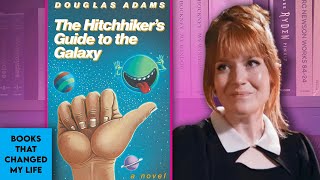
A recorded conversation between Chris Collins and Mercedes Bryce Morgan reflecting on Douglas Adams’s The Hitchhiker’s Guide to the Galaxy. The speakers use the book’s absurdist perspective to discuss adulthood, leadership and collaboration in creative work, the value of questions over definitive answers, and how adopting an outsider/alien viewpoint can deepen storytelling. The transcript includes a verbatim excerpt from the book (the Babel fish/God passage) and a brief plot summary and reaction to the novel’s themes.
Questions this video answers
YouTube video created and uploaded by Chris Collins.
October 8, 2025.
Chapters
This time on books that change my life. So do you think the absurdity of the universe is meant to be an allegory for real life here on Earth?
Yes, I think I find everything absurd. I think that's probably why I said I laugh at horror movies where I think people pretend like when you become an adult, you know what you're doing and then you become an adult and you realize that no one knows what they're doing at all in every sector of life because everyone's doing it for the first time. And you can do something, you can learn a little bit more, but then you'll have a new experience that you don't know. And we love to have answers because it makes us feel very comfortable. But we're just grabbing at what we think is maybe the best answer based on our experience of the world.
How do you approach that internally when you're in a leadership role, like directing? And the absurdity of what you just said, like the contradiction, how do you, how do you like work through that?
I think it's because it's not about the answer. It's about the answer that works best for your life or for the creative project because everything is so unique and different. Like for example, if I'm making a movie, there might be 10 different ways to shoot a scene. But what is what feels best to us for what this is as an overall whole? And it will be its own special thing. Because I don't, I don't necessarily believe in absolute truth, but I believe in doing what's right for other people around you, ethically. And your experience in your life.
Yeah, like even the way you're describing that, you're describing it as a collaboration, not a top down dictatorship. Yeah, you're saying us.
Yeah, because I want to create art that other people can enjoy. And I personally, some people might just create art for themselves and go off. That's amazing. But what I purposely want to do is create it for other people. And I feel like that's what this book did for me. It made me laugh a lot.
Does adopting an alien perspective help artists.
In any ways?
Yeah, I think, I think we have to see things outside of ourself to be able to understand ourselves more or else we kind of become too stuck in our own tunnel vision. And so I think that's very helpful. And I think really good storytellers are able to look at someone different from them and tell a story from their perspective as though it is their own. You don't notice the difference because it feels so true. To the human experience. Yeah.
And kind of the, the disassociation allows you to analyze it in a different way, right?
Yeah, exactly, yeah.
What do you think is more important, the answer or the question?
Definitely the question. The answer is so unsatisfying through and through. But even though I say that I'm still human and I would like a good answer, but I know I'll never get that.
So read that for me.
Okay. The argument goes something like this. I refuse to prove that I exist, says God, for proof denies faith, and without faith I am nothing but says man, the Babel fish is a dead giveaway, isn't it? I could not have evolved by chance. It proves you exist and so therefore, by your own arguments, you don't. Oh dear, says God. I hadn't thought of that. And promptly vanishes in a puff of logic. Oh, that was easy, says man. And for an encore goes on to prove that black is white and gets himself killed on the next pedestrian crossing. Most leading theologians claim that this argument is a load of dingo's kidneys. But that didn't stop Oolong Kulfid making a small fortune when he used it as a central theme of his best selling book. Well, that about wraps it up for God.
Does God exist?
All I can claim is that I don't know anything. So I think that he might exist for some people and I think if that helps them in a way that doesn't hurt people, that's amazing for them. But for me to claim I know anything would kind of be putting myself on too high of a pedestal.
So kind of if somebody hasn't read this, just kind of explain the book as you've experienced it.
So the book is about a simpleton who realizes that his house is going to be bulldozed, but he realizes it's not just for a highway, it's to create an alien hyperpass and Earth is going to be destroyed at the same time. And so he goes on this wild experience quest throughout the galaxy. And meanwhile you learn, you question the purpose of life, the existence of God, the existence of yourself and everything that has ever been, all while trying to find the answer to life, the universe and everything.
And do you ever come to a conclusion?
You learn some answers, but you maybe question whether those answers are satisfactory.
So no.
Yes, but no.
Yeah, well said.
Yeah.
Okay, so the big question, how did the Hitchhiker's Guide to the Galaxy change your life?