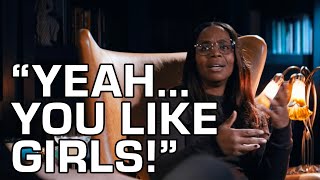
This YouTube interview (by Chris Collins) features Kimberly Ann Harrison describing how reading Roll of Thunder, Hear My Cry in seventh grade—with her teacher Ms. Baker at Lorbear Middle School—connected her to stories her grandmother told about life in Yazoo City/Jackson, Mississippi and shifted how she understood race and family history. The conversation also covers her middle-school social life (sports, popularity), early awareness of same-sex attraction (as early as kindergarten), remaining closeted through adolescence, and later finding representation and freedom upon entering the entertainment industry.
Chapters
This time on books that changed my life. Tell me about.
Your.
Feelings on life in seventh grade.
Yeah, okay, so my feelings on life in seventh grade. It's my first black teacher, my second black teacher.
In middle school and her name is Ms. Baker at Lorbear Middle School. And we're gonna read Roll of Thunderheart my cry. Okay. This is our first kind of. This is my first type of like chapter, chapter type book. Like heavy stuff, but I didn't know that. And living with my grandmother, she told us these exact stories growing up. But as a kid, you don't. You're like, okay, you're making up stuff or okay, whatever. But to pick up a book and literally hear the same type of stories that my grandmothers, you know, was telling me, I'm like, okay, this, this really happened. And it made me look at her through another lens, a different lens. But this book was the first time through the lens of a character in which it's one thing for a 75 year old woman to tell me to, to talk to, talk to, tell me at the time in middle school, like, this is what I went through. But then for someone my age, Cassie, like, you know, our main character in here, to kind of go through it with her and understanding, like, this is exactly what your grandmother went through in Jackson, Mississippi. Cause my family's from Yazoo City in Jackson, Mississippi. So I'm like, this is my. His last name Taylor. I'm like, let me pay attention. Let me just sit up a little bit. And I think my teacher at the time saw that I sat up, you know, a little bit more. But this was like a, this was a big book for me. This truly is the book that changed me.
Okay, but in seventh grade, are you, are you popular?
In seventh grade? I am 100% that basketball girl, that soccer girl.
So sports?
Sports, yes.
So popular.
Popular.
You feel good about life, you feel good about where things are headed.
I am closeted, so everything is great except for.
Do you date boys?
I don't date anyone. Oh, I don't date anyone.
And does anybody ask?
They ask. They ask. It's there, you know, the questions are there like, oh, you're in sport, you know, but you deny, deny. I mean, this is like what, these early 90s.
So. And then there's, you know, nobody around. You got Ellen, you know, but that as far as what I'm seeing, you know, the representation. So it's very kind of like there's a whole part of me that is nobody knows about.
And you knew from kindergarten.
Kindergarten. I Remember standing up on top of that slide in Golden Springs elementary talking about. Yeah, you like girls?
Do you remember the first girl that you.
I sure do. I will not reveal the name, but I do. It was in kindergarten. Long brunette hair. I don't even. Like, maybe it was a hair, but, yeah, I do. I do. But you're still a kid, so you're like. I like you in a way more than a friend.
Yeah.
Because I like these people as friends.
But there's some. There's a magic.
There's some magic there.
Yeah.
Yeah.
But you don't. You don't tell anybody.
No, no. Absolutely not.
When was the first time you told somebody?
I want to say it was probably when I was working on Friends. It was that long? Yeah.
When was your first relationship that you would consider substantial?
I would say substantial. Like in college. In college. I say college, but, like, once I kind of got into the industry and it was no longer Ellen was my only kind of.
Representation that I saw. So it felt like the moment I came in, you know, came into the entertainment industry, I came alive because I was around people that were like me of all different colors, of all that. There was no judgment. There wasn't, you know, so, like, a lot of my freedom came from literally, the show Friends.
So how do you navigate all those expectations in school? Like prom.
I'm a storyteller.
Right, but what is the storyteller situation?
I have a soccer game that weekend. I'm busy. And not even a dress, you know?
Were you just happy to have it off the plate, or did it. Did it bother you?
It didn't bother me at all. I was happy to have it off the plate. No, I'm not. I. Kim will never run to jump in a dress. No, I'm not. I'm not running. So I'm just looking to dodge that.
You know, it wants you dodging. You're good.
Dodged a good. I'm kidding. Yes. Yeah. Yeah.
That's good.
Yeah, yeah, yeah. Save money.
Yeah.
Yeah.
How did you feel about race? In seventh grade?
I was cool. I never have had.
I grew up in Southern California, so it's everybody. It's a melting pot.
You know? But like, that book in particular, I think it was the first time I had to hear this out loud. This was reading out loud with your friends and your peers. And this isn't like a book that you just kind of go home and you can talk to mom and be like, hey, it says this in here, or grandma says, it hits different. It hits different in front of Everyone, you know, and being one of a few black people in that room, you know, in the classroom, and you're reading out loud. When I look back, I'm like, there was a reason Ms. Baker had us read that out loud. You know, everything that was all kind of calculated. And I'll never forget when we got to the first kind of moment where, you know, in the book, Cassie does something and she stands down or, like, one of the big moments where she has to apologize for something that she didn't do. And I will never forget the comment I made. And I was like, I would have told that girl XYZ. And Ms. Baker was like, no, you wouldn't have. Not at that time. You wouldn't have. No, you wouldn't have.
And so that made me go home and ask my grandma, like, so let me ask you a little bit more. So this book actually allowed us to bond in a different way, you know, that we hadn't before.
And you. Yeah, because you understood her. I understood her, yeah.
Through the lens of a. Yeah. I mean, she, like, you know, the opening is, you know, Cassie and her brothers walking to school and having to deal with the white kids on the bus and intentionally, you know, swerving to get mud. My grandmother, every day we had to walk to school from Battle street all the way down Jefferson. And the kids are like, look at all the inns. Look at the little inns walking. I'm like.
That'S so that. I'm like, Grandma. Like, that's what she's like, yeah. Every day. Every day. I'm like, wow. So this became like, this is real. This is real. And a way to engage with my grandmother, besides soap operas in history, in a lived history. And from that moment on, I was just constantly kind of going to her to inquire. I mean, the book takes place in Jackson, Mississippi. My family's from Jackson, Mississippi. Lenny Taylor, my grandmother, Mildred Taylor. I'm like, there's something very special about that book that I always.