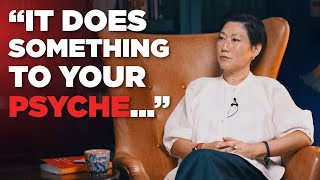
This is a YouTube video titled "https://www.youtube.com/watch?v=t1yUDuPModQ" containing a conversation between two speakers discussing cultural perspectives on patriarchy, gender roles, and family traditions in China and the United States. The dialogue explores topics such as arranged marriages, women's roles, and societal expectations across generations. The content is reflective and informative, focusing on cultural and gender issues.
In here she says for women is yin, she cried sadly. The darkness within where untempered passions lie and man is yang. Bright truth lighting our minds. What is the difference in China with the patriarchy versus here culturally?
I don't really know if there is a difference. I think patriarchy is kind of the constant here, the male. And I'm going to only speak from the Chinese perspective because that's all I know.
Well, Chinese and then a female perspective.
True. So that point in the book and actually all of the mothers immigrant experiences when they were in China, women, and I don't know if you know this, but women when, when young girls were born, they were raised to be married into the husband's family. Once they are married into the family, they are part of the husband's family, never to return to their own. So the daughters are never fully, they never fully belong to the family that they were born into because they're only being taught how to cook, clean, embroider all those things so that they can take them to their husband's family. So the daughters were always seen as almost a burden and a way to trade for a better life. So if you had a daughter that could do all these things and you married her off into a well off family, then your daughter would have, you know, status. And so the men really dominated in how families were perceived and the power that they had over other families and especially over the women. Women were just there to serve the men. And I think, you know, a lot of the hardships that women had to deal with, there's a lot of trauma there. And I think that's what a lot of American women. Now you're talking about the yin and the yang. So okay, now in the Americanized version, men still have that ruling fist. I am the leader of the family and the women still do the caretaking, the nurturing. So there does have to be this balance. And I see it in my parents. You know, my dad's always been the one to work out of the home. My mom is always the one to work in the home. And it has to have that balance to create their marriage of 62 years.
Were your parents marriage arranged?
No.
So in China though, would they be arranged?
Oh, absolutely.
So that's a difference?
Oh, huge difference.
Because if you choose somebody versus.
Of.
Your own choice, I don't know how you're traded. Is it a trade or how does it work?
Essentially, yes. You have what's called a dowry and you can have a goat, a sheep and family jewels that would the daughter would take into that family to increase her value. So in addition to her maybe having the bound feet. Do you know about the bound feet? Kind of, again, that was a way.
That sort of stuff's kind of hard to.
Oh, it's.
It's hard to understand.
It really is. But it was their way of, again, keeping the women in their place. Because you can't walk, forget about running. So the women were really there to just sit and, you know, needlepoint, have the children and carry on the family name with sons. And it's. Yeah, it's hard. My great grandmother had bound feet, and you have to crack the bones. It's torture. And so that really does something to your psyche, you know, where you are meant to be in the family. And so the husbands are strong. They go out and work in the fields. The women stay at home and do the caregiving. It's very clear the roles. So, yes, when you come to the States, it's still that way, but you have more freedoms, obviously, picking who you can marry. My grandparents, grandfather and grandmother were matched, but with the condition that they liked each other. So every generation gets a little bit more looser, I guess, and you start having more choices because they start pushing back and saying, I don't want that. So, you know, my parents were able to choose each other. I was obviously able to choose my partner. And. But I still think that there is that underlying. And it's also society, the patriarch. I mean, now, of course, it's, you know, some men stay at home, some women are in the workforce, But I think in traditional families, it's still the man. You know, we take the man's name, and I think it's, you know, it's still. It's still there, still.