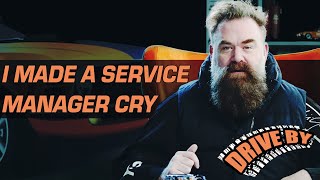
Chris Collins reads his Auto Success article about seven lessons from managing crying employees, including why Emily didn't see termination coming and why service managers hide financial statements. The preview shows how advisor phone attitude and follow-up directly control whether customers return.
Foreign.
Welcome everybody to Service Drive Revolution. This is your Friday Drive by these. We'll be doing these every week. Russo was concerned that people might think Drive by would promote Drive By Shootings. It has nothing to do with that. It's just a little motivational thing on Friday to help your Friday be a little more fun and take you through the weekend. So you're ready to go on Monday when we upload the next edition of the full episode of Service Drive Revolutions. It's something motivational and fun that we'll do. I got approached by Auto Success magazine because they heard about the Service Manager competition and me giving away a Jeep to a service manager and they wanted to be a part of it. And they're very supportive and fun and I thank them for that. And, and they also in the process said, hey, would you write articles for us? Now I've done this before. I did it for Fixed Ops magazine years ago and never really got a lot of feedback. But you know, the way I write and what I do is a little bit different. So they're open to it. They'll let me write what I want, which is, you know, makes it worth it for me. So in the upcoming edition of Auto Success, I have an article in there called the seven Lessons I have Learned from Crying Employees. Please support them, make sure you get the episode when it comes in the mail, and give them lots of love. But I wanted to read this to you, this article and hopefully it'll, it'll motivate you, but also it's a little fun and entertaining I think you will find. So here we go. Seven Lessons I've Learned from Crying Employees. Leadership lessons come flying in like arrows when you're 18 and two weeks into being a lot manager. Emily was 20, hard working, cute and authentic in a way that resonates from the inside out. A little dumpy and disorganized, but never late. She drove the second shuttle for me while on her summer break from college. I borrowed my service manager's office that was in the middle of the write up area but seemed like as private as a basement. From her happy, naive disposition, she clearly had no idea what was coming. As she sat down, I closed both the doors, then sat behind the desk. If given the chance to place a wager on the upcoming events, she might have just as easily bet on getting a raise over getting fired. She cried a lot. I had no clue what to do. My instinct in that moment was to give her a hug while the back of my mind screamed, are you joking? Seriously, you Crashed two shuttle vans and one customer car in a week. I never know what to do when employees cry. I've heard others say no crying in baseball or the classic buck up sport. It's my kryptonite. But it also makes me feel a little manipulated. Lesson number one, no matter how bad someone's performance, they never expect to get fired. Lesson number two, there's no system for dealing with crying. Last year, I had a service manager from the Midwest in my office for a boot camp. At 56, he was similar to General Patton in look, but sweet and eager to learn. He had started out as a tech and worked his way up. He'd been the manager for a little over 20 years, and his dealer had signed him up for our coaching program two months prior. Now, had I known he was going to cry, I would have never put him on the spot by asking him a feeler question. Feeler questions are something I do when I'm teaching complicated things or new things to a group, and I need to get a feel for how they are retaining or processing it. It lets me know if I should hammer that subject more until they understand it or or move on to the next thing. He tried to answer me, but it was instantly evident he was fighting back tears. After unsuccessfully fighting it, he covered his face and through his tears, apologized to the room. If I counted how many times this has happened in a boot camp between myself and my team, it's well over 10. After Patton composed himself, he explained that he never knew his department was losing money. Now he felt like he'd been living a lie. His boss was was always telling him, get me more gross. And what are we going to hit in gross? Or will we hit 500,000 in gross this month, Mike? Yes, sir, we will. Lesson number three. The financial statement shouldn't be a secret. Send your manager to me and I'll train them on it. And how to create fixed absorption. Lesson number four. The goal of business is profit, not gross. In every NAD and NCM composite, I see expenses have outpaced gross the last couple years. When service managers chase gross, they usually chase RO accounts with discounts. It's a recipe for higher losses or lower net to gross 100% of the time. Lesson number five. High fixed absorption is driven by fixed profit, not fixed gross. Lesson number six, you can rarely cut yourself into profitability. You have to know how to sell more per customer. And lesson number seven, I'm 47 and I still don't have a mechanism for handling employees crying.
Now here's a clip from next week's sdr.
Let'S just talk about the things as an advisor, we can control. So can we control how we answer the phone? Yes. Can we answer the phone with a good attitude or a bad attitude? Can we be in a hurry or take our time? Can we show empathy or not? Not care? We can. When a customer comes in, can we let the customer wander around and wonder where to go and who's going to help them? Or can we run out to a car and welcome, how are you doing today? And connect with them and ask them about their kids and their work or whatever it is that matters and really, genuinely make friends with the customer. Do we control that as advice? We do now as advisors. Can we follow up with customers beyond what they expect? Could we call them before they call us? Do we control that or somebody else? Well, where I work at is what they're going to start with. But the phones don't work 100. You can control it. Okay, so if we have a working phone, we can follow up. We could email, text, whatever. We could follow up with customers and exceed their expectations, Right? Could we? Could we? Could, could we? Could we be better than any other advisor that's ever helped him? Could we? Could we greet them, follow up, check history, care about them? Could we treat them now, I know this is crazy. It's crazy. I've been accused of being crazy before. Could we treat them like family? Yes.