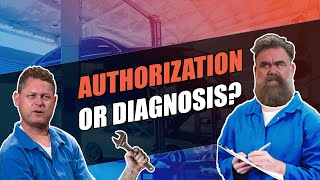
A podcast/video discussion (Chris Collins, Jeremy O'Neal, and a third speaker) debating whether shops should sell 'repair authorization' (a bundled spend authority to allow shops to fix issues without repeated approval) instead of selling diagnostic time. They cover presentation tactics, when repair authorization can backfire, customer trust, examples from independent shops vs dealerships, and an extended case where Jeremy quoted $26,000 for a Ford F350 6.0 Power Stroke with smoking/misfire symptoms and the customer declined. The conversation highlights communication, customer relationship/trust, technician time, callbacks, and shop capacity.
Questions this video answers
Ford F350
6.0 Power Stroke
About 200,000+ miles
$26,000
Mid-50s male, contractor
Chapters
I tried your. Your diagnostic. Sell it as a package. Don't sell Diagnostic Time and repair authorization.
We call it Jeremy. It has a name. Repair authorization.
He doesn't want to give it a name.
You tried it and it worked, right?
Well, if you.
Oh, you're writing it down. So.
Did it work or not?
No.
What happened? Tell me what happened.
It backfired miserably.
So could we acknowledge that it might have been the way you presented it?
I.
It could long term turn out to.
Wait, explain.
Wait, wait, wait. Did you just challenge my presentation skills?
Yes, exactly. How it happened and how you presented it.
I'm not going to remember that, but I'll give you the story behind it.
So female or male customer?
Male customer. Comes how old? I'm going to say mid-50s.
What's he do for a living?
Contractor.
Contractor. Okay, mid-50s contractor. And what kind of car truck?
A Ford F350.
How many miles?
200, some thousand.
So he's a driver?
Yep.
How beat up was it?
No, it looked good from the outside. Okay, So I had 6.0 power stroke.
Helped him before?
No, first time customer.
First time customer.
First time customer.
So he comes in and what's wrong with it?
It's smoking. Has a misfire. And check. Engine light is on.
And this is a Ford.
Yeah.
Your favorite, everybody. If you're new to the show, Jeremy o' Neil is a huge fan of Ford Motor Company.
Yes, I am. I own a lot of their stock. I do not own any of their stock. So he comes and says, hey, can you diagnose my misfire and why my truck's running so bad? And he used the word diagnose. I said, well, sir, here at Freedom Auto Repair, we do things a little bit differently. We're experts at what we do. Let me take a quick look at your truck, and I can probably tell you kind of in a nutshell what it's going to take to get the thing fixed. You are more than getting it fixed rather than the diagnosed. Right. And so he was with me at this point in time. Like I'm leading him down the path. Right. Setting the hook, bringing things along. So with my past experience with 6.0s, my friends out there will know that I've paid a very huge price. I had one 6.0 that cost our shop a ton of money. I will not give you the dollar.
Amount, but that number cost it because we diagnosed it wrong or what?
We just. It was just a long, just messed up repair process. And I put the custom first. So we just paid A large bill on that. So, long story short, I go back to the customer and say, well, you obviously have this issue. This issue and this issue. And typically on these 6.0s, this is what you're looking at doing at this point in time with your mileage, it's best to replace the entire engine. We'll go ahead and I'll give you a price. For a complete running engine with new injectors, new turbo, this and that, you're looking about $26,000. How does that sound?
I can't believe it.
I can't believe it didn't work.
$26,000.
First meet, right? Like, we've never met the guy before. We have no established relationship.
I'm really glad you guys can have fun at my expense.
You Babe Ruth, that you're swinging for the fences. I like that part.
So, first of all, you're like the. You're like the battered. The battered housewife. Like, so, because you guys messed up one before, you're telling this guy he needs everything.
What do you get for 26,000?
A new truck?
No, no, no, no. It's not a new truck.
What is that?
Because the body's going to be just as old truck worth probably 15.
Yeah. So I don't. I.
This.
This scenario might not apply.
What do you mean, this scenario? I thought it applied across the board.
Well, you're. You're going for the. You're going for the throat. Like, that's a oversell at best.
That's not an oversell. I. I can factually back up everything that we quoted there. So keep in mind the. That truck definitely had a bad injector if. And then we also had excessive pressure going into the cooling system, so it had bad head gaskets. And then with the mileage that's on at that point in time, you're looking at pretty much going in and changing everything out to make it reliable.
So I'm a certified interrogator, and I can. I can read below the surface here. I can tell by different things that you're doing, which I won't point out that what you wanted to say, what you meant to say was, I don't want to work on your truck.
Oh, okay. I can agree with that one.
So let. Let's not say the repair authorizations don't work. Let's say that you didn't want to tell the guy that you didn't want to work on his truck because it maybe is a little past what you wanted to endure. You knew that it was going to be a mess. You don't like Fords.
Correct. So you're just saying that.
I have a history with Fords that is sour. You feel like if you replace an injector, that won't fix it in the end and he'll just come back. And so this really is. Is something more psychological on your. It's about you, the customer, not okaying and signing for $26,000.
You know what that reminds me of?
No.
What do you do if you're attacked by a clan of clowns?
What do you do if you're attacked by a clan of clowns?
Do you want to guess or are we just gonna.
I just. I have this visual of clowns out on the bridge, out here walking.
Yeah, happens every other day.
What do you do if you're attacked by a clan of clowns?
Go for the Juggler.
The Juggler clown.
I like that.
Okay. Yeah. Also like in the way you presented it. One thing I would say about repair authorization is you're presenting it like you already diagnosed it and you already know what's wrong with it. The way I would present it is I'm giving myself this amount of money to work with. If it's less, it'll be less. If it's more, I'll let you know.
See, and I'm glad you bring that up because when we shot that initial episode, there was just something in my brain that was just like, okay, so for my independent advisors that are watching the show and listening to this, they're really going to struggle with this because independent shops live in diagnostic land all day long, especially if we're a repair shop. So I've been on both sides, I've been at the dealership and I do agree we get pattern failures there. It's easier to take and put a dollar amount attached to a concern or a code. But in the independent world, it's. There's so many different variables that come in with the age of the cars, past history and all that. So I just want a little bit of clarification on that for the independent advisors out there with repair authorization. So thank you for clearing that up.
Okay, but what, what are we selling?
Peace of mind.
Okay. And so peace of mind comes with a well maintained and operating vehicle.
Yes.
Okay. So we're the ones in, in the scenario that think labor time and parts price.
Yeah. That's the technical side of the repair.
What are customers thinking?
What am I in my car and will it be fixed?
And how much is it and how much is it? Yeah. And so we project our. Our business model on the customer in just about everything we do. And, hey, we. We need an hour to diagnose it, but we're not going to fix it. But we got to call you. But we don't have time to call you because we're so busy. Like, it's a disaster. Like, how far out are you booked in your shop? Like, you were saying earlier that you shut off for a. You don't take appointments for a week every third week.
Correct.
You shut off appointments for a week?
Yes.
Okay, so you're not in. Customers are not in short supply.
No.
Okay. How much time during the day do you guys spend calling and updating? And how many just in. In the time we've hung out together, how many people call you for an update or you're calling them for an update?
Well, we have. I have a great proactive system with that. So realistically, a lot of time is.
Spent communicating with customers.
It's part of the job. I mean, you have to communicate with.
The customers, but once again, they just want it fixed.
Correct.
And so if you gave yourself not 26,000, but you give yourself a little bit to work with, it would save the phone calls, the back and forth. And it also gives your technician more time. It will cut down on comebacks, too, because how many times you put in an injector, then test drive it, and it's something else, and the customer's like, oh, no, I thought it was just the injector.
I understand that. I. And you.
You got this. You got the. The outcome you wanted here. But sometimes the customer saying, no, I'm gonna take it is. Is I'm just figuring out.
So If I had 12 of those come in and I could close for them, that's my monthly sales number in four cars. I could work on four cars a month and be totally happy.
Yeah.
I think that the thing that we know about this is it's gonna come back.
Oh, goodness.
Oh, my gosh.
I think, too, with repair authorization, one thing that maybe we didn't talk about as much as we should is that the first thing on this is the trust part. Like, you have to have a relationship built, and you have to have that confidence, and the client has to have confidence in you that you're trustworthy of, that you'll take care of their $2,500 budget. That goes first. You have to connect with the customer on the deep level. It's not necessarily something I do right out of the gate on the first customer when I've never met them before. I want to do it with someone that. That we've got a dialogue established. So I think that establish first and then kind of play the.
Why did you even take the appointment if you don't want to work on Fords?
I. I do want to work on Fords.
No, you clearly don't.
No, I do. They're our second car line out of the top five that we work on.
What's the top one?
Chrysler.
So Chevy is third.
Chevy's third.
Where's Dodge?
Chrysler. That's all in Chrysler number one. Yeah. So Chrysler, Dodge, Jeep number one, Ford number two, GM number three, Toyota number four, Honda number five. And bringing up the number six spot is Kia and Hyundai.
Thank you so much for watching this clip of Service Drive Revolution. Now you can catch the full episode on YouTube, iTunes, or Spotify or wherever you consume your podcast. If you have any questions, go ahead and post them in the comments below. Make sure you subscribe and hit the bell icon so you're notified when we post new episodes. I'm Chris Collins and you can find me on Facebook and Instagram @chrisbulldog Collins and I'll see you again on the next episode.