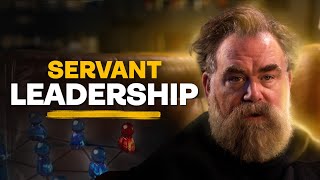
Chris Collins, in a short YouTube segment titled 'Leadership Therapy: Servant Leadership,' critiques the notion of 'servant leadership.' He argues the label is sentimental ('like a Hallmark card') and misleading: leaders should serve the mission, not be servants to their team. Collins emphasizes leaders must work harder, set example, build culture, and focus on mission and strategy rather than adopting a 'leaders eat last' servant posture.
Chapters
Barry, book number 5596, Servant Leadership. I'm reading about the principle now and very intrigued by the concept of giving more in order to expect more from my team.
This is leadership therapy. I'm Chris Collins. I am not a licensed therapist, but I do know a lot about leadership. And I wrote a book called I Am Leader, and I've fixed a lot of businesses. And when somebody gets the IAM leader book and activates it with this little QR code, put your phone up there. You ever done that? And you.
You get access to an app that has leadership training in there. We have the 17 laws, all kinds of videos. I go through the books in, in detail. But more importantly, there's a community in there where we ask questions, we have discussions, and every Sunday we meet and kind of talk about what's going on and different aspects of leadership. And so Barry here has a pretty good question. Servant leadership. So.
I always hesitate to tell people what. I really have experience with this, but I, I think the term servant leadership is like Hallmark card. Like, it makes the person saying it feel good, but I don't really understand what that means. In a sense, if you're the leader, you're not the servant. You're the leader. Like, we, we dumb down leadership to the point where it's not. It's not even management anymore. Like.
Yes, you have to work harder than everybody else. That's what makes you the leader. But that doesn't make you a servant. And if you're serving anything, you're serving the mission, not the people. Now, you need to develop people. You need to surround yourself with good people. You need to create an atmosphere and a culture that people want to buy into the mission you're going on. And there's a lot of reward in that. Collaboration with other people and seeing people grow and seeing people become leaders on their own. But you're the leader. You're not the servant. You're just not. I don't, I don't understand. That doesn't make any sense to me. Like, the, you know, once again, these, these people are very nice, and I'm not throwing shade at anybody. But servant leadership, the leaders eat last. Like, all that is. It's how you want to feel. It's not leadership. I've. I've never, I've never worked with a. A really effective leader. And they were talking about servant leadership. They were talking about the, the mission, the strategy, and how can we get better people to go on this mission with us. And they were working really, really hard. They were very engaged, and they were very smart and talented. And the idea that you're working harder than everybody else doesn't make you the servant. It makes you the leader. So.
Yeah, I hate to say that Santa isn't real, but to me.
I don't. It's a contradiction. It's like the.
The sober alcoholic or whatever. It doesn't. Doesn't make any sense. Like, you're the leader. Stop. You don't need to make excuses for that. Step into it. Be. Be the example. Be the one that everybody wants. Have the energy and charisma that people want to be around and.