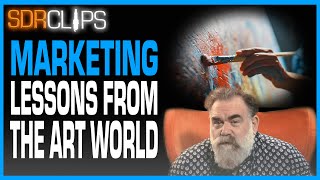
This YouTube interview (Service Driver Revolution / Chris Collins) uses the speaker's art-world experience—notably as a ‘bulldog artist’ with gallery shows and a Howard Stern tie-in—to draw marketing lessons for businesses. Key takeaways: choose a clear niche, deeply understand your customer, and prioritize marketing (especially when scaling). The show itself functions as a primary marketing channel; closing includes CTAs and contact/offers information.
Questions this video answers
8333 Ask SDR
offers.chriscollinsinc.com
Chapters
What lessons did you learn from your time in the art world?
Oh, in the art world, yes, because.
It'S definitely its own thing.
So, yeah, people probably don't know that for a while. Even when I was doing this, I was doing bulldog paintings, and I was in a bunch of galleries.
I had a couple art shows. I was on Howard Stern because I was the official artist of Beth Stern's bulldog rescue event. I think I did that a couple times.
And it got to the point where the art was.
Becoming a job in the sense that people were depending on it. I had, you know, deadlines, and I had galleries that were giving, you know, that were giving me space in their galleries, and they would. The thing that would sell the most was commission. So I would go into a weekend and have two or three commissions.
And it just, you know, it just wasn't fun. And I wasn't gonna. I wasn't gonna scale that at the time. Just kind of would have had to have committed to it to make it go.
And I just enjoyed it more as a fun thing. I didn't really ever think of it as a career.
Actually.
Looking back on that, I don't know if that.
Was the right decision. I'm not sure. But what did I learn from it?
Yeah.
Well, one thing is that marketing.
Is probably the most important thing in the sense that I was, you know, I was doing a niche, and it was bulldogs, and I was the bulldog artist. And, like, even the Wall Street Journal did a piece on me, and the guy asked me, like, oh, would you paint my lab? And I'm like, I only paint bulldogs. And he's like, for any amount of money, would you paint a lab? And kind of, like, as a joke, said, no. But that kind of became the thing. Like, I was the guy that just painted bulldogs, and, you know, they were happy and kind of fun. They were easy to look at and digest and poppy, you know. And so.
I think it's the same thing with. With dealerships or service departments or anything is like, you know, you want a niche and really understand your customer. But if you have a Subaru, you know, like, the best thing to do with a Subaru service drive is put in a dog wash, because they all have dogs. Or if you have a Jeep dealership, you want to. You know, you want to accessorize and have tons of options around for them to personalize and that sort of thing. So really understanding your client and then marketing to them and marketing becomes the most important thing, because many times, like, I was keenly aware that I Wasn't the best artist, but I was selling way more than artists that were better than me because I understood marketing.
Yeah. That's good. Well, I think that the Stern thing was a huge propeller for you. Yeah.
But I manufactured that.
Yeah. That you recognize that Beth was a way to get more publicity. And being in galleries in New York would make sense for an artist.
Yeah. And the, you know, the thing they wanted to do with me next, because I was in galleries like Florida, New York, Denver, like more kind of Hawaii, more like.
Kind of tourist series or whatever, the one thing that everybody on my team believed is that I would sell a lot more in Japan and. And in Germany, and they wanted me to open galleries there. And that would have been the next thing was for me to open my own galleries, too.
But, yeah, marketing, I think, in a sense, is maybe one of the most important skills. Knowing who your client is and then going right after it. Yeah.
The more you do this and the more you get to see more businesses. Is there one that you found yet? That marketing isn't the linchpin?
If you think about business in the sense that what business is ultimately is solving a problem. No matter how big the problem is, you solve most of the time, you can't scale a business. Just word of mouth. So you're gonna have to have.
Some sort of ability to market. Like, word of mouth is. Okay. Like, for example, our company. Right. We. We were word of mouth for a long time because we couldn't handle the volume.
That's right.
But when you start to scale, then marketing becomes more important. And in a sense, our best marketing is a show.
Yeah. It's got the furthest reach.
Yeah. But it's marketing. Like, we are having a conversation with.
Our friends, but.
They let us, you know, they let us know, too. If we get off too far from what they want or whatever, we pay attention to that.
Yeah. It's almost instant feedback in a certain way. And I think that the marketing team is doing a good job of deciphering that feedback because it's not direct. Like, that sucked. Right. So there's other things that the marketing team looks at. I think it's fascinating. But I would say that one thing that I'm learning from you and from just the business itself is that marketing is becoming more and more prevalent.
Thanks so much for watching this clip of Service Driver Revolution Soon. We're uploading new stuff every day, so make sure you subscribe and click the bell icon so you don't miss out. If you have a question, you'd like us to answer on the show. Call 8333 Ask SDR and we'll answer your question on the show. That's 8333 Ask SDR. For special deals on our books and training, head over to offers.chriscollinsinc.com now that's offers.chriscollinsInc.com I'm Chris Collins and I'll see.