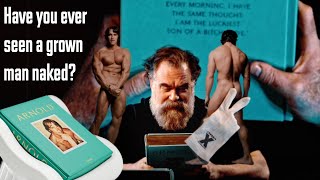
Chris Collins reviews the oversized Taschen monograph on Arnold Schwarzenegger in a YouTube unboxing/review format. He describes the physical package (large signed volume #93/100, stand, signed Annie Leibovitz life-size print, and a smaller companion book) and praises the design (teal cover, gold lettering). Collins outlines the book's four thematic sections—bodybuilder/athlete, actor, American (politics), and activist—highlights notable photographer contributions (Annie Leibovitz, Platon), quotes a few lines printed in the book, and strongly recommends it as a holiday gift.
Have you ever seen a grown man naked? I just did. This is a very big book for a very big man. Arnold's from Taschen, and it's our newest addition to the library.
What we have here in front of us is most of what comes with this. So we have the stand that you saw, and it also comes with a life size print of this image of Arnold skiing by Annie Leibowitz. This smaller book is actually a book, and we'll go through that in a minute. But this is more about the story. But what's really special about this bigger one. If you can imagine, Arnold Schwarzenegger was born in 1947. So he's knocking on 80 years old. If you think about Arnold starting off as a bodybuilder and then becoming an actor and a politician, he has been photographed by some of the best photographers in the world. This is number 93 of 100, signed by Arnold. The print is signed by Annie Leibowitz.
Dedicated to his children. This kind of Tiffany teal blue color is amazing. Probably does not show up on camera as well as it does in person, but it is stunning. And the gold letters really, really pop. Tasha and I had a launch party for this book that we were invited to and attended. And Diane Hansen, who's the editor, interviewed Arnold on stage. She was saying that it took over 10 years just to get the rights to a lot of the images that are in here because different photographers had different access points, some had passed away. Diane is incredibly talented. And part of the reason why some of these Taschen books are so special. It is broken down into four different sections. The first one is him as an athlete or a bodybuilder. Then an actor, then an American, and then an activist. The American section is is politics. Arnold's first quote here is the worst thing I can be is the same as everyone else. I definitely feel that. And it resonates with me. At the beginning of this, I made the joke, have you ever seen a grown man naked? Arnold's naked in here. But we're not going to. We're not going to show you that. My favorite section in here is the section on politics. It starts right here with this image that's very pop arty, the American flag behind him. Then there's a Platon picture here. You can kind of see we have a couple books by him here in the library. And he just has a very distinct style where his portraits are very, very up close. And then in the activist section, this image, this reminds me a little bit of Marcel Duchamp's. Self portrait. It's more about what isn't there than what is there. Now, let's look at the smaller one. There's images in here that aren't in the. The bigger one. Quite a few, actually. But this is more in the style of the book where you go through the story basically of his life up until now. The. The quote on the back of this is, when I wake up every morning, I have the same thought. I am the luckiest son of a bitch alive. The holidays are coming up, and I would highly, highly recommend that you either tell Santa that you want this book or you are Santa and you gift this book.
We supported Arnold when he ran for governor. And I felt like he was a really good politician. He was business friendly, had empathy, a lot of common sense. Arnold maybe was kind of the last good governor California ever had, one that really believed in the American dream and that if you work hard, you can succeed. So let's. Let's think about this for a second and kind of unpack it. Look at this image here of arnold, born in 1947, coming out of World War II. He's in Austria, which was on the losing side of that war. He's dealing with an older generation that has a lot of guilt. Pretty, pretty bleak. One of Arnold's favorite books, and one he has quoted often, is JFK's Profiles in Courage. So JFK wrote this when he was in the Senate. It's just profiles of different people that showed courage. And if you think about Arnold in the sense that he was born into a situation that wasn't ideal, he came to America with a gym bag and a dream for what was possible. The difference between Arnold was his work ethic. It was his vision. Nobody saw him as an actor. Nobody thought he could be governor, but he believed in himself, and it did happen. And so it really is about how you see yourself. Anybody can come here and. And if you work hard and you have a certain sense of vision and you work towards it, you can make something special of yourself. So incredible execution on Pashan's part. And we are excited to have this as a piece of the library.