My Top 7 Books of All Time
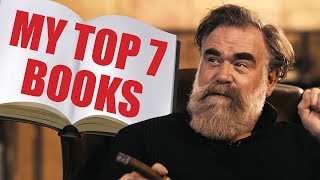
Chris Collins introduces the Video Syndicate X library and walks viewers through his top seven books, explaining why each influenced him. He frames the channel as focused on books (plus related lifestyle topics) and offers personal anecdotes and recommendations for experiencing the works (e.g., listening on Audible, watching related YouTube content). The seven books named in this chunk are: Created Equal (Mark Lyta), Sing Backwards and Weep (Mark Lanegan—referred to as Mark), Interaction of Color (Josef Albers), How to Win Friends and Influence People (Dale Carnegie), Maps of Meaning (Jordan Peterson), The Holy Bible (David Hammons — an art object), and For the Blind Man in a Dark Room Looking for a Black Cat That Isn't There (Anthony Huberman).
Chapters
Foreign.
So I've heard that if you have two books, you have a personal library. I just happen to have over 25,000 books and I want to show it to you. And I'm going to go over my top seven books of all time. So come on in. Sam.
Welcome. This is the first Video Syndicate X library. The goal of this channel is to pass along information that we learn from books to recommend books and also share some lifestyle things like music, vinyl, tequila, cigars. But the heart and soul of this channel is going to be books. This channel is about sharing the information in books that have made an impact on me, that have changed my life, and hopefully starting a conversation with with you. The list that we're going to go through today, the top seven, these are my favorite books. This list is about kind of giving you a little insight into who I am and I'm going to share why they've had an impact on me. Let's get started.
Mark Lyta Created Equal. I first learned about mark with his YouTube channel, Soft White Underbelly. It's. It's a lot to take in, but his book is connected to that. You can tell that he very early on was interested in human behavior and why people are the way that they are with a ton of empathy and compassion. Because what he does on that channel is he interviews people and oftentimes they're pimps, their hookers, their white supremacists, people that we might consider extreme in their lifestyles or their behaviors. One of the biggest takeaways and lessons for me is we're not much different. We're really not. When, when you watch somebody who's a, who's a pimp or somebody who's a prostitute, you start to see that we're not that much different. And maybe a couple of those things in their story that happened to them in their childhood or if we had the same parents they had, I don't know that you can say we wouldn't have turned out different. I would encourage you to go watch Soft White Underbelly to subscribe to Mark's apps and support him. He's showing a lot of empathy and humanity that I think we all could learn from.
Foreign.
Sing Backwards and Weep. If you're familiar with Mark's work, he was the singer for the Screaming Trees. He's put out a bunch of incredible solo projects. The. The list of music that he's created is second to none. The writing that Mark does in this book, the closest thing I can say is it's like Bukowski but he goes through kind of his early music career in his drug addiction, and it kind of ends with him in rehab. You would never do heroin after reading this book. But it is an incredible piece of art. He is an incredible storyteller. And it's on audible, and Mark reads it, and that might be the best way to experience it. Maybe the saddest part about this is that Mark passed away a couple years ago, and we won't get any other books.
Albert's Interaction of Color. I stumbled on this book when I was studying color to try to get better with my paintings. Come to find out, Albert's came over from Germany during World War II in England, ended up teaching at Yale for a couple of years. His gift to the students into Yale was this book. It's way more about the psychology of color than it is color itself. He wanted students to understand, like, how do you make three colors look like two? How do colors interact? He used to do this with his students where he would put a red Coke can, and he would ask everybody to study the red. The Coke red. It's a famous red, right? And then he would take the can away and he would put up 12 different reds, and he would ask the students to pick the red that was the Coke can. People couldn't get it right. And the lesson was that we all experience color different. The distance, the lighting, all of it has an influence in how we interact and perceive color. We all think that we see red the same. We think that the red that I see is the same red that you see. But that's just not the truth. And that's why I have the book in Psychology.
Dale Carnegie, how to Win Friends and Influence People. So in my early 20s, I took a position with a consulting company. So I moved from Seattle to Portland. I had relocated. I was working really, really hard, trying to make something of myself. The company that I was working for had promised me a bunch of things that didn't come true. And I was having a hard time because I wasn't making friends. I didn't have a lot of friends. And sometimes, you know how things just kind of happen, like they're mental to be, or. I. I don't know. I don't know why I bought that book. I didn't really even have that much money. I was kind of broke at the time, but I did. And I just, right there on a bench, started reading it. And I mean, the whole book is really just stories about different situations. But by the end of it, I was crying. Like I was the Problem. I saw everything from my point of view, and I wasn't seeing it from others point of view. Years later, I made a required reading. When I was running this business, I had like 420 employees. I made it required reading for all new employees, which was a hard thing to execute. HR would give people the book, and then I would ask them, like, you know, what they learned from the book. And of course, varying degrees of participation. But I remember one time the HR department was out of the books and kind of, to me, make a point. I said, well, I'll pick up some more of them on my way home. And I went to the Borders in Orange county and they have a handful of them. I grabbed them. I'm waiting in line. I go up to the front and the cashier there was a younger kid. He had the plugs, you know, that stretch your ear. He had a nose ring. He had a mohawk. He's checking me out. And he goes, I read this book pretty good. And I go, oh, really? He goes, you just got to realize one thing. Thing. Everybody's walking around with a big me on their forehead. And that's really the truth. Everybody's walking around with a big me on their forehead. And if you want to make friends and you want to influence people, you got to forget about your me and you got to focus on their me.
Jordan Peterson, Maps of Meaning. I have a really soft spot for Jordan Peterson. I feel like he's the father figure I never had. When people say things about him that are derogatory or kind of judgmental, I. I feel like they are paying attention to what he's saying because he's so sweet and so thoughtful in what he says, but Maps of Meaning. I got this book before Jordan was. Was famous. I don't know how I landed on it. Now, in hindsight, because this is the first edition of the book when he was still at Harvard, I think there aren't that many of this book in circulation. I highlighted all over the thing and wrote notes in it. But, I mean, it is my personal book and I love it. It's a dense book. I would encourage everybody to pick it up. It starts off talking about culture in business. Culture is the most misunderstood thing because we think culture is. Why aren't my employees happy? That isn't what culture is. Culture is about law and order and structure. It's an incredible book and my favorite book that Jordan does. I owe a lot to him, not just because of this book, but because of his videos. He's put his maps of meaning course from Harvard and from Toronto, up on YouTube. You can watch it. He's a beautiful human being, and we are lucky to have him in this time.
The Holy Bible by David Hammons. You ask people, who's the most influential artist in the last hundred years? Consumers are going to say Picasso, but artists are going to probably say Marcel Duchamp. Duchamp, in his lifetime, didn't create a lot of art, but he influenced a lot of artists. And so an example would be in New York. There was a show, an art show, where you could pay to enter your art, and the art would be shown to anybody who came. The spirit was, anybody can enter this. There's no judgment, there's no prize. People are gonna come see it and let the public kind of determine the value or importance of the art. And a bunch of artists were going to enter it. And Duchamp said, oh, it's really not that there is judgment. There is a jury. He said, I'll prove it to you. So he goes to the hardware store and he buys a urinal. He signs it Armut and enters it into the show, pays the fee and calls it a fountain. Guess what? They didn't show it. The point that Duchamp ended up making from that was, listen, I'm the artist. If I put something in an art show or in an art gallery, and you come to that art gallery, to that art show, you are by default forced to see it as art. And, you know, famously, Jeff Koons with his Hoover vacuum cleaners and Andy Warhol, I mean, there's so many artists who were given the freedom and the liberty to create art. Duchamp had a huge effect. David, in this book, as a tribute to Duchamp, he took the book that has all of Duchamp's artwork in it and then recovered them and put a really cool leather cover on it that says the Holy Bible. The idea behind that, the execution of that, it's genius.
For the blind man in a dark room Looking for a Black Cat that isn't there by Anthony Huberman. I was at Arcana Books one day, and Lee, the owner, was talking to me, and I said, lee, like, what's new and interesting? Or. And he goes, you know, I don't know if you would like it, but there's this one book. I really bought it on a leap of faith, Lee's recommendation, because I didn't get it in the moment because it wasn't like a normal book. And I started reading it, and, I mean, first of all, the message in the book is the idea that at the end of the day, the blind man might have the advantage over the rest of us that can see. And the reason why is because the blind man is putting in the work. Because they have to really apply themselves to a situation that is 10 times the work as it is, if you can just see, and that in the end gives them a broader understanding of what. What the situation really is. Then let's talk about the execution of this book. The design of the book is incredible. Now, Anthony is not an author. He has written a few books and curated a few books, but he's a curator. That's. That's his career. So this book is more of a piece of art than it is a book that you would put out to publish. And sometimes I give this book to people that I really care about or I think would experience it in the way that I did, and it makes them stop for a second and think about what a book really is, how a book communicates, how a book is designed, how you experience a book, how you interact with the book. And for that reason, it's my. It's my number one. It's. It's beautiful, well executed, incredible content. Not like anything else you would say. See, like, I don't think there's another book out there that is like this. So it's my number one. Welcome to the Syndicate X Library Channel.







