ND Stevenson on the Monster Blood Tattoo Trilogy
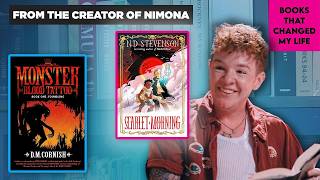
YouTube interview (Chris Collins hosts) with ND Stevenson about books that changed his life, focusing on D.M. Cornish's Monster Blood Tattoo trilogy. Stevenson recounts growing up homeschooled in South Carolina, early storytelling and illustration, discovering the trilogy around age 15, and how its worldbuilding, monster themes, and authorial path (blog, sketches → publication) inspired his own work (comics, Nimona, Scarlet Morning). The conversation covers faith and leaving the church, empathy for "monsters," mentor/mentee dynamics, Stevenson’s creative rituals (playlists, blackout curtains, tea/coffee, cocktail), and a brief walkthrough of passages from Monster Blood Tattoo (e.g., opening line about Rosamund). Format: recorded interview/transcript with read-aloud passages and host prompts.
Chapters
This time on books that changed my life.
Ottoman was a boy with a girl's name.
What do you think about that?
Well, now that you mention it. What makes something monstrous? What makes us repulsed by something? Is that a way that we should be feeling or is that something that needs to be explored? I always related to villains and monsters because I felt really out of place. Felt out of place in South Carolina. I was like the only girl with a buzz cut. You know, the first time I broke down crying because in my heart I was wor. I didn't really believe in Jesus. I was six years old.
Have you ever thought about how that experience affected your storytelling?
That is really central, I think, to every story I've ever told. They've taught you to divide and conquer two. I see. Rule by division, divide by rules. The everyman creed.
The big question, how did Monster Blood Tattoo by DM Cornish change your life?
This was the book that.
Foreign.
Welcome to the Syndicate X library where we love books, especially books that have changed lives. Today we are joined by a multi talented guest author and illustrator, co producer of the Oscar nominated adaptation of Nimona, as well as a showrunner on Netflix, She Ra and the Princess of Power. And most recently, the author and illustrator this gem, Scarlet Morning. And joining us to talk about a book that changed his life, Monster Blood Tattoo Trilogy by D.M. cornish. We are so excited to announce the books that Change My Life website. We made a way for you to show your book pride and that you love books. Hats, tees, hoodies. Check it out. Link in the description. Everybody needs a self help hat.
Please welcome Indy Stevenson. What do you think of the library?
Oh, it's all right.
It's stunning. I like really wish I had just an entire day to just poke around in here. Your, your collection is out of this world.
You're always welcome to come and just hang out. It's a better experience than alone.
Just, just sneak in after hours and just spend the night.
I know just during the day like just because it isn't set up like this during the, during a normal day. So.
Yeah, all right, I'm taking you up on that. You're going to regret it.
No, there's nothing better than having people experience it and enjoy it and you know, and use it as inspiration too.
It's incredible.
Ordered a mimosa and then we have a little, a little gift bag for you too.
Oh gosh, y' all are so fun.
So we're, we're doing our own like library merch so you can.
Fiction. I love it. It matches my shirt.
That sucks.
Oh, my God.
Fun, right?
This is great. Thank you so much.
We're trying to have fun with books.
Thank you so much for the goodies.
Lynette says there's always room for one more book.
I'm going to get so much wear out of these.
Those are the most popular.
I'm going on book tour in, like, two weeks, and these are coming with me.
Awesome.
Thank you so much.
Man, this smells good.
Presents.
Cheers.
Cheers to you. Thank you so much for having me.
Oh, thanks for coming.
Before we get to the book, let's just kind of give it context of time. Where did you grow up?
I grew up in South Carolina.
South Carolina. And what did your parents do?
My. My mom was a stay at home mom. My dad was in advertising, so he did local billboards, like in our city.
Oh, wow. So was he into. Was he the design or selling them or which part?
He started his own company. Later. He'd actually hire my mom, and then she fired him and she became the CEO of the company. And they all work there together now.
What a power move.
Did she demote him or kick him out?
She sort of. She came in and, like, transformed the business. So he still works there. He just is more in the, like, front facing side. They work closely together. Yeah. But it's become a family business.
And do you have siblings?
I do. I'm one of five.
And where are you in the order?
Dead center.
Dead center?
Yep.
Middle child.
And it's very symmetrical. I've got, like, older brother, older sister, me, little sister, little brother. I'm like, perfectly bookended. And then me, whatever. You know, I had to shake things up a little bit when it came to the gender side.
Why were you homeschooled? Was that just a thing that your parents thought was important?
It was, yeah. I mean, growing up.
My family has changed a lot since then, but we were very, very conservative and very religious, and so there was a lot. There was a pretty big homeschool movement, probably still is in South Carolina. So we were quite. We were part of quite a large group, but it was very much about, like, you know, in public school. They'll teach us evolution. They'll teach us things that aren't biblical. And so the idea was sort of, you know, kind of raising this army of, like, God warriors in exactly the way that you wanted them raised and not really, like, letting anyone else have that input. So that, I think, was the idea behind it. So we were, yeah, like, very, very fundamental.
But church three times a week, kind of A thing.
Yeah, we were there all the time.
But honestly, in lots of ways, I still really loved being a homeschooler. Like, I got really good at finishing my work quickly, and then I could kind of do whatever I wanted. And so that gave me time for, like, imagination play, and eventually for writing the first draft of what would go on to be scar. I was, you know, I could just go and, like, write in my spare time. So.
You know, it really had its ups and downs. There's a lot of things looking back now that, you know, it was like, wow, I can't even believe that that happened. But in lots of other ways, I kind of liked it too. Like, it worked for me.
Yeah, it's interesting kind of looking back, Right. Like, you can see it for what it is, but there's good with the bad. And like, I was. So I was homeschooled until third grade, but I drove my mom crazy, and I was a pastor's kid, and my parents were missionary, so I was pkmk.
Yeah.
And same sort of thing. I wasn't allowed to watch tv. I couldn't listen to music. Like, it was very, very strict.
Where were you homeschooled?
We lived in an Airstream trailer in Mexico.
Oh, wow.
So it was in the trailer. This is why I drove my mom crazy. You know, just all this. All this energy.
Yeah.
Nowhere to go. Yeah. So in third grade, they were over, and then they put me in a Christian school, which wasn't much different than homeschooling, except you were with other kids, but you still didn't have, like, the.
Sort of things that you would have in a. In a public school, like gym and art, and none of that existed. It was just the basic subjects.
Yeah. Yeah. That was very similar to white. We had sort of like a coalition of homeschoolers. We met once a week in person. So it's a little bit like a school, but it was a lot of electives that it'd just be the parents teaching. So they teach art and drama and creative writing, and that's where I got a lot of my artistic training. But I really didn't have.
Any formal training at all until I applied for art school after high school. Yeah, public school was really my first foray, really any kind of consistent art education. And so was that.
So I was. I went to public school for the first time in ninth grade. Was it close to that for you, or was it.
I was 11th.
11Th.
I grade. And so, yeah, I did junior and senior year of public school.
So the very end so, yeah, I had four years of it, I guess.
Yeah. So that change is, like. I kind of understand that. Like. Like, you know, the thing that stuck out to me the most is. Is having gym class and being naked in front of everybody was the OD thing, because I'd never experienced that until then. And, you know, that's at the time when, like, you know, your hormones are the. It's just like, you know, you're trying to figure things out. And that was the.
You know, I don't know, the hardest part, I guess, or the weirdest part.
Yeah, I think I didn't have to take gym class. I don't know if that's, like, normal for, you know, upper high schoolers or not. I didn't have to do it. It still is, like, wild to me when I hear about. Doesn't sound real. It sounds kind of fake. Or my friends will be like, I was, like, bullied. I was, like, pushed into a locker. And I was like, in real life, I thought that just happened in movies. You can't. Like, that really happened to people. So still, in a lot of ways, I kind of, like, missed a lot of maybe the classic high school experience.
So what kind of kid were you?
I was. You know, storytelling was kind of the entire centerpiece of my childhood and, you know, my personality, like I said, I was really imaginative. I think storytelling was really the way that I, like, bonded with other kids or it became my social currency. I would try and suck people into these games, imagination games that I was playing, or I would just tell them a story. One of my best friends, we were at some swim meet or other, and I wasn't swimming because I was a terrible swimmer. And I found this little patch of grass. I just started walking around in circles and kind of whispering to myself, some story. And I had never met her before in my life, but she saw me doing that, came over, started walking around in a circle with me. What are you doing? And I just started telling her the story that I'd been telling myself. And that ended. We ended up becoming best friends. She ended up being, you know, a big influence on Scarlet Morning, on this book that I would go on to write years later. But that was kind of how I. That was how I made friends. That was how I reached out to people. And I would kind of, like, you know, like, you know, I'm playing this game. I'll write you a part. I'll give you a name, and you can do this. You're the person who does this. And then. And I would Just do that whenever I could, however I could. I was really unselfconscious about it. I think that that was one of the things I liked about being homeschooled is that I kind of did have this sort. It was awkward, but it was also just, you know, I'd never been shoved into a locker. I just, you know, I didn't really question any of these things or if what I was doing was weird or if I stuck out. I didn't really care.
So you didn't have fear?
Not in that way. I think not till later. Now I do. But at the time it was very, you know, I didn't really care if I looked strange. I wasn't. I didn't feel like I was in the same world as everywhere else, as everyone else was. I was in my own world.
Why do you have fear now?
Oh, I just.
It caught up with me. I think eventually I realized I was like. Oh. I don't know if it was the years spent at home during the pandemic, like not socializing as much or what it was, but like, yeah, no, it caught up with me eventually. I don't know if I can tell you why, but.
I guess sooner. I've still never been shoved into a locker, but maybe I've been shoved into lockers by life a little bit more now.
So is it fear of other people's opinions?
My theory is that there's a bit more self consciousness from everyone, from all of us together. Part of it is that surveillance has increased so much in the world. So like the other day I was taking out the trash and I fell down. I did this like hilarious pratfall down the, down the driveway. There's a big slope in our driveway. And I like flipped over the trash can and I was like. My first thought wasn't that I was hurt, it was that what if someone's ring doorbell caught me and I end up a meme on TikTok. And I never thought about that kind of thing before, you know. So like now I think we explained, expect to sort of be filmed everywhere we go. We worry about being in the background of someone's, you know, video. It's just something. Even as I walk past my. My desktop computer, I sort of wonder, like, I think about all the Zoom meetings and like, did I leave the camera on? Is someone watching me right now? Maybe that's just me or maybe that is something that's like increased overall, but I think it's maybe a little bit of both. I think just the fact that we all Expect to be watched a little bit more now.
That's my theory.
Yeah. That is uncomfortable. I don't. Do you think that there's a way to get that back?
I hope so.
Yeah.
Yeah, I hope so. I think it's a lot of, like, exposure therapy of just trying to, like, you know, in lots of ways. As a kid, I wound up being one of five. I had so little time for myself. I. I never had my own room. There was nowhere I could go to be alone. And I always dreamed one of my big fantasies was having this perfect room in my head that I could crawl into, and time would stop and I could just be there by myself, and it would be full of bean bags, and it would have, you know, like, a swimming pool. All my favorite things would be there. And now as an adult, I don't have a swimming pool, and I don't have that many beanbags. But I do have a room that only has things that I like in it. It has my books. It has my reading chair. It has everything that is mine, only my favorite things. And I can spend as much time as I want in there. And I think if I'd been a kid, I would have. I would have never left because I did really want that time to just kind of hold myself up and be with my books and write and play neopets at the time. But I think it was being forced to go out. My parents also were always traveling and took us along to all these places that now I can really appreciate. At the time, not so much. So now I have to be the one doing that. I have to be the one being like, no, we're going. We're saying yes to this. We're going out to see friends. I'm gonna fly to that international book festival. We are going to do the things that, like, maybe I'd rather just stay at home under my blanket reading, but we're going out. So a lot of that is the way that I'm like, I have to be my own parents. Kind of like pushing myself out of the nest.
And in a sense, like, are you thinking during those types of situations that like it. It's uncomfortable now, but I'll feel better after I do it.
Absolutely.
Yeah.
Yeah.
Do the same thing.
Yeah. And I think there's a balance. There are times where I'm like, I don't have the social battery. I'm gonna stay in tonight. And I'm, like, trying to give myself grace with that, too, because it is fine. It is fine to, like. I think it's the first time I've been able to indulge my more introverted tendencies. My whole life has been kind of like. I ran a show for five years.
The only time I wasn't talking to people was when I was asleep. And now it's kind of like, you know, a process of being like, all right. No, it is okay to kind of just like, spend the day being quiet. And I've wanted to read this book. I'm gonna sit and read this book. I don't really think that it's. I don't think that itself is the problem. It's being. It's making sure that I'm not missing out on things that I'm gonna really regret missing out on.
Yeah. Makes sense. And so you're. You're 15 when this book comes into your view? I guess we would say. Who introduced you to it?
No one introduced me to it. I. I was such a voracious reader. I was. I was burning through so many books that I pretty much read everything, at least in, like, the kid and young adult section. And so this was one that I just, you know, I was. I was. I really loved spending time in bookstores. And a lot of that was not just reading, but picking up the books and kind of admiring the binding and sort of wondering what it would be like to see my own name and my own stories, like, in a bookstore on the COVID.
How old were you.
The first time you thought that?
I think I was pretty young. I started. Someone got me as a gift, a blank, you know, white cover, white pages, book for me to fill out, to make my own book. And I was too young to even write at this point, so I had my mom writing out the captions, and I would draw the pictures. It was about a family of bubbles who went on vacation. And so that was genius already, right? Yeah. We gotta bring it back. It's called Bubble. Bubble.
What was the COVID like?
It.
How many bubbles?
They're four. They're mother, father, brother, sister, and then three little triplet baby bubbles and a dog. I'm not exactly sure how young I was. I want to say that would have been around six or seven.
But very early.
Like, very early on.
You had this idea?
Yeah, I think I was seeing the books that I had and thinking about them, thinking about the illustrations and the story being told more than my siblings were. It was just something that I. And I was drawing. I don't remember a time when I wasn't drawing. My dad would bring home boxes of junk paper from work that were all printed on one side, and I would draw on the other side. And so we had boxes and boxes of these drawings. And I was making comics, even though I didn't really know that's what it was. I was doing sequential art, where every frame was sort of separated by a vertical line.
And so, yeah, like, I was doing that for as long as I could remember. I think by the time I got a little bit older, this book was actually part of it. One thing I learned, I became such a fan of it that I followed his blogspot and I was commenting on it and his story of how he became an author. He was an illustrator, and he literally dropped a sketchbook of drawings in front of his editor, and she picked it up and was like, oh, what is this? And it was this world he'd been working on for 15, 20 years, something like that. And that's how these books came to exist. And when I heard that, I was like, wow, who can I drop my sketchbook in front of? I have to go everywhere with my sketchbook and just like, oops, do you know how to get this published? Because I had no idea. I didn't know anybody who had been published. I didn't know anyone who worked in books. It was still this whole other world for me, but it became a little bit more real knowing that story. I'm like, okay, I just have to find the right person. I just have to drop my sketchbook enough times and it'll happen.
And that really, I think this book was one of the first times that.
That became real to me, in a sense. Was it blurring the lines of publishing where it isn't this linear thing? It's something that can. The inspiration and the outcome can start with the illustration, not with the words. Or you could do both and not just one, Right?
Yeah. I mean, I think because publishing is.
Kind of very, like, linear in a lot of ways.
Definitely. And I think knowing nothing about it like it is. So, I mean, what's step one? What's step two? What is any of this? How do any of these people with their names on these books, how did it happen for them? I had no idea. I did know. I think. I think the line between author and illustrator was so throughout my life, I think I have always been reassessing that line because I've never been quite sure am I more of a visual storyteller or more of a writer. And I've always. I keep coming back to that question with a slightly different answer every time, but I've never done anything that didn't have a visual element. Scarlet Morning is heavily illustrated because it's such a part of who I am. And there were times when I got to school and I thought, this is where I'm gonna. I was an illustration major and a creative writing minor, and I thought, this is it. I'm gonna meet people here who know how to get published and are gonna give me notes, and this is where it's gonna happen. And instead.
I decided, well, maybe I'm not actually a writer, because I didn't really find a community. I didn't get the feedback I was looking for, and they weren't really interested in reading the kind of stories that I wanted to write in that department. And so I dropped my creative writing minor eventually, and I decided, all right, maybe writing's not for me. Maybe I'm just an illustrator, but that's still storytelling, so maybe that's okay. And then I accidentally fell into comics, and that's really. That's how I got published, and that's where my career began.
And do you see? Comics is like the. The combination of both. Like, the melding of both, in a sense.
They are.
I think, like, some of the comic art is nuts. Yeah, absolutely nuts.
My favorite thing about comics is that, like, yes, it is the perfect marriage between illustration and writing. It's also neither one. It's also this mysterious thing in between the two where they meet. And it is a story that's told in the negative space. You ask the reader to sort of make these jumps in between panels. So much can happen in the gutters between panels. And on the one hand, it's one of the oldest mediums. I mean, you can see cave paintings as being that you can see. You can find, you know, comics drawn on wax tablets that we discovered in Pompeii. Like, it is an ancient art form, and also it feels brand new at the same time. Like, it is something that has been defined so much by the last century.
And.
The possibilities are endless.
So as soon as. Like, at first, I think I was a little. I was a little cautious about getting into comics. I definitely expected to be, you know, well, you know, you haven't read this important comic. You only read the mainstream ones. You don't know. Like, I. I was aware of how much my comics education was lacking, and instead, I found myself completely sucked in by it. It was.
You know, a way of telling stories that I had never experienced before, and I was completely taken. And, yeah, nothing was ever the same after that.
And so you said you kind of struggle with you know, the writing of the story and the illustration, it kind of seems like you haven't figured. It's interesting to hear you say you struggle when it feels like you kind of have it figured out.
I don't think it's a struggle so much. Like, it's not a like. Well, sometimes it is. It's. It's more of a just a frequent re. Evaluation, I guess, of where that line is. Because I've worked now. I've worked in comics, I've worked in tv, I've worked in animation, and now I'm working in prose. And so the dividing line between the stories that you tell through text and the stories that you tell through illustration, it's completely different all over again. I mean, I think it's different for every single comic, for every single novel, for every single cartoon, but it's definitely the stories that I told through Nimona, my first book, and Scarlet Morning. I had to relearn everything because prose is so different. The negative space that you're working with is now in someone else's imagination. And when you're illustrating that, you have to be careful not to step on their feet, kind of. You don't want to quash the reader's imagination because the picture that you can paint through words alone, sometimes it's richer than any illustrator, me or anyone else would ever be able to capture. And so you really don't want to show too much or show the wrong thing at the wrong time. So figuring that out, it was just completely new again, which I found really exciting.
I have always, you know, drawing is the way I kind of especially find the characters. So I was drawing the characters and writing it at the same time through the whole thing. They felt very hand in hand to me the whole time. And it was just figuring out how much of that was going to be, was going to make it into the book, which illustrations to include, which would.
Be harder to turn over to somebody else.
I think it would have been very difficult to turn Scarlet Morning over to someone else in a large part because it's very heavily illustrated. And so the flow through the book, there would be times where the illustrations inform the text and vice versa. So there'd be little moments, even little comedic moments, where the characters. You know, there's one where the character wakes up to hear a mysterious noise kind of wakes her up. And there's a little, like. Oh, like a little like, pop. Like a Popping Awake panel. And I sort of removed some of the text because with that illustration, I didn't need some of the text. I think I would have had to work very, very closely within Illustrator to get that same kind of interplay. Not impossible. I was actually looking at other books. I was looking at the Phantom Tollbooth and By the Great Horn Spoon, both of which are classic, middle grade, heavily illustrated books that I read as a young kid. And I think they kind of inspired me eventually to go into comics because there's so much interplay, and I don't know exactly what the process was between author and Illustrator, but it is seamless. It is, you know, it's perfect. You really are just bouncing the reader across the page in this way that just. It's perfect. So I think it would have been difficult, but definitely it has been done, and it's been done extremely well.
See, it surprises me that you're even open to it. I thought you were gonna say that you would, like. It'd be hard to turn either one over, but you're open to it. Yeah, I don't think I would be.
I think for this book, I wouldn't have been, because it is so personal. So I'm like, no, the character would never do that. And it's like, well, how do you know that? And I'm like, well, I don't know. I've been writing this character since I was my character, 13 years old. So that's, you know. But yeah, I mean, I think that there's something beautiful. Like, animation is very collaborative, and so there's something beautiful that happens in the exchange between two people. People. I'm kind of interested in storytelling in all its forms. I think I would love to try everything once, but books are the place where I feel like I.
Thrive the most.
What version? What, like.
Storytelling? Haven't you done that? You want to do that? You want to try?
I haven't done anything in live action. I'd be very interested in that. I also think that, like, you know, I was a theater kid, and I would love one day to get back into theater. I would love to do just a community theater, you know, or like, like teach a drama class or something like that. Or like, puppeteering. I visited Laika Studios up in Portland last year, and they do all the, you know, Paranorman and Coraline and seeing all these little puppets and you've got people knitting tiny sweaters for them with. With needles. And I was like, oh, my God. In another world, I would have loved to just be, you know, styling a doll's hair all day.
Yeah, I think that those are the ones. Maybe even, like.
Comic Strips. I used to do those for, like, the homeschool, I think. I don't even know if we had a homeschool paper or I just made one. But, yeah, I love doing those.
Would you do them every day?
Probably, yeah. I think there are a few that I did that were, like, serialized, and they were kind of like single panel. I was very inspired.
So when you're 15, do your parents give you an allowance? Are you working and buying the book with your own money?
I was working, yeah. I had a job. I was driving myself. I'd been spending time in bookstores. We had this mall really, near our house. It was this dead mall. All it really had was a movie theater and a bookshop, the Barnes and Noble. But that was one of the first places my parents let me hang out with my friends by myself. So they dropped the us off there. There was nowhere else to really go. So we would just stay in the, like, the Barnes and Noble, and I would do dramatic readings from my friends or sometimes we'd, like, roast the books that we found. Like, we were haters. We had so much fun and. And I was a little older by the time I picked this up, but.
But it was your money that you spent.
It was my money, and. And this was a place I just really loved to hang out. And. And, yeah, this was.
So explain. Kind of explain the book if somebody hasn't read it.
So this book, it is an adventure story. It is set in this.
World that is sort of like Victorian inspired. Goopy monster, dark, semi magic, like magic meets technology. I would be very, very hesitant. It has some things in common with steampunk, and it is entirely different. I would not call it that at all. But it does have a machinery aspect that's sort of crossed with the physicality of monsters. They sort of grow monsters and they power their machines and they use their, like, sinew and muscle to sort of make the everyday life run here. And then their heroes, superheroes, more or less, are these people who have implemented themselves. They've had surgeries to put monster organs inside their bodies, and they give them these subtle superpowers. So this character, she has electricity powers, but it's more static electricity than it is. Like, once a book, she can do a really big lightning bolt, and then she has to recover for the rest of the book. It's very, very grounded, pretty gritty, and, yeah, like, goopy. Like, there's a lot of, like, I think, like, for a while the Henson Company had the rights, and I was like, please happen. Please happen. I really want to see it. That would have been perfect. That very kind of like, you know, like critters, like little scurrying and sometimes big ogre, like creatures. It's a world where humans live in fear and hatred of monsters and are trying to kill as many as possible. So the name Monster Blood Tattoo, it sounds really edgy, but it's actually these monster hunters, every time they kill a monster, they take their blood and they tattoo basically like a check mark, like another one that I killed. And it shows their status within the monster hunting community. So it's this really, really rich world that the author was, you know, working on for years. And the illustrations are in the form of. Of kind of like a field notebook kind of. They're very loose sketches. And so it feels like someone who's in this world who is kind of drawing from life and it makes it feel even more real.
One interesting thing about the book is the index in the back. It's kind of crazy. It's very detailed.
Yeah. Some of that is like they basically speak their own.
It's their own language, right?
Yeah. On the other hand, I didn't realize until later. I think a lot of it is the author's also Australian. So I think some of the slang is also just Australian slang. But as a kid I was reading it, I was like, these aren't words. What am I reading? But you do catch on and sometimes, yeah, there's quite a significant appendix at the back that kind of explains. The characters will just drop a term that they know and no one will explain explain it. You just keep going. But you do get into the swing of it at a certain point. That's become something that I really like, look for. And I love in books these days where, like, you know, the classic is like A Clockwork Orange. It's like you do know what they're saying, even if all of the words are made up by the author. And so that's one of the things I love about this book.
Kind of the role of the fear of other plays a part in this. Can you kind of talk to that?
I love monsters. I love them. And I always related to villains and monsters because I felt really out of place. I felt out of place in South Carolina. I was like the only girl with a buzz cut in school. Like, I was like, I did not. I've never fit in. And I never, even from very young age, I just knew that this was not the place where I belonged. And a lot of that, you know, just this sort of sneaking suspicion that Underneath it all, maybe I was something really bad. Maybe that was why I didn't fit in. A lot of that was the religion of it all as well, of the kind of like learning how to present myself as this perfect Christian and knowing underneath that. You know, the first time I broke down crying because in my heart I was worried I didn't really believe in Jesus. I was six years old and, you know, that was the first time I started just praying almost every week, maybe even more just doing it all over again. Like Jesus come into my heart in case it didn't work last time. Maybe this time it'll work. The church I was a part of, you know, the Calvinist tradition and the Presbyterian tradition was basically that like, God has already decided if you're in or not. You can have your life changed. You can pray, you can invite him into your heart, but, you know, he already knows if you're going to do that or not. So if you're. It's kind of a nice and naughty list, basically, or that's how I saw it. And so my great fear was that I was something perverse or something kind of twisted, something wrong. And I didn't belong on the nice list.
And so that, I think really led to my interest in monsters. This book really kind of gave that form.
And it gave it form in this kind of like, you know, the interest in this type of monster. These kind of creepy, crawly, sort of like sharp teeth, like kind of skittering around, living in the woods. Like these were like. These sort of almost like fae, like, you know, they sort of are humanoid. But the kind of stories that, you know, the changeling myth, I think it has a lot in common with. I felt like a changeling, you know, that feeling of like, have I been swapped with my parents, real child? I really thought about those kinds of things at that age. And so this book just really gave me, I guess, a footholder. Like this is what I'm interested in. I wasn't as interested in vampires or werewolves or zombies because they were actually really bad. They were villains. And I wanted the misunderstood monster. Those were the ones I connected with. And you know, and you have your heroes who are killing monsters as per sport, basically and tattooing their conquest on their arms, but they have monster organs in their own bodies. They've turned themselves basically into another kind of monster. And I was so interested in that.
And the contradiction of it.
Yeah, yeah, absolutely.
Do you remember how young you were when you started to feel like the religious part was a big contradiction? Like, I remember I think I was like 7 or 8, and I was like, you know, they say the adults are saying to do this stuff, but they're all miserable and they're all cheating and lying. And, like, what they say and what they do is so far apart. I can't. Like, that was the beginning of me questioning authority. Pretty young was like, no, this doesn't make sense, you guys. Like, there's no way that God is love if this is how we act.
Yeah.
Because we judge and hate everybody.
Absolutely.
It's so odd. Like, if Jesus is love, then why are we so judgmental and so against everybody else?
Yeah, I felt that a lot growing up. There was so much judgment and there was so much cruelty in this casual way. And it's a South casual.
Very casual, like.
Or it was couched in, like, I'm doing this for you. I'm just concerned for you. What you're doing isn't normal, you know, and that was so. I just always knew that that did not. That did not run parallel to my internal truth. But I didn't know if the problem was with them or with me. And it was really, you know, like, the reason why I actually.
Regret isn't the word. I didn't have a choice. It's not something I could regret. But, like, I don't. I guess I'm not bitter about the fact that I was homeschooled because what they actually gave us was independence. My parents, in trying to keep us more sheltered from the world, were teaching us to rebel and in teaching us the Bible, at a certain point, I knew the Bible better than my parents did because they hadn't grown up that way. So I was able to actually push back and ask questions that, like, I kind of wasn't supposed to be asking. And so in a strange way, that upbringing sort of prepared me to leave the church. And, you know, a lot of the people, all of my siblings, have had their own moment. My. My parents themselves have had that moment. We're a much different family now.
But when you started to ask questions about it, and for people that didn't grow up in that sort of household, like, the Bible and religion is kind of designed in a way where you aren't supposed to ask questions and you're supposed to believe. And, like, there's even parts of the Bible that, like, speak to the person that is. Is the. The most righteous is the one who just believes without asking the questions. Right?
Yeah.
So there's like, an element of faith. How were you. How were you met with when you Ask the questions. Like when you started to say like, hey, this doesn't add up, was it because for me it was like, you're not supposed to talk about that.
Absolutely.
And then that made me question authority even more because I was like, huh?
Yeah.
Like, if it was real, you wouldn't be scared to talk about it.
Yeah. I had Bible studies grind to a halt because they ask a question that couldn't be answered. And I felt really bad and awkward because the person leading the Bible study was someone that I really looked up to. But there was, I think, the moment where it would be years until I actually left. But I went on a mission trip to Wales, of all places. There's a sister church situation. So we slept on the floor of this church for a week, and we did vacation Bible school and tried to get the kids to pray with us and read the Bible. And the thing about that was, you know, I was really bonding with these kids. And at a certain point, I started getting really stressed out. Like, there's one kid in particular. He was like, I knew he wasn't going to read the Bible. I knew he wasn't going to pray with me, but I loved him and I didn't want him to go to hell. And so I was like, you know, I went to my, my leader and I said, like, you know, I'm just like, really? Like, I just, why are we here? Like, I feel like if God has chosen him to save, he'll do it. But, like, what if he hasn't? Like, do we have a choice at all? And my, my, my youth leader said, well, no, we don't. God's decided. And I was like, it's just like the Matrix. And he's like, oh, that's actually a good way of thinking of it. Yeah, it's the Matrix. And I started screaming and I ran out of the room. It was very dramatic. And I, like, I ran screaming into the other room and had to be talked down by, you know, my friends who were there on this mission with me. And then I had a half a week still where I had to be a missionary and I had to tell these kids something that I had just sort of had my, my world shattered. That, you know, no matter how much I love someone, if they weren't the right kind of person, there was no chance for them. And that was really, I think the first moment where that break was just like, okay, it's not my own. I'm not the one who's wrong here. What I've just heard from you is this, like, most horrifying thing I've ever heard, and I don't think I can do that, you know, so that was really. It definitely. It definitely made things awkward for everyone else in those Bible studies around that missions trip.
But have you ever thought about how that experience affected your storytelling or your world building?
Absolutely. That is really central, I think, to every story I've ever told.
You know, I think some of these are very obvious. Nimona is the story of a shapeshifter who can be anything. But underneath it all, she's a monster. And then there's the institution, you know, this place that holds all the power, and they rule everything with the optics and this, like, invisible iron fist. And then I think she, Ra is even more obvious with the Horde versus the princesses and the sort of, like, the indoctrination of. Of Adora leaving to fight on the side of good.
It's something that I think, because you don't just have your entire worldview. It's like one day realizing, like, you're walking on the ground, and then you realize, oh, the ground is the sky. And you're like, wait, what? Like, I have to. Like, everything is different, and everyone else is. A lot of other people have already known this, and I'm having to literally piece everything together from scratch. It is something that I think about all the time. It's. It's. I. I'm still putting the pieces together.
Yeah, it's a. That's a. When you're young, it's very. It's very confusing. It was for me, at least, especially because I cared very deeply. Like, I wanted to be good and. But I kind of like you. Like, I never felt like it made any sense or I fit in, in that way, and I couldn't just go along with it. I don't know how to inside. Like, I don't know. I could go along with it in the room, but I was kind of like, I can't wait to get out of here. Yeah, I just wanted out.
And that empathy was the thing that, like, created that break. The love, like, the actual, like, love of someone and the hope that they would be okay was the break. I was like, I would be a less empathetic person if I stayed here. This is making me, like, you know, if there's no hope for that person, the logical thing would be to remove yourself and, you know, stop caring about them, which I think you see a lot of, especially in the kind of the evangelical sphere of the, like, all right, well, you're damned for Hell, so that's your. Whatever. You know, like, there's. There's a. For me to, like, embrace that empathy, I had to find my own way.
So do you think that Cornish is trying to speak to that in this book? Do you think he had a similar experience?
I can't say. I think I was. I was not aware of that as a kid reading this. You know, I was very. I was just really into the world and the monsters and. And this character of Europe, the, like, this kind of central figure who's very larger than life and very, like.
You know, she's got all this mythology about her. I was so drawn to her especially. But I do think that. I do think it's there. I think also, you know, the author, as far as I'm aware, is a Christian. I actually wrote him an email once because I was consumed with guilt that I was in church all the time. And I don't think I ever paid attention to a single sermon. I was always thinking of my own stories in my head, and I was so guilty about that. So I wrote him an email. I was like, what do you do? How do you do it? If you, like, you know, how do you both be a good Christian, and how do you, you know, how do you write your story? How can you do both? And he wrote me a really, really thoughtful email back, and I treasured it so much. I'm not sure that, like, you know, the. The what. I would go on to my own journey with faith and my own journey away from faith. I don't know that that's shared by him, but I think that we. I think there is that we probably share that same thing of that just compulsion, that interest in the dark side, in the monstrous side about what makes something monstrous, what makes us repulsed by something and why, and is that a way that we should be feeling, or is that something that needs to be explored and opened up to the light? I definitely think that that is a strong theme throughout these books.
What did he say?
I think he very gently pointed out a bit of a fallacy in the question itself, was that if I loved God, I could not love anything else. And what he said was that if you really love something that is loving God, God wants you to love things. And I found that really comforting at the time. I still think that's really good answer. Yeah, I think that that is like, you know, the sort of the way that I could not balance my own faith and my own personality almost in a way that was something that, like, I do not think that's true for everybody.
And so I think that that was at the time it was really comforting for me.
The most powerful characters in here are almost kind of the most vulnerable. Right. And do you like that sort of storytelling where it's like, it's just that contradiction?
I am so compelled by vulnerability and by the way that like, I think as a society we're compelled by vulnerability and it's not always acknowledged. I find it really funny the way like let's say Han Solo. Everyone is like, oh yeah, this cool guy and he's so smooth and you watch the movie and he's not at all, he's a loser. He's the guy who lives in his van with his best friend who's also his dog. And he's like, he's not cool around girls. He's just like, nuh, maybe you're the poop head. He's not a cool guy. And the second movie is entirely him being the second and third movie is him being kind of frozen in carbonite, carted around. He's not in control almost ever. And I'm fascinated by the way we remember him as this cool, suave guy because he's played by a cool suave guy. But really what makes that character work in a way that maybe the other characters that tried to be Han Solo don't always is that he is vulnerable, is that he's a guy who is on the run, he's scared, he is fronting. You know, we are compelled by the softness and not just by the masculine energy and the macho ness and the like. That's not really what clicks, I think, with us as people. And so I really love a character that is both strong but has these moments where that mask is stripped away and you kind of see them as they are and you see them as someone who needs help. You see them as someone who's not in control. You see them as someone who needs your help. Even you know, the entire last part of this book, I mean there's spoilers, but it is a lot of just this like 12 year old boy who's just run into this legendary monster hunter and is now. Her monster organs are revolting, she's overextended herself and is now rapidly dying because these organs are eating her alive from the inside out. And that is so much of this character is you realize she's just held together by chewing gum. Basically the place her strength comes from is also the thing that's killing her. And I think especially because it's from the point of view of a kid, you look at the adults and they control your life. They decide where you go and what you do and everything about your life when you're that age. And the first moment you realize that they don't have it figured out, that they're scared that they're flawed, that they lie, that they don't always know what's best for you. It's a really big moment in a kid's life and I think that that's what's at the heart of these books. I think I was inspired a lot about that. For Scarlet Morning, it is kind of about the moment where a mentor, I guess it becomes human in your eyes, where they stop being this larger than life person and you start seeing them just as a person, including their flaws, including the disappointments. I'm really, really interested in that.
Yeah, me too. It's complicated. It isn't linear.
Yeah.
Like, yeah, even the hero has, you know, there's always some sort of price to pay or something. Do you find it easy to be vulnerable?
Not really. I think you would think, because I love to overshare. I'm always like telling anyone who will listen about, like, my life and the things I've been through and everything. I think that's the storyteller. But in a way, sometimes I think that's my way of not being vulnerable by, like leading with so much personal information that I've always. I've already kind of curated.
Like it's almost a mask.
Yeah, I think so. So when it comes to being.
To really stripping that away, it can be difficult. I'm getting better at it as an adult. I think part of that is. Is my marriage and my friend group, which.
Just learning to trust people and letting my guard down around them.
It's a lot better than it was, I think, especially in my younger years when I didn't have a lot of stability. A lot of my. That distance was more fear that I would hurt other people than fear that they would hurt me. But it was still fear.
And in recent years, I think I have really. Things have changed a lot for me. And there is that kind of like the people that I trust to show the real me. I think we're getting there.
It gets easier the older we get, I think. Can we kind of go through the book together?
Absolutely.
So I'll give this to you and then you can kind of read it. So this is the very first line of the book.
Rosamund was a boy with a girl's name.
What do you think about that?
Well, now that you mention it.
Do you remember that as a kid or I.
It certainly didn't. Would not have. I would not have clocked it as anything other than at the same time I was really compelled by anything that blurred the lines in gender. That has always been something that I was interested in. I think the way that that would manifest for me was many years off. But no, absolutely.
That was definitely. That definitely pulled me in.
Okay, go to the next one. Page 9.
In the Warren that was Madame Operas, Rosamund often hid himself away from the taunts and snickers that he still endured from the other children. He would lose himself in his favorite books and pamphlets. Reading them avidly, he dared to dream that there could be a better lot for him beyond the Marine center society's corroding walls and let his head fill with scenes of battles and marauding monsters and the mighty heroes that conquered them.
Yeah, perfect, right?
Okay, go to 198.
Well, it's not a name meant for a boy. Did you know that? Her expression relaxed. She laughed her liquid chortle. Oh, I see. So some would have meant. So some would have meant it for a girl. What concern is it of mine how your sires chose to label you Things are more than their names.
So the interesting part to that is what does he mean by things? Is he dehumanizing people or is it things? How do you. How do you perceive it?
That's really. I really. This is, you know, when you grow up with something, you don't really see it this way. You like, go back later and you're like, oh my God, that's where that came from. So I really love the passages that you've chosen to highlight because I am like. I'm like. My mind is a little bit blown right now where I'm like, this is.
Oh yeah, we're making you zero in on.
I'm seeing it this way for the first time. But yeah, I mean, I would say that this is something like in some ways the character who's speaking Europe is in some ways, you know, she's a noble woman. She's got the most status of anyone. She's the top of the food chain in this world. And yet she's also, you know, maybe not who she presents herself to be. And I think some part of her knows that.
I think there probably is a little bit of dehumanization to it of, you know, she is not quite. She's a little self centered. One of the things I like about her, she's a very flawed person. She's very focused on herself and so not always the most sensitive person. But in some ways it's also very affirming. I think that she probably is being somewhat real here because she's probably also referring to herself.
Yeah, it's great writing.
214 Freckle laughed again. They've taught you to divide and conquer too. I see. Rule by division, divide by rules, the everyman creed.
What do you think about that?
I think it's what these books are about.
And it is the fear of the other and the way that that lets those in control, those with power, sort of keep the rest of the population under control.
That is the core theme of these books. And Rosamund starts out in that first passage. You know, he loves to read books about monster killing, about the brave strong people who kill monsters every day just because they're monsters. And by the end this takes so many twists and turns throughout all the books. I will not spoil it. But that's really, you know, that's the statement of the theme that you know, these little kids reading these books and dreaming of a better life are being taught that that better life lies in the description destruction of those even in the tiers below them.
And now the ways that like again, I wouldn't have thought of it this way as a 15 year old reading it as that little buzz, buzz headed kid in southern public school reading in the middle of chemistry. But now the way that I relate to monsters of the sort of like the way society.
Right now, the way that the country that I live in is saying that I'm the monster, the people that I love are the monsters. And that's a way of sort of pointing and saying like look over there. Those are the real dangerous people. This you know, handful of people who are just trying to live their lives. Those are the people that are the real danger. Look away from everything else. That's I think what monsters are. To me. I think that that's what monsters are. Whatever that metaphor is, can certainly change, can certainly mean all all kinds of different things. But to me and my love of monsters, that is where. That is why I hold it so close to my own heart.
Yeah. It's interesting that it's still relevant.
I think it always will be.
Yeah. Stories just take on other lives.
It's been tried and true through the history of human beings. You know, there's always been some other other that it will be convenient in that moment to scapegoat.
Well, because to maintain power you gotta divide. You gotta have an enemy. Yeah, yeah. And you know, it's interesting, too, on the flip side is what you. What you do is you create an enemy in a community, and it goes back and forth, you know?
Yeah. Yeah.
So what's the overall lesson in the book?
I think that the book is about defying authority, kind of leaving familiar paths behind, and also in.
It's about connection.
And the connections that we draw with other people that even maybe we would not have met under normal circumstances, we would not normally share a destiny under normal circumstances. We would have lived two different lives in two different spheres. But in the ways that when those spheres intersect, that when those two people learn to love each other, that what is possible completely changes. It's completely overhauled. And Europe, like I said, she is kind of this selfish person. She's this sort of, you know, she has this idea of perfection for herself, and it is her relationship with Rosamund. It is that kind of like he becomes her apprentice through their travels, and by the last book, you know, they're kind of side by side through the whole story, the whole plot.
And.
He changes her. He changes her mind. He opens her up to possibilities that she hadn't considered. And this is this very powerful woman, very wealthy, like, of noble lineage, and she sort of becomes, you know, she becomes changed. And I think that that is what I find most compelling about this book and what has really stayed with me about it and what I sort of followed into my own career. I love that relationship between mentor and mentee and the ways that they both teach each other. That's what Scarlet Morning's about. That's what Nimona is about. Those. Those stories are very close to my heart. I have my own, you know, mentor, mentee, relationships from my own past, some of which ended badly, some of which I still think of very fondly, sometimes both.
But there is something that, like, I think it's a very formative moment in any kid's life. The first moment they realize that the person that they look up to is just a person. And I think when the mentor is also open to learning from their mentee, it's, you know, it can really. I think that, like, it can really change things for the better. So, yeah, I'm very, very compelled by that.
So the. The big question, how did Monster Blood Tattoo by DM Cornish change your life?
This was the book that gave me a language for the kinds of, like, beasts and critters I was interested in. It made me believe that I could be an author. It made me, you know, kind of, like.
Get really into the craft of storytelling, of world building.
I was so involved in the blog that actually in the third book of this trilogy, I'm actually thanked in the acknowledgments because I was like, I posted so often on the blog. It was kind of my first foray into the kinds of books that one day I was really interested in telling. And it was the spark that kind of lit the Tinder. And now, you know, Scarlet Morning, I think when, you know, it has. Has so many seeds that were planted by this book. So I'm so fond of it and I. I really want people to give it a shot.
It's magic. It's beautiful. I love that. Okay, now I want to switch a little bit and just kind of ask you a little bit about your process. So I'm. I'm really curious. When you're creating, do you have, like you said, you have a room that is kind of designed for. For intention? Is it designed for you to write and be creative in and draw?
It is. I'm like, I'm always on a search for like the perfect writing environment and it doesn't exist. And so I'm always like, oh, if I just like. I started doing this thing. I was reading through a book of Poe stories and I started reading his Dupin stories. And he's this guy, he's like, I work best at night. So he spends the whole day with the curtains drawn and the candles lit, and then at night he can go walking through the city during actual night. And I was like, that's such a great idea because I also like, my brain doesn't kick into gear until like 4pm at the earliest. And so I end up squeezing a lot of my writing into like the three hours between that and dinner or having friends over, whatever I do with that evening. So I was like, if I could turn the day into night, then I'd also have the night to like, do whatever I want. Can't go wrong. So I like. I bought blackout curtains. I. I like lit all the battery operated candles and I made my own little. My own little cozy den. And. And it like worked. It worked actually really well. But then it also really maybe predictably threw off my circadian, circadian rhythm so much that I had to. I have to use it very sparingly. But I mostly.
How long did you give it a try?
I started doing that like a couple months ago. So not too long.
Not too long.
But I think there's something about the novelty that like, when you're home. I work from home, and so I'M always like, oh, you know what? I really need to paint that wall, or I really need to go and scour the bathroom shower tiles. Like, there's always something that you can do to kind of put things off. So much of the.
A form of procrastination.
So much of the struggle is just getting myself to sit down and open my laptop. So the place that we end up writing the most is not my office that I've so beautifully designed. It's our living room. And it kind of has. It's still a very beautiful room. It has these bay windows that look out on the street. And we have just a lot of people who walk on our street all day. And I love to kind of people watch. And something about that really makes that the best spot for me.
And we have. My husband's grandmother passed a couple years back and left him this antique writing desk. And so I sit there, and that's where I do most of my writing these days. It's a really beautiful little spot.
Are there any rituals that you have before?
I try to read a little bit before I start writing?
What would you read?
Really? Anything. Anything that's been. Like, I said, I was working on this book of post. A lot of it is, you know, if I get stuck in my book, I like to kind of be like, all right, how has someone else solved this problem? So I went back for a while. You know, I was like, I was sort of struggling with the mystery aspects of Scarlet Morning. And so I went back and I read all of the mysteries that I really loved to read growing up. I mean, I even went back and read Nancy Drew and the Hardy Boys just like, you know, books that had mystery as their core. And, like, what. How did other people solve this problem? I went back to my favorite middle grade. I went back to my favorite, you know, just like, anything that I could think of. You know, I. The second book in the series, Evening Gray, that I'm still writing right now has a kind of, like, grand old manner that's a part of it. And so I went back and tried to read as much like Gothic romance or, you know, I read like. Like Remains of the Day and Rebecca, and, like, anything that, like, could kind of spark that inspiration that I felt like I was sort of. Things weren't connecting yet. So I always find I don't do it all the time. Sometimes I'm like, okay, cool, let's jump right in. And I always kind of regret it because it always makes the, like, the going so much easier when I have to sing before? Yeah.
Do you listen to music?
Yes. What? I have a playlist. I have a different playlist for everything I work on. And it's basically songs that I feel either thematically or just vibes based go with the story that I'm working on. So, Scarlet Morning, I have a playlist that's like 400 songs. It is unlistenable to anyone but me because it's like half sea shanties, half, like, cowboy music, half Florence and the Machine, half, like, the December. Like, it's like. And then like, just anything. Just anything I can think of.
And you just let it play.
I just let it play on shuffle. And I've listened to it so much that it no longer. When I have, like, a new song, I want to, like, really listen to it. So it's songs that, like, some of them I've been listening to since I was a teenager. Like, it's just. It is well worn, a well worn playlist for me. And so I find that that sort of plunges me into the feel of the book while also not being. If I'm listening to something, like, it's like, oh, here's a new album that just came out. I'm gonna wanna sit down, I'm gonna wanna listen to the words, I'm gonna wanna parse it. And so it has to be sort of familiar to me and sort of fit in some way. Sometimes it's pretty tenuous. It has to fit into the world of the story.
Coffee?
Tea? Yeah, coffee.
Lots of coffee.
Not a huge amount. I struggle a lot with sleep, so I have to sort of cut myself off at a certain time of day. I do like to sit down with a cocktail at the end of the day. And that sort of makes it a little bit more like, you know, I think that's when I start to, like. I'm like. I save kind of the fun parts for that part where I'm like, all right, let's put the, like, the finishing touches on it. Let's do the fun part that I maybe been putting off. Like, it's the part that is, I think, where I just let myself relax a little bit and lean into the. The fun of writing, which it can not always be that way. Or sometimes there's the research. Sometimes there's a kind of, like, why aren't things connecting? Let's really beat this out. One time I spent, like, a whole week just trying to teach myself, like, quantum theory. There was a reason, but that definitely. I definitely left it behind at a certain point.
Did you Start with the dual split.
I started with like, quantum theory for Dummies. And like, the ones that are like, okay, tell it to me like I'm five because I'm neat. That's how I'm gonna need it. But I was. I took like 70 pages of notes. I did nothing else but read this week. And it was. I don't know why I did that, because I actually, I every. My brother is a physicist. Everything I've heard from actual physicists where I'm like, I understand even less than when I started. And they're like, yep, that's how you. That's how you know it's working. That's what it's like for all of us.
Do you have a go to cocktail?
Yeah, I actually, like. There's one. It's a take on a Manhattan. It's called remember the main. It has a little bit of cherry hearing in it. So it's kind of like a sweet, like, liquor forward cocktail. It is, yeah. It's my favorite.
So that. That first sip of the cocktail, when you're writing, how does it change what's happening in the room?
I think it's the kind of thing, like I said, they're the parts that just flow a little bit easier for me. Like, I love writing dialogue changing to prose. Like, so much of the scripting that I did in comics and in animation, it's so much like you're gut instinct, like, kind of following the thread. There's no time to really sit with something and pick it apart and put it back together. You have to kind of just. There are deadlines. There are deadlines with books too, but I miss all of those.
They're meant to be.
Yeah, exactly. But, you know, I. With prose one, you know, the thing that I really love about it is that you can just. You can let yourself fall down those rabbit holes. You can spend that time, you know, like, reading old books and, and, and really just like digging in, like, wanting to understand before you write a single word. And then, you know, at the end of the day when it's kind of like, all right, I've been putting off, like, I love writing dialogue. Dialogue is very intuitive. Anything that is sort of like, you don't want to lose touch with the intuitive side either, even in the middle of all of that research and, and, you know, trying to.
You know, lay those foundations in a way that will hold. But I try to. I try to save those things for.
Who's your favorite writer of dialogue? Martin Buz. Bukowski.
Interesting.
I also like the way he puts it on a page.
Yeah.
One thing that I don't like about dialogue is where, like, where they'll put the name and then the. Like, he. You have to kind of figure it out.
Yeah.
And there's a rhythm. There's a rhythm that tells you who's saying what.
I'm the first. The first author that comes to mind is Douglas Adams. I feel like so much of that story becomes, like, as told by the characters.
I'm trying to think. Like, who exactly. Cause, like, when I. The first drafts of Scarlet Morning were told entirely through. No prose at all, just a single initial. And then these back and forths between mystery characters. And then I made up the characters around those initials later. And so that was.
So you kind of knew what it meant.
Yeah. It was also a little bit more like, coming from theater, a little bit more like, you know, like a play. Two characters sitting on stage and just kind of riffing. I think that was a lot of inspiration as well. So, like, obviously, Shakespeare. I was a huge Shakespeare kid. Yeah.
Tell us a little bit about the meaning or the meaning.
So Scarlet Morning is this world where.
There'S been this massive storm, and it's caused the ocean to become this desert of salt. And salt has swept in and basically covered everything. And it's consuming this world a little at a time. And things are going missing. Not just being buried under the salt, but they're going missing from memory. They're going missing from the world. Just people, objects, and even entire islands are just vanishing, and no one even remembers they were there. And so our main characters are two orphans. They live on an island called Caveat. That is basically. It is way out there. It's being. Is in the process of being buried under this salt. Everyone else has given up. These two kids are passing the time just reading books, playing imagination games, passing the time waiting for someone to come and get them, which they were always told someone was. And finally, someone does come, and it's a pirate. And it's a pirate ship. And so they're brought aboard and basically fall in with this crew of pirates led by this mysterious woman who goes by Captain Cadence Chase. But they suspect that there might be more to her story than she's letting on. And she might have ties to the mysterious pirate who really seemed to have caused everything, caused this world to fall into ruin. And that pirate's name is Scarlet Morning, and she disappeared, and no one has seen her since. And, you know, they start to suspect that Cadance Chase might have a connection to that Pirate. So that's the setup. And it's really. You know, it's a story that's kind of a love letter to the past, to the things that have been lost, the things that are going missing around us every day, and that we don't think to memorialize until it's too late. And then it's also a little bit of a, you know, a spark of hope for the future, for a world, no matter how strange it might seem to us now, that, you know, in some ways is still. It might be really beautiful, and there might be something there worth finding if we.
If we open our hearts and try to make. Try to build something new.
What is the salt?
The salt is. I got really into salt while researching this story. It's so interesting to me. It is this. I read the book Salt. It's basically a really condensed history of the world. I can't remember the author's name. I'm sure it will be in the notes for this episode. Episode later. But it's a brief history of the world as told through salt. How we have mined it, how we have produced it, wars that were fought over it, because it's the only mineral that we need to survive. And it was just really fascinating. It's something that not only preserves. So us figuring out that salt could preserve meat really, really changed the world when it came to trade. And then it's also something that's corrosive. It eats away at many things. And so that really stuck with me that, like, this was something that could not only lock things in a permanent stasis, but also eat away at them at the same time. And so it sort of became, I guess, a metaphor for time, the way that it. It preserves some things and it destroys others. And you don't get to choose which one.
Wow. That's genius. I love that. Yeah, that's a. That's a crazy connection.
And the fact that it. You know, it's all white. Like, the white of a page. Like, it literally represents sort of, like, erasing of words on the page. And then it's also just like. I love reading about, like, lost Arctic expeditions and mountaineering. Mountaineering expeditions that went very poorly. Like, all of these things. There's something so I find so interesting about snow and ice and this, like, blankness of a place that is both hostile and beautiful and doesn't want you there. And the ways that it kind of consumes the people who try to conquer it. And then I thought it would be really interesting to show a world that looked kind of Arctic that looked like it was buried under snow, but then it was a very temperate world, and you have these kids who are barefoot and short sleeves, like, making their way across this polar realm. So I found that a very compelling image.
That's amazing. This is going to be hard to do, I'm sure, but your top five books of all time.
Okay. I'm going to count Monster Blood Tattoo as one. I'm going to count Hitchhiker's Guide to the Galaxy as one. Both Rebecca and Remains of the Day are recent additions. And then I'm going to say the Phantom Tolkien booths. That one's a really close one. That. Between that and by the Great Horn Spoon, I think we slightly fall on the side of the Phantom Tollbooth.
And I'm sure I'm missing a really obvious one, but those.
I mean, you did great on the spot, because that's a. It's a hard one.
Yeah. Well, I was thinking it for. Of it for this podcast. I was like, what am I going to talk about? Like, which attraction do I want to go? I would say say that, like, a close. Like, an honorable mention would be the Chronicles of Prydane books, which are another, like, sort of somewhere in between CS Lewis and JK Rowling or JRR Tolkien. Really great Welsh mythology fantasy series.
What are you reading right now?
I am reading. I'm reading a book about Los Angeles, the founding of the city of Los Angeles called the Mirage Factory.
And then I just finished reading two incredible graphic novels, Flip. And this place kills me. And everyone's name has evacuated my head like little birds. So I will hope that there will be a list later that everyone can check these out. And I'm still working my way through the works of Poe. And I've been working on Moby Dick for, like, three years. I'm not making any progress. He is like, I'm pretty sure, like, we have, like, the same brain in that we're both so flighty. Like, the second that, like, he says something, I'm just like, oh, yeah, I should think about that. And then I'll be, like, four hours. I'm still just holding the book, and I read a word, and I'm like, oh, my God, no, we gotta work on this.
I thought that only happened to me.
That's funny. That's great. Well, I appreciate you doing this. It was fascinating conversation. I learned a lot.
So much. Yeah.
I hope the mimosa was good.
It was delicious.
And you, you are always welcome to come here if you want to just sit with Books.
I would love to work through all of these books. They're so beautiful. Your connect. Your collection is just stunning.
I'm a. I'm a fan of books that kind of break form too, so I'm. That's why. I mean, I think it's so powerful to be the illustrator and the writer. Like, you have, you know, it's a. It's a sharper knife, I think it's.
You know, it's very unique. And they're both very difficult to do in different ways, so it's fun.
Oh, yeah. I'm sure you give a. Like, whenever I've written a book, I always feel like I gave a piece of my soul. Like, I always tell people, they're like, oh, how do I write a book? I'm like, oh, well, get ready to die 10 times. And so I would imagine you're dying twice as much.
My God. I always get to the illustration. I'm like, who wrote this?
I can be very ambitious.
Is there an editor in this world?
In this world?
Yeah. That's giving you notes?
Do I have an editor? Yes. Yes, if anyone.
How is that relationship?
She's amazing. Oh, my God.
Yeah.
Yeah. No, she's the best.
Does that kind of help you in the process?
Definitely, yeah. She lets me do my thing. But then she also, like, she's so. Especially, like, starting out, and I was so. It was my first prose book. I was terrified. And I was like, if she reads it and if she, like, oh, my God, she has the power to destroy me right now. Just, like, with a word. And she, like, I have not met anyone who is better at, like, giving you the most thoughtful and yet so useful. Like, helpful. Like, true. Like, this is, like, this one note. I'm like, oh, my God, you're so right. I know what needs to happen. But she makes it sound so supportive and so positive and so. And so uplifting. At no point do I feel criticized. And again, like, there are certain criticisms I could have gotten at that time. I would have just crumbled into ash. I would have just been done. I was just like, I'm too stupid for this. Just leave me alone. And so the fact that, like, she, like, she really not only, like, gives me freedom is, like, very, very gentle with me, but then also is just so incisive, so brilliant. She's brilliant. And then my. My husband as well, like, he reads everything I. I do, and he gives me.
Is he your muse?
Yeah, absolutely. Another genius. He just, like, every time he gives me a note, I'm like, oh, my God, you're right. Why didn't I think of that? Yeah, he's. He's my secret weapon.
That's amazing. That's fun. We are so excited to announce the books that changed my life.
Website.
Website. We made a way for you to show your book pride and that you love books. Hats, tees, hoodies. Check it out. Link in the description. Everybody needs a self help hat.







