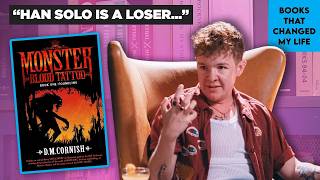
ND Stevenson on why the best characters seem strong but are actually vulnerable. Han Solo looks tough until you see his fear. In young-adult fiction, when a kid realizes their mentor is flawed, that's where the real emotion lives.
Chapters
This time on books that changed my life.
The most powerful characters in here are almost kind of the most vulnerable. Right. And do you like that sort of storytelling where it's like, it's just that contradiction?
I am so compelled by vulnerability and by the way that like, I think as a society we're compelled by vulnerability and it's not always acknowledged. I, I find it really funny the way like, let's say Han Solo, everyone is like, oh yeah, this like cool guy and he's so smooth. And you watch the movie and he's not at all, he's a loser. He's the guy who lives in his van with his best friend who's also his dog. And he's like, he's not cool around girls. He's just like, nuh, maybe you're the poop head. He's not a cool guy. And the second movie is entirely him being. The second and third movie is him being kind of frozen in carbonite, carted around. He's not in control almost ever. And I'm fascinated by the way we remember him as this cool, suave guy because he's played by a cool, suave guy. But really what makes that character work in a way that maybe the other characters that tried to be Han Solo don't always, is that he is vulnerable, is that he's a guy who is on the run, he's scared, he is fronting. You know, we are compelled by the softness and not just by the masculine energy and the machoness and the like. That's not really what clicks. And I think with us as people. And so I really love a character that is both strong but has these moments where that mask is stripped away and you kind of see them as they are. And you see them as someone who needs help. You see them as someone who's not in control. You see them as someone who needs your help. Even, you know, the entire last part of this book, I mean there's spoilers, but it is a lot of just this like 12 year old boy who's just run into like, you know, this legendary monster hunter and is now like her monster organs are revolting. She's overextended herself and is now rapidly dying because these organs are eating her alive from the inside out. And that is so much of this character is like, you realize she's just held together by chewing gum, basically in order. The place her strength comes from is also the thing that's killing her. And I think especially because it's from the point of view of a kid. You look at the adults and they control your life. They decide where you go and what you do and everything about your life when you're that age. And the first moment, you realize that they don't have it figured out. That they're scared, that they're flawed, that they lie, that they don't always know what's best for you. It's a really big moment in a kid's life, and I think that that's what's at the heart of these books. I think I was inspired a lot about that. For Scarlet Morning. It is kind of about the moment where a mentor, I guess it becomes human in your eyes, where they stop being this larger than life person and you start seeing them just as a person, including their flaws, including the disappointments. I'm really, really interested in that.
Yeah, me too. It's complicated. It isn't linear.
Yeah.
Like, yeah, even the hero has, you know, there's always some sort of price to pay or something.