Our Library's Hifi Setup
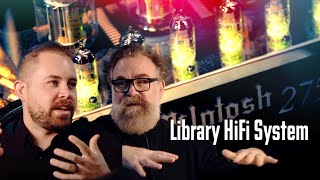
Video tour and gear breakdown of the Syndicate X Library hi‑fi system. Chris Collins and Ian (Audio Element) describe the goals (music for events and movies), explain two systems (main music via Harbeth/Jubilee speakers and a surround setup for home theater), list core components (Jubilees, Macintosh MC275 power amps, Macintosh C2700 preamp, Grand Prix Audio Parabolica turntable and Monaco rack, Hana Umami Red cartridge, VTL TP 6.5 Series 2 phono preamp, Lena DAC + master clock, Transparent Audio cabling, Dali Opticon surrounds powered by Macintosh MHT300), and share lessons learned from experimenting with gear (turntable and speaker choices, cable effects, and Roon recommendation).
Questions this video answers
Hana Umami Red (stated price: $4,000).
VTL TP 6.5 Series 2.
Each Jubilee is powered by one Macintosh MC275 power amplifier.
Macintosh C2700 preamplifier.
Lena DAC streamer and the Lena master clock.
Chapters
There's. There's just a certain magic it has that mixture of church and high school. Like you can't argue with the quality game changer here.
Been a bit of a journey.
So. Welcome to the Syndicate X Library. Today I want to go over our audio system. Now many of you already have asked when we're doing record reviews, what we're using. And so we're going to go through and in detail what the equipment is. And I'm also at the end of the video going to explain to you some mistakes that I've made and some things that I've learned that maybe can. Can save you some time and frustration. So I have Ian here from Audio Element.
Hello everybody.
He has been crucial in the design of this and kind of helping me and guiding me. The vision that I came with was that I wanted to create an experience here in the Library that when we have events or we have parties or get togethers, the guests are going to experience music in a way that they never have before. There's a lot of great equipment out there, but maybe the most important thing is how the equipment works together.
Yeah, actually, I think the perfect word is to curate. It's curation. And that's what we do at Audio Element.
And we're going to go through the system kind of piece by piece. And then also we have a surround sound system in here. So we have two systems basically, which was part of my vision that I want to be able to play movies in here. And also when I have events, I want to be able to play music or sounds that affects the whole room, not just listening area. So first part is the speakers are the clit Jubilees. Those seem to kind of be the best so far for this room.
Yeah, I think for what you're trying to do in here and play good music to a lot of people and not have it quite centralized to one specific spot. You want it to sound good everywhere. Jubilees are perfect.
It has that mixture of church and hi fi.
Each Jubilee is powered by one Macintosh MC275, which is a classic amplifier that Macintosh has made for I think 50 or 60 years at this point. This is the. The fifth iteration of it. So it's the most modern rendition. It's really the perfect amplifier for the Jubilees. Just brings out some good tonality, some richness.
And of all the stuff that we've tried over the years, the thing that I love about the Macintosh is that it gets out of the way. Like a lot of the stuff that I've tried puts a Kind of a.
Filter colors in its own way.
I just love how it does a great job and it gets out of the way. It's not trying to put any sort of color on it. Next we have the.
Yeah, so, yeah, so the Macintosh power amps are taking input Pro from the preamp, which is the C2700, also made by Macintosh. So it's got eight input tubes in it. They all light up. Very cool preamp. Perfect combination with the MC 275s.
And then we really just have that thing set to two.
Yeah, the two input DAC and the phono. That's all we're using.
That's it.
And we've got it basically hooked up to the home theater control as well. It's the best of both worlds.
I'm a huge fan of direct drive for many reasons.
Direct drive is preferable to a lot of people. It's speed control number one. It can't be topped by a lot of belt driven turntables. Easy maintenance most of the time, especially at the level that you're at now with the Grand Prix Audio Parabolica. So Alvin Lloyd, who, who is the. The owner and CEO of, of Grand Prix Audio, he got his start actually in the Indy circuit and he eventually became VP of Swift Engineering, which was huge on the Indy circuit at the time, and kind of said, you know, how can I apply this to audio? What can I do? I think the very first thing he did was make the rack that we're also using over here in the system as well. That's the Grand Prix Monaco. And he just took a lot about what he knew with resonance control and where energy goes kind of throughout the turntable, the preamp, the phono stage, everything that's sitting on that rack, it's still going to create all this energy. And you got to find a way to make it not so much a part of the equation. And so that's what he's doing with isolation and resonance control in the rack. Eventually he came out with a turntable. He's doing the same kind of thing. Very cool.
There's just a certain magic with the Grand Prix that is beyond words at that level.
Certainly. Yeah.
What kind of cartridge are we running on that?
So we're using the Hana Umami Red, which is a very special cartridge.
It punches up.
Yeah, that's kind of the way that we like to describe it. It's not inexpensive, it costs $4,000, but it sounds closer to an eight or $10,000 cartridge.
The next thing is the phono Preamp.
So.
I'm gonna guess I tried 20 different phono preamp.
Yeah. Yeah, that's the one you mentioned earlier. It's been a bit of a journey. And where we ultimately ended up was the VTL TP 6.5 Series 2.
So they're part of the Manly company, right?
Yeah. So it's a bit of a separation, actually. So V by David Manley and his son Luke Manley, and eventually they split up. I think David wanted to make more pro audio and Luke said, I really like making what we're making. David started Manly Labs, Luke kept vtl. And that's still how it is to this day.
These VTLs look like used VCRs that have been retrofitted. Like, you can't argue with the quality and what they do.
Not at all. I think they're happy with the design. They see no reason to make a change. And it's. It's industrial. That's how it's always looked. That's part of their familiarity, part of the brand.
But it sounds incredible. What is it about it that makes it so much better than everything else?
Unbelievably good circuitry and R and D that goes into the design of all these. They're built to order, it's a specialty company, and they treat each piece with a lot of care. VTL is constantly making updates, even to the current models.
Now going to the. The dac.
So we've got the Lena DAC streamer and the Lena master clock.
So when you. When you brought that over the first time you hooked it up and you.
We.
We listened to a couple songs and then you did the wait. But there's more.
There's more.
And you go to your box and you pull out a time clock. And then it got even better.
Yeah, the time clock is really massive. It affects timing in the digital domain. And basically, you know, there is a clock inside the DAC itself, but when you unburden itself from that and you get its own power supply and much better circuitry, you give it that opportunity to correct the timing a little bit better. And what that does, essentially, is it lowers the noise floor, lets a lot more detail come through. That was just not present before.
Ian did the same thing to us today because he brought cables.
So those are the transparent reference signals, BNC cables. And essentially that's. It's the link between the DAC and the clock. And even changing those cables out makes a huge difference.
So that's the dac, which I am.
You know, that thing is a workhorse for us and does a great job. The one thing about that dac, that has always been an issue, and same thing for me at home, because I also have it at home, but the app for it locks up all the time. It doesn't connect. It's. It's kind of goofy. So you suggested Roon.
Yeah, yeah. So essentially, a lot of companies that make DAX streamers, they. They usually have their own app, which you would use to link up whatever sort of streaming accounts you might have and. And play it all through that and control the system basically using that app. And most of them do a pretty good job. But we do always recommend using Roon instead, just because that's. It's software completely dedicated to that exact purpose.
And it's been a game changer here because it's just. It's functional. And I. I don't know if I'm crazy, but I do.
Notice that it sounds a little bit different.
Does decode the file differently than other apps might? There is a difference. Yeah, definitely.
Let's talk about the cables.
Cable cabling is all done by a company called Transparent Audio, which is the same cabling that I brought today. For the clock cables that we're using, we've got super level cable all throughout the entire system. That's speaker cable, XLR interconnects, RCA interconnects.
Can we just kind of talk about that for a second? Because in. In the stratosphere, a lot of people will talk about how cables don't matter, and then some people say they do matter. But just from my experience, I'd been through three different cables because the ones I had that were pretty expensive. The bottom end was better, but the top end disappeared. Then the other ones that I had that were kind of middle of the road were okay, but they were missing something. And then everything got better when I put those in. Which you knew would happen. But why is there a debate about the cables when it's so dramatic?
Well, because if you get to the physics of it, lots of times you can run tests and get the exact same result. Right. And I don't know why that is on paper that you would think there's no difference whatsoever. But when you hear it, it's night and day, right? Yeah. And if you don't hear it, you don't hear it. Right. Then I say, don't spend the money. But if you do hear it and say, that's something that I want in my system, you know, that puts us on a different path.
Yeah. To me, the cables have been Dramatic. Yeah, because those cables are. Are they taking into consideration what the equipment is?
Yeah. So at a certain level with transparent, what they'll actually do is they'll calibrate it. They'll basically tune the cabling and the filters inside the cables to match the equipment that you're using.
Let's talk about the surround sound.
So we've got the Dali Opticon on wall surrounds rigged up around this entire room.
And those are interesting speakers. The design Danish made. You can't see them in here.
You don't know that they're well hidden, which is really nice.
But they definitely show up.
Yeah, they produce. And that's powered by the Macintosh MHT300 running the surround.
And then that becomes Daddy. Basically. It takes over.
Exactly.
And then it kicks on the center. So we have a center speaker too.
Yes. Yeah. We've also got the Dolly Opticon center channel.
What I didn't understand about surround sound is that most of the time the voices, the speaking is in the center, usually. So the Jubilees aren't getting enough of that. So if you don't have the center, you can't really hear the dialogue.
Yeah. As far as vocals are concerned, and you're going to be doing home theater, having a center is pretty crucial.
So let me. And you had no part in my mistakes, by the way. The first mistake that I made and the reason why I tried 20 different phono preamps was I was in love with the techniques. I don't know, being a kid, I had techniques. When I was pretending to be a dj, I. I got the Technics SP thousand res reference turntable. The thing is, is a boat anchor. I mean, there was a time there where I. I was trying a different phone of. I tried different amps. Everything, like in everything. In the end, it was the turntable. Because as soon as the Grand Prix came in, it was like nothing could make it sound bad. And then the other one was speakers. So in here, I love the Jubilees speakers, but I did not like the look because the way that the room is set up with the bookshelves and the screen, it's like square on. Square on square.
Yeah, it's very angular.
And I wanted speakers that gave it, you know, a different look. So we tried different. Different speakers. And one speaker that I ended up buying just kind of on a Hope in a. In a Prayer, was the avant gardes. Yeah, same thing. Like there was nothing we could do to make those things sound good. I just learned that sometimes you're trying to. You're in love with a piece of gear, and you're trying to make that piece of gear work, and it's just not.
Just not working.
It's not the piece of gear.
Yeah.
To have. I guess. So that, that is the system. So when we're doing album reviews or if, if you're ever here for an event or a workshop, you, you will, you will experience the, the system. But. Well, I, I appreciate everything that you, me and your patience. It's well curated. You've done a great job.
Thank you, Chris. Yeah, Real proud of this system. Loved working on it for you.
Cool. Thank you. And we'll see you guys next time.







