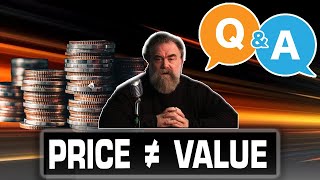
Hosts Chris Collins and Christian answer a caller (Michael) about whether raising door rates and improving effective labor rates (to ~85%) is causing loss of repair orders (ROs). They argue that declines in RO count are usually due to customer experience, advisor training, shop systems, capacity, and marketing rather than price alone; perceived value matters more than absolute price. They note 85% effective labor rate is low compared to a target around 110% and advise adding customer value if pricing increases rather than simply lowering prices.
Chapters
Foreign.
To your Friday drive by. This is where we answer your questions, whatever is pressing. If you just had a friend that could help you out with some advice. A friend with some experience.
Lots and lots of experience, or just a little experience.
Yeah, some experience. A friend that cares. We care.
Yeah, we've seen a thing.
The phone number is 8333-Ask-SDR. That's 8333-Ask.
S D R. And before we get to today's question, I would like to speaking of friends, I would say that our show has friends, people that religiously watch or listen to the show, people that are wonderful about calling in with questions for our Friday drive bys. And I would say there is no caller more prolific than John from Yakima and Yakima, Washington. Yes, my people. These are your people. Maybe they'll be our people soon, which would be great. But John, you want to move to Yakima? No, but I would move to Washington, the state. So John from Yakima sent us this pair of T shirts, one for me and one for Chris. And this is a T shirt for the beer farm in Pasco, Washington, which Chris is very familiar with. This central Washington, if you will, some.
Of the Seahawks fans.
Yeah, of course they're Seahawks fans. But John's son just opened this bar. If you're anywhere near central Washington, and I'm talking near like if you're in Montana, Idaho.
Virginia, anywhere near central Washington state, Canada. If you're in bc, hop on down, go to the beer farm. They literally grow beer on the farm. So you go through the fields and you would think that there'd be corn or beans or something like that in there. Nope. Cans of beer grow at the beer farm in Pasco, Washington. So, John, thank you so much for listening. We are happy to promote your son's new venture. And it's a lot of hard work. It's not unlike what we do in the service department where you got to take great, great care of customers and make them happy and keep them coming back. So that's my. That's the Christian promo.
It's funny that people get this backwards. We send them a swag bag if they're call, but people send us stuff.
Yeah, we've gotten a few things. It's been kind of neat.
Yeah.
Cool. Well, if I'm ever there, I'll stop by.
Me too.
Okay, let's go to today's question.
Hey, Chris, My name is Michael. I recently partnered with a group in Arkansas after working for a big public in Texas for the past five years. When I actually got here, the effective labor rates were just not where we wanted to be. We changed the pay plans, raised the door rate and got the effective labor rates north of 85% door rate. And of course the pricing has gone up. The question now begs is when do we need to be concerned with the erosion of the amount of ROs we're writing every month in relation to the pricing. A lot of the advisors think because we raised the pricing that we're losing some customers and I'm sure we're losing some. But what kind of reduction in RO count would caution you that maybe you priced yourself out of the market?
Michael, first thing is 85% of door rate is not as good as 110 of door rate. I would be focused on over, not under.
Just FYI, it's a little low. It's actually a lot low.
Especially if you're talking like he said.
That very casually, like it was a good thing.
Well, I'm gonna guess it was probably 65 when he started. He's got it up to 85.
So this is a good question. I think.
I think there's so many, so many angles to this because I just need more information. Like I don't know. Before you got there, were they, were they running everything on coupons? Like how are they getting people in? Did you stop the marketing? Whatever. Most of the time if there's an erosion in customers, the price is secondary to the experience, your shop capacity, the systems you have in place and your advisor training and how weak they are. So a lot of times advisors will say oh we're losing customers because of price. Which means.
They, their perception and their value for what they do is very low. Because if you have a bunch of advisors with high self esteem that believe in what they do, care about the outcome, care about customers, they, they don't feel like.
The customers aren't getting value. Like that's the like. When I was an advisor I felt like I should be able to charge more than the other advisors there because of the way that I treated people. And so you don't want any erosion. But the way to fix erosion is usually not pricing. It's to add value to whatever it is you're doing by the ease of getting in, the ease of write up. You know, if somebody needs additional work when they come in, can you get it done or they gotta come back in three days, all of that. So. And you're in a smaller market so you know you can't go too far with your pricing. If you start Seeing it show up everywhere, that your prices are too high, you maybe need to back off. I don't know.
But I don't. I don't. It's usually not the pricing that's the symptom. The cause is usually the experience, your advisor's training and talent level, all that. Yep.
Would you agree? Yeah, I. 1,000%. So the funniest thing about the whole door rate ELR discussion is that if you pulled 10 customers.
Maybe two or three, know what your door rate is in the first place. If. But I can promise you promise, like all the way. Cross my heart, hope to die, sickle needle in my eye style. Promise that 0 out of 10.
On the life of your dog?
On the life of my dog, my child. Anybody? Not yet, but I really like one. But 0 out of 10 customers know your ELR. 0.
100% customers know that they need whatever it is that they need.
Correct. So.
The only people that have issues with your pricing are your employees. The customers don't. What they perceive is value. So if a customer comes in and says this job is too expensive, what are they saying that makes them think it's expensive? It's that they don't see the value for what they have to pay for it. Right.
And in a sense, they don't believe in you.
And they don't believe in you. Yes. I always say that no one ever walks into Tiffany's and says, hey, you got any coupons? It just doesn't happen because there's a perceived value attached to whatever they're selling for whatever price.
Actually, we have a friend named Matt that would do that.
He's special.
Most people I don't know that. I don't know Matt's headed to Tiffany's either. True. But you kind of get my point. So I think that the bigger thing is, is that at the end of the day, if you're. Whatever you've done, if you've. You have to mentally do a thing where. If you've raised your price by 20 bucks or 30 bucks or whatever it is, you have to provide 40 bucks or 50 bucks worth of value, whatever you deem that to be the case. But it's got to be a situation where the customer wins 100% of the time. Your ELR will never be in a discussion that you have with your customers.
Thanks for the question, Mike. We'll see you next time on Service Drive Revolution. Thanks for watching this week's Drive By. I hope we gave you something to think about over the weekend. We're uploading new stuff every day, so make sure you subscribe and click the bell icon so you don't miss out. If you have a question you'd like us to answer on the show, call 8333 Ask SDR and we'll answer your question on the show. That's 8333 Ask SDR. For special deals on our books and training, head over to offers.chriscollinsinc.com now that's offers.chriscollinsInc.com I'm Chris Collins, and I'll see you in the next video sa.