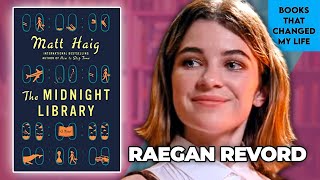
Actress Raegan Revord talks about Matt Haig's The Midnight Library, a novel where the main character Nora explores alternate versions of her life. Revord reads an excerpt called 'Things I Have Learned' that contrasts regret with the emotional richness available in any single existence, and discusses how the book transforms from despair into hope.
Chapters
This time on books that changed my life. Okay. 277.
277.
This the whole page?
I don't know. Do you want to read that or do you just want to explain it?
I can read the whole page.
So it's her, is it? Facebook post before she tried to kill herself?
Yeah. This is what she posted? Yeah. Things I have Learned, written by a nobody who has been everybody. It is easy to mourn the lives we aren't living. Easy to wish we developed other talents, said yes to different offers. Easy to wish we worked harder, loved better, handled our finances more astutely, been more popular, stayed in the band, gone to Australia, said yes to the coffee or done more bloody yoga. It takes no effort to miss the friends we didn't make and the work we didn't do and the people we didn't marry and the children we didn't have. It is not difficult to see yourself through the lens of other people and to wish you were all the different kaleidoscopic versions of you they wanted you to be. It is easy to regret and keep regretting ad infinitum until our time runs out. But it is not the lives we regret not living that are the real problem. It is the regret itself. It's the regret that makes us shrivel and wither and feel like our own and other people's worst enemy. We can't tell if any of those other versions would have been better or worse. Those lives are happening, it is true, but you are happening as well. And that is the happening we have to focus on. Of course, we can't visit every place or meet every person or do every job. Yet most of what we feel in any life is still available. We don't have to play every game to know what winning feels like. We don't have to hear every piece of music in the world to understand music. We don't have to have tried every variety of grape from every vineyard to know the pleasure of wine. Love and laughter and fear and pain are universal currencies. We just have to close our eyes and savor the taste of the drink in front of us and listen to the song as it plays. We are as completely and utterly alive as we are in any other life and have access to the same emotional spectrum. We only need to be one person. We only need to feel one existence. We don't have to do everything in order to be everything, because we are already infinite. While we are alive, we always contain a future of multifarious possibility. So let's be Kind to the people in our own existence. Let's occasionally look up from the spot in which we are. Because wherever we happen to be standing, the sky above goes on forever. Yesterday I knew I had no future.
And.
And that is impossible for me to accept my life as it is now. And yet today, that same messy life seems full of hope, potential. The impossible, I suppose, happens via living.
I love that.
Do you remember reading it the first time?
I do.
What were you thinking?
I was thinking about the beginning of the book. Because reading this is such a. It almost was like reading something written by a different person. Because in the beginning of the book, it's obviously told through Nora's perspective. And the beginning of the book is such this, like, hopeless, heavy, weighted down feel. It feels like a rainy weather situation. And it's so heavy and dark. And then this one, there is just so much hope. And that's what she said. And yet today, that same messy life seems full of hope, potential. And that's what you get from this, is that through the midnight library and through her experiencing all these different lives and all the different things she could have been and could have done, she sees so much hope in what her life is now. And I think that was what was just so cool to me, is that in the beginning there wasn't any hope. She experiences this and she's so excited for what her life could be. And the way Matt Haig communicates that in this page and a half alone is so cool.
Okay, one more tab.
You don't have to understand life, you just have to live it.
Does that sum up the book?
That sums up the book so well. I think all of the quotes that was highlighted just showed all the different pieces of the book that you take away from it. But that one especially like, you want to control and you want to understand and you wanna ask so many questions. And asking questions is a good thing, but you also would wanna be in the moment and you wanna live and you don't wanna think ahead and you don't wanna think about the future too much because then you miss the present. And I think that last one is just such an important quote about what this book means. So great, such a great book. I love it so very dearly.