Reading THIS BOOK at 11??? || CC Rice on 'The Bluest Eye'
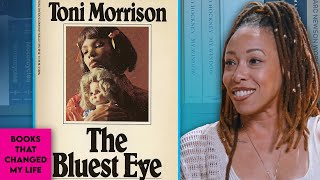
CC Rice read The Bluest Eye at 11 and it shaped how she saw herself. She's now a voice coach and author who works with trauma, and recently coached dialects for a stage adaptation of Morrison's novel at the Huntington in Boston.
Questions this video answers
1970
1976
11 years old
At the Huntington in Boston, 2022
Chapters
This time on books that changed my life.
The Bluest Eye. It's both a tragic story and an incredibly beautiful story that is so far ahead of its time. It is a masterpiece of epic proportions.
I can't believe you read this book at 11. It's heavy.
Me, I was reading the book from all of the young girls perspectives. I was seeing myself honestly in all of them.
Self esteem plays such a big part of it.
If your self esteem dies while you're still a child, it's almost like you just get stuck.
Did you give a piece of your soul riding the root of awareness?
My whole soul, eight years old, was this really screwy time for me. I suffered from migraines and then that led to lockjaw. So I'd go to bed and I'd sleep and I'd clench my teeth to try to hold all my secrets in. And I never healed from it until I was in college and I started to take voice and speech classes. And I realized I had been holding emotions and the tension in my stomach for my entire childhood. I wanted to write a book that helped people get through the understanding and the knowledge of how they are impacted in a way that is honest but not as heavy and as hard to hold.
Okay, big question.
Yeah.
How did the Bluest Eye by Toni Morrison change your life?
It allowed me to.
Welcome to the Syndicatex library where we love books, especially books that have changed lives. We have a multi talented guest joining us today. She's classically trained actress, a voice and dialect coach, body language analyst, producer, expert in human behavior and communication. Her latest book, the Root of Awareness is available now. She's here to talk about the book that changed her life, the Bluest Eye by Toni Morrison.
Please welcome to the show, Cece Rice.
Thank you. So sweet.
So before we get to the Bluest Eye, tell me a little bit about your book and should I hold it up?
Do you want to hold it?
Yeah.
Yeah.
So I love the COVID Do you? Thank you. I'll tell you a funny story about the COVID So this is the root of awareness. Tools to ground and grow vocal and physical communication which is very important that we communicate in all the ways. And that's really the crux of the book. It develops from the core of what the body is, what the voice is, how the two things come together and how one of the things I repeat numerous times in the book is that the body is the instrument, the voice is the music. Everything that the instrument goes through, all those dents, dings, stress, trauma habits, holdings show up in the voice, you're essentially just a giant accordion and whatever buttons are pressed are going to affect that sound. And it grows from that basic understanding the roots of what communication is and how we have the impulse to create sound.
And then there's the trauma informed part of it where we really talk about what those dents and dings are and what they do to different sectors of the energy system. And then it grows into how do you fix it? What do you do next? Because that's the number one question I get from people, is, okay, now that you've told me what all my issues are now, what, how? And so the last part of the book, the integration section, is about public speaking and tools to self coach and to self improve and to use everything from the two previous parts of the book that have grounded you in activation and focus. And then you move into this integrated part where there's tools to communicate with people. How do you have a conversation? What is compassionate communication? How do you make sure that when you have a conversation, you come to it from the place of being ready to listen to what the other person has to say, rather than from the place of ready to speak about what you have to share? I say, do you need therapy or a conversation? And therapy is the part that can happen with anybody, can happen with your mother or your best friend, where you just need to vent and say all the things that are on your mind. But the conversation is when you've processed your side and then you're ready to hear, okay, what's going on with you? So that now I can integrate that into what I've discovered about what's happening with me. So that is essentially what the book is.
The funny story about the COVID is that I had this idea that the COVID would be the tree of life and it was going to be this artistic thing. And my publishers kept sending me drafts and I just wasn't satisfied. Either it felt scientific or it felt too spiritually. It just. There was something ungrounded about the covers that we were getting. And we were about a week out and I woke up in the middle of the night and I was like, what's wrong with you? You have to be on the COVID of the book. I've spent five years, really my whole life being the front facing element of the thing that I do. Whether it's teaching or acting or social media. It's always every frame of every social media post I have has my face in the frame. People recognize me by my face, not by my name or by a tree or by A book title. And so I got up the next day, went to Michael's, bought a little miniature tree, created this foam and dirt mound for myself. And I shot that in my living room by myself. Like, set up the camera, set up the lights, did my hair.
What kind of camera?
I. Is it a Canon or it's a Nikon? Nikon.
Nikon.
It's my old camera that I never use for anything. And I had to dig it out of my closet and mount it. And I couldn't be more happy with it, but it was almost great. Cover something else. Thank you.
And what a great smile. Geez Louise.
Thanks.
You light up a room.
Thank you. That's so nice.
The energy coming from this is pretty great.
I think that's why I got that download, was that it needed to come through me, not through some other thing that wasn't actually going to capture the essence that I wanted it to bring, which was. I consider myself a guide.
Right.
My company is called Guided Inspiration. I do coaching, but I don't like the word coach. Like, to me, a coach is the person who stands on the sidelines and yells at you about what they used to be able to do. And to me, a guide is a person who has been down a path before and is willing to hold your hand and take you with them so that you can then go on your own. And so for me, I had to be the guide. I had to say, come in on the COVID come toward this thing. Is this for you? Here's an offering. So thank you for that.
Oh no, it's great. So what, what common kind of behavioral cascades do you see in people that they're carrying? Because you mentioned trauma. What are the patterns from childhood that keep you from being a good orator?
Well.
There'S a multitude. There is no limit to the number of things that a human being can experience and at what point in their life. So each energy system in the body rules different things. So depending on where the trauma occurred and when or how it will affect different parts of your system and therefore different ways in which you communicate. For example, the root is the early part of life, ages 0 to 2, sometimes up till 5, depending on how your life goes. But I talk a lot in the book about how the things that happen to us when we can't even remember it, where we're not quite making long term memories yet, are actually the most impactful for safety, security and trust. That early part of our lives, we are so vulnerable and we are subject to our environment and everything that a Baby is communicating has to do with the physical reality. Are you hungry? Are you tired? Are you cold? Are you hot? Are you sleepy? All of those things are about environment and whether or not when you cry out in need, someone responds. And if no one responds when you cry out in need, or if their response is terse or cold or ineffectual, in that capacity, the child doesn't stop kneading. The baby doesn't stop feeling the physical things that it needs, but it does stop crying. And so that effect from the very beginning on what I call the root voice, which is all the sounds that we come with, moans, groans, laughs, cries, all those things that just no one has to teach us how to do. We don't need a language center functioning to understand that. Sounds just come up and out of us. All those root sounds are affected by the root of our lives. That age is 0 to 2, period. And how your voice is responded to that early on has an effect on how you use root sounds later. So if you notice someone who doesn't laugh.
Cries, but only really weeps, doesn't, doesn't make the sound, has lost the ability to make the sound, that is an indicator of some kind of safety, security, trust, trauma, whether it occurred early in life or whether that security trauma occurred later in life, it is deeply connected to the sounds that are connected to what we feel in the physical realm. So each section of the body has that. The intimate center, the sacral. If you can't speak in your intimate voice, that Barry White voice that says, it's just for you, baby, that can be representative of trauma, particularly sexual trauma. Right? And depending on this is a wild thing.
Quick story. I used to watch a lot of the Real Housewives of Salt Lake City first season. And Whitney, one of the women on the show, very busty woman, very childlike voice, incredibly high pitched, squeaky. And when she'd get into a conflict with someone, her voice would get higher. She'd become much more infantilized. And I had heard this kind of voice many times. And so I start to look at her shoulders and her shoulders are really pulled forward and she sort of pulls her chest in. And so I'm watching her and I'm observing her over a couple of episodes. And so I make a video about it. And in the video, without making any declarations or accusations, I say, this is something that I see a lot with people who have experienced early childhood sexual abuse. And the reason being is that pulling into the chest, hiding development, especially if you're a woman who develops early or in a way that is very easy to notice, the chest will pull back in order to kind of hide that. But with the voice, what happens is either you get frozen at the time that the trauma occurred, or you freeze your voice at the place where the trauma occurred as a way to signal to the rest of the world, I am not a woman. I'm a child. I'm not available sexually. Please avoid me. And so I heard her voice, and I thought, this is what this sounds like to me. Either a season or two later, she starts doing some therapy, some hypnosis therapy, and other things that she did. And she discovers that she had blacked out an entire chapter of her early childhood where she had been abused. And I was like, I knew it, I felt it, I heard it, I saw it. And it was a big confirmation for me in that sphere of everything matters, it's happening on multiple levels from multiple angles. But when those things are all put together, the story is very, very similar. Latoya Jackson is another really great example of this, and they abound. The more you learn about it, the more you start to hear it. And that's not to say that every person or woman with a high pitched voice has experienced that, but it is to say that oftentimes the counter to that is. Is the truth, that that can be the result. So hopefully that answers your question.
No, it does. And.
Have you ever read that Body, the. The book, the Body Keeps the Score?
Oh, yes, it's quoted in my book a couple of times.
That was a hard one for me.
It's real hard. Rough. It's real rough.
Yeah.
It's actually one of the reasons I wrote my book.
Oh, really?
I wanted to write something because I had the same experience.
I had to put it down a.
Couple times, Several times, multiple times. And I. I actually used to assign it in my classes when I was teaching at Rutgers. It was required reading for my class to help them really understand the role that trauma plays in the body and how we hold onto it. But every time I would assign, I think we would do chapter five, My students would come back and they would be really shut down, and they'd have a hard time talking, and they would say, you know, I couldn't get through it, et cetera. And I felt really strongly that the book is very important. It was one of the first books that I read that really put into language things that I had known and been picking up on since I was a kid. But I wanted to write a book that helped people get through the understanding and the knowledge of how they are impacted by their trauma and their past and their history in a way that is honest but not as heavy and as hard to hold.
Yeah, there's a place for that, for sure.
Yeah. So. But very important.
That book is presented very scientifically.
Correct.
There isn't a lot of empathy. I mean, I don't know how it would. But it's very.
Especially the beginning of the book. Now, the end of the book is why I'm assigning it in a theater class, because the end of the book is all about how to apply therapy for past trauma and, you know, PTSD in a theatrical context and how people are helped through their trauma through theater. And this was something I had been experiencing as an actor, as a teacher, for all my life. And this book really solidified the power of not using your words to tell your story, but using, in his example, Shakespeare's words. And these are prisoners who have taken on the mission of putting a Shakespeare play on. And when they're coping with death and when they're coping with war, when they're coping with all of these things that they understand in their own life, but they get to use words that are larger than life and a container that can hold huge emotions. Right. Shakespeare can hold these gigantic swells of your own emotion as long as the language keeps driving through. And that people were actually able to express things through what I call a particular kind of triangulation, where you're using the language of Shakespeare to access your own traumas and then have this space where instead of being shamed afterward or feeling like you cave in on yourself after you've told your story of what happened to you, the audience applauds, and it sort of reorients your relationship to the expression of emotion and the expression of trauma. Because, you see, oh, this isn't something I have to be afraid of or pull away from, but it can actually be a space to allow other people to feel closer to me and to say, great job, you did it.
Yeah. Isn't there kind of a power in the disassociation, the abstraction of it?
Absolutely. We need it. We absolutely need it.
We get trapped in our own cycle and our own story of ourselves. If it's just about us all the time, we also feel more alone, I think. But when we start accessing large emotion through character, right. Then you can say, oh, some of these experiences are universal. It's not my story completely, but, boy, do I have access to this. Well, why do I have access to this? Well, because something is universal. And that witnessing is so important to healing. And I think theater is one of our greatest underutilized therapy tools. It doesn't even need to be for performance in the wider world if we can use it with each other. And I talk a lot about that in the book. How do you create a community that gives you a space to tell your story? Through poetry, through other language, and then finally your own language, once you found access and a way to let a little air out of the tire of the most volatile of those emotions by practicing the pathway of emotional release, by practicing the pathway of sound release. That, to me is the biggest thing that most people are missing is that therapy, whether it's yoga, whether it's massage, whether it's, you know, however you choose to do it, if it is lacking sound making, that's not about language, but making sound to release the feeling that's in you. Even if you stretch in the morning, if you suppress the sound while you stretch and the breath while you stretch, you don't quite get the stretch you need.
Trying to think. If I make no, I think I.
Knew, like the difference between A.
Versus A.
Where I'm holding my breath and I'm pushing something down. I can feel that it doesn't quite release. And then you add the sound and there it goes.
Same thing with martial arts. Like when you.
The power.
Yeah, right.
Because it's the release. If you're holding it, you're not impacting. So if you go and it goes somewhere, there's directional quality and you're stronger because of it.
Yeah, it makes sense. How hard was it to write the book? Did you give a piece of your soul?
Oh, it's my whole soul is there. It's a.
People don't understand how hard it is.
You know, it was both easy and hard. There were half the book I wrote by sitting down at my computer and typing the way we do. The other half I wrote with my publishers, lecture style in a zoom meeting that was being recorded. And then they'd send me transcripts and I'd read the transcripts and then I'd take pieces and move them around and organize. And then I had to match them because then the voice had to be the same. And that was maybe the hardest thing I've ever had to do. But it was ultimately like a channeling. I felt that the book dragged me around. I felt pulled by the book, that the book knew what it wanted to be and I was not moving fast enough or efficiently enough to just come on, fill in the. What's Next. Okay. And then this. And then this. I hardly had to think. I wasn't sitting right. Once I wrote the outline, it was like plugging consciousness completely. And it's because it's what I teach. And I just needed a place to put all of the things that I teach. Every time someone would ask me, is there a good book about this that I could read? And I'm well.
And I thought, okay, well, this needs to exist. Write the book that you want to read, or write the book that people are asking to read that has yet to be written. And so that's what this was for me. And I also realized it couldn't just be a book. There had to be sound. There had to be a visual component. If I'm going to take you through warmup exercises and how to train your body to release emotion, to release sound, to release breath, through stretch, through foundation. I need an illustrator. I need a video companion. I need all of these other elements in order to make the whole thing.
Lift so it becomes more of an experience completely.
Yeah.
Okay. The bluest eye.
Let's talk about it.
So, interestingly, I don't know if you knew this, but the book came out in 1970, and it only sold a couple thousand copies up until Oprah made it the book of the month.
Yeah, that I actually didn't realize that Oprah was the one that brought it to the masses, because this is actually my mom's copy. This is the fourth, I think, edition. Fourth printing.
What year?
1976. This was printed, and my mom read it, I believe, in 76, in a college course that she had at UC Berkeley. And so this was her copy from class. And it was on our bookshelf as long as I can, before I was born, obviously. And my mom was the one that just handed it to me one day and said, read this, and didn't say anything else about it. So I didn't know that other people didn't know the book. And so that came as a surprise to me later because it was a book that had, to me felt like it was always around. I had always seen it on the shelf, even though I didn't interact with it. But, you know, you're a kid and you see a book that has a little girl with a baby doll on it, something about it says, read me. Even though I needed to be invited, I knew that there was something in there for me. Just, you know, don't judge a book by its cover. But sometimes the COVID is the thing that says, come here.
So how old are you when mom hands it to you.
I think I was about 11. I think I was the same age that Pecola is in the book. And I think that that's probably why she gave it to me, because I was, you know, about to go through puberty. And there's so much talk from a child's point of view about what puberty is and how our bodies are changing and what's going on. And my mom is not the best at having those conversations. She's much more of a. Here's. I bought you a book, you know, what's happening to my body Book for girls. I bought you a book. Read this. And so I think this was the novel version of handing me, you know, what's happening to my body.
So where did you grow up?
I grew up in the East Bay area in California. San Francisco. Bay area.
What did mom do?
My mom is an attorney.
And what did dad do?
Dad's a dentist.
Oh, wow.
Yeah. They both actually went to UC Berkeley, but met before that, which is why they both went there. My mom's from LA and my dad's from the Bay Area.
So was your childhood pretty good?
Yeah, I mean, yeah, upper middle school. You notice how I.
That's an indicator of something being underneath that. Yes, I had a very loving. And ultimately everything was always. We were provided for, though I didn't have any understanding of money or anything like that. And we. I grew up in Pittsburgh, California, which is lower middle class to working class town. And I believed we didn't even have money for McDonald's, which probably wasn't actually true, but my belief system as a child was we don't spend money on things. You know, we go to pay less for the shoes.
You get a dollar if you need school lunch money and that's it.
Just the essentials.
Just the essentials. But I also talk about in my book, a lot of the first chapter is about the traumas that I did have that really affected why I became a voice teacher later, because I had to ultimately figure out how to heal myself. When I was in college, I suffered from migraines as a kid. Started getting headaches when I was 8 years old and I would get them almost every day. I'd get picked up from school a lot. I'd miss out on things. If it was too hot outside, you know, it's California. I couldn't be outside. My mom would pick me up from school and I'd look kind of glazed over and she'd know instantly. And then that led to lockjaw. Started waking up every morning, and I had what's called trismus. My. Couldn't open my mouth, chew, couldn't speak. So that went on for years. I saw a bunch of doctors and specialists, and every time they told me, like, you seem normal. Blood work's fine, Scans are fine. You'll just figure it out. You'll live with it. And it wasn't until I got to college that I started to recognize that. Started getting headaches at 8. I talk about this in the book, but I was molested by a stranger at an R. Kelly concert, of all places. But I blacked it out. I didn't remember until I was 16. And it was a stranger whose face I can't even picture. And that was when I started sort of shifting. My dad's best friend, close family friend of his, also a dentist, there was a tragic car accident, and the whole family passed away. Same year that that happened. And so eight years old was this really sort of screwy time for me. And I never healed from it until I was in college and I started to take voice and speech classes, and my teachers started to make me make sounds from down here in my belly. And I had to let things go. And I realized I had been holding emotions and the tension in my stomach for my entire childhood. And then I would massage my jaw every day as part of the warmups we would do for class. And I started just doing the stretching and sound making and facilitating my emotions through Shakespeare, through theater, through language. And I started to get memories back, started to put pieces together. My lockjaw went away, my headaches went away, all because of.
Theater and the practice and the technique of having to process things instead of holding them. To having to release things into space and out of my body and to correct my posture and to sit up tall rather than like this, being small, which was causing me. And clenching my teeth every night like this. So I'd go to bed and I'd sleep, and I'd clench my teeth to try to hold all my secrets in. And I call it secret keeper's tension now. And the clenching was causing me the headaches and the lockjaw and all the things. Shoulder tension, stomach tension, toes curling all the time. And that was the stuff that I recognized that I had to learn my own body to undo. And I'd been seeing doctors the whole time, and no one had ever asked me, what's your stress level? Like? Have you experienced any trauma? What's. You know. Because people look and they say, your mom's a lawyer. Your dad's a dentist. Life is great. But no one really understood that I never had tools to process emotions. And I was so observant of the world around me. I was taking in so much that I was taking it in and just keeping it and thinking it was mine to hold.
It's crazy how that happens, right? So how did that affect you with making friends and fitting in when you were a kid? Because it had to isolate you, didn't it?
Well, interestingly enough, I have always been really good at socializing. That's been the thing that I relied on. I had a really hard time reading and writing.
I understood much later in life that probably had pretty intense dyslexia. That sometimes gets less intense as you get older. But. But I thought everyone sort of wanted to read right to left. Like, even to this day, when I look at a piece of text, I read it backward, and then I have to reorient myself and go the other way. I flip things upside down all the time. I was writing my name upside down and backward and all these things. And so school and spelling and paying attention in class was just way too much for me. Socializing and connecting to people was, like, my superpower. I'm a Virgo. I could observe, see a person who needs a friend. I talk about this in the book, too. I'd watch all the kids in class instead of paying attention to the teacher, and I'd see this kid and his legs bouncing. I'm like, oh, he has to go to the bathroom. And I'm looking over at this girl, and I'm like, oh, she's chewing gum. Oh. And I was just fascinated by people. And I would get moved around the class all the time because you couldn't sit anyone next to me. Cause I'd talk to anyone. I'd make friends with anybody. So socializing was always. And performing was always my thing because it didn't require me to read and write. And now here I am. Yeah, writing and reading.
So when mom hands this to you at 11, had you read a lot of books up until then?
Yeah. So the library thing. Right. I.
Had started to understand how to read later than other kids, though. Like, I think when I was about seven, I started to get what reading was a little bit. And I was of the generation where they stopped teaching phonics, so it was all sight reading. And that was very overwhelming for me. But at some point, I started to figure out language. And the reason why I figured it out was because there was a competition. And our teacher had us put A star by our name for every book we finished. And I thought, oh, that's it. And so I started reading Babysitter's club books like it was my job. I would just like power through these books because I was motivated and I had a friend, we would read together and then we would trade books. And she actually really helped me with reading comprehension because we would talk about the books and I'd say, like, oh, I missed that. Wait, who's that character? I don't remember reading that. And I started to understand that I had a very different relationship with comprehending what I was reading than other people and that I needed to have that reinforcement and that talking about it to actually absorb what I was reading. And so I had read a lot of really easy books. This, when my mom handed me this book, it actually felt easy to me to read. I mean, the first chapter is, you know.
There'S a green and white house. You know, it's very, very simple. And then it grows into this beautiful prose and beautiful dialogue. But it welcomed me in, in such a way that I didn't feel that I didn't have access to it. And that was incredibly important. And so when she handed it to me, I thought, A, I have to read this because I'd do anything my mom tells me to do. I'm a rule follower. And B, I thought it made me feel a little bit special because I don't think she had given it to either my older sister. I don't think she had thought that my sister would read it or would have the same experience with it. And it felt personal. It felt like my mom wanted me to have something or to experience something that was uniquely for me. And she did this a lot. She would buy a book and give it to one of us and that felt special. It felt.
Just like a little gem and a gift that wasn't shoes or clothes or, you know.
So kind of explain to the audience the premise of the book.
Yeah. So the Bluest Eye. It takes place over the course of one year. You go through all four seasons. And it is centered around an 11 year old dark skinned black girl named Pecola Breedlove. And Pecola is an outcast. She is essentially shunned by most people because she's not pretty and she's not smart in other people's eyes. And she is seen as unworthy of love both from her perspective and from the perspective of others around her. There's nothing charming about her in the way that she is portrayed. However, she has an enormous imagination and.
A desire to be seen and a desire to be loved that is so potent and so strong. And ultimately, the book is about Lorain, Ohio, in the 40s. This town that is, you know, mostly black, but there are definitely white people around and within the neighborhood. And it is a story of, you know, early assimilation, what it was like for.
Black people who both, some of them who, you know, had always been in the north, but also once the great migration happened, there was this influx of southerners who were now in the northern states. And that really shaped a time in America that this dark skinned black girl is looking at white baby dolls with blue eyes and coveting them and wanting to have blue eyes and praying for blue eyes and asking for blue eyes and. And she goes through a lot and you find out about generational trauma. The book is so brilliant because it spans the past and the history of Pecola's parents. The trauma that her dad has been through, how he's been objectified, the trauma of her mother. Her mother has a club foot and so she shuffles when she walks. And so she is seen as an outcast in many ways from the other beautiful women. And the story ends up that Pecola is raped, ultimately by her father. And for him, it's this act of affection where he's trying to show a girl that has not experienced love. Love. This is his sort of point of view. And she experiences it as trauma. And she gets pregnant. And everyone in the town, I shouldn't say everyone, but people in the town get it. They know this is her father's baby, but the way in which it's spoken about in the book is so beautiful. And that her two best friends.
Want the baby to survive and they want it to live. Even though the adults, for a reason that they can't understand, are telling them we don't think the baby's gonna make it. And they don't get why. They don't understand that you incest is not the most viable. And so they plant marigolds and they say, okay, these marigolds are gonna brighten up the scenery. They're gonna make you happy. They're gonna be this symbol so that the baby will survive and know that it's loved and that it's in an environment of love. And the marigolds don't make it and they don't flower and they don't bloom. And Pecola loses the baby and she becomes an outcast. And she's always been an outcast, but now she, as a woman who grows up, she lives on the outskirts of town in a place where she can see people and they can see her and she just sort of haunts. And it's both a tragic story and an incredibly beautiful story that is so far ahead of its time. It is a masterpiece of epic proportions. It is pastiche. It's all of these styles. And there's avant garde elements to the way the language is written, just in the plasticity of the page. Their dynamics and the use of dialogue is so brilliant that you can hear the whole world that in its specific in place. And to me, it's just such an achievement, especially as Toni Morrison's first novel. You read it and it feels like it dropped out of the sky, you know.
How did it make you feel at 11? Because it's a heavy book. At 11.
I didn't get that it was heavy. Really?
Like the incest and rape and all that?
No, because I didn't have anything to. I don't know that I understood enough how bad that was to understand how to judge it. Like, I don't think that there was language in the world about incest that gave me any perspective other than, oh, this is a thing happening in a book. It didn't really hit me in the soul until I was older. But instead, for me, I was reading the book from all of the young girls perspectives. I was seeing myself honestly in all of them. I felt awkward and weird and funny looking as a kid. And, you know, people commented on the color of my skin ad nauseam just all the time. And a lot of the language that was used about Maureen, who is the half white girl, was a lot of the language that was used about me. But I didn't have the positive traits that Maureen had. I didn't have long flowing hair, I didn't have green eyes. I just had yellow skin. Okay, so then there's this character. And then I would see something about them that, oh, this girl has kinky hair. I have that. I get what that is. Oh, these girls, their parents are a bit more stable, but they're also kind of ferocious and they like to fight and they're manipulative and, you know, they're scheming, but they're also smart and they defend. And I was seeing myself in all of these young girls point of views. And I had never read a book like that. I had never read a book where there were. There was a group of black girls, which in my life at that time, that is what I knew. I understood that dynamic. I understood the dynamics of being in a group of Kids where there were dark skinned girls who got treated differently than the light skinned girls. I understood the jealousies and I understood colorism. I understood privilege of having lighter skin, but I understood the limits to that privilege. And this was maybe the first and only book I've ever read that's actually captured that dynamic in the context of young girls trying to understand on top of all of that, what is going on with their bodies and what is going on in this town and what's wrong with these adults.
Yeah. Can you kind of unpack that a little bit? Just in the sense, like I remember dating a girl who would have been considered dark skinned.
Okay.
And her.
Referring to other people as light skinned and being blown away by that. Shocked that that happens.
Yeah, yeah.
I mean, colorism, that's what, that's the term for it.
Yeah, yeah. So colorism is essentially.
Either the practice or, you know, the idea that lighter skin is superior to darker skin. And it's, you know, based in some facets of the overall structure of colonialism and white supremacy that in many cultures, you know, as with any caste system, there has to be a way to separate people and to break people down into groups. And in the south in particular, you know, the one drop rule was the thing. If you had one drop of black blood, you were considered black. But what that did within black communities is it deposited anyone who was not fully white into the black community. And so then there were all of these layers of color and proximity to whiteness. And even during slavery, house slaves were fair skinned because they could more easily assimilate into the master's world. So if guests came over, they were less offensive to the guests because they didn't have skin that drew attention to them. They weren't working in the field, out in the hot sun, and therefore their skin stayed lighter. Those, you know, house enslaved people. And so from that into the modern context, there has been a big, you know, I shouldn't say big, but there is a dividing line between the experiences of privilege or perceived privilege based on your proximity to whiteness and the oppression that you face the further away from whiteness you are and the ability or inability to pass or to seem like you don't stick out is privileged in predominantly white spaces. And that gets internalized within the black community. And sometimes lighter skinned people are going to experience the result of what it feels like for dark skinned black people to be ostracized. Right. You're. Am I going to welcome you with open arms and treat your experience as though it's exactly the Same as mine, when we both know that it's different because we inhabit spaces differently.
My grandfather, who could pass for white, though I don't know that he knew he could. Like he was a bit sort of naive about it as he would tell me the story. And he was in the army and he was in an all black regiment. And when he was in Texas, he was stationed in Texas, he went to a lunch counter somewhere and he walks in, he's in his uniform and the person comes up and says, oh, you don't have to pay, it's on the house. He thinks, oh my gosh, wow, this place is amazing. And he goes back to his all black regiment and he tells everybody found this great place. If we go and we're in uniform, they'll give us free food. And so the next day he shows up with all of his friends and they don't serve him. And so it was this.
Way for him to see for the first time that who he had aligned himself with in his own mind and in his own culture and in his own upbringing, when he was on his own, the world didn't see him that way. And he could assimilate, he could pass. And so for me, even as a kid, I took note of that and I took it as a way to recognize when I have privilege. How can I use it to uplift darker skinned people who I know don't have the same privilege that I do? How can I balance spaces when I see, oh, there are black people here, but by the numbers, and we're all light skinned black people. And what does that mean? And what does that say about what it is that we're actually doing here? And how do we call that out in such a way that moves things forward? And so how do you call that.
Out in a way that moves things forward?
It depends on the context. In educational spaces or in theater, which is where I often spend a lot of my time, it truly means having conversations about, means reading plays that require dark skinned people, that require people that are not so malleable that they could be anything, that there is actually a call that this person is recognizably this color. And that is important for the storytelling and in educational spaces. I have been known in a faculty meeting to say, well, one of the reasons why our students aren't as forthcoming with their emotions, especially those of them who are black or dark skinned, whether they're Indian, whatever it is, is that if they see that the entire faculty is either light skinned or white, they do not feel represented. And Calling that out and naming it because there are people, non maliciously who don't recognize the difference between welcoming dark skinned people into spaces that have been previously reserved for light skinned people. Hollywood is like this. You see Dorothy Dandridge and Dorothy Dandridge, though not incredibly fair skinned. Fair skinned enough, right. And then you see the lack of dark skinned leading ladies for 40 more years, 50 more years. You know.
Halle Berry being the next black woman to win an Oscar reminds you that she's mixed race. And so then there's all of these. And then you see and you listen to Viola Davis and you hear her talk about her experience and you recognize there's no such thing as meritocracy when somebody like Viola Davis has had the struggles that she's had to be seen still as, you know, the equivalent to Meryl Streep, but not get Meryl Streep money, you know. So I think as a light skinned black person who feels both sides, right. I happen to be the lightest skinned member of my family. Both my parents are black. I just came out really light. So my younger sister is much darker than I am. And so when we're together we have one experience. And when my sister's by herself, she has a different experience. My sister's with her very fair skinned kids. She gets treated like she's their nanny. So there's all of these things that deserve being talked about wherever you are. Even within my family, I call it out because generationally I remember being told, oh, that person's this, that or that. And I would, you know, tell my elders, that's not okay, don't talk about it.
It's very surprising to me.
Yeah.
Do you think the, the perception of beauty has changed?
Yes.
Very much so. Especially in the past couple of years. I remember some singular moments in my life where I felt like the, the beauty standards were shifting. And this book is so much about beauty and beauty standards and who's in, who's out, and what we think about those people. I remember being a kid and seeing Naomi Campbell on the catwalk and knowing that she was beautiful while simultaneously knowing, where are all the other women that look like Naomi Campbell? She's not the only one. So how come there are.
Hundreds of white models that all kind of look the same and then there's only one Naomi Campbell, where are the rest? And so I knew then, okay, no.
We'Re not considered beautiful. Then I started to see another big turning point. Tyra Banks on the COVID of the swimsuit Sports Illustrated swimsuit edition. That was a Mind blowing moment for me because I was like, I have never seen a body like that on the COVID of a magazine of that caliber. That she could be curvy and caramel skinned and that it wasn't being lightened up, even though Tyra Banks still has hazel eyes. And, you know, she's not dark skinned, but she's not super light skinned. So there felt like, okay, there's a shift happening.
And then there was a really big moment for me when Kerry Washington was playing Olivia Pope on Scandal. This is gonna really shift something because not only did Kerry Washington grow up well off and, you know, with resources, but she doesn't have to be shamed for that. She doesn't have to pretend to not be that caliber of person. And she gets to be beautiful and she gets to be well dressed and she gets to be the lead and the camera's on her the whole time. And we see her as a sexual object and we see her as the object of romance and we see her with, you know.
Moments of not having straight hair. I paid a lot of attention to hair texture as a kid. As a light skinned black girl with kinky hair. I didn't see a lot of that. So I almost didn't see any of it. So I didn't really. Except for Toni Morrison, who I always felt sort of a kinship with. But Toni Morrison wasn't seen as this beautiful woman. She was seen as intelligent, she was seen as provocative. She was seen as pushing the envelope. And so I thought, oh, that's a space I can occupy. But I wasn't. I never expected to be in any alignment with the beauty standard. And. And now that I'm 40 and I'm on social media and I look however I look to people. I've had people say things to me in comments like, oh, well, you have pretty privilege. And I thought, oh my God, so I'm pretty now. The standard has shifted enough that people assume that I have always had this privilege because of how the world is different now.
So it's wild.
That is wild.
It's pretty strange to navigate and as a person from a super multicultural place, right? I live in Oakland. I grew up in Pittsburgh. I grew up around Mexicans, Indians, Chinese, Tongans, you know, black, white, Sicilian, anything you could think of. Our town had it. And so I felt comfortable being around people who were different from me. When I first went away to college, I went to UC Santa Barbara for two years before I transferred. I was in culture shock. I had never seen so many white people in one place. And I didn't know how to manage it. And so I made friends with the girls from Hawaii.
And, you know, I'll tell you, nothing makes me more uncomfortable than a bunch of white people.
That's why I live in la.
Yeah.
So it's tabbed.
Okay.
And I thought we would just kind of play a fun little game. Just.
Oh, my God.
Pick one.
Okay. Wow. Ooh. Okay. Is there a difference between purple and blue?
Nope.
Okay.
We just ran out of blue. Probably.
I'm going to go for the end.
Okay. What page is that?
205.
All of us, all who knew her felt so wholesome after we cleaned ourselves on her. We were so beautiful when we stood astride her ugliness. Her simplicity decorated us. Her guilt sanctified us.
Her pain made us glow with health. Her awkwardness made us think we had a sense of humor. Her inarticulateness made us believe we were eloquent. Her poverty kept us gorgeous.
The power of self deprecation.
There's. I mean, because this is the end of the book, this is like the takeaway of how.
Pecola became a way for everyone else to see themselves in opposition to her rather than like her. And that was, I think, what made me want to see myself and see the ways in which I was like her. Not as in opposition, not better, but the same. And.
Why?
Because I think that people deserve to be.
At the center.
And not at the outside.
And I just felt like her being on the outside let everybody else be inside. And I wondered what it would be like for her to be inside and for them to feel outside, to not feel better because they deemed her as worse. But maybe to say, oh my gosh, look how unique and beautiful this person is. How we all would aspire to that. But. But we don't get that.
And it's. It's. It's also.
It's a way of calling out America. You know, I think Toni Morrison is so good at calling out society for how it uses comparison as a way to uplift some and by demonizing others.
Pick another one.
Okay.
But there are some who collapse silently, anonymously, with no voice to express or acknowledge it. They are invisible. The death of self esteem can occur quickly, easily, in children before their ego has legs, so to speak. Couple the vulnerability of youth with indifferent parents, dismissive adults, and a world which, in its language, laws and images, reinforces despair. And the journey to destruction is sealed. I feel like that's a direct answer to what we were just talking about.
I mean, self esteem plays such A big part of it, yeah.
Hearing Toni Morrison's way of talking about this book in particular, like, I've watched a couple of interviews that she's done when I was working on the play version of this, and the way in which she can so eloquently talk about her own writing. Not a lot of people can do that. And the death of self esteem. If your self esteem dies while you're still a child, it's almost like you just get stuck in that childhood state. And I think that Pecola experiences that. I think that that's what the novel is about. She doesn't grow up, she gets older. But there's something about her that stays.
Imaginative and in her own experience. And, you know, she ultimately, I guess what the logical reader would say is that she experiences psychosis by the end where she believes that her eyes are blue. And she, you know, when other people don't see it and don't comment on it, it doesn't cause her to say, oh, maybe my eyes didn't turn blue. But instead she just stays in her own reality and says, oh, they just can't see it.
And because her self esteem is so.
Dead, it's a disassociation, right?
It's. It's. I mean, it's a lot of things, right? It's. It's disassociated from her reality. It's disassociated from her body as it is, because she can no longer feel safe in her own body. And so she leaves it, she discards it, you know, once her father takes over her body and it's of no use to her anymore. And so only the mind is the. The space that she chooses to live in. And she.
I can't believe you read this book in 11.
I know, it's heavy. It is. I'm glad it came back into my life, though, as a play. Ah. Lydia diamond wrote a beautiful play adaptation of it that was done at the Huntington in Boston in 2022. And I did the dialect coaching on it. And it was one of the joys of my life because for so long I had wanted to hear this language out loud and have it embodied and have the voices sound the way that they're supposed to sound. And I got to give that to people. I got to be in the room and coach them on the accent and coach them on the rhythms and talk about how there needed to be a song underneath it and how there needed to be this joy in this life in order to pull this stuff off the page and allow the characters that we can have sympathy for as readers, but no one else in the play can have sympathy for them. But to allow that then to become the audience's experience, how can they have sympathy for a character that they are seeing. Seeing embodied and saying, ooh, she doesn't look like the normal beauty standard that I'm used to, but yet I care for her and I like her, and I think she's fun and funny. Because the things that Pecola lacks in terms of personality or intelligence, it's hard to actually make people feel that someone lacks intelligence because you see an embodied human being who is putting on this performance of a lack of intelligence, and in your own mind, you think, wow, how amazing they are at doing that. It upends something about how we see each other because we're able to see the duality of. I know this person is performing, and I see the thing they are performing so clearly, and so we get both realities at once. And to me, that is. That's the power of taking a novel and turning it into a play and bringing an audience into a room and having them feel it all at once rather than read it a couple days at a time.
I would have liked to have seen that play.
Oh, you would have loved it. Did it go off so? It was one of the most beautiful, most beautifully staged plays I've ever seen. Oye, Tempo, who is the director, is an absolute theater visionary. I've worked with her a couple times. I worked with her on the Wedding Band, another play set in the 40s with black people. And she's so good at creating.
Rhythm and beauty on stage. And rhythm is such a huge part of this book. The language is rhythmic.
The language? Yeah, the. You know, the language almost creates the rhythm in a way.
Absolutely. Even the plasticity on the page, you know, look at Jane. Jane is this da, da, da. Like, there's a rhythm underneath it, and then this text is squished together, and so you start to read a bit faster. And I prefer to read aloud a book like this because there's just so much dialogue and there's so much, you know, flowery stuff that I want to hear it rather than just see it, you know?
Okay, big question.
Yeah.
How did the Bluest Eye by Toni Morrison change your life?
It allowed me to see myself as the main character, even if I wasn't beautiful, even if I wasn't smart, even if I couldn't speak up for myself.
That my imagination.
Was worthy enough to be explored and that I could spend time there and that. That would be something worth having, even if just for myself.
And that was big for somebody like me at that time, who didn't really know what I was going to become. But I knew I had a lot of imagination and I knew that my interior world was something special.
And it made me feel central.
And that was the first time I think I'd ever felt that before I even felt it by watching, like, TV shows and stuff. You know, we talk about representation matters because it allows you to see yourself. It was reading and seeing through that instead of seeing an actual person embody what I was hoping for. It was seeing that the point of view of little black girls was worth writing about. And that made me, being a little black girl, feel worthy of being here. That people actually could care.
It's incredible.
Yeah.
Thank you.
Thank you doing this. Thank you for having me. It's been great. Get this book and this one too.
But this one first.
That one first. And then you'll really understand. I mean, they're both about trauma. They're both about how it lives in us and what it does later. So it's great.
You're a healer.
Yeah.
Is that how you would classify yourself?
That's how I would classify myself for myself, yes. I use other words to satisfy other people's ideas, but I see myself as a healer.
That's a fun career.
Yeah, it is.
Because you're giving, you know, this is my job. It's fun.
Yeah.
Well, thank you for doing this.
Thank you. Thank you so much.
We are so excited to announce the Books that Change My Life website. We made a way for you to show your book Pride in the YouTube Love Books. Hats, tees, hoodies. Check it out. Link in the description. Everybody needs a self help hat.







